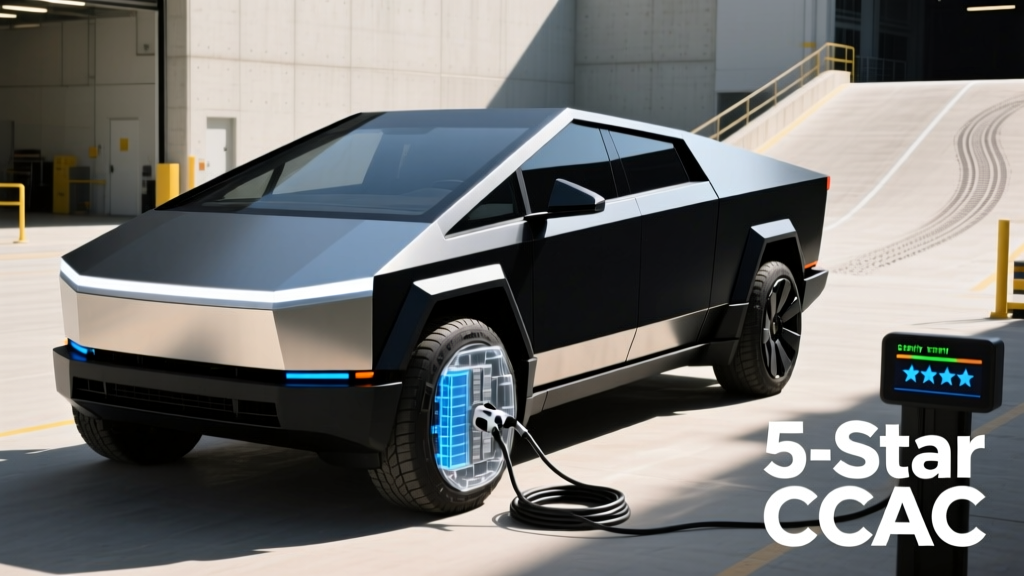
The Tesla Cybertruck remains one of the most polarizing vehicles on the road, but beneath the stainless-steel exoskeleton and angular drama lies a serious question for buyers: how safe is it? If you've been searching for a definitive Cybertruck crash test rating, the answer is more nuanced than a simple star score. As of early 2026, neither NHTSA nor IIHS has published full crash-test results for the Cybertruck, leaving buyers to rely on Tesla's internal data, structural engineering analysis, and the vehicle's active-safety suite. This review covers everything we know about Cybertruck safety alongside the complete ownership picture — range, charging, pricing, and whether it earns a spot in your garage over a Rivian R1T or Ford F-150 Lightning.
Cybertruck Crash Test Rating: What We Know in 2026
The National Highway Traffic Safety Administration (NHTSA) has not yet released an official 5-star safety rating for the Cybertruck as of the 2026 model year. The Insurance Institute for Highway Safety (IIHS) has also not published crashworthiness test results. This absence is not unusual for low-volume or structurally unconventional vehicles — the stainless-steel exoskeleton and unconventional crumple-zone geometry make standardized barrier testing more complex.
- NHTSA Overall Rating: Not yet rated
- IIHS Rating: Not yet tested
- Active Safety (NHTSA): Forward collision warning, AEB, lane departure warning — all standard
- Recall History: Multiple recalls issued in 2024–2025 (accelerator pedal trim, rearview camera, windshield wiper motor)
What we do know from Tesla's internal testing and regulatory filings is that the Cybertruck was engineered around a 48-volt electrical architecture and a structural battery pack that contributes to torsional rigidity. The stainless-steel outer shell (Ultra-Hard 30X cold-rolled steel) adds dent and intrusion resistance, though crash energy management depends more on the underlying aluminum and steel frame rails than the exterior skin. The truck comes standard with automatic emergency braking, lane-keeping assist, blind-spot monitoring, and eight surround cameras — hardware that supports Tesla's Autopilot and optional Full Self-Driving (Supervised) system.
Range, Battery, and Real-World Efficiency
The 2026 Cybertruck is available in three trims, each with a different range and powertrain configuration. Tesla uses a structural battery pack with an estimated ~123 kWh of usable capacity (NMC chemistry), though Tesla has not published official cell-level chemistry details for the latest production run.
| Spec | AWD | Cyberbeast | Rear-Wheel Drive* |
|---|---|---|---|
| EPA Range | 340 mi | 320 mi | ~250 mi (est.) |
| Battery (usable) | ~123 kWh | ~123 kWh | ~85 kWh (est.) |
| Chemistry | NMC | NMC | LFP (est.) |
| MPGe (combined) | ~58 MPGe | ~56 MPGe | ~62 MPGe (est.) |
| Efficiency | ~58 kWh/100mi | ~60 kWh/100mi | ~54 kWh/100mi (est.) |
| 0-60 mph | 4.1 sec | 2.6 sec | 6.5 sec (est.) |
| Horsepower | 600 hp | 845 hp | ~285 hp (est.) |
| Drivetrain | Dual-motor AWD | Tri-motor AWD | Single-motor RWD |
*Rear-Wheel Drive trim announced for 2026 delivery; specs are Tesla estimates and subject to change.
The AWD's EPA rating of 340 miles is competitive for a full-size electric truck. However, independent testing and owner reports consistently show highway-range figures between 260–290 miles at sustained 70-75 mph speeds. The Cybertruck's tall, flat-fronted profile creates significant aerodynamic drag (~0.38 Cd), which hits efficiency hard above 65 mph. In cold weather (below 32°F), expect an additional 15–25% range reduction, dropping real-world highway range to approximately 200–240 miles for the AWD trim. City driving with regenerative braking recovers more range, with some owners reporting 300+ miles in stop-and-go conditions.
Charging Speed: DC Fast and Level 2 Home Charging
The Cybertruck supports Tesla's NACS connector natively (it was one of the first vehicles to ship with NACS as standard), meaning it has full access to the Tesla Supercharger network and, increasingly, other networks adopting the NACS standard. Charging performance is respectable but not class-leading among 2026 pickups.
| Charging Level | Max Power (kW) | Speed / Time | Notes |
|---|---|---|---|
| Level 1 (120V) | ~1.4 kW | ~3 mi/hr | Emergency only; impractical for daily use |
| Level 2 (240V / 48A) | 11.5 kW | ~25 mi/hr; full charge ~12 hr | Tesla Wall Connector or equivalent NACS L2 |
| DC Fast Charge | 250 kW (peak) | 10–80% in ~28 min | Peak rate not sustained; tapers significantly above 60% SoC |
A critical detail often missed in spec sheets: the Cybertruck's 250 kW peak DC charge rate is just that — a peak. The charge curve tapers notably once the battery passes 60% state of charge. In real-world Supercharger sessions, expect sustained rates closer to 170–200 kW for the bulk of the session, with the final 20% (80–100%) adding significant time. If you're road-tripping and charging from 10% to 80%, plan on roughly 28–32 minutes at a V3 or V4 Supercharger. Battery preconditioning — activated automatically when you navigate to a Supercharger — is essential for achieving peak rates, especially in cooler temperatures.
Pricing, Trims, and Federal Tax Credit Eligibility
The Cybertruck's pricing has stabilized after initial volatility during the 2024–2025 reservation fulfillment period. Here's where the 2026 lineup stands before incentives:
| Trim | Base MSRP | §30D Credit Eligible? | Est. After Credit |
|---|---|---|---|
| Rear-Wheel Drive | $60,990 | Yes (if under $80K cap) | ~$53,490* |
| AWD | $79,990 | Yes (at $80K truck cap) | ~$72,490* |
| Cyberbeast | $99,990 | No (exceeds $80K MSRP cap) | $99,990 |
*Assumes full $7,500 §30D credit. Eligibility depends on buyer income, battery sourcing, and MSRP caps. See IRS rules below.
- MSRP Cap: Trucks/SUVs/vans must be under $80,000. The Cyberbeast at $99,990 does not qualify.
- Income Caps: $150,000 (single), $225,000 (head of household), $300,000 (joint filers) modified AGI.
- Battery Sourcing: Critical minerals and battery components must meet escalating domestic-content thresholds. Tesla's supply chain compliance varies by production batch — verify with your dealer at purchase.
- Point-of-Sale Transfer: Eligible buyers can apply the credit as an upfront discount at purchase rather than waiting for tax filing.
- Source: IRS.gov — Clean Vehicle Credits
Performance, Towing, and Cargo Practicality
The Cyberbeast's 2.6-second 0-60 mph time makes it the quickest production pickup ever sold, but most buyers will live with the AWD's still-impressive 4.1 seconds. Dual-motor all-wheel drive provides confident traction, and the steer-by-wire system — a first for a production vehicle at this scale — delivers surprisingly precise handling for a 6,800-pound truck. There is no mechanical connection between the steering wheel and the wheels; redundancy is handled through multiple electronic control units.
Towing and Payload:
- Max towing capacity: 11,000 lbs (AWD and Cyberbeast)
- Payload capacity: 2,500 lbs
- Bed length: 6 feet (composite bed with motorized tonneau cover)
- Bed volume: ~67 cu ft (with tailgate closed)
- Front trunk (frunk): ~7 cu ft — fits a carry-on or charging cables
Passenger Space:
- Seating: 5 passengers (3-across rear bench)
- Front legroom: ~41.5 inches
- Rear legroom: ~38.2 inches (tighter than an F-150 Lightning's rear seat)
- Rear headroom: Limited by the sloping roofline — tall passengers may find it snug
Real-world towing note: towing near the 11,000-lb max will cut range roughly in half. Plan for 150–170 miles between charges when pulling a heavy trailer, and note that the Cybertruck does not currently support integrated trailer brake controllers from all aftermarket brands — verify compatibility before purchase.
Technology, Driver Assistance, and Notable Drawbacks
The Cybertruck's interior is minimalist even by Tesla standards: an 18.5-inch front touchscreen handles virtually all vehicle functions, with a smaller 9.4-inch rear screen for passengers. There are no physical stalks — turn signals are on the steering wheel rim, and the yoke-style steering wheel (standard on Cyberbeast, optional on AWD) takes genuine adaptation. The 48-volt architecture powers everything from the steer-by-wire system to the powered bed cover, reducing wiring harness weight and enabling faster accessory response.
Driver Assistance:
Tesla's Autopilot and optional Full Self-Driving (Supervised) are SAE Level 2 driver-assistance systems. The driver must remain fully engaged, hands on the wheel (or torque-applied with the yoke), and eyes on the road at all times. The Cybertruck is not a self-driving vehicle. FSD (Supervised) adds automated lane changes, traffic-light recognition, and city-street navigation, but it requires constant supervision and does not replace the driver.
- Stainless-steel body panels show fingerprints, smudges, and water spots — regular detailing is required.
- Steer-by-wire learning curve: The variable-ratio steering feels unnatural for the first 500–1,000 miles; some drivers never fully adapt.
- Visibility: The angular design and thick A-pillars create larger blind spots than conventional trucks; rely on cameras.
- Off-road capability: Despite 16 inches of ground clearance, the Cybertruck lacks front and rear locking differentials and is not designed for serious rock crawling.
- Recall history: Multiple recalls in 2024–2025 for accelerator pedal, rearview camera, and wiper issues suggest early-production quality inconsistencies.
- No Apple CarPlay / Android Auto: Tesla's proprietary infotainment is the only option.
Cybertruck vs. Rivian R1T vs. Ford F-150 Lightning
| Category | Tesla Cybertruck AWD | Rivian R1T Dual-Motor | Ford F-150 Lightning Ext. Range |
|---|---|---|---|
| EPA Range | 340 mi | 352 mi | 320 mi |
| DC Fast Charge (peak) | 250 kW | 220 kW | 150 kW |
| 10–80% Time | ~28 min | ~30 min | ~41 min |
| 0-60 mph | 4.1 sec | 4.5 sec | 3.8 sec |
| Max Towing | 11,000 lbs | 11,000 lbs | 10,000 lbs |
| Starting MSRP | $79,990 | $75,900 | $69,995 |
| NHTSA Rating | Not rated | Not rated | Not fully rated |
| §30D Credit | Eligible (AWD) | Eligible | Eligible |
Battery Warranty and Long-Term Ownership
Tesla covers the Cybertruck's battery and drive unit with an 8-year / 120,000-mile warranty (whichever comes first), with a guaranteed minimum 70% capacity retention over that period. This is slightly better than the industry-standard 8yr/100,000mi threshold and reflects confidence in the structural pack design. The vehicle limited warranty is 4 years / 50,000 miles.
Long-term degradation data for the Cybertruck specifically is still limited given its late-2023 launch, but Tesla's NMC packs in the Model S and Model X historically show 10–15% degradation over 150,000 miles. The structural pack's integrated cooling system should support comparable or better longevity. For buyers concerned about out-of-warranty replacement, a full Cybertruck battery replacement is estimated at $15,000–$22,000 based on current Tesla service pricing — a significant expense, though unlikely to be needed within typical ownership periods.
Who Should Buy the Cybertruck?
- You want maximum Supercharger network access and NACS-native charging.
- Acceleration and tech novelty are priorities (the Cyberbeast is unmatched).
- You value the stainless-steel body's dent and corrosion resistance.
- You're comfortable with a steep learning curve (steer-by-wire, yoke, touchscreen-only controls).
❌ Look elsewhere if:
- You need a proven crash-test rating before purchasing — wait for NHTSA/IIHS results or choose the F-150 Lightning.
- Off-road capability is a primary use case — the Rivian R1T Quad-Motor or Rivian's dedicated off-road packages are more capable.
- You want a traditional truck experience with physical controls, CarPlay, and a more comfortable rear seat.
- Budget is a concern — the F-150 Lightning offers comparable utility starting ~$10,000 lower.
Frequently Asked Questions
Has the Cybertruck been crash tested by NHTSA or IIHS?
As of 2026, neither NHTSA nor IIHS has published official crash-test ratings for the Cybertruck. NHTSA has not completed its 5-star safety evaluation, and IIHS has not run its crashworthiness battery. Tesla states the vehicle was designed to meet or exceed federal safety standards, and the truck includes standard AEB, forward collision warning, and lane-keeping assist. Buyers who prioritize verified crash-test data should monitor NHTSA.gov and IIHS.org for updates.
What is the real-world range of the Cybertruck?
The AWD trim carries an EPA rating of 340 miles, but real-world highway driving at 70+ mph typically yields 260–290 miles. Cold weather (below freezing) can reduce range an additional 15–25%. City driving with frequent regenerative braking opportunities gets closer to the EPA figure. The Cyberbeast's additional motor and weight reduce its real-world range to approximately 240–270 miles on the highway.
How fast does the Cybertruck charge at home and on the road?
At home on a Level 2 charger (240V, 48A), the Cybertruck adds approximately 25 miles of range per hour, taking about 12 hours for a full charge. On DC fast charging, it peaks at 250 kW, with a 10–80% session taking approximately 28 minutes. The charge rate tapers significantly above 60% state of charge, so the last 20% adds considerable time.
Does the Cybertruck qualify for the $7,500 federal tax credit?
The AWD ($79,990 MSRP) and the upcoming Rear-Wheel Drive ($60,990 MSRP) trims are under the $80,000 MSRP cap for trucks and may qualify for the full $7,500 §30D credit — provided the buyer meets income limits ($150K single / $300K joint) and the vehicle's battery meets critical-mineral and domestic-component sourcing requirements. The Cyberbeast ($99,990) exceeds the MSRP cap and does not qualify. Always verify current eligibility at IRS.gov before purchasing.
Is the Cybertruck worth buying over the Rivian R1T or F-150 Lightning?
It depends on your priorities. The Cybertruck wins on Supercharger access, acceleration (Cyberbeast), and tech novelty. The Rivian R1T offers superior off-road capability, a more refined interior, and a Gear Tunnel for extra cargo. The F-150 Lightning is the most practical and affordable option, with a conventional truck layout, proven fleet durability, and better rear-seat comfort. If a verified crash-test rating is a dealbreaker, the Lightning and R1T may be safer bets until NHTSA/IIHS complete their evaluations.
What are the biggest pros and cons of owning a Cybertruck?
Pros: Supercharger network access, blistering acceleration (Cyberbeast), stainless-steel durability, distinctive design, 11,000-lb towing, 48-volt architecture, over-the-air updates.
Cons: No official crash-test rating yet, steep steer-by-wire learning curve, fingerprint-prone body, tight rear headroom, no CarPlay/Android Auto, multiple early-production recalls, high price for Cyberbeast (no tax credit), limited off-road hardware.