Since the Tesla Cybertruck began deliveries in late 2023, one feature has dominated forums, YouTube thumbnails, and showroom conversations: Cybertruck Crab Walk. The idea — all four wheels turning in the same direction so the truck moves diagonally — was originally promised as a headline capability of the steer-by-wire system. But as we move through the 2026 model year, the reality is more nuanced. This review covers exactly what Crab Walk is, where it stands today, and evaluates the Cybertruck as a complete electric pickup: range, charging, pricing, tax credits, and how it stacks up against the Ford F-150 Lightning and Rivian R1T.
What Is Cybertruck Crab Walk, Really?
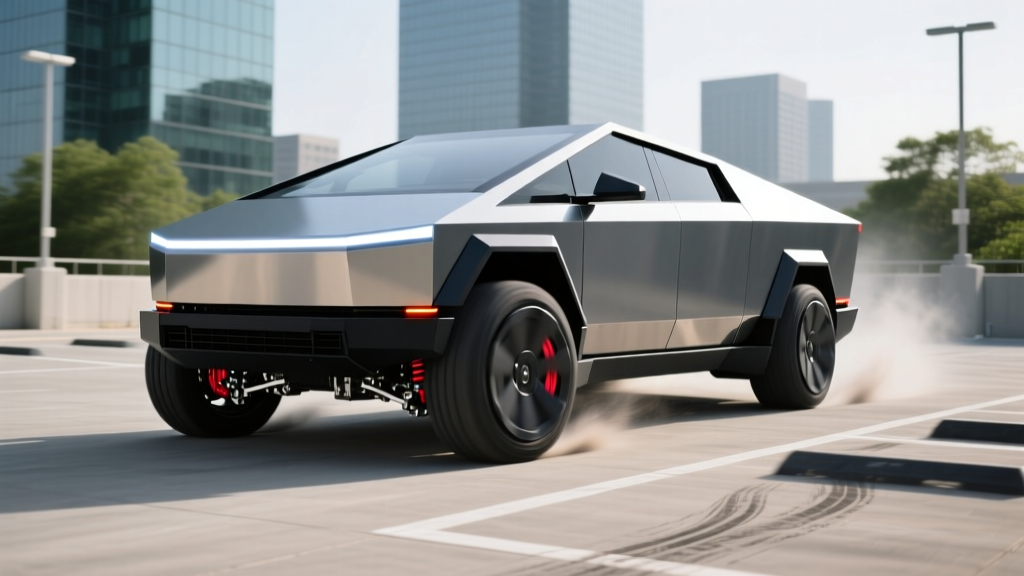
Crab Walk refers to a vehicle's ability to angle its body and move diagonally by turning all four wheels in the same direction simultaneously. Tesla demonstrated this concept during the Cybertruck's 2019 unveiling and subsequent update events, leveraging the truck's fully steer-by-wire architecture — meaning there is no mechanical linkage between the steering yoke and the wheels. Instead, electronic signals command the front and rear steering actuators independently.
However, as of the 2026 model year, Tesla has not enabled a dedicated Crab Walk mode via over-the-air update. The rear-axle steering system is active — it provides a tighter turning circle (approximately 35 feet curb-to-curb) and enhances stability at highway speeds by counter-steering the rear wheels — but the full diagonal-drive mode demonstrated in concept videos remains unavailable. Tesla has not provided a timeline for its release.
2026 Cybertruck Specs at a Glance
| Specification | AWD | Cyberbeast |
|---|---|---|
| EPA Range | 325 miles | 320 miles |
| Battery (usable) | ~123 kWh, NMC | ~123 kWh, NMC |
| Drivetrain | Dual-Motor AWD | Tri-Motor AWD |
| Horsepower | 600 hp | 845 hp |
| 0-60 mph | 4.1 sec | 2.6 sec |
| Max DC Fast Charge | 250 kW (NACS) | 250 kW (NACS) |
| 10-80% DC Charge | ~28 min | ~28 min |
| Level 2 Home Charge | 11.5 kW (~37 mi/hr) | 11.5 kW (~37 mi/hr) |
| MPGe (combined) | 67 MPGe | 65 MPGe |
| Towing Capacity | 11,000 lbs | 11,000 lbs |
| Bed Length | 6 ft (72 cu ft) | 6 ft (72 cu ft) |
| Rear Legroom | 38.2 in | 38.2 in |
| Base MSRP | $79,990 | $99,990 |
| Battery Warranty | 8 yr / 120,000 mi | 8 yr / 120,000 mi |
Source: fueleconomy.gov, Tesla specification sheets (2026 model year). Specs subject to change by manufacturer.
Real-World Range: What the EPA Number Doesn't Tell You
Real-World Expectation: ~250-280 miles highway at 70 mph; ~200-240 miles in sub-freezing temperatures; ~260-290 miles mixed city/suburban driving.
The Cybertruck's stainless-steel exoskeleton is visually striking, but it is not aerodynamically optimized. Its boxy profile creates significant drag at highway speeds, which is where EVs lose efficiency fastest. In independent testing, the Cybertruck AWD has returned approximately 2.0-2.2 kWh/mile at sustained 70 mph highway speeds — translating to roughly 250-270 miles before needing a charge, well below the 325-mile EPA sticker.
Cold weather compounds this. At temperatures below 32°F, expect a 20-30% range reduction due to battery chemistry limitations and increased cabin heating demand. The Cybertruck uses a heat pump for climate control, which helps, but the large 123 kWh NMC battery still requires significant energy to maintain optimal operating temperature. If you commute in northern climates, plan for 200-240 miles of usable range in winter.
Efficiency figures from fueleconomy.gov rate the AWD at 67 MPGe combined (50 kWh/100mi), which is below the F-150 Lightning's 70 MPGe and the Rivian R1T Dual-Motor's 73 MPGe. The Cybertruck's weight — approximately 6,600-6,750 lbs depending on trim — and angular design are the primary culprits.
Charging Speed: DC Fast, Level 2, and the 800V Question
| Charging Level | Power / Rate | Time / Miles Added |
|---|---|---|
| Level 1 (120V) | ~1.4 kW | ~4 mi/hr — impractical for daily use |
| Level 2 (240V, 48A) | 11.5 kW | ~37 mi/hr; full charge in ~11 hrs |
| DC Fast (Tesla Supercharger V3) | 250 kW peak | 10-80% in ~28 min; ~200 mi in 15 min |
| DC Fast (Non-Tesla CCS via adapter) | ~150-200 kW typical | 10-80% in ~35-40 min |
The Cybertruck charges at a peak of 250 kW on Tesla's V3 Supercharger network using its native NACS connector. However, like all EVs, it does not sustain peak rate for the entire session. The charge curve peaks around 20-30% State of Charge and tapers progressively — by 60% SoC, you'll see roughly 150-170 kW, and above 80% it drops below 50 kW. This is why the industry standard measurement is 10-80% time, which Tesla estimates at approximately 28 minutes.
One notable limitation: the Cybertruck does not use an 800V architecture (unlike the Hyundai Ioniq 5 or Rivian R1T's newer platform). This caps its maximum charge rate compared to what 800V vehicles can achieve at 350 kW chargers. On non-Tesla DC networks using a NACS-to-CCS adapter, expect slightly slower speeds due to handshake and protocol overhead.
For home charging, a Level 2 Wall Connector at 48 amps delivers 11.5 kW, adding roughly 37 miles of range per hour. Given the Cybertruck's ~123 kWh usable battery, a full 0-100% home charge takes approximately 11 hours — plan for overnight charging on a dedicated 60-amp circuit. Installation costs typically range from $800-$2,500 depending on panel capacity and run length; a 200-amp electrical panel is usually sufficient, but older homes may require a panel upgrade ($1,500-$3,000).
Performance and Driving Dynamics
The Cybertruck Cyberbeast's tri-motor powertrain produces 845 horsepower and rockets to 60 mph in an estimated 2.6 seconds — supercar territory in a 6,750-pound stainless-steel wedge. The dual-motor AWD trim is no slouch either, with 600 hp and a 4.1-second 0-60 time.
The steer-by-wire system is the Cybertruck's most distinctive driving characteristic. With no mechanical connection between the yoke and the wheels, Tesla has programmed a variable steering ratio: at low speeds, the yoke requires fewer turns lock-to-lock (making parking maneuvers easier), while at highway speeds the ratio firms up for stability. Most drivers report an adjustment period of 1-2 weeks, after which the system feels natural — but it remains a polarizing feature.
The rear-axle steering (up to approximately 10 degrees) reduces the turning circle to roughly 35 feet, comparable to a midsize sedan. This is where the steer-by-wire hardware could enable Crab Walk, but Tesla has not activated that mode. The adaptive air suspension provides up to 16 inches of ground clearance in Off-Road mode and can lower the truck for highway efficiency or bed loading.
Pricing, Trims, and Federal Tax Credit Eligibility
| Trim | Base MSRP | §30D Credit Eligible? | Est. After Credit |
|---|---|---|---|
| AWD | $79,990 | No (exceeds $80K truck cap) | $79,990 |
| Cyberbeast | $99,990 | No (exceeds $80K truck cap) | $99,990 |
This is a critical point for buyers: the Cybertruck does not qualify for the $7,500 federal EV tax credit under IRS §30D. The reason is the MSRP cap. For trucks and SUVs, the cap is $80,000, and while the AWD trim's base MSRP is $79,990, any added options, destination charges, or configuration upgrades push it above the threshold. The Cyberbeast at $99,990 exceeds the cap outright.
- MSRP Cap: ≤$80,000 for trucks/SUVs; ≤$55,000 for sedans
- Buyer Income Cap: ≤$300,000 (joint), ≤$225,000 (head of household), ≤$150,000 (single)
- Battery Sourcing: Critical minerals and battery components must meet phased-in domestic/free-trade-partner percentages
- Point-of-Sale Transfer: Eligible buyers can apply the credit as a down-payment reduction at the dealer
- Final Assembly: Must occur in North America
Some buyers may find relief through state-level incentives (California's CVRP, Colorado's state credit, etc.), but these vary by jurisdiction and are separate from federal rules. Check your state's energy or DMV website for current programs.
Interior, Tech, and Practicality
The Cybertruck's interior follows Tesla's minimalist philosophy: a single 18.5-inch front touchscreen handles infotainment, climate, and vehicle controls, with a smaller rear touchscreen for second-row passengers. There are no physical buttons for climate or audio — everything routes through the screen, which continues to divide opinion among owners.
Cargo and space: The 6-foot bed offers 72 cubic feet of volume with the motorized tonneau cover closed. The bed features integrated LED lighting, a 120V/240V outlet (PowerShare), and a maximum payload of approximately 2,500 lbs. The front trunk (frunk) is small — roughly 7 cubic feet — suitable for charging cables and a bag or two but not a full grocery run. Rear-seat legroom measures 38.2 inches, adequate for adults on shorter trips but tighter than the F-150 Lightning's 43.5 inches.
Driver Assistance: The Cybertruck ships with Tesla's basic Autopilot (lane centering + adaptive cruise). Full Self-Driving (Supervised) is available as a $8,000 add-on or $99/month subscription. It is critical to understand that FSD is a SAE Level 2 system — the driver must remain fully engaged, hands on the yoke, and eyes on the road at all times. It is not autonomous driving.
Pros, Cons, and the Competition
- Tri-motor Cyberbeast performance (2.6s 0-60)
- Stainless-steel exoskeleton durability
- 11,000-lb towing capacity
- Rear-axle steering reduces turning circle
- Tesla Supercharger network access (NACS native)
- 240V bed outlet for job-site or camping power
- No federal §30D tax credit (MSRP cap)
- Real-world highway range well below EPA
- Crab Walk feature not available as of 2026
- Steer-by-wire yoke polarizing and requires adaptation
- Below-average efficiency (67 MPGe combined)
- Rear seat legroom tighter than competitors
- No Apple CarPlay / Android Auto
Versus the Ford F-150 Lightning: The Lightning starts at ~$54,995, qualifies for the $7,500 federal credit on eligible trims, offers a more conventional (and familiar) driving experience, and provides 320 miles of EPA range on the Extended Range battery. Its trade-off: slower DC charging (peak ~150 kW on older models, improved on 2025+ refresh) and less performance. The Lightning is the pragmatic work-truck choice; the Cybertruck is the statement piece.
Versus the Rivian R1T: The R1T Dual-Motor starts around $69,900 (eligible for the credit on base trims), offers superior build quality, a more refined interior, and a quad-motor option with comparable performance. Its 800V architecture enables faster DC charging. The R1T's 4.5-foot bed is shorter than the Cybertruck's 6-foot bed, and its ~328-mile EPA range is competitive. The R1T wins on refinement and adventure-readiness; the Cybertruck wins on bed length and raw Cyberbeast acceleration.
- Choose the Cybertruck if: You want maximum performance, need an 11,000-lb tow rating, value Supercharger network access, and don't need the federal tax credit. The Cyberbeast is for thrill-seekers who also need a truck bed.
- Choose the F-150 Lightning if: You want a traditional truck experience, need the $7,500 tax credit, prioritize rear-seat space, and value conventional service networks.
- Choose the Rivian R1T if: You want premium build quality, faster 800V charging, a more refined interior, and plan to use the truck for overlanding and adventure travel.
Frequently Asked Questions
Does the Cybertruck actually have Crab Walk in 2026?
No. While the Cybertruck's steer-by-wire system and rear-axle steering hardware theoretically support diagonal movement, Tesla has not enabled a Crab Walk driving mode via software as of the 2026 model year. The rear steering does function for tighter turns and highway stability, but full crab-mode diagonal drive remains unavailable.
What is the real-world range of the Cybertruck?
The EPA rates the AWD at 325 miles and the Cyberbeast at 320 miles. In real-world highway driving at 70 mph, expect 250-280 miles. In cold weather (below freezing), plan for 200-240 miles due to battery thermal demands and cabin heating.
How fast does the Cybertruck charge?
On a Tesla V3 Supercharger, it peaks at 250 kW and charges from 10-80% in approximately 28 minutes. At home on a Level 2 (240V, 48A) charger, it adds about 37 miles of range per hour, taking roughly 11 hours for a full charge.
Does the Cybertruck qualify for the $7,500 federal EV tax credit?
No. The IRS §30D credit has an $80,000 MSRP cap for trucks. The Cybertruck AWD starts at $79,990 but typically exceeds the cap with destination fees and options. The Cyberbeast at $99,990 is well above the threshold. Neither trim qualifies.
Is the Cybertruck worth buying over the F-150 Lightning or Rivian R1T?
It depends on priorities. The Cybertruck wins on raw Cyberbeast performance, bed length, and Supercharger access. The Lightning wins on price, tax credit eligibility, and conventional usability. The R1T wins on build quality, interior refinement, and 800V charging speed. All three are capable electric trucks — the right choice depends on your budget and use case.
What is the Cybertruck's battery warranty?
Tesla covers the battery and drive unit for 8 years or 120,000 miles, whichever comes first, with a minimum 70% capacity retention threshold during the warranty period.