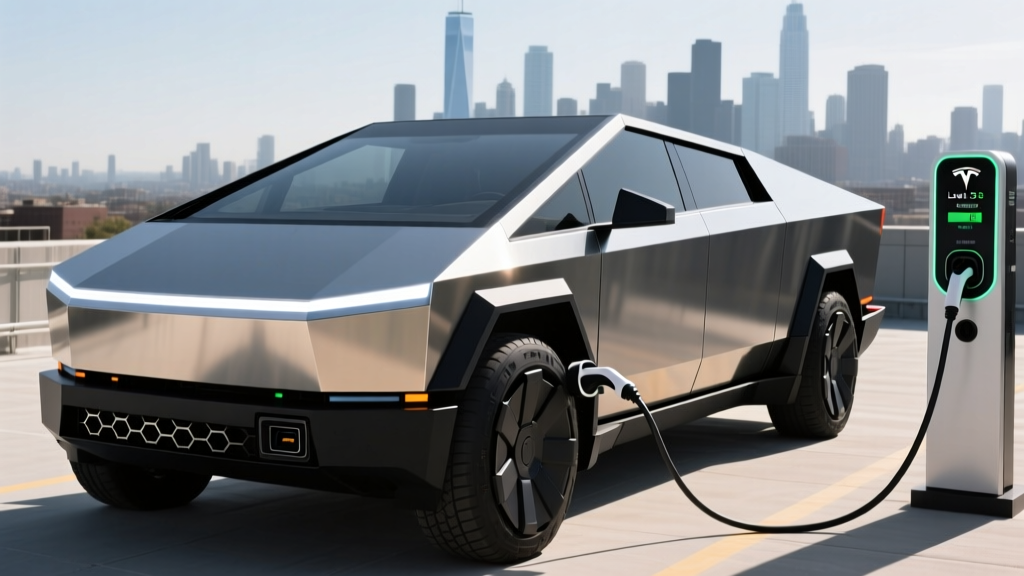
The Tesla Cybertruck doesn't care if you think it's beautiful. It was designed to provoke, to polarize, and to dominate the conversation around electric pickups. But beyond the angular stainless-steel exoskeleton and the social-media stunts, there's a serious EV underneath — one that demands a rigorous, numbers-first evaluation. In this review, we strip away the hype and examine whether the Cybertruck is genuinely cool where it counts: range, charging speed, efficiency, utility, and ownership economics in 2026.
Quick Verdict: Is the Cybertruck Actually Cool Beyond the Looks?
The Cybertruck's cool factor extends past its sci-fi styling into genuinely impressive engineering: a 48-volt electrical architecture (an industry first for a production vehicle), steer-by-wire steering, and an 800-volt-class battery pack enabling 250 kW DC fast charging. But cool doesn't mean perfect. The AWD dual-motor variant delivers a credible 318-mile EPA range, while the tri-motor Cyberbeast trades range for a 2.6-second 0-60 mph time. The question isn't whether the Cybertruck turns heads — it's whether its real-world utility matches its spec sheet.
| Specification | AWD (Dual-Motor) | Cyberbeast (Tri-Motor) |
|---|---|---|
| EPA Range | 318 mi | 301 mi |
| Battery (usable) | ~123 kWh (NMC) | ~123 kWh (NMC) |
| Drivetrain | Dual-Motor AWD | Tri-Motor AWD |
| Horsepower | 600 hp | 845 hp |
| 0-60 mph | 3.9 sec | 2.6 sec |
| Max DC Fast Charge | 250 kW | 250 kW |
| 10-80% DCFC Time | ~28 min | ~28 min |
| Level 2 Charge Rate | 11.5 kW (~34 mi/hr) | 11.5 kW (~34 mi/hr) |
| Towing Capacity | 11,000 lbs | 11,000 lbs |
| Payload | 2,500 lbs | 2,500 lbs |
| Bed Length | 6 ft (72 in) | 6 ft (72 in) |
| Base MSRP | $79,990 | $99,990 |
| MPGe (combined) | 67 MPGe | 61 MPGe |
| Efficiency | 50 kWh/100 mi | 55 kWh/100 mi |
Real-World Range: What the EPA Sticker Doesn't Tell You
EPA Estimated Range: 318 miles (AWD) / 301 miles (Cyberbeast)
Real-World Expectation: 250–280 miles highway at 70-75 mph; 200–240 miles in freezing temperatures with cabin heat; up to ~290 miles in mild city/suburban driving with regen.
The Cybertruck's angular slab sides and massive frontal area create aerodynamic drag that punishes highway efficiency far more than sedans like the Model S or Model 3. In independent real-world highway testing at sustained 70-75 mph speeds, expect to see consumption climb to 55-60 kWh/100 miles, which translates to roughly 250-280 miles of usable range before you need a charger. This is a meaningful gap from the 318-mile EPA sticker on the AWD trim.
Cold weather compounds the problem. The Cybertruck's stainless-steel body doesn't insulate like traditional materials, and while Tesla's heat pump system is efficient, battery chemistry (NMC) is sensitive to low temperatures. At 20°F with cabin heating active, plan for 25-35% range reduction — putting realistic winter highway range closer to 200-240 miles. Preconditioning the battery before DC fast charging is essential and is handled automatically when you navigate to a Supercharger in the Tesla app.
City driving with frequent regenerative braking opportunities yields better results. The Cybertruck's heavy mass works in its favor during stop-and-go traffic, where regen recovers significant energy. Tesla's efficiency rating of 50 kWh/100 mi (AWD combined) is achievable in suburban conditions but optimistic for sustained highway travel. For reference, the EPA's fueleconomy.gov data confirms the 67 MPGe combined figure for the AWD variant.
Charging Speed: 250 kW Peak, but the Curve Matters
| Charging Level | Max Power | Miles Added per Hour | Notes |
|---|---|---|---|
| Level 1 (120V outlet) | ~1.4 kW | ~3-4 mi/hr | Emergency/trickle only |
| Level 2 (240V, 48A) | 11.5 kW | ~34 mi/hr | Home Wall Connector; full charge ~11 hrs |
| DC Fast Charge | 250 kW peak | ~170 mi in 15 min | 10-80% in ~28 min; tapers significantly above 80% |
The Cybertruck supports 250 kW peak DC fast charging via the NACS (Tesla) connector, which is now the dominant North American standard adopted by virtually every major automaker for 2025 and beyond. At a V4 Tesla Supercharger or compatible 250+ kW station, the Cybertruck can add roughly 170 miles of range in 15 minutes — impressive for a vehicle this large.
However, peak kW is not sustained kW. The Cybertruck's charge curve holds near peak rate between roughly 10-40% State of Charge (SoC), then progressively tapers. By 60% SoC, you're likely seeing 150-180 kW, and above 80%, the rate drops sharply to protect the NMC battery cells — often below 50 kW. This is why Tesla quotes a 10-80% time of approximately 28 minutes rather than a full 0-100% time. Charging from 80-100% can take an additional 25-30 minutes.
For home Level 2 charging, the Tesla Wall Connector delivers up to 11.5 kW (48 amps on a 60-amp circuit), adding about 34 miles of range per hour. A full overnight charge from 20% to 100% takes roughly 11 hours. If your home electrical panel only supports a 40-amp circuit (common in older homes), you'll be limited to ~9.6 kW, adding approximately 28 miles per hour. Budget $500-$1,500 for a licensed electrician to install a dedicated 60-amp circuit, with potential panel-upgrade costs of $1,500-$3,000+ if your home's service is maxed out.
The Cybertruck's 48-volt electrical architecture reduces current draw on auxiliary systems and allows thinner wiring harnesses — a genuine engineering advancement that improves overall efficiency and reduces weight compared to traditional 12-volt systems. This is one area where the Cybertruck's "cool" factor translates directly to practical benefit.
Performance and Drivetrain: Speed Meets Utility
The dual-motor AWD Cybertruck produces 600 horsepower and reaches 60 mph in 3.9 seconds — quicker than most sports sedans from a decade ago, in a 6,800-pound stainless-steel truck. The tri-motor Cyberbeast escalates to 845 hp and a 2.6-second 0-60 mph time, making it one of the fastest production vehicles ever sold, regardless of powertrain. Both variants feature adaptive air suspension with up to 16 inches of ground clearance in Extract Mode for off-road use, dropping automatically at highway speeds for improved aerodynamics.
Steer-by-wire replaces the traditional mechanical steering column with electronic actuators. The result: variable steering ratios that require less than one full turn lock-to-lock at any speed. It takes adjustment — there's no physical connection between the yoke and the wheels — but the precision and responsiveness are genuinely impressive once familiar. Rear-wheel steering further tightens the turning circle to just 34.6 feet, remarkable for a vehicle over 223 inches long.
Towing capacity is rated at 11,000 pounds for both trims, competitive with full-size ICE pickups. However, towing at capacity will reduce range dramatically — expect 120-150 miles of real-world range when pulling a heavy trailer, as consumption can exceed 100 kWh/100 mi under load. Payload capacity is 2,500 pounds, and the 6-foot composite bed (with powered tonneau cover) can handle 4x8 sheets of plywood with the tailgate down.
Pricing, Tax Credits, and Ownership Economics
| Trim | Base MSRP | As-Tested (typical) | §30D Credit Eligible? |
|---|---|---|---|
| AWD (Dual-Motor) | $79,990 | $82,000-$85,000 | Likely NO — exceeds $80,000 truck MSRP cap |
| Cyberbeast (Tri-Motor) | $99,990 | $102,000-$110,000 | NO — exceeds $80,000 truck MSRP cap |
Here's where the Cybertruck's cool factor collides with fiscal reality. Under current IRS §30D rules, the federal clean vehicle tax credit of up to $7,500 has strict MSRP caps: $80,000 for trucks, vans, and SUVs. The AWD Cybertruck's base MSRP of $79,990 sits just under the cap, but any dealer-installed options, destination charges, or upgrades that push the vehicle's MSRP above $80,000 disqualify it. The Cyberbeast at $99,990 is categorically ineligible.
Additionally, §30D imposes buyer income limits (modified adjusted gross income cannot exceed $300,000 for joint filers, $225,000 for heads of household, or $150,000 for single filers) and battery component/critical mineral sourcing requirements that change annually. The Cybertruck's battery supply chain has been a moving target as Tesla works to localize sourcing. As of early 2026, even the base AWD trim's credit eligibility is uncertain due to critical mineral sourcing rules — always verify current eligibility on the IRS website or with a tax professional before purchase.
The point-of-sale transfer option (available since 2024) would allow eligible buyers to apply the credit as an immediate price reduction at the dealer rather than waiting for a tax refund — but only if the vehicle qualifies. Given the Cybertruck's pricing, most buyers should not count on receiving the federal credit.
Total cost of ownership remains challenging compared to rivals. The Cybertruck's insurance premiums run 30-50% higher than a Ford F-150 Lightning due to repair costs for the stainless-steel body and low production volume. Depreciation is still uncertain with limited used-market data, though early indicators suggest it may depreciate faster than the more mainstream F-150 Lightning or Rivian R1T.
Interior, Tech, and the Steer-by-Wire Experience
The Cybertruck's interior is minimalist even by Tesla standards. A single 18.5-inch touchscreen dominates the dash, running Tesla's latest software with access to streaming, gaming, and a full trip planner with Supercharger routing. Rear passengers get a 9.4-inch touchscreen for climate and entertainment controls. The front trunk (frunk) is modest but useful, and the powered bed cover includes integrated LED lighting and 120V/240V outlets capable of powering tools or appliances — a feature Tesla calls Powershare, supporting up to 11.5 kW of bidirectional output (V2L/V2H capable).
Driver assistance comes via Tesla Autopilot standard, with Full Self-Driving (Supervised) available as a $8,000 option or $99/month subscription. FSD remains an SAE Level 2 system — meaning the driver must remain fully engaged and attentive at all times. It is not autonomous driving. The system handles highway lane-keeping, adaptive cruise, and city street navigation impressively well, but requires constant supervision and can make errors at construction zones, complex intersections, and in adverse weather.
Build quality has been the Cybertruck's most persistent criticism. Early 2024-2025 production units drew complaints about panel gaps, trim rattles, and software glitches. Tesla has made iterative manufacturing improvements through 2026, but the Cybertruck still doesn't match the fit-and-finish of the Rivian R1T or even the Ford F-150 Lightning. Buyers should expect minor cosmetic imperfections and plan for a thorough post-delivery inspection.
Pros
- Class-leading acceleration (2.6s Cyberbeast 0-60)
- 250 kW DC fast charging with ~170 mi in 15 min
- 48-volt architecture and steer-by-wire are genuine innovations
- 11,000-lb towing and 2,500-lb payload
- Powershare bidirectional power (V2L/V2H up to 11.5 kW)
- Air suspension with 16" ground clearance in Extract Mode
- Stainless-steel body resists dents and corrosion
Cons
- Real-world highway range ~250-280 mi vs. 318 mi EPA
- Most trims ineligible for $7,500 §30D federal tax credit
- Insurance premiums 30-50% above competitors
- Build quality and panel consistency still lagging
- Steer-by-wire requires significant driver adaptation
- Highway efficiency poor due to aerodynamics (50+ kWh/100 mi)
- Bed shorter than traditional full-size pickups (6 ft)
Cybertruck vs. the Competition: Is It Worth the Premium?
| Attribute | Tesla Cybertruck AWD | Ford F-150 Lightning | Rivian R1T (Dual-Motor) |
|---|---|---|---|
| EPA Range | 318 mi | 320 mi (Ext. Range) | 352 mi (Max Pack) |
| Base MSRP | $79,990 | $54,995 | $75,900 |
| §30D Tax Credit | Unlikely | Eligible (select trims) | Eligible (select trims) |
| Max DCFC | 250 kW | 150 kW | 220 kW |
| 0-60 mph | 3.9 sec | 3.8 sec (Platinum) | 4.5 sec |
| Towing | 11,000 lbs | 10,000 lbs | 11,000 lbs |
| Bed Length | 6 ft | 5.5 ft | 4.5 ft (+ Gear Tunnel) |
| Charging Network | Supercharger (native) | Supercharger (adapter) | Supercharger (adapter) |
The F-150 Lightning undercuts the Cybertruck by $25,000 at the base level and qualifies for the federal tax credit on many trims, making it a dramatically more affordable entry point. The Rivian R1T offers superior build quality, more range with the Max Pack, and the innovative Gear Tunnel for enclosed storage. Both competitors now access the Tesla Supercharger network via NACS adapter, eliminating Tesla's former charging-moat advantage.
The Cybertruck's advantages are speed, the 48-volt architecture, steer-by-wire novelty, and bidirectional power capability. But from a pure value and practicality standpoint, the Lightning and R1T serve most truck buyers better at lower cost. The Cybertruck is a purchase driven by desire, not by spreadsheet optimization.
Who Should Buy the Cybertruck?
The Cybertruck is best suited for buyers who:
- Want the most attention-grabbing vehicle on the road and can absorb the premium
- Need genuine truck capability (11,000-lb towing, 2,500-lb payload) with sports-car acceleration
- Value bidirectional power (V2L/V2H) for job sites, camping, or home backup
- Have home Level 2 charging and access to Superchargers for road trips
- Accept that real-world range will be 250-280 miles highway, not 318
It is NOT the right choice for buyers who prioritize value, tax-credit eligibility, proven build quality, or maximum range. Those buyers should test-drive the F-150 Lightning or Rivian R1T first.
Frequently Asked Questions
What is the real-world range of the Tesla Cybertruck?
The EPA estimates 318 miles for the AWD and 301 miles for the Cyberbeast. Real-world highway driving at 70-75 mph typically yields 250-280 miles. In freezing temperatures, expect 200-240 miles with cabin heat. City driving with regenerative braking can approach or slightly exceed the EPA estimate.
How fast does the Cybertruck charge at home and on the road?
At home on a Level 2 Tesla Wall Connector (11.5 kW), it adds ~34 miles per hour, fully charging overnight in ~11 hours. On DC fast chargers, it peaks at 250 kW, reaching 10-80% in approximately 28 minutes and adding about 170 miles in 15 minutes.
Does the Cybertruck qualify for the $7,500 federal EV tax credit?
Most likely not. The §30D credit caps truck MSRP at $80,000. The Cybertruck AWD starts at $79,990, but any added options or destination fees push it over the limit. The Cyberbeast at $99,990 is categorically ineligible. Buyer income limits and battery-sourcing rules add further restrictions. Always verify with the IRS or a tax professional.
Is the Cybertruck worth buying over the F-150 Lightning or Rivian R1T?
If you prioritize speed, futuristic tech, bidirectional power, and exclusivity — yes. If you prioritize value, tax credit eligibility, proven build quality, or maximum range — no. The Lightning costs $25,000 less and qualifies for the credit; the R1T offers better fit-and-finish and 352 miles of range.
What are the biggest Cybertruck drawbacks owners report?
Build-quality inconsistencies (panel gaps, trim fitment), higher-than-expected highway energy consumption, insurance costs 30-50% above competitors, steer-by-wire adaptation period, and real-world range falling 15-20% below EPA estimates on road trips.
Can the Cybertruck power my home during an outage?
Yes. Tesla's Powershare system supports bidirectional power up to 11.5 kW via V2H (vehicle-to-home) and V2L (vehicle-to-load) capability. This requires the Tesla Powerwall or a compatible home integration setup installed by a licensed electrician. The Cybertruck's ~123 kWh battery can power an average home for several days during an outage.
What battery chemistry does the Cybertruck use and how long is the warranty?
The Cybertruck uses NMC (nickel-manganese-cobalt) lithium-ion cells in a structural battery pack. Tesla provides a battery and drive unit warranty of 8 years or 120,000 miles (whichever comes first), with a minimum 70% capacity retention threshold during the warranty period. NMC chemistry offers high energy density but is more sensitive to extreme heat and sustained 100% SoC storage than LFP — Tesla recommends daily charging to 80-90% for battery longevity.