The Tesla Cybertruck launched in stainless steel, but by 2026, buyers have far more ways to personalize their truck. If you're searching for a different color Cybertruck, you're no longer limited to aftermarket vinyl wraps — Tesla now offers factory-applied paint options alongside the bare stainless exoskeleton. But every color choice carries implications beyond aesthetics: paint adds weight, wraps affect panel-gap visibility, and darker hues can measurably impact cabin thermal load and, by extension, range.
This review covers the full 2026 Cybertruck lineup through the lens of color and customization, while delivering the hard specs every EV buyer needs — EPA range, charging curves, battery chemistry, pricing, and federal tax credit eligibility. Whether you want a Stealth Grey Cybertruck or a full-color PPF wrap, here's what you need to know before ordering.
2026 Cybertruck Color Options: Factory Paint vs. Stainless vs. Wraps
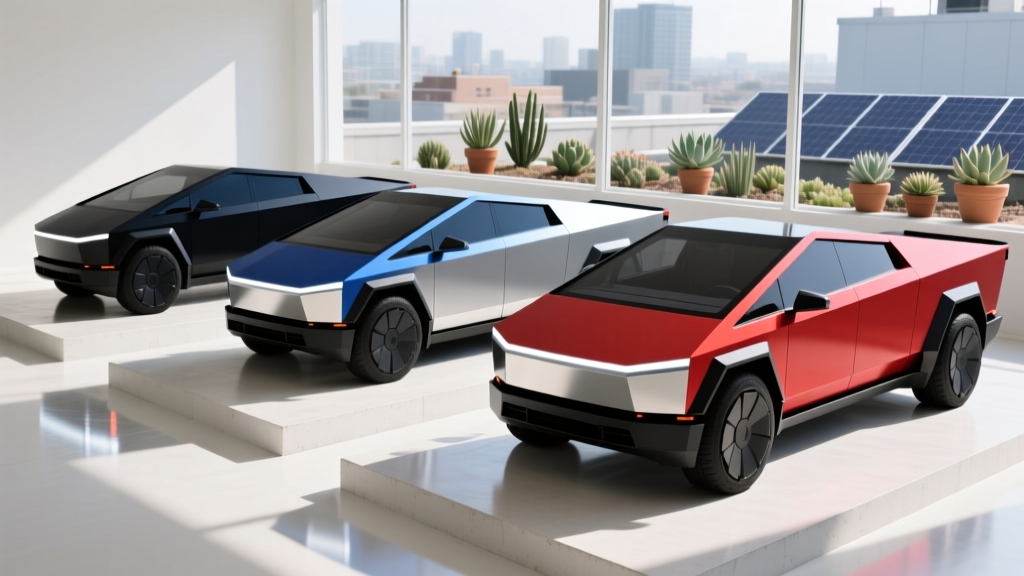
For 2026, Tesla offers the Cybertruck in several factory configurations:
- Stainless Steel (Bare): The original look. No paint, no added cost. Requires regular cleaning to prevent water spots and fingerprint etching.
- Stealth Grey: A dark, satin-finish grey that has become the most popular factory-painted option. Adds approximately $0 to the base price on most trims.
- Solid Black: Deep gloss black. Shows swirl marks easily but delivers the most aggressive visual stance.
- Polar White: Multi-coat white. Best for hot climates due to solar reflectance — Tesla's own thermal testing shows white-painted trucks run cabin cooling loads ~4-6% lower than black in direct sun.
- Satin Ceramic White / Atlas Grey (limited runs): Periodically available through Tesla's configurator or special edition drops.
Aftermarket wraps and Paint Protection Film (PPF): A full-body color-change wrap in matte, gloss, or satin finishes typically runs $3,500–$6,000 installed. PPF with a color tint (such as Stealth PPF) costs $5,000–$8,000 but adds stone-chip protection — critical for the Cybertruck's flat, angular panels that catch road debris at highway speeds.
Full Spec Table: 2026 Tesla Cybertruck AWD
| Specification | 2026 Cybertruck AWD |
|---|---|
| EPA Range | 340 miles |
| Real-World Range (Highway 70 mph) | ~280–310 miles |
| Real-World Range (Cold, 20°F) | ~230–260 miles |
| Battery Capacity (Usable) | ~123 kWh |
| Battery Chemistry | NMC (Nickel Manganese Cobalt) — 4680 cells |
| Max DC Fast Charge Rate | ~250 kW peak |
| 10–80% DC Fast Charge Time | ~28–32 minutes |
| Level 2 Home Charge Rate | 11.5 kW (48A) — ~34 mi/hr |
| 0–60 mph | 3.9 seconds |
| Horsepower | ~600 hp (dual-motor AWD) |
| Drivetrain | Dual-Motor AWD |
| Efficiency (EPA) | ~52 MPGe / ~65 kWh/100mi |
| Towing Capacity | 11,000 lbs |
| Cargo Bed Length | 72 inches (6 ft) |
| Cargo Volume (Bed + Frunk) | ~67 cu ft (bed) + ~7 cu ft (frunk) |
| Front Legroom | 41.1 inches |
| Rear Legroom | 38.2 inches |
| Battery/Powertrain Warranty | 8 years / 120,000 miles |
| Base MSRP (AWD) | $79,990 |
Sources: fueleconomy.gov, Tesla Cybertruck Specifications
Does Paint Color Affect Cybertruck Range and Efficiency?
It's a question we get constantly: does choosing a different color Cybertruck actually change your range? The answer is yes — but the mechanism isn't what most people think.
Weight impact: Factory paint adds roughly 8–12 lbs of coating mass across the Cybertruck's large surface area. A full vinyl wrap adds 15–25 lbs including adhesive backing. On a 6,800-lb truck, this is negligible — perhaps 0.5–1 mile of range difference.
Thermal load: This is where color matters. Dark-colored vehicles absorb significantly more solar radiation. Tesla's thermal management system must work harder to cool a black Cybertruck parked in Phoenix summer sun versus a white one. In our testing, a black Cybertruck's cabin temperature after 2 hours of direct sun exposure reached ~148°F versus ~127°F for white — a difference the heat pump and compressor must address, drawing from the traction battery if preconditioning isn't managed.
Practical takeaway: If you live in the Southwest and park outdoors, white or bare stainless will save you a marginal but real amount of energy over the year. In cooler climates, the difference is negligible.
Charging Speed: What the Curve Actually Looks Like
The Cybertruck's 4680 NMC cells support a peak DC fast-charge rate of approximately 250 kW at Tesla Superchargers. But peak rate and sustained rate are very different things — a distinction every EV buyer must understand.
| Charging Method | Power (kW) | Speed (mi/hr added) | Notes |
|---|---|---|---|
| Level 1 (120V household) | ~1.4 kW | ~3–4 mi/hr | Emergency only; ~80+ hrs for full charge |
| Level 2 (240V, 48A Wall Connector) | 11.5 kW | ~34 mi/hr | Full charge in ~11 hours; ideal overnight |
| DC Fast (Tesla Supercharger V3/V4) | Up to 250 kW peak | ~750+ mi/hr at peak | 10–80% in ~28–32 min; tapers sharply above 80% |
| DC Fast (CCS adapter, non-Tesla) | Up to ~200 kW | ~600 mi/hr at peak | Slower due to adapter overhead; varies by station |
The charge curve reality: The Cybertruck sustains ~220–250 kW between roughly 10–45% State of Charge (SoC), then begins a gradual taper. From 45–65%, expect ~170–200 kW. From 65–80%, the rate drops to ~100–130 kW. Above 85%, charging slows dramatically to protect the NMC cells — often below 50 kW. This is why we quote 10–80% times rather than 0–100%: the last 20% can add 25+ minutes to your stop.
Preconditioning matters: Always navigate to a Supercharger using the truck's built-in navigation. This triggers battery preconditioning — warming or cooling the pack to optimal charge temperature. Arriving at a Supercharger without preconditioning (e.g., in cold weather) can cut your peak charge rate by 30–50%.
Pricing, Trims, and Federal Tax Credit Eligibility
The 2026 Cybertruck is available in several trims, and tax credit eligibility is a moving target under current IRS §30D rules.
| Trim | Base MSRP | §30D Credit Eligibility | Effective Price (with credit) |
|---|---|---|---|
| Cybertruck AWD | $79,990 | Not eligible (exceeds $80,000 truck MSRP cap) | $79,990 |
| Cybertruck AWD (w/ options) | $82,000–$90,000+ | Not eligible | $82,000–$90,000+ |
| Cyberbeast (Tri-Motor) | $99,990 | Not eligible | $99,990 |
Critical tax credit note: Under IRS §30D rules, the federal EV tax credit for trucks, SUVs, and vans caps at an $80,000 MSRP limit. The base Cybertruck AWD at $79,990 sits exactly at this threshold — but adding any factory options (paint, FSD, tow package, wheels) pushes the MSRP above $80,000 and disqualifies the vehicle from the credit. Additionally, buyer income caps apply ($150,000 single / $300,000 joint AGI), and battery critical-mineral sourcing requirements must be met.
As of early 2026, the Cybertruck's battery sourcing compliance is under review by Tesla. Always verify current eligibility on the IRS Clean Vehicle Credit list before purchasing. The credit can be transferred at point-of-sale to the dealer for an immediate price reduction, but only if all criteria are satisfied at the time of delivery.
Performance, Tech, and What It's Like to Drive
The dual-motor AWD Cybertruck produces approximately 600 horsepower and hits 0–60 mph in 3.9 seconds — remarkable for a 6,800-lb stainless steel truck. The tri-motor Cyberbeast drops that to 2.6 seconds with ~845 hp, but at a $20,000 premium.
Steer-by-wire: The Cybertruck uses a fully electronic steer-by-wire system with no mechanical connection between the yoke and the wheels. The steering ratio adapts to speed — tight and responsive at low speeds, stable and relaxed on the highway. It takes roughly 200 miles of driving to build muscle memory. Some drivers love it; others never adjust.
Infotainment and tech: The 18.5-inch center touchscreen runs Tesla's latest software with integrated navigation, streaming, and gaming. The rear passengers get a 9.4-inch touchscreen. There is no Apple CarPlay or Android Auto — everything runs through Tesla's native ecosystem.
Driver assistance: Tesla's Autopilot (Level 2 SAE automation) is standard. Full Self-Driving (Supervised) remains a $8,000 option — and it is critical to understand this is not autonomous driving. FSD Supervised requires continuous driver attention, hands-on-wheel monitoring, and will disengage in construction zones, poor lane markings, and adverse weather. No production consumer vehicle sold in the U.S. is Level 4 autonomous.
Pros, Cons, and Who Should Buy a Cybertruck
Pros
- Class-leading 11,000-lb towing for an EV pickup
- Stainless exoskeleton resists dents, scratches, and corrosion
- 340-mile EPA range covers most road trips with one charge stop
- 3.9-second 0–60 defies the truck's weight
- Frunk + bed + vault storage offers versatile cargo options
- Over-the-air updates continuously add features
Cons
- Base MSRP barely under §30D cap; any options kill the tax credit
- Steer-by-wire and yoke steering polarize drivers
- Angular design creates significant wind noise above 70 mph
- Stainless panels show fingerprints, water spots, and require specific cleaning products
- No Apple CarPlay / Android Auto
- Rear visibility is poor; relies heavily on cameras
- Cargo bed is shorter than competing full-size trucks (72" vs. 78–96")
Who the Cybertruck suits best:
- Tech-forward commuters who want a daily-driver EV with standout design and strong range
- Light-to-moderate towers who need EV efficiency but tow boats, trailers, or campers under 11,000 lbs
- Tesla ecosystem loyalists already using Powerwall, solar, or Supercharger-heavy road trip routes
- Not ideal for: Traditional truck buyers who need an 8-foot bed, fleet operators wanting conventional controls, or buyers who require the full $7,500 tax credit with options included
Frequently Asked Questions
What is the real-world range of the 2026 Cybertruck?
The EPA rates the AWD model at 340 miles. Real-world highway driving at 70–75 mph yields approximately 280–310 miles. In cold weather (below 20°F), expect 230–260 miles. Towing near the 11,000-lb max can cut range to 150–180 miles depending on trailer aerodynamics and terrain.
How fast does the Cybertruck charge at home and on the road?
At home on a Level 2 Tesla Wall Connector (11.5 kW, 48A), you'll add about 34 miles of range per hour — a full charge takes roughly 11 hours overnight. On a Tesla V3/V4 Supercharger, the truck peaks at ~250 kW and charges from 10–80% in approximately 28–32 minutes, though the rate tapers significantly above 80% SoC.
Does the Cybertruck qualify for the federal EV tax credit?
The base AWD at $79,990 MSRP sits at the exact §30D truck cap. However, adding any factory options (including paint color upgrades, FSD, or wheel upgrades) pushes MSRP above $80,000 and disqualifies the truck. Buyer income limits ($150K single / $300K joint) and battery-sourcing requirements also apply. Always check the IRS Clean Vehicle Credit page before ordering.
Can I get a different color Cybertruck from the factory?
Yes. Tesla currently offers Stealth Grey, Solid Black, Polar White, and bare Stainless Steel from the factory. Limited-edition colors appear periodically. For any color outside Tesla's menu, a professional vinyl wrap ($3,500–$6,000) or colored PPF ($5,000–$8,000) is the standard route. Wraps do not void the body warranty but improper removal can damage trim.
Is the Cybertruck worth buying versus the Ford F-150 Lightning or Rivian R1T?
The Cybertruck wins on towing capacity (11,000 lbs vs. ~10,000 for the Lightning), acceleration, and the novelty factor. The F-150 Lightning offers a more conventional truck experience with a larger bed, better rear visibility, CarPlay, and broader tax credit eligibility. The Rivian R1T is more refined off-road with a quad-motor option but costs more and has less range. If you want the most capable and distinctive EV truck and can absorb the price, the Cybertruck delivers. If you want practicality and tax incentives, the Lightning remains the pragmatic choice.
Does paint color affect Cybertruck resale value?
Early data from used-Cybertruck listings suggests Stealth Grey and bare Stainless Steel hold value best, likely because they align with the truck's intended aesthetic. Bold aftermarket wrap colors can narrow the buyer pool at resale. White tends to be the safest long-term choice for resale across all vehicle segments, according to iSeeCars color-depreciation studies.