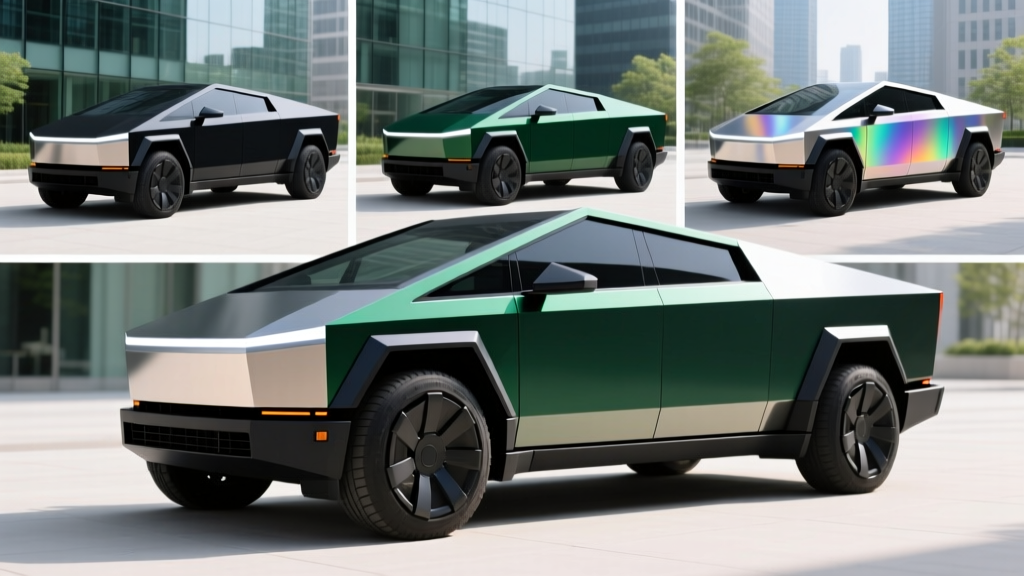
The Tesla Cybertruck's stainless steel exoskeleton was designed to be bare — and for its first year on the road, it was. But Tesla has since rolled out factory color options, and the aftermarket wrap ecosystem has exploded. If you're configuring a Cybertruck in 2026 or considering a post-purchase color change, this guide covers every factory and aftermarket color path, plus the full spec profile you need to evaluate the truck as a daily driver, tow rig, and road-trip EV.
Every Cybertruck Color Option Available in 2026
When the Cybertruck launched, Tesla offered exactly one "color": raw stainless steel. The cold-rolled 300-series alloy was the design statement. As of the 2026 model year, Tesla has expanded the palette — though not in the traditional sense of a body-paint shop. Because stainless steel doesn't accept conventional automotive paint the way aluminum or stamped steel does, Tesla uses a specialized coating process applied over the stainless panels.
Factory Color Options
As of 2026, Tesla offers the following Cybertruck exterior finishes directly from the factory:
- Stainless Steel (Standard): The default bare-metal look. No additional cost. Shows fingerprints, water spots, and fine scratches more readily than painted finishes.
- Satin Black: A matte black coating that gives the truck a stealth, monolithic appearance. Priced at approximately $6,500 over base. Hides fingerprints better than raw steel but shows dust and pollen.
- Satin White: A pearl-white coating with a satin finish. Also priced around $6,500. Offers the highest contrast against the truck's black trim and fender flares.
- Satin Gray (Stealth): A mid-tone gray that splits the difference between the stainless look and Satin Black. Introduced for the 2025 model year and carried into 2026.
All factory color options use a PVD (Physical Vapor Deposition) or advanced polymer coating process rather than traditional automotive clear-coat paint. This matters for long-term durability: these coatings are resistant to UV fading and chipping but can be more difficult to touch up if deeply scratched compared to conventional paint.
Aftermarket Wraps and Paint Protection Film
The Cybertruck's flat panel geometry makes it one of the most wrap-friendly vehicles on the market. Professional full-body wraps typically cost between $4,500 and $8,000 depending on material (gloss, matte, satin, chrome, color-shift) and installer reputation. Popular wrap brands like 3M, Avery Dennison, and XPEL all offer Cybertruck-specific kits.
Paint Protection Film (PPF) is another common choice, particularly for owners who want to preserve the stainless steel or a factory color while adding scratch and rock-chip resistance. Full-body PPF runs $5,000 to $9,000 installed. Many owners combine PPF with a tinted or colored top layer for a semi-custom look.
Color Decision Framework:
- Choose Stainless Steel if: You want zero upcharge, the original design intent, and don't mind regular wiping to manage fingerprints.
- Choose a Factory Color if: You want OEM warranty coverage on the finish, a cohesive look, and don't want to deal with third-party wrap shops.
- Choose an Aftermarket Wrap if: You want unlimited color choices (including colors Tesla doesn't offer), plan to change the look every few years, or want reversible customization.
- Choose PPF if: You want protection without changing the look — or want to protect a factory color investment.
Range, Battery, and Real-World Efficiency
Color choices don't affect range, but the Cybertruck's polarizing shape certainly does. The angular stainless steel body creates more aerodynamic drag than a curved, wind-tunnel-sculpted SUV — and that shows in the efficiency numbers.
| Spec | AWD (Dual-Motor) | Cyberbeast (Tri-Motor) |
|---|---|---|
| EPA Est. Range | 340 miles | 320 miles |
| Battery Capacity (usable) | ~123 kWh (NMC) | ~123 kWh (NMC) |
| MPGe (Combined) | 79 MPGe | 74 MPGe |
| Efficiency | 48 kWh/100 mi | 51 kWh/100 mi |
| Drivetrain | Dual-Motor AWD | Tri-Motor AWD |
| Horsepower | 600 hp | 845 hp |
| 0–60 mph | 3.9 sec | 2.6 sec |
| Towing Capacity | 11,000 lbs | 11,000 lbs |
Real-World Range Reality Check: The EPA 340-mile figure for the AWD trim is achievable in mixed city/suburban driving at moderate temperatures. On sustained highway trips at 70–80 mph, expect 260–290 miles of usable range. In cold weather (below 32°F), range drops an additional 15–25%, putting realistic winter highway range closer to 210–240 miles. Towing cuts range dramatically — plan for roughly 150–180 miles when pulling a 7,000+ lb trailer. The Cybertruck's 48-volt architecture and heat pump help mitigate cold losses, but physics is physics: a 6,600-lb angular truck pushes a lot of air.
The Cybertruck uses an NMC (nickel manganese cobalt) battery pack. NMC chemistry offers high energy density — essential for a truck this heavy — but it's more sensitive to sustained 100% state-of-charge storage than LFP chemistry. For daily driving, Tesla recommends setting the charge limit to 80–90% and only charging to 100% before long trips.
Charging Speed: DC Fast Charging and Home Level 2
The Cybertruck supports the NACS (North American Charging Standard) connector natively — no adapter needed at Tesla Superchargers. This is a significant advantage in 2026, as NACS has become the dominant DC fast-charging standard in North America, with Electrify America, EVgo, and most major networks now offering NACS cables alongside CCS.
| Charging Level | Power (kW) | Speed (miles/hr) | Notes |
|---|---|---|---|
| Level 1 (120V) | ~1.4 kW | ~3 mi/hr | Emergency/trickle only; adds ~36 miles overnight |
| Level 2 (240V, 48A) | 11.5 kW | ~25 mi/hr | Full charge in ~11 hours; standard home setup |
| Level 2 (240V, 80A) | 19.2 kW | ~42 mi/hr | Requires Tesla Wall Connector + 100A circuit; full charge ~6.5 hr |
| DC Fast (peak) | 250 kW (V3 Supercharger) | ~500+ mi/hr (peak) | 10–80% in ~28 minutes; tapers above 60% |
| DC Fast (sustained avg) | ~150 kW avg (10–80%) | — | Charge curve tapers progressively; don't plan around peak kW |
A critical note on the Cybertruck's charge curve: like most large-battery EVs, peak charge rate is only sustained at low states of charge (roughly 5–35% SoC). Above 60%, the rate tapers significantly. A 10–80% session at a V3 Supercharger takes approximately 28 minutes, but a 10–95% session can stretch to 50+ minutes. For road trips, plan stops around the 10–80% window to minimize time at the charger.
At home, the Cybertruck's massive 123 kWh battery means Level 2 charging takes longer than smaller EVs. On a standard 48-amp Level 2 circuit (the most common home installation), you're adding about 25 miles of range per hour — meaning a near-empty battery needs 11+ hours to fully replenish. Upgrading to an 80-amp circuit with the Tesla Wall Connector cuts that to roughly 6.5 hours, which is far more practical for daily use.
Pricing, Trims, and Federal Tax Credit Eligibility
The Cybertruck's pricing has shifted since its initial reveal, and the 2026 lineup reflects Tesla's repositioning of the truck as a premium offering rather than the budget EV originally promised in 2019.
| Trim | Base MSRP | Federal Tax Credit (§30D) | Effective Price (if eligible) |
|---|---|---|---|
| AWD (Dual-Motor) | $79,990 | Up to $7,500 (see below) | ~$72,490 |
| Cyberbeast (Tri-Motor) | $99,990 | Up to $7,500 (see below) | ~$92,490 |
Note on the RWD trim: Tesla announced a rear-wheel-drive Cybertruck at a lower price point, but as of early 2026, it has not entered production and remains listed as a future model. We'll update this review when it becomes available.
Does the Cybertruck Qualify for the §30D Federal Tax Credit?
The Cybertruck's eligibility for the IRS §30D Clean Vehicle Credit depends on several factors that buyers must verify before purchase:
- MSRP Cap: Pickup trucks must have an MSRP at or below $80,000. The AWD trim at $79,990 qualifies; the Cyberbeast at $99,990 does not.
- Buyer Income Cap: Modified adjusted gross income must not exceed $150,000 (single), $225,000 (head of household), or $300,000 (joint filing).
- Battery Sourcing: The credit splits into two halves — $3,750 for critical-minerals sourcing and $3,750 for battery-component manufacturing. Both must be met for the full $7,500. Tesla's supply chain has been evolving; verify current sourcing compliance on the IRS qualified-vehicles list at the time of purchase.
- Point-of-Sale Transfer: As of 2024, buyers can transfer the credit to the dealer at purchase, reducing the out-of-pocket cost immediately rather than waiting for tax filing. This is available for the Cybertruck if all eligibility criteria are met.
- US Final Assembly: The Cybertruck is assembled at Giga Texas, satisfying this requirement.
Bottom line: Only the AWD trim potentially qualifies, and only if your income is within limits and the battery sourcing requirements are met at time of purchase. Always check the fueleconomy.gov tax credit tool for the most current eligibility status before buying. Consult a tax professional for your specific situation.
Interior Space, Cargo, and Practicality
The Cybertruck's angular design creates a surprisingly spacious cabin, though its footprint is smaller than a full-size F-150 or Silverado. It seats five across two rows.
- Front legroom: 41.5 inches
- Rear legroom: 38.2 inches
- Bed length: 6 feet (72 inches) with the tonneau cover closed; extends to ~8 feet with the midgate folded down into the cabin
- Bed width (between wheel wells): ~48 inches — fits standard sheet goods flat
- Cargo bed volume: ~67 cu ft (bed alone)
- Front trunk (frunk): ~7 cu ft — useful for charging cables and small gear
- Lockable under-bed storage: Yes, the "vault" design includes sealed compartments
The powered retractable tonneau cover is a standout feature — it's load-rated (can support ~300 lbs distributed), and combined with the midgate, it lets you carry items up to 8 feet long with the bed effectively extending into the cabin. This is a genuine utility advantage over trucks with fixed rear windows.
For families: the rear seat is comfortable for adults on shorter trips, and two child seats fit easily with LATCH anchors. The flat floor (no transmission tunnel) helps with middle-seat comfort. However, the cabin is notably narrower than an F-150, and the rear windows are small, which some kids find confining on long drives.
Technology, Driver Assistance, and Standout Features
The Cybertruck runs Tesla's current-generation infotainment and driver-assistance stack. Key technology highlights include:
- 18.5-inch center touchscreen with a secondary 9.4-inch rear-seat display
- Steer-by-wire: The Cybertruck is the first Tesla (and one of the first production vehicles) to use a fully steer-by-wire system with no mechanical connection between the yoke and the wheels. This enables the variable-ratio steering (less than one full turn lock-to-lock) and eliminates the need for a traditional round steering wheel.
- 48-volt electrical architecture: A first for a modern production vehicle, reducing wiring harness weight and enabling more powerful accessories.
- Adaptive air suspension: Up to 16 inches of ground clearance in Off-Road mode; lowers automatically at highway speeds for efficiency.
- Tesla Vision-based Autopilot: Standard. Includes adaptive cruise, lane centering, and automatic emergency braking.
- Full Self-Driving (Supervised): Available as a $8,000 add-on or $99/month subscription. Despite the name, this is an SAE Level 2 driver-assistance system — you must remain fully engaged and supervising at all times.
SAE Automation Level: Level 2 (Partial Driving Automation)
Tesla Autopilot and FSD (Supervised) are Level 2 systems. The vehicle can steer, accelerate, and brake under certain conditions, but the driver must remain attentive, keep hands on the yoke, and be prepared to take over instantly. This is not self-driving. For context, only Waymo and Zoox robotaxi services currently operate at Level 4 (high automation in geofenced areas).
Notable Drawbacks
The Cybertruck is not without compromises that affect daily ownership:
- Visibility: The angular design and thick A-pillars create significant blind spots, especially to the rear quarters. The rearview camera is essential, not optional, for lane changes.
- Stainless steel maintenance: Bare stainless shows every fingerprint, water spot, and smudge. Tesla sells a proprietary cleaning kit; owners report needing to wipe the truck down frequently to maintain the look.
- Weight: At roughly 6,600–6,800 lbs curb weight, the Cybertruck consumes tires faster than lighter EVs and puts more stress on suspension components.
- Charging time with large battery: The 123 kWh pack means longer home charging sessions and longer DC fast-charge stops compared to smaller EVs.
- No Apple CarPlay/Android Auto: Tesla's closed infotainment ecosystem remains a deal-breaker for some buyers accustomed to phone integration.
- Insurance costs: Due to the stainless steel body, steer-by-wire system, and limited collision-repair expertise, Cybertruck insurance premiums run 30–50% higher than comparable trucks. Get quotes before ordering.
Warranty Coverage
| Coverage | Term |
|---|---|
| Basic Vehicle Limited Warranty | 4 years / 50,000 miles |
| Battery & Drive Unit Warranty | 8 years / 120,000 miles (minimum 70% capacity retention) |
| Restraint System | 5 years / 60,000 miles |
| Corrosion (body) | 12 years / unlimited miles (limited coverage) |
The 8-year/120,000-mile battery warranty with a 70% capacity-retention threshold is competitive for the truck segment. Given NMC chemistry's typical degradation curve, most owners should see 85–90% capacity retention at 100,000 miles under normal use (avoiding frequent 100% charges and DC fast-charging exclusively). The stainless steel body won't rust in the traditional sense, but the coating on colored variants carries its own warranty terms — confirm with Tesla at purchase.
Who the Cybertruck Is For (and Who Should Look Elsewhere)
Pros
- Tri-motor Cyberbeast delivers supercar-level acceleration (2.6 sec 0–60) in a truck
- 11,000-lb towing capacity with integrated trailer brake controller
- Vault bed with powered tonneau and midgate is genuinely innovative
- Steer-by-wire provides razor-sharp low-speed maneuverability
- NACS native charging — widest fast-charge network access
- 48-volt architecture is a generational leap in vehicle electrical design
- Air suspension with 16" ground clearance handles off-road and highway equally well
Cons
- Efficiency is poor for an EV (48–51 kWh/100 mi) — high charging costs on road trips
- Real-world highway range falls well short of EPA estimates
- Only the AWD trim may qualify for the §30D tax credit; Cyberbeast does not
- Stainless steel body requires constant maintenance or a costly wrap/PPF
- Insurance premiums are significantly above average
- No Apple CarPlay or Android Auto
- Rear visibility and cabin width trail full-size competitors
The Cybertruck is best for: Tech-forward buyers who want a statement vehicle with genuine truck capability, don't mind the efficiency trade-offs, and have access to home Level 2 charging. It works as a daily commuter if your round trip is under 200 miles, and the towing capacity is real. The Cyberbeast trim is for performance enthusiasts who want a truck that embarrasses sports cars at stoplights.
Look elsewhere if: Maximum range and efficiency are your priorities (the Rivian R1T or Ford F-150 Lightning offer better real-world efficiency), you need a full-size crew cab for six passengers, you want a traditional round steering wheel, or you need the cheapest possible cost-per-mile. Buyers focused on utility over spectacle may find the F-150 Lightning or Chevy Silverado EV more practical for the money.
Frequently Asked Questions
What is the real-world range of the Tesla Cybertruck?
The AWD trim carries a 340-mile EPA estimate, but real-world highway driving at 70–80 mph typically yields 260–290 miles. In cold weather (below freezing), expect 210–240 miles on the highway. Towing a heavy trailer drops range to roughly 150–180 miles. The Cyberbeast trim is rated at 320 miles EPA with similar real-world reductions.
How fast does the Cybertruck charge at home and on the road?
At home on a 48-amp Level 2 charger, the Cybertruck adds about 25 miles of range per hour, taking roughly 11 hours for a full charge. On an 80-amp Level 2 circuit, that improves to ~42 mi/hr and ~6.5 hours. On a V3 Supercharger (250 kW peak), a 10–80% session takes approximately 28 minutes, though the charge curve tapers significantly above 60% SoC.
How much does the Cybertruck cost after federal tax credits?
The AWD trim starts at $79,990 and may qualify for up to $7,500 under the §30D credit if MSRP, income, and battery-sourcing requirements are met — bringing the effective price to roughly $72,490. The Cyberbeast at $99,990 exceeds the $80,000 truck MSRP cap and does not qualify for the federal credit. Always verify eligibility on fueleconomy.gov and consult a tax professional.
Is the Cybertruck worth buying vs. the Rivian R1T or F-150 Lightning?
It depends on your priorities. The Cybertruck wins on acceleration (especially Cyberbeast), steer-by-wire tech, and the innovative vault bed. The Rivian R1T offers better efficiency, a more refined interior, and a quad-motor option. The F-150 Lightning provides a more traditional truck experience with a lower starting price and broader dealer support. If you want a conversation piece with real capability, the Cybertruck delivers. If you want the most practical electric truck, the R1T or Lightning may serve you better.
Can I wrap or paint a Cybertruck myself?
DIY wrapping a Cybertruck is possible due to its flat panels, but the truck's size (over 19 feet long) and the precision needed around edges make professional installation strongly recommended. Factory color options use specialized coatings that can't be replicated with standard automotive paint. If you want a custom color, a professional vinyl wrap ($4,500–$8,000) is the most practical path.
Does the Cybertruck's stainless steel body rust?
The 300-series cold-rolled stainless steel used on the Cybertruck is highly corrosion-resistant and will not rust like conventional steel. However, it can develop surface staining from environmental contaminants, road salt, and hard water. Regular cleaning with Tesla's recommended stainless steel cleaner is necessary to maintain appearance, especially in coastal or winter-salt environments.