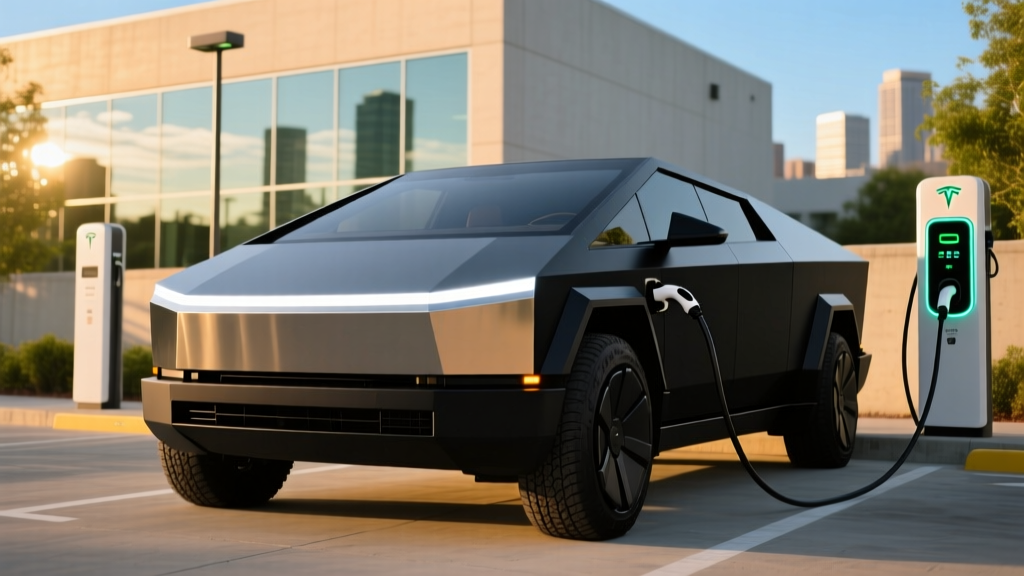
The Tesla Cybertruck remains one of the most polarizing electric vehicles on the road, but beneath its stainless-steel exoskeleton sits a massive battery pack that demands serious energy. For buyers and owners alike, the burning question is practical: how much does it cost to charge a Cybertruck, and how does that compare to fueling a gas truck?
This review covers the 2026 Tesla Cybertruck lineup — AWD, Cyberbeast, and the anticipated rear-wheel-drive variant — with exact charging costs, real-world range data, performance specs, and tax-credit eligibility. Whether you're weighing a purchase or optimizing your ownership, the numbers below cut through the hype.
2026 Tesla Cybertruck: Core Specs at a Glance
| Spec | AWD (Dual Motor) | Cyberbeast (Tri-Motor) | RWD (Expected 2026) |
|---|---|---|---|
| Base MSRP | $79,990 | $99,990 | ~$60,990 (announced) |
| Battery (usable) | ~123 kWh (NMC) | ~123 kWh (NMC) | ~123 kWh (est.) |
| EPA Range | 340 mi | 320 mi | ~250+ mi (est.) |
| MPGe (combined) | 72 MPGe | 69 MPGe | TBD |
| Efficiency | 47 kWh/100 mi | 49 kWh/100 mi | TBD |
| 0–60 mph | 3.9 sec | 2.6 sec | ~6.5 sec (est.) |
| Horsepower | 600 hp | 845 hp | ~300 hp (est.) |
| Max DC Charge Rate | 250 kW | 250 kW | 250 kW (est.) |
| 10–80% DCFC Time | ~30 min | ~30 min | ~30 min (est.) |
| Level 2 (11.5 kW) | ~30 mi/hr | ~30 mi/hr | ~30 mi/hr (est.) |
| Drivetrain | Dual Motor AWD | Tri-Motor AWD | RWD |
| Battery Warranty | 8 yr / 120,000 mi | 8 yr / 120,000 mi | 8 yr / 120,000 mi (est.) |
Sources: EPA Fueleconomy.gov, Tesla Cybertruck specs. RWD figures are preliminary estimates for the announced base model.
Real-World Range: What the EPA Sticker Doesn't Tell You
EPA estimate: 340 miles (AWD) / 320 miles (Cyberbeast)
Real-world highway (70 mph, mild weather): ~270–295 miles
Real-world highway (cold, below 32°F): ~210–250 miles
City/mixed driving (regenerative braking active): ~310–335 miles
The Cybertruck's boxy, angular design creates significant aerodynamic drag — a drag coefficient (Cd) well above a sleek sedan like the Model S. At sustained highway speeds above 70 mph, energy consumption climbs sharply. Tesla's EPA testing cycle includes generous low-speed and regenerative-braking segments that flatter the numbers.
In cold weather, expect a 20–30% range reduction. The large 123 kWh NMC battery pack takes longer to precondition, and cabin heating draws heavily without the benefit of a heat pump on early production models. If your commute involves sustained 75–80 mph highway driving in winter, plan for roughly 220 miles of usable range between charges.
On the positive side, the Cybertruck's massive battery means even at reduced efficiency, you still have more absolute range than many smaller EVs. The 47–49 kWh/100 mi consumption figure is thirsty by EV standards, but the sheer capacity compensates.
How Much Does It Cost to Charge a Cybertruck?
Let's break down the actual cost to charge the Cybertruck's ~123 kWh battery across three common scenarios. These calculations assume charging from 10% to 90% state of charge (adding roughly 98 kWh of usable energy).
Home Charging (Level 2, 240V)
The national average residential electricity rate in early 2026 sits around $0.17/kWh according to EIA data. Charging the Cybertruck from 10–90% at home costs:
- 98 kWh × $0.17 = ~$16.66 per full charge session
- Cost per mile: ~$0.059/mile (at real-world 280 mi range)
- Cost per 100 miles: ~$5.90
If you have access to off-peak utility rates (common with time-of-use plans at $0.08–$0.12/kWh), that drops to $7.84–$11.76 per session, or roughly $0.03–$0.04 per mile. A solar-equipped home can push this near zero marginal cost.
At 11.5 kW (48A), a full 10–90% home charge takes approximately 8.5 hours — easily accomplished overnight.
Public DC Fast Charging (Tesla Supercharger)
Tesla Supercharger rates in 2026 average $0.30–$0.40/kWh depending on location and time of day:
- 98 kWh × $0.35 (avg) = ~$34.30 per session
- Cost per mile: ~$0.12/mile
- Cost per 100 miles: ~$12.25
Third-Party DC Fast Charging (Electrify America, EVgo)
The Cybertruck uses the NACS (Tesla) connector natively. At non-Tesla networks, you'll need a NACS-to-CCS adapter (included with some model years, available separately for ~$200). Third-party rates often run $0.40–$0.55/kWh:
- 98 kWh × $0.48 (avg) = ~$47.04 per session
- Cost per mile: ~$0.17/mile
Cost Comparison: Cybertruck vs. Gas Truck
| Scenario | Cybertruck AWD | Ford F-150 4WD (3.5L EcoBoost, 20 MPG) |
|---|---|---|
| Home charging / fueling (per 100 mi) | $5.90 | $17.50 (at $3.50/gal) |
| Public DCFC / fueling (per 100 mi) | $12.25 | $17.50 |
| Annual cost (15,000 mi, 80% home) | $1,065 | $2,625 |
| 5-year energy cost | $5,325 | $13,125 |
Even relying heavily on public DC fast charging, the Cybertruck costs less per mile than a comparable gas truck. Home charging delivers the most dramatic savings — roughly $1,560 saved annually versus gasoline at $3.50/gallon.
Charging Speed: DC Fast Charge and Home Level 2
| Charging Level | Power (kW) | Miles Added per Hour | 10–80% Time |
|---|---|---|---|
| Level 1 (120V, 12A) | 1.4 kW | ~3 mi/hr | ~70+ hours |
| Level 2 (240V, 48A) | 11.5 kW | ~30 mi/hr | ~8.5 hours |
| DC Fast (Tesla Supercharger V3) | 250 kW (peak) | ~150+ mi/hr (peak) | ~30 minutes |
| DC Fast (V4 Supercharger) | 250 kW (peak) | ~150+ mi/hr (peak) | ~30 minutes |
Charging curve reality check: The 250 kW peak rate only sustains briefly at low state of charge (roughly 10–25%). By 50% SoC, the rate tapers to approximately 150–170 kW. Above 80%, it drops further to 50–80 kW. This is normal lithium-ion behavior, but it means the "30 minutes to 80%" figure is the practical benchmark — charging past 80% adds significant time.
For home Level 2 charging, Tesla's Wall Connector at 48A (11.5 kW) is the recommended setup. Installation typically costs $800–$2,500 depending on your electrical panel's capacity and the run length from panel to garage. Homes with 200A service usually accommodate this without a panel upgrade; older 100A panels may require a $1,500–$3,000 upgrade.
Performance, Interior, and Technology
Performance
The Cyberbeast's 2.6-second 0–60 mph time makes it one of the quickest production trucks ever built, aided by instant torque from three motors producing 845 hp. The dual-motor AWD variant still delivers a sports-car-rivaling 3.9 seconds. Both use steer-by-wire and four-wheel steering, giving the 6,800+ lb truck a surprisingly tight turning radius of 34.7 feet.
Towing capacity is rated at 11,000 lbs (AWD and Cyberbeast), though towing at that limit reduces range by approximately 40–50%. Plan for 160–180 miles of range when towing near max capacity.
Interior and Cargo
- Front headroom: 41.1 in | Legroom: 41.1 in
- Rear headroom: 38.3 in | Legroom: 38.5 in
- Bed length: 6 ft (72 in) with tailgate closed; 8 ft with tailgate down
- Bed width: 48 in between wheel wells
- Bed volume: ~67 cu ft (tailgate up)
- Front trunk (frunk): ~7.1 cu ft
- Max payload: 2,500 lbs
The minimalist interior centers on an 18.5-inch front touchscreen and a 9.4-inch rear screen. Physical controls are nearly absent — even the glovebox opens via the touchscreen. Build quality on 2025–2026 models has improved over early 2024 deliveries, though panel-gap variation remains more noticeable than on a Rivian R1T.
Driver Assistance and Standout Tech
Tesla Autopilot and Full Self-Driving (Supervised) are SAE Level 2 driver-assistance systems. The driver must remain fully attentive, with hands on the steering wheel (or torque applied via steer-by-wire) and eyes on the road at all times. These systems do NOT make the Cybertruck autonomous.
Standout technology includes:
- Steer-by-wire: No mechanical connection between yoke and wheels; variable ratio adjusts with speed
- Four-wheel steering: Rear wheels turn up to 10° for tight low-speed maneuvers and stability at speed
- Adaptive air suspension: Up to 16 inches of ground clearance in Off-Road mode
- Armor glass: Laminated stainless-steel-reinforced glass (resistant to impacts, but not bulletproof)
- Powershare: Up to 11.5 kW of vehicle-to-load (V2L) power output — enough to run power tools, a campsite, or essential home circuits during an outage
- Tesla Autopilot: Standard; FSD (Supervised) available as a $8,000 option or $99/month subscription
Notable drawbacks: The yoke steering is polarizing and requires a learning curve, particularly for three-point turns. The stainless-steel body is fingerprint-prone and difficult to repair — collision shops need Tesla-specific training and equipment. Visibility is compromised by thick A-pillars and the angular roofline. And at 8,000+ lbs curb weight, tire wear is accelerated; expect replacement every 25,000–35,000 miles at $400–$600 per tire.
Pricing, Trims, and Federal Tax Credit Eligibility
| Trim | Base MSRP | Federal Tax Credit (§30D) | Effective Price |
|---|---|---|---|
| AWD (Dual Motor) | $79,990 | $7,500 (if eligible) | $72,490 |
| Cyberbeast (Tri-Motor) | $99,990 | $7,500 (if eligible) | $92,490 |
| RWD (announced, est.) | ~$60,990 | $7,500 (if eligible) | ~$53,490 |
- MSRP cap: Trucks/vans/SUVs must be ≤$80,000 MSRP. The AWD Cybertruck at $79,990 qualifies; the Cyberbeast at $99,990 does NOT.
- Buyer income cap: AGI ≤$150,000 (single) / ≤$300,000 (joint) / ≤$225,000 (head of household)
- Battery sourcing: Critical minerals and battery components must meet escalating domestic-content thresholds per the Inflation Reduction Act
- Point-of-sale transfer: Eligible buyers can transfer the credit to the dealer at purchase, reducing the purchase price directly
- Assembly: Must be assembled in North America (Cybertruck is built in Austin, TX ✓)
Source: IRS §30D Clean Vehicle Credit. Eligibility rules are subject to change — verify current requirements with a tax professional before purchasing.
Critical note: The Cyberbeast's $99,990 MSRP exceeds the §30D truck MSRP cap of $80,000, making it ineligible for the federal credit. Only the dual-motor AWD trim currently qualifies, and only if you meet income and battery-sourcing requirements. The announced RWD model, once available, would also qualify on MSRP grounds.
Who Should Buy the Cybertruck?
✅ Choose the Cybertruck if:
- You need a full-size truck bed with 11,000-lb towing and V2L capability for job sites or off-grid use
- You have reliable home Level 2 charging and want to minimize fuel costs vs. a gas truck
- You value acceleration and tech-forward features (steer-by-wire, Powershare, air suspension)
- You're a Tesla ecosystem user (Supercharger network, app integration, OTA updates)
❌ Look elsewhere if:
- You frequently tow long distances — range drops to ~170 mi under heavy load
- You prioritize traditional truck ergonomics, physical controls, or conventional styling
- You lack access to home charging (public DCFC costs erode the fuel-savings advantage)
- You want proven long-term reliability data (Cybertruck is still early in its production lifecycle)
Key competitors: The Rivian R1T ($69,900+, 352 mi EPA, more refined interior, better off-road articulation) suits buyers wanting adventure-truck versatility. The Ford F-150 Lightning ($55,000+, 320 mi EPA, conventional truck feel, Pro Power Onboard) appeals to traditional truck buyers going electric. The Cybertruck wins on raw performance, Supercharger access, and V2L power output — but trails on interior quality and conventional usability.
Frequently Asked Questions
What is the real-world range of the Tesla Cybertruck?
The EPA rates the AWD Cybertruck at 340 miles and the Cyberbeast at 320 miles. In real-world highway driving at 70+ mph, expect 270–295 miles. In cold weather (below freezing), plan for 210–250 miles. City driving with regenerative braking recovers more energy, yielding results closer to the EPA estimate.
How fast does the Cybertruck charge at home and on the road?
At home on a 240V Level 2 charger (11.5 kW / 48A), the Cybertruck adds about 30 miles of range per hour, with a full 10–90% charge taking roughly 8.5 hours. On a Tesla V3/V4 Supercharger (250 kW peak DC), a 10–80% charge takes approximately 30 minutes, though the charge rate tapers significantly above 50% state of charge.
Does the Tesla Cybertruck qualify for the $7,500 federal EV tax credit?
The dual-motor AWD Cybertruck ($79,990 MSRP) qualifies on price grounds since the §30D cap for trucks is $80,000. The Cyberbeast ($99,990) does NOT qualify due to exceeding the MSRP cap. Buyer income limits ($150K single / $300K joint) and battery-sourcing requirements also apply. Always verify current rules on IRS.gov before purchasing.
How much does it cost to charge a Cybertruck per month?
For a typical driver covering 1,250 miles per month with 80% home charging (at $0.17/kWh national average) and 20% DC fast charging (at $0.35/kWh), the monthly charging cost is approximately $89–$100. That compares to roughly $219/month for a gas F-150 at 20 MPG and $3.50/gallon.
Is the Cybertruck worth buying vs. the Rivian R1T or F-150 Lightning?
The Cybertruck excels in acceleration, Supercharger network access, and V2L output (11.5 kW). The Rivian R1T offers a more refined interior, better off-road capability, and a more practical quad-motor option. The F-150 Lightning provides a familiar truck experience with strong value. Choose the Cybertruck if you prioritize performance, Tesla's ecosystem, and distinctive design — but test-drive all three before committing.
How long will the Cybertruck battery last?
Tesla warranties the Cybertruck's battery for 8 years or 120,000 miles, whichever comes first, with a minimum 70% capacity retention threshold. Based on Tesla's NMC battery track record in the Model S/X fleet, owners can reasonably expect 80–85% capacity retention at 150,000 miles with normal use. Avoiding frequent 100% charges and excessive DC fast charging extends longevity.