Cybertruck Charge Port: Location, Design, and Why It Matters
If you're shopping for a Tesla Cybertruck or planning your first road trip in one, the Cybertruck charge port is one of the first things you'll need to understand. Unlike the more conventional port placement on the Model Y or Model 3, Tesla positioned the Cybertruck's charge port in a location that reflects its angular, stainless-steel exoskeleton design — and that choice has real implications for how you plug in at home and at public DC fast chargers.
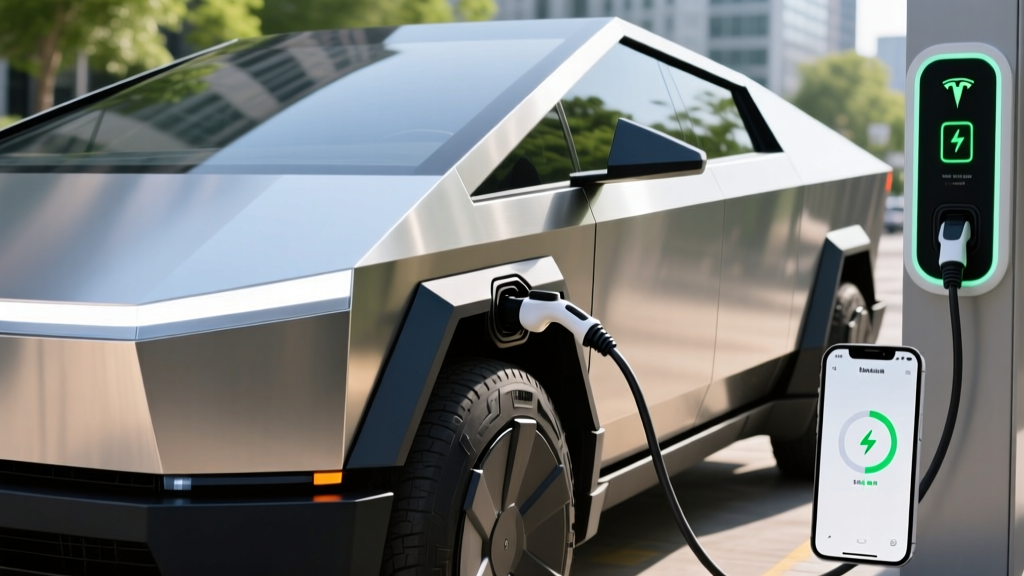
The Cybertruck uses the North American Charging Standard (NACS) connector, which Tesla opened to the broader industry starting in 2022 and which has since been adopted by Ford, GM, Rivian, Hyundai, and most major automakers. The port itself is located on the driver-side rear fender, just ahead of the rear wheel arch, hidden behind a motorized door that blends into the stainless-steel body panel. This placement is similar to the Model 3 and Model Y but sits higher due to the truck's ground clearance and bed configuration.
Why does port location matter? When you're backing into a Supercharger stall or pulling up to a home wall connector, the rear-fender position means you'll want to approach chargers from the driver's side. At most Tesla Supercharger stalls, this works seamlessly. At third-party CCS or NACS stations with shorter cables or awkwardly placed pedestals, you may need to pull through or angle the truck carefully. The Cybertruck's 82-inch width (excluding mirrors) also means tight charging stalls designed for compact sedans can feel snug.
Cybertruck Charging Speeds: DC Fast, Level 2, and Level 1
Charging speed is where the Cybertruck's 800-volt-class electrical architecture pays dividends. Here's a breakdown across all three charging levels:
| Charging Level | Connector | Max Power (kW) | Speed (mi/hr added) | Notes |
|---|---|---|---|---|
| Level 1 (120V) | NACS (J3400) | ~1.4 kW | ~3–4 mi/hr | Emergency/top-off only; ~50+ hrs for full charge |
| Level 2 (240V, 48A) | NACS (J3400) | 11.5 kW | ~30–34 mi/hr | Home Wall Connector; ~10–12 hrs for full charge |
| Level 2 (240V, 32A) | NACS (J3400) | 7.7 kW | ~20–22 mi/hr | Mobile connector w/ NEMA 14-50 adapter |
| DC Fast Charge | NACS (J3400) | 250 kW (peak) | Up to ~185 mi in 15 min | At V3/V4 Superchargers; tapers above 60% SoC |
Real-world DC fast charging: The Cybertruck peaks at approximately 250 kW on V3 and V4 Superchargers, but like all EVs, it doesn't sustain that rate. The charge curve is aggressive in the 10–40% state-of-charge (SoC) window, pulling above 200 kW, then progressively tapering. Expect a 10–80% charge in roughly 28–35 minutes depending on battery temperature, ambient conditions, and whether the truck has preconditioned its pack via navigation to the charger. Above 80%, charging slows dramatically — plan to unplug at 80% on road trips unless you specifically need a full pack.
Preconditioning matters: Navigate to a Supercharger using the Cybertruck's built-in navigation, and the thermal management system will warm or cool the battery to its optimal charging temperature before you arrive. In cold weather (below 40°F), skipping preconditioning can add 10+ minutes to your 10–80% time because the pack limits charge rate to protect the cells.
Battery, Range, and Efficiency Across All Trims
The Cybertruck uses a large lithium-ion battery pack with nickel-based chemistry (NMC-type), consistent with Tesla's performance-oriented vehicles. The usable capacity is approximately 123 kWh across the dual-motor and tri-motor configurations. Tesla does not publish exact cell-level chemistry specs, but teardown analysis and energy-density calculations point to a 4680-cell NMC architecture.
- Cybertruck AWD (Dual Motor): EPA est. 340 miles — expect ~280–310 mi highway at 70 mph; ~230–260 mi in cold weather (below 30°F)
- Cyberbeast (Tri Motor): EPA est. 320 miles — expect ~260–290 mi highway; ~210–240 mi in cold weather
- RWD (base, announced/expected 2026): EPA est. ~250 miles (preliminary) — real-world highway likely ~200–220 mi
The Cybertruck's boxy aerodynamics (drag coefficient ~0.38–0.40 estimated) and 6,600–6,800 lb curb weight penalize highway efficiency more than sleeker EVs. City driving with regenerative braking recovers more energy, so mixed-use real-world range often lands closer to the EPA sticker than pure highway driving does.
Efficiency figures from fueleconomy.gov place the AWD Cybertruck at approximately 70 MPGe combined (roughly 48 kWh/100 mi), which is notably less efficient than a Model Y Long Range (~120 MPGe). That's the cost of a 6,800-pound stainless-steel truck. For context, that translates to roughly $0.07–$0.10 per mile on residential electricity at $0.15/kWh, compared to $0.16–$0.20/mile for a gas truck averaging 18 MPG at $3.50/gallon.
Full Specs: Cybertruck AWD and Cyberbeast at a Glance
| Specification | Cybertruck AWD | Cyberbeast (Tri Motor) |
|---|---|---|
| EPA Range | 340 miles | 320 miles |
| Battery (usable) | ~123 kWh (NMC, 4680 cells) | ~123 kWh (NMC, 4680 cells) |
| Drivetrain | Dual Motor AWD | Tri Motor AWD |
| Horsepower | 600 hp | 845 hp |
| 0–60 mph | 4.1 seconds | 2.6 seconds |
| Top Speed | 112 mph | 130 mph |
| Max DC Fast Charge | 250 kW | 250 kW |
| 10–80% DC Time | ~28–35 min | ~28–35 min |
| Level 2 Rate | 11.5 kW (48A) | 11.5 kW (48A) |
| Towing Capacity | 11,000 lbs | 11,000 lbs |
| Payload | 2,500 lbs | 2,500 lbs |
| Cargo (bed) | 74 cu ft (6-ft bed) | 74 cu ft (6-ft bed) |
| Frunk | 7.1 cu ft | 7.1 cu ft |
| Efficiency (combined) | ~70 MPGe / 48 kWh/100mi | ~66 MPGe / 51 kWh/100mi |
| Base MSRP | $79,990 | $99,990 |
| Battery Warranty | 8 yr / 120,000 mi | 8 yr / 120,000 mi |
| Basic Warranty | 4 yr / 50,000 mi | 4 yr / 50,000 mi |
Pricing, Trims, and Federal Tax Credit Eligibility
The Cybertruck's pricing has shifted since its late-2023 launch, and as of the 2026 model year, here's where trims stand:
| Trim | Base MSRP | Federal §30D Credit | Effective Price (if eligible) |
|---|---|---|---|
| Cybertruck AWD | $79,990 | Up to $7,500 | ~$72,490 |
| Cyberbeast | $99,990 | Up to $7,500 | ~$92,490 |
| Cybertruck RWD (expected) | ~$60,990 (preliminary) | Up to $7,500 | ~$53,490 |
Critical tax credit caveats: The IRS §30D Clean Vehicle Credit has strict eligibility requirements that change annually:
- MSRP cap: Trucks/vans/SUVs must be under $80,000 MSRP. The Cybertruck AWD at $79,990 squeaks under this cap; the Cyberbeast at $99,990 does not qualify.
- Buyer income cap: Modified AGI must not exceed $150,000 (single), $225,000 (head of household), or $300,000 (joint filers).
- Battery sourcing: Increasing percentages of critical minerals and battery components must be sourced from the U.S. or FTA-partner countries. Tesla's domestic manufacturing gives the Cybertruck an advantage here, but verify current-year compliance on the IRS eligible-vehicle list before purchase.
- Point-of-sale transfer: As of 2024+, you can transfer the credit to the dealer at purchase, reducing your out-of-pocket cost immediately rather than waiting for a tax refund.
The Cyberbeast's $99,990 MSRP exceeds the $80,000 truck cap, meaning it does not qualify for the federal credit. Only the AWD trim currently qualifies, and only if your income and the battery-sourcing requirements align. Always confirm with a tax professional and check the latest IRS guidance before counting on the credit.
Interior, Cargo, and Everyday Practicality
The Cybertruck seats five (with an optional front bench seat configuration allowing six in some model years). Interior space is generous but shaped by the angular exterior:
- Front legroom: ~41.5 inches
- Rear legroom: ~38.5 inches (tighter than an F-150 Lightning's rear seat)
- Bed volume: 74 cu ft (6-foot bed with motorized tonneau cover)
- Frunk: 7.1 cu ft (lockable, with a drain for use as a cooler)
- Bed width between wheel wells: ~49 inches (will not fit a standard 4×8 sheet of plywood flat)
- Towing: 11,000 lbs max (with integrated trailer brake controller available)
The 18.5-inch front touchscreen handles nearly all vehicle controls — there are no physical buttons for climate, mirrors, or even the glovebox. A rear 9.4-inch touchscreen serves back-seat passengers. The steer-by-wire system (no mechanical linkage between the yoke and wheels) takes adaptation but offers a variable ratio that requires less hand movement at low speeds.
Notable drawbacks: The stainless-steel body shows fingerprints aggressively and is difficult to repair after dents. Visibility is compromised by thick A-pillars and the angular rear window. The yoke steering is polarizing, especially during multi-point turns. And at 82 inches wide, the Cybertruck doesn't fit comfortably in many older parking garages or narrow urban streets.
Driver Assistance: Autopilot and FSD (Supervised)
Tesla's Autopilot and Full Self-Driving (Supervised) are SAE Level 2 driver-assistance systems. The driver must remain fully engaged, hands on the yoke (or providing torque input), and eyes on the road at all times. The Cybertruck is not a self-driving vehicle. Only Level 4 services like Waymo operate without a human driver in geofenced areas.
The Cybertruck ships with Tesla's latest HW4 (Hardware 4) Autopilot computer and a suite of cameras (Tesla has moved away from ultrasonic sensors and radar, relying on a vision-only approach). Standard Autopilot includes traffic-aware cruise control and autosteer on marked roads. The optional FSD (Supervised) package adds automated lane changes, traffic light and stop sign recognition, and city-street autosteer — but its performance remains inconsistent in construction zones, heavy rain, and complex intersections.
For 2026, Tesla has not released the Cybertruck with any SAE Level 3 or Level 4 capability. Treat FSD as an advanced convenience feature, not a replacement for an attentive driver.
Cybertruck vs. F-150 Lightning vs. Rivian R1T: Which Electric Truck Wins?
| Category | Cybertruck AWD | F-150 Lightning (Ext. Range) | Rivian R1T (Dual Motor Max) |
|---|---|---|---|
| EPA Range | 340 mi | 320 mi | 410 mi |
| Max DC Charge | 250 kW | 150 kW | 220 kW |
| 0–60 mph | 4.1 sec | 3.8 sec | 3.5 sec |
| Towing | 11,000 lbs | 10,000 lbs | 11,000 lbs |
| Bed Length | 6 ft | 5.5 ft | 4.5 ft (w/ Gear Tunnel) |
| Base MSRP | $79,990 | ~$74,990 | ~$87,900 |
| Charging Network | Tesla Supercharger (NACS) | NACS (Supercharger access) | NACS (Supercharger access) |
| §30D Credit Eligible | Yes (AWD only) | Yes (select trims) | Yes (select trims) |
Choose the Cybertruck if: You want the fastest DC charging in the electric truck segment, need a full 6-foot bed, value Supercharger network reliability, and appreciate the polarizing design. It's the best pick for frequent road-trippers who prioritize charge speed over maximum range.
Choose the F-150 Lightning if: You need a more conventional truck experience, want broader dealer service access, prefer a traditional steering wheel, and value Ford's Pro Power Onboard for job-site use. It charges slower but feels more familiar.
Choose the Rivian R1T if: Range is your top priority (410 mi on the Max pack), you want the most refined interior, and you value Rivian's gear tunnel storage and adventure-oriented design. It's the most expensive option but the most capable off-road.
Who Should Buy the Cybertruck?
The Cybertruck is best suited for:
- Tech-forward truck buyers who want the most futuristic EV truck experience and don't mind the learning curve of steer-by-wire and a touchscreen-only interface
- Frequent road-trippers who benefit from Tesla's Supercharger network and the Cybertruck's class-leading 250 kW DC charging speed
- Towing users who need 11,000-lb capacity and integrated trailer features (note: towing cuts range roughly in half — plan for ~160–170 miles per charge when max-towing)
- Urban/suburban commuters with home Level 2 charging who rarely need the bed but want the security of an enclosed, lockable vault-style bed cover
It's a poor fit for buyers who need a wide bed for sheet goods, want easy body repair after parking-lot dings, prefer physical buttons, or live in areas with limited Tesla Service Center access. The Cybertruck's stainless-steel panels can't be fixed at a conventional body shop.
- Fastest DC charging among electric trucks (250 kW peak)
- Access to Tesla Supercharger network (30,000+ stalls globally)
- 6-foot bed with powered tonneau and 2,500-lb payload
- 11,000-lb towing with integrated brake controller
- Exhilarating performance (4.1s 0–60 in AWD; 2.6s in Cyberbeast)
- 48A Level 2 home charging is among the fastest in the segment
- Stainless-steel exoskeleton is dent-resistant (though fingerprint-prone)
- Highway efficiency is poor (~70 MPGe) due to aero and weight
- Real-world highway range drops significantly (280 mi or less at 70+ mph)
- Bed width between wheel wells won't fit a 4×8 plywood sheet flat
- Cyberbeast doesn't qualify for §30D credit (over $80K MSRP cap)
- Steer-by-wire and yoke require significant adaptation
- Limited service center network; stainless-steel body repair is difficult
- Rear visibility is compromised; camera mirror is a must
- 82-inch width is problematic in tight garages and urban parking
Frequently Asked Questions
Where exactly is the Cybertruck charge port located?
The Cybertruck charge port is on the driver-side rear fender, just ahead of the rear wheel arch. It's concealed behind a motorized door that opens via the touchscreen, the Tesla app, or by pressing the door when the truck is unlocked. The port uses the NACS (J3400) connector standard.
What is the real-world range of the Cybertruck?
The EPA rates the AWD at 340 miles and the Cyberbeast at 320 miles. In real-world highway driving at 70 mph, expect roughly 280–310 miles (AWD) and 260–290 miles (Cyberbeast). In cold weather below 30°F, subtract another 15–20%, bringing highway range down to ~230–260 miles. City driving with regenerative braking gets closer to the EPA sticker.
How fast does the Cybertruck charge at a Supercharger?
At a V3 or V4 Supercharger, the Cybertruck peaks at approximately 250 kW. A 10–80% charge takes roughly 28–35 minutes, with the fastest charging occurring in the 10–40% SoC window. The charge curve tapers significantly above 60%, so plan road-trip stops around 10–80% rather than charging to full.
Does the Cybertruck qualify for the $7,500 federal EV tax credit?
Only the Cybertruck AWD at $79,990 MSRP qualifies, as it falls under the $80,000 truck cap. The Cyberbeast at $99,990 does not qualify. Additionally, your modified adjusted gross income must be under $150K (single) / $300K (joint), and the battery must meet current-year critical-mineral and component sourcing requirements per IRS §30D rules. Always verify eligibility before purchase.
Can I charge the Cybertruck at non-Tesla chargers?
Yes. Since the Cybertruck uses the NACS connector, you can charge at any NACS-equipped station. For CCS1 chargers, Tesla sells a NACS-to-CCS adapter. The truck also works with CHAdeMO stations using a separate adapter, though CHAdeMO infrastructure is increasingly rare. At home, any NACS-compatible Level 2 wall connector (Tesla or third-party) will work.
How much does it cost to charge a Cybertruck at home?
With a ~123 kWh battery and the national average residential rate of ~$0.16/kWh (2025 EIA data), a full charge from 0–100% costs roughly $19.70. A typical 10–80% top-up costs about $13.80. That's equivalent to roughly 3.5–4.5 gallons of gas, making home charging dramatically cheaper than fueling a comparable gas truck.
Is the Cybertruck good for towing?
The Cybertruck tows up to 11,000 lbs, which is competitive with gas half-ton trucks. However, towing at or near max capacity cuts range roughly in half — expect ~160–170 miles per charge when towing heavy. Tesla's integrated trailer brake controller and trailer-specific Autopilot mode help, but plan charging stops carefully on long towing trips.
What is the Cybertruck's battery warranty?
Tesla covers the Cybertruck battery and drive unit for 8 years or 120,000 miles, whichever comes first, with a minimum 70% capacity retention guarantee. The basic vehicle warranty is 4 years or 50,000 miles. This is slightly better than the industry-standard 8yr/100,000mi battery warranty offered by most competitors.