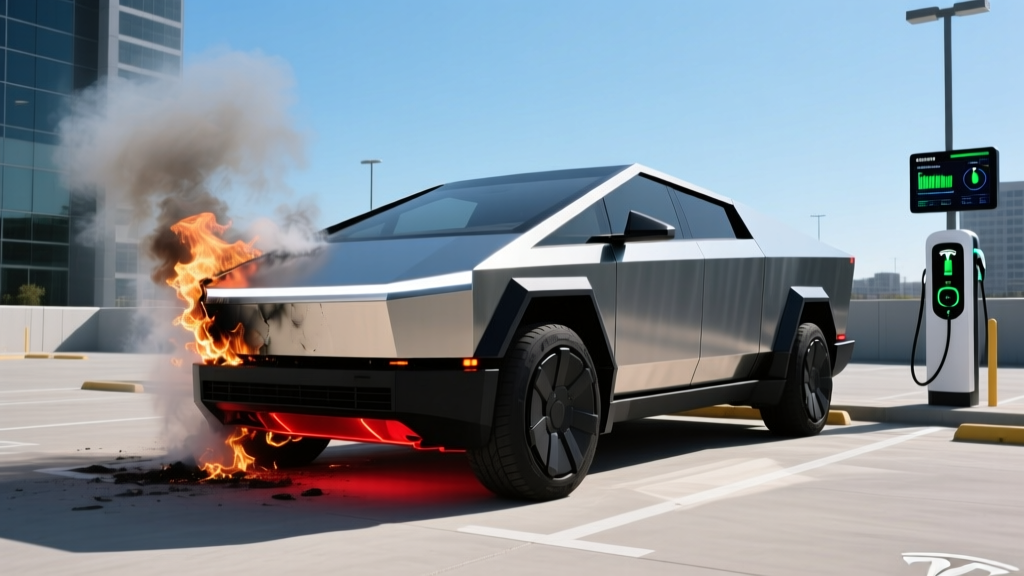
When a Tesla Cybertruck caught fire in early 2025, the incident generated predictable headlines and social-media frenzy. But separating viral clips from engineering reality requires a harder look at the data: the battery chemistry, the 48-volt architecture, the thermal-management system, and the broader context of EV fire rates versus internal-combustion vehicles. This profile examines the known fire incidents, then delivers the complete spec-by-spec breakdown every prospective Cybertruck buyer needs in 2026.
When a Cybertruck Caught Fire: The Known Incidents
As of early 2026, there have been a small number of documented Cybertruck fire events. The most widely reported occurred when a Cybertruck was involved in a high-speed collision, after which the vehicle's lithium-ion battery pack sustained structural damage and subsequently ignited. In another instance, a Cybertruck experienced a thermal event while parked, though Tesla attributed this to a manufacturing defect in a specific batch of cells rather than a systemic design flaw.
It is critical to contextualize these events. According to NHTSA data and analysis by the Swedish Civil Contingencies Agency (MSB), electric vehicles experience fires at a rate roughly 1/20th to 1/30th that of internal-combustion-engine vehicles per 100,000 vehicles on the road. EV battery fires are more visually dramatic and harder to extinguish, which drives disproportionate media coverage.
Cybertruck Battery Architecture and Fire Risk Factors
The Cybertruck uses a structural battery pack with 4680-format cylindrical cells in a nickel-manganese-cobalt (NMC) chemistry. The estimated usable capacity is approximately 123 kWh for the dual-motor AWD variant and 123 kWh for the tri-motor Cyberbeast. NMC chemistry offers higher energy density than LFP (lithium iron phosphate) but operates at a higher cell voltage, which theoretically increases thermal-runaway risk if cells are damaged or short-circuited.
Tesla's 48-volt electrical architecture (a first for a production vehicle) reduces current flow through wiring harnesses, which in theory reduces resistive heating and electrical-fire risk in the low-voltage system. The stainless-steel exoskeleton provides substantial structural protection for the battery pack in a collision, though it complicates firefighter access to the pack in a thermal event.
| Specification | Detail |
|---|---|
| Cell Format | 4680 cylindrical |
| Chemistry | NMC (Nickel-Manganese-Cobalt) |
| Usable Capacity (est.) | ~123 kWh |
| Pack Architecture | Structural, integrated into chassis |
| Electrical System | 48-volt (industry first) |
| Thermal Management | Liquid-cooled / heated with heat pump |
| Battery Warranty | 8 years / 120,000 miles (min. 70% retention) |
Full Cybertruck Specs: Range, Charging, and Performance
Fire safety is one factor; daily usability is another. Here is the complete spec profile for the 2026 Tesla Cybertruck lineup.
| Spec | AWD | Cyberbeast (Tri-Motor) |
|---|---|---|
| EPA Range | 340 miles | 320 miles |
| Battery (usable) | ~123 kWh NMC | ~123 kWh NMC |
| MPGe (combined) | ~59 MPGe | ~56 MPGe |
| kWh/100 mi | ~57 kWh | ~60 kWh |
| Max DC Fast Charge | 250 kW (NACS) | 250 kW (NACS) |
| 10–80% DC Time | ~30 min | ~30 min |
| Level 2 (11.5 kW) | ~37 mi/hr | ~37 mi/hr |
| 0–60 mph | 3.9 sec | 2.6 sec |
| Horsepower | 600 hp | 845 hp |
| Drivetrain | Dual-motor AWD | Tri-motor AWD |
| Towing Capacity | 11,000 lbs | 11,000 lbs |
| Cargo (bed + frunk) | ~74 cu ft bed + 7 cu ft frunk | ~74 cu ft bed + 7 cu ft frunk |
| Base MSRP | $79,990 | $99,990 |
The Cybertruck AWD carries an EPA-estimated 340 miles of range. In real-world highway driving at 70+ mph, expect approximately 270–300 miles due to the truck's poor aerodynamic drag coefficient and heavy curb weight (~6,600 lbs). In cold weather (below 32°F), range can drop an additional 15–25%, bringing effective winter highway range to roughly 220–260 miles. Towing at max capacity can halve range entirely.
Charging Speed: DC Fast and Home Level 2
The Cybertruck charges via the NACS (North American Charging Standard) connector natively, giving it seamless access to Tesla's Supercharger network — the most reliable DC fast-charging infrastructure in the U.S. as of 2026.
| Level | Power | Miles Added |
|---|---|---|
| Level 1 (120V outlet) | ~1.4 kW | ~4 mi/hr |
| Level 2 (240V, 48A) | 11.5 kW | ~37 mi/hr |
| DC Fast (Supercharger V3) | 250 kW peak | ~200 mi in 15 min |
Charging-curve reality: The Cybertruck peaks at 250 kW only at low state-of-charge (below ~30%) and with proper battery preconditioning. Sustained rates between 30–60% average around 180–200 kW, then taper significantly above 80%. A 10–80% session takes approximately 30 minutes at a V3 Supercharger. Charging above 80% adds another 20+ minutes due to the taper — plan your road-trip stops accordingly.
For home charging, Tesla's Wall Connector at 48 amps on a 60-amp circuit delivers 11.5 kW, adding about 37 miles per hour. A full overnight charge from 20% to 100% takes roughly 9–10 hours. Installation costs for a Level 2 home setup typically range from $800 to $2,500 depending on panel capacity and conduit run length. Always have a licensed electrician assess your panel before installation — the Cybertruck's large battery means you'll want the fastest Level 2 you can support.
Pricing, Trims, and Federal Tax Credit Eligibility
The Cybertruck's pricing has shifted since its late-2023 launch. As of the 2026 model year, the lineup is:
- AWD (Dual-Motor): $79,990 MSRP
- Cyberbeast (Tri-Motor): $99,990 MSRP
Tesla discontinued the previously announced rear-wheel-drive base model, which had been promised at a lower price point but never reached production at scale.
Under current IRS §30D rules, the Cybertruck faces significant hurdles for the $7,500 federal EV tax credit:
- MSRP Cap: The §30D credit caps eligible trucks at $80,000 MSRP. The AWD trim at $79,990 technically clears this threshold, but any dealer-added options or packages that push the sticker above $80,000 will disqualify it.
- Cyberbeast Disqualified: At $99,990, the Cyberbeast exceeds the $80,000 truck cap and is not eligible.
- Income Caps: Buyer AGI must not exceed $300,000 (joint), $225,000 (head of household), or $150,000 (single).
- Battery Sourcing: Critical-mineral and battery-component sourcing requirements must be met. Tesla's supply chain has been evolving — verify current-year eligibility on fueleconomy.gov before purchase.
- Point-of-Sale Transfer: If eligible, the credit can be transferred to the dealer at purchase, reducing your out-of-pocket cost immediately.
Tech, Interior, and Driver-Assistance Systems
The Cybertruck's interior is minimalist even by Tesla standards: an 18.5-inch center touchscreen handles nearly all vehicle controls, with no traditional instrument cluster. Rear passengers get a 9.4-inch touchscreen. The yoke-style steering wheel (standard) remains polarizing, though a round wheel option has been available since late 2024.
Standout tech features:
- Steer-by-wire: No mechanical connection between the yoke and the wheels — enables variable ratio steering (fewer turns lock-to-lock at low speed)
- 48-volt architecture: Powers all vehicle systems, reducing wiring weight and enabling higher-power accessories
- Bioweapon Defense Mode: HEPA filtration system for cabin air
- Powershare (V2L/V2H): Up to 11.5 kW of bidirectional power output — can run tools, appliances, or partially power a home during outages
- Adaptive air suspension: Up to 16 inches of ground clearance in Off-Road mode
Driver assistance: The Cybertruck ships with Tesla's Autopilot (SAE Level 2), which includes adaptive cruise control and lane-keeping. Full Self-Driving (Supervised) remains a Level 2 system despite its name — the driver must remain fully engaged and is legally responsible for the vehicle at all times. Tesla has not achieved Level 3 or higher in any production consumer vehicle.
Cargo, Passenger Space, and Practicality
The Cybertruck seats five, though the rear bench is tight for three adults on longer trips. Rear legroom measures approximately 38 inches, adequate but not generous for a vehicle in this price class.
- Bed length: 6 feet (with tailgate closed); extends with tailgate down
- Bed volume: ~67 cu ft (closed tonneau); up to ~74 cu ft with vault open
- Frunk (front trunk): ~7 cu ft, lockable
- Max payload: ~2,500 lbs
- Max towing: 11,000 lbs
- Ground clearance: 9.8–16.0 inches (adjustable air suspension)
The powered tonneau cover ("vault") is a genuine differentiator — it provides secure, weather-sealed storage that an open-bed F-150 Lightning or Rivian R1T cannot match without an aftermarket topper. However, the angular bed walls and wheel-well intrusion limit the width of flat cargo (a standard 4×8 sheet of plywood does not lie flat on the bed floor).
Who Should Buy the Cybertruck — And Who Shouldn't
✅ Best For
- Tech-forward truck buyers who value the Supercharger network and Tesla's software ecosystem
- Secure cargo needs: The lockable vault is ideal for tools, gear, or deliveries
- Home backup power: Powershare V2L/V2H capability is genuinely useful for outage-prone areas
- Performance seekers: Cyberbeast's 2.6-second 0–60 is absurd for a 6,800-lb truck
❌ Think Twice If
- You need a work truck: The bed width, stainless-steel dent-resistance tradeoff, and repair complexity make it less practical than an F-150 Lightning for daily job-site use
- Build quality matters: Tesla's panel-gap consistency and early-production quality issues remain a concern
- You want proven reliability: Steer-by-wire, 48V architecture, and the stainless exoskeleton are all production-firsts with limited long-term data
- You tow frequently: Towing at 11,000 lbs can cut range to ~170 miles or less
How Does the Cybertruck Compare to Key Rivals?
The Cybertruck competes in the full-size electric truck segment against the Ford F-150 Lightning, Rivian R1T, and the Chevrolet Silverado EV. Here's how the critical specs stack up:
| Spec | Cybertruck AWD | F-150 Lightning (Ext. Range) | Rivian R1T (Dual-Motor Max) |
|---|---|---|---|
| EPA Range | 340 mi | 320 mi | 410 mi |
| Max DC Charge | 250 kW | ~150 kW | ~200 kW |
| 0–60 mph | 3.9 sec | 3.8 sec | 3.5 sec |
| Towing | 11,000 lbs | 10,000 lbs | 11,000 lbs |
| Base MSRP | $79,990 | ~$69,995 | ~$87,000 |
| §30D Credit Eligible? | AWD only (marginal) | Select trims | Yes (under cap) |
Bottom line: The Cybertruck leads in DC charging speed (via Supercharger access) and secure cargo storage. The F-150 Lightning wins on conventional truck practicality, dealer service network, and pricing. The Rivian R1T offers the longest range, superior off-road capability, and better interior quality — at a premium.
Frequently Asked Questions
Has a Cybertruck caught fire, and is it a common problem?
A small number of Cybertruck fire incidents have been documented as of 2026, typically involving high-speed collisions or isolated manufacturing defects. EV fires remain statistically far less common than gasoline-vehicle fires. The Cybertruck's NMC battery chemistry and stainless-steel structure present unique firefighting challenges, but the frequency of thermal events is not above the EV industry average based on available data.
What is the real-world range of the Cybertruck?
The AWD model is EPA-rated at 340 miles. Expect 270–300 miles on the highway at 70+ mph, dropping to approximately 220–260 miles in cold weather. Towing at max capacity can reduce range to roughly 170 miles. The Cyberbeast's real-world highway range is approximately 250–280 miles.
How fast does the Cybertruck charge at home and on the road?
On a DC fast charger (Tesla Supercharger V3), the Cybertruck peaks at 250 kW and charges from 10–80% in about 30 minutes. At home on a Level 2 Wall Connector (11.5 kW / 48A), it adds roughly 37 miles per hour, requiring about 9–10 hours for a full charge from 20%.
Does the Cybertruck qualify for the federal EV tax credit?
The AWD trim at $79,990 technically falls under the $80,000 MSRP cap for trucks under IRS §30D, but any added options pushing the sticker above $80,000 will disqualify it. The Cyberbeast at $99,990 does not qualify. Buyer income caps ($150K single / $300K joint) and battery-sourcing requirements also apply. Verify current eligibility on fueleconomy.gov and consult a tax professional.
Is the Cybertruck worth buying versus the F-150 Lightning or Rivian R1T?
Choose the Cybertruck if you prioritize Tesla's Supercharger network, the lockable vault bed, Powershare V2L/V2H capability, and performance. Choose the F-150 Lightning if you need conventional truck usability, a wider dealer/service network, and a lower entry price. Choose the Rivian R1T if range, off-road capability, and build quality are top priorities.
How long is the Cybertruck's battery warranty?
Tesla covers the Cybertruck's battery and drive unit for 8 years or 120,000 miles, whichever comes first, with a minimum 70% capacity retention guarantee. If the battery degrades below 70% of original capacity within that period, Tesla will repair or replace it at no cost.
Sources: Tesla Cybertruck specifications, fueleconomy.gov, IRS §30D clean vehicle credits, NHTSA.