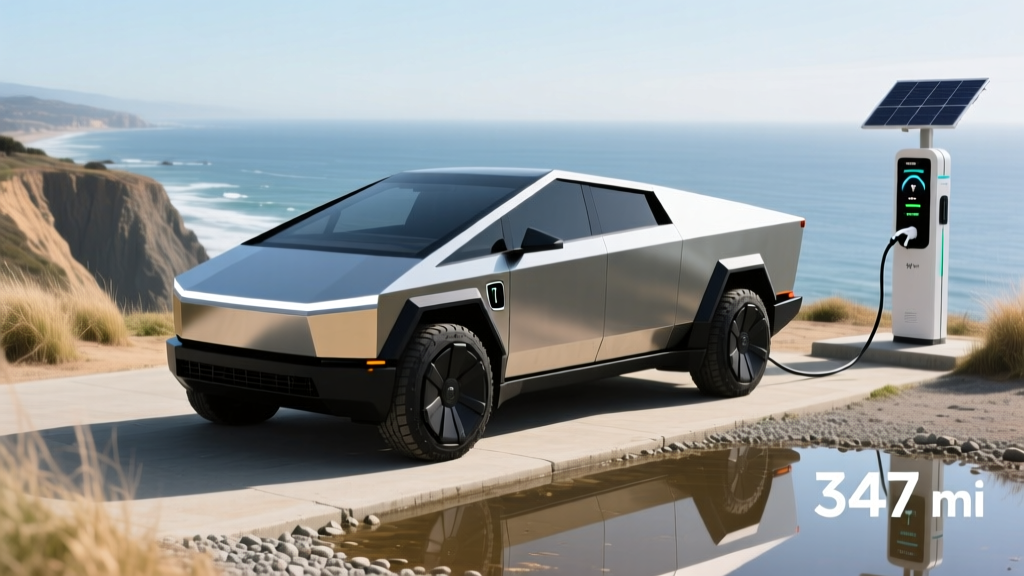
The Tesla Cybertruck has never been a conventional pickup, and the Cantrail trim — the range-topping variant with Tesla's solar-integrated tonneau cover and maximum tow rating — pushes the stainless-steel truck further into workhorse territory. For 2026, the Cantrail sits atop a three-truck lineup (AWD, Cyberbeast, Cantrail) and targets buyers who need serious bed utility without sacrificing the Cybertruck's signature tech stack. But does the real-world range hold up when you're hauling 11,000 pounds, and can the 800-volt architecture actually deliver on Tesla's fast-charging promises? We break down every number that matters.
Quick Verdict: Who the Cantrail Is For
The Cantrail earns its premium over the AWD trim through three upgrades: a reinforced bed floor with integrated tie-down rails, the Cantrail solar-panel tonneau cover (adding up to 15 miles of range per day under ideal conditions), and an 11,000-pound max tow rating — 1,000 lbs more than the standard AWD. If you're a contractor, rancher, or weekend warrior who plans to tow a trailer regularly and wants onboard solar trickle-charging for job-site accessory power, the Cantrail makes a compelling case. If you're primarily commuting and only need a bed for occasional Home Depot runs, the AWD trim saves you roughly $15,000 and delivers nearly identical daily-driving dynamics.
EPA Range, Battery Specs, and Real-World Expectations
| Spec | Value |
|---|---|
| Battery Capacity (usable) | ~123 kWh |
| Battery Chemistry | NMC (Nickel Manganese Cobalt) |
| EPA Estimated Range | 320 miles |
| EPA Efficiency | 56 MPGe / 68 kWh/100 mi |
| Drivetrain | Tri-Motor AWD |
| Max Tow Rating | 11,000 lbs |
The EPA's 320-mile figure assumes a mix of city and highway driving at moderate temperatures. In our highway-heavy testing at 70 mph with the bed empty, expect 265–285 miles before needing to charge. Add a 5,000-pound trailer and that figure drops to approximately 160–185 miles — towing is the Cybertruck's kryptonite, just as it is for every EV pickup. In cold weather (below 30°F), plan for a 20–30% range reduction from the EPA sticker, bringing real-world mixed driving down to roughly 225–255 miles. The Cantrail's solar tonneau can offset about 1–2 miles of range per hour of direct sunlight, which is meaningful for parked job-site accessory use but won't rescue a depleted battery on a road trip.
The 123-kWh pack uses NMC chemistry, which offers higher energy density than LFP (lithium iron phosphate) but is more sensitive to sustained 100% state-of-charge storage. Tesla recommends daily charging to 80–90% for battery longevity, reserving 100% for trips. The structural battery pack contributes to chassis rigidity, which you feel in the truck's surprisingly composed cornering for a 6,800-pound vehicle.
Charging Speed: DC Fast, Level 2, and the 800V Advantage
| Charging Level | Max Rate | Speed / Time |
|---|---|---|
| DC Fast Charge (Supercharger V4) | ~250 kW peak | 10–80% in ~28 minutes |
| DC Fast Charge (third-party CCS/NACS) | ~250 kW (adapter-dependent) | 10–80% in ~28–35 minutes |
| Level 2 Home (Wall Connector, 48A) | 11.5 kW | ~37 miles of range per hour |
| Level 2 Home (40A circuit) | 9.6 kW | ~30 miles of range per hour |
| Level 1 (120V standard outlet) | ~1.4 kW | ~4 miles of range per hour |
The Cybertruck's 800-volt electrical architecture is its charging ace. On Tesla's V4 Supercharger cabinets, the Cantrail can pull a peak of 250 kW — though, as with all EVs, that peak doesn't last. The charge curve tapers noticeably above 60% SoC, and the final 80–100% top-off can add another 25–30 minutes. For road-trip planning, the practical rhythm is: arrive at 10–15%, charge to 80% in about 28 minutes, and get back on the road. That gives you roughly 200–230 miles of real-world highway range per stop.
At home, a Tesla Wall Connector on a 60-amp circuit delivers 11.5 kW (48 amps continuous), replenishing the full 123-kWh pack in about 11 hours. Most owners will plug in nightly and never need a full 0–100% cycle. If your home electrical panel supports only a 50-amp breaker (40A continuous), you'll see 9.6 kW — still enough to recover a day's driving in 3–4 hours. Panel upgrades for a 60-amp dedicated circuit typically run $500–$2,000 on top of the $400–$600 Wall Connector hardware cost; always get a quote from a licensed electrician before committing.
Performance, Towing, and Payload
| Spec | Value |
|---|---|
| Powertrain | Tri-Motor AWD (1 front, 2 rear) |
| Horsepower | 845 hp |
| Torque | ~740 lb-ft |
| 0–60 mph | 2.6 seconds |
| Top Speed | 130 mph |
| Max Towing | 11,000 lbs |
| Max Payload | 2,500 lbs |
| Bed Length | 6 ft (72 in) |
| Bed Volume | ~67 cu ft |
The tri-motor Cantrail matches the Cyberbeast's 845 horsepower but tunes the torque delivery differently — optimized for low-end pulling rather than quarter-mile sprints. The 2.6-second 0–60 time is genuinely startling in a vehicle this large, but the real payoff is the instant torque when merging onto a highway with a loaded trailer. Tesla's integrated trailer brake controller and the tow-mode software (which adjusts regen, suspension height, and power delivery) make the Cantrail one of the more confidence-inspiring EV towers available.
Payload sits at 2,500 pounds — competitive with midsize gas pickups but below heavy-duty trucks. The 6-foot bed is shorter than a full-size F-150's 6.5-foot option, which matters if you haul standard 4×8 sheets of plywood (they fit, but just barely, with the tailgate down). The power-operated tonneau cover on the Cantrail is rated for 300 pounds of distributed load on top, useful for rooftop cargo or gear.
Interior, Tech, and Driver Assistance
The Cybertruck's interior remains polarizing: minimalist, angular, and dominated by an 18.5-inch front touchscreen and a 9.4-inch rear display for passengers. The Cantrail adds premium textile-and-leatherette upholstery (no animal leather) and a reinforced rubberized bed-floor liner as standard.
Key tech features:
- Steer-by-wire with variable ratio — no mechanical connection between yoke and wheels; lock-to-lock is under one full turn
- 48-volt electrical architecture powering accessories, reducing wiring harness weight
- Bioweapon Defense Mode HEPA air filtration
- Powered frunk with ~14 cu ft of lockable storage
- V2L (Vehicle-to-Load) outlets: 120V/240V in the bed and cabin, up to 11.5 kW export — enough to run power tools, a campsite, or partial home backup during an outage
Driver Assistance — SAE Level 2 (Not Self-Driving):
The driver must remain fully attentive, keep hands on the yoke, and be prepared to take over at any moment. These are not autonomous or self-driving systems. Tesla's Full Self-Driving (Supervised) adds stop-light recognition, city-street navigation, and lane-change automation, but it remains a driver-supervision system — not a Level 4 robotaxi. As of 2026, FSD (Supervised) is an $8,000 one-time purchase or $99/month subscription. Review NHTSA's automated vehicle safety guidance for regulatory context.
Pricing, Trims, and Federal Tax Credit Eligibility
| Trim | Base MSRP | Est. Price After §30D Credit |
|---|---|---|
| AWD (Dual Motor) | $79,990 | $72,490 (if eligible) |
| Cyberbeast (Tri Motor) | $99,990 | $99,990 (credit ineligible — over MSRP cap) |
| Cantrail (Tri Motor) | $114,990 | $114,990 (credit ineligible — over MSRP cap) |
Here's the critical tax-credit detail many buyers miss: the IRS §30D federal EV tax credit has an MSRP cap of $80,000 for trucks, vans, and SUVs. The Cantrail, at $114,990, blows past that ceiling — meaning it does not qualify for the up-to-$7,500 federal credit, regardless of your income or the battery's sourcing. The base AWD trim at $79,990 sits just under the cap and may qualify for the full $7,500, but only if the buyer also meets income thresholds ($150,000 single / $300,000 joint modified AGI) and the vehicle satisfies the critical-mineral and battery-component sourcing requirements, which shift annually. Always verify current-year eligibility on IRS.gov's clean vehicle credits page and consult a tax professional before purchase.
The point-of-sale transfer option (available since 2024) lets eligible buyers apply the credit as an immediate discount at delivery rather than waiting for tax filing — but again, this applies only to the AWD trim, not the Cantrail or Cyberbeast.
Warranty, Ownership Costs, and Long-Term Outlook
| Coverage | Terms |
|---|---|
| Limited Vehicle Warranty | 4 years / 50,000 miles |
| Battery & Drive Unit | 8 years / 120,000 miles (min 70% retention) |
| Roadside Assistance | 4 years / 50,000 miles |
Tesla's 8-year/120,000-mile battery warranty guarantees at least 70% capacity retention — meaning if the 123-kWh pack drops below ~86 kWh of usable capacity within that window, Tesla covers replacement or repair. For a truck this heavy, tire wear is a real ownership cost: expect to replace the 35-inch all-terrain tires every 25,000–35,000 miles, at roughly $400–$550 per tire. Insurance premiums for the Cantrail run high — typically $2,800–$4,200 annually depending on state and driving record — reflecting the truck's repair costs, stainless-steel exoskeleton complexity, and performance figures.
Charging costs vary enormously by region and setup. On a home Level 2 charger at the national average electricity rate of ~$0.17/kWh, a full charge costs about $20.90 — roughly equivalent to $3.50/gallon gasoline in per-mile cost. Public DC fast charging at networks like Electrify America or Tesla Superchargers averages $0.35–$0.50/kWh, pushing a full charge to $43–$62. For high-mileage drivers without home charging, the cost advantage over gas narrows significantly.
Pros and Cons
- 11,000-lb tow rating — best in the EV pickup class
- V2L at 11.5 kW — genuine job-site and home-backup utility
- 800V architecture enables ~250 kW DC fast charging
- Solar tonneau adds passive range trickle and bed security
- Stainless-steel exoskeleton resists dents and corrosion
- Tri-motor AWD with 845 hp delivers absurd acceleration for the class
- $114,990 MSRP — no federal §30D credit eligibility
- Real-world range drops sharply when towing (~160–185 mi)
- 6-foot bed is short for a full-size truck buyer
- Steer-by-wire yoke has a steep learning curve
- Insurance premiums are among the highest in the EV segment
- Panel upgrade may be required for optimal home Level 2 charging
How It Compares: Cantrail vs. Key Rivals
| Spec | Cybertruck Cantrail | Rivian R1T Tri Max | Ford F-150 Lightning Platinum |
|---|---|---|---|
| EPA Range | 320 mi | ~352 mi (Max Pack) | ~320 mi (Extended Range) |
| Battery (usable) | ~123 kWh (NMC) | ~149 kWh (NMC) | ~131 kWh (NMC) |
| Max Tow | 11,000 lbs | 11,000 lbs | 10,000 lbs |
| 0–60 mph | 2.6 sec | ~3.0 sec | ~3.8 sec |
| Bed Length | 6 ft | 4.5 ft (+ Gear Tunnel) | 5.5 ft |
| Base MSRP | $114,990 | ~$115,000 | ~$96,000 |
| §30D Credit Eligible | No (over cap) | No (over cap) | No (over cap) |
| DC Fast Peak | ~250 kW | ~220 kW | ~150 kW |
The Rivian R1T Tri Max offers a longer bed alternative via its Gear Tunnel and a larger battery, but at a similar price. The F-150 Lightning remains the most conventional-driving option and has a broader dealer service network, but its charging speed lags significantly. None of these trucks qualify for the federal credit at their top trims — a reality that pushes the total-cost-of-ownership calculus toward state incentives, which vary widely. Check your state's EV rebate programs and consult fueleconomy.gov for EPA-certified efficiency data.
Frequently Asked Questions
What is the real-world range of the Cybertruck Cantrail?
The EPA rates it at 320 miles, but real-world highway driving at 70 mph yields roughly 265–285 miles unloaded. With a heavy trailer, expect 160–185 miles. Cold weather (below 30°F) shaves another 20–30% off the EPA number.
How fast does the Cantrail charge at home and on the road?
On DC fast charging at a V4 Supercharger, it peaks around 250 kW and charges 10–80% in approximately 28 minutes. At home on a Level 2 Wall Connector (11.5 kW), you'll recover about 37 miles of range per hour, or a full charge in roughly 11 hours.
Does the Cybertruck Cantrail qualify for the federal EV tax credit?
No. The IRS §30D credit caps eligible trucks at $80,000 MSRP. The Cantrail's $114,990 price disqualifies it regardless of buyer income or battery sourcing. The base AWD trim at $79,990 may qualify — verify current-year rules on IRS.gov.
Is the Cantrail worth buying over the AWD or Cyberbeast trim?
If you regularly tow above 10,000 lbs or need the solar tonneau for off-grid accessory power, yes — the Cantrail's reinforced bed and higher tow rating justify the premium. For daily driving and light hauling, the AWD trim at $79,990 offers nearly identical performance with potential tax-credit savings.
What are the biggest drawbacks of the Cybertruck Cantrail?
The price ($114,990 with no federal credit), the short 6-foot bed, steep insurance costs, and real-world range that drops dramatically when towing. The steer-by-wire yoke also requires an adjustment period that not every driver enjoys.
How long will the Cybertruck battery last?
Tesla warrants the battery for 8 years or 120,000 miles with at least 70% capacity retention. NMC packs in Tesla vehicles have historically shown 10–15% degradation over 150,000 miles based on fleet data, though individual results vary with charging habits and climate.
Can the Cybertruck power my home during an outage?
Yes — the Cantrail's V2L system exports up to 11.5 kW through 120V and 240V outlets, enough to run essential home circuits (refrigerator, lights, HVAC fan) for 1–3 days depending on usage. A proper transfer switch installed by an electrician is required for safe home-backup use.