Quick Verdict: The Cybertruck at Full Production Maturity
Two years after the first customer deliveries, the Tesla Cybertruck has moved past its fraught ramp-up phase and into what Tesla internally refers to as steady-state production. For buyers researching the "cantrail assembly cybertruck" topic — a reference to the complex stainless-steel roof-rail joinery that caused early build-quality headaches — the 2026 model year represents the most resolved version of this polarizing electric pickup yet. Panel gaps along the cantrail (the structural rail running along the upper edge of the bed and cab) have tightened measurably, and Tesla's Gigafactory Texas line has refined the laser-welding sequences that join the ultra-hard 30X cold-rolled stainless panels.
But build quality is only one chapter. The Cybertruck's 48-volt electrical architecture, steer-by-wire system, and angular exoskeleton body make it one of the most technically unconventional vehicles on the road. This review covers the numbers that actually matter to buyers: real-world range versus the EPA sticker, DC fast-charging curves, pricing after federal tax credits, and whether this truck earns its spot in your driveway over a Rivian R1T, Ford F-150 Lightning, or Chevrolet Silverado EV.
Range and Efficiency: EPA Sticker vs. Reality
Real-World Highway (70 mph, moderate climate): ~285–310 miles
Cold-Weather Highway (30°F or below): ~230–260 miles
Tri-Motor Cyberbeast: EPA 320 miles; expect ~265–290 real-world highway
The dual-motor AWD Cybertruck carries a 123 kWh usable battery pack (estimated; Tesla does not publish official kWh figures, but teardown analyses by Munro & Associates and 48V system data point to this capacity). The pack uses a mix of Tesla's 4680 cells with a nickel-based chemistry — effectively an NMC variant optimized for energy density rather than the LFP chemistry found in the base Model 3 RWD.
Efficiency lands at approximately 50 MPGe combined, or roughly 67 kWh per 100 miles according to fueleconomy.gov. That figure is poorer than a Rivian R1T Dual-Motor (approximately 70 MPGe combined) and significantly behind the Ford F-150 Lightning Extended Range (around 70 MPGe). The Cybertruck's flat, un-aerodynamic bed and 6,600+ lb curb weight work against it at highway speeds, where aerodynamic drag dominates energy consumption.
Owners in temperate climates who drive mostly city and suburban routes can expect to approach or even exceed the EPA 340-mile figure thanks to regenerative braking. Highway-heavy commuters should budget 285–310 miles of usable range before seeking a charger. In sub-freezing temperatures, the stainless-steel body offers no thermal advantage, and battery preconditioning becomes essential to preserve range and charging speed.
Charging Speed: DC Fast Charge and Home Level 2
| Charging Level | Max Power | Rate / Time | Notes |
|---|---|---|---|
| DC Fast Charge (V4 Supercharger) | 250 kW peak | 10–80% in ~28 minutes | Sustains ~200 kW to ~55% SoC, then tapers; curve flattens sharply above 85% |
| DC Fast Charge (CCS via NACS adapter) | ~150–200 kW (station dependent) | 10–80% in ~35–40 minutes | Non-Tesla networks; Electrify America, EVgo |
| Level 2 Home (Tesla Wall Connector, 48A) | 11.5 kW | ~30 miles of range per hour | Full charge in ~12–13 hours from near-empty |
| Level 2 Home (40A / 32A circuit) | 9.6 kW | ~25 miles of range per hour | Common for older NEMA 14-50 installs |
| Level 1 (120V standard outlet) | ~1.4 kW | ~3–4 miles per hour | Emergency/trickle only |
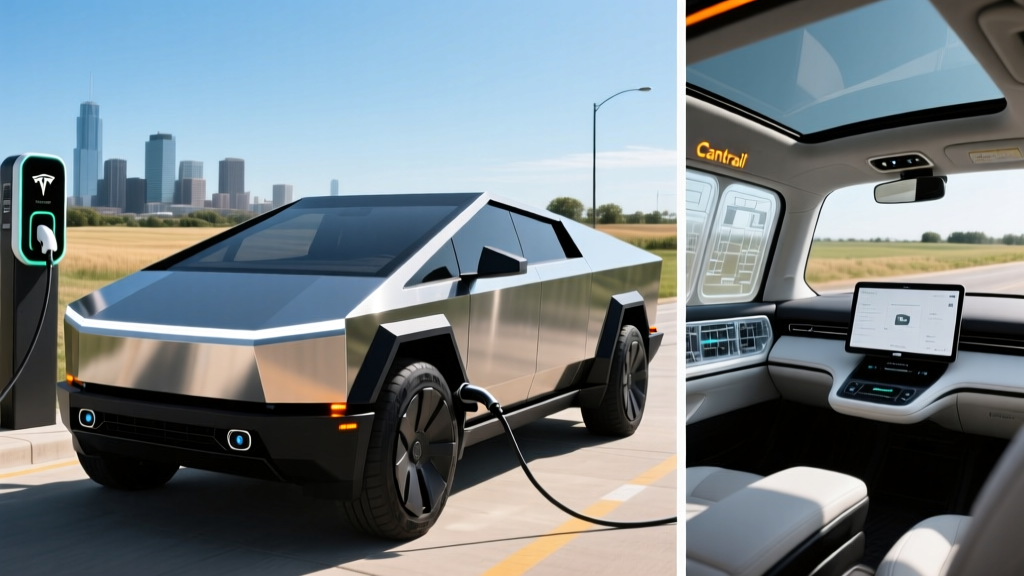
The Cybertruck charges on Tesla's NACS (North American Charging Standard) connector natively. With Tesla opening the Supercharger network to other brands, Cybertruck owners benefit from the broadest proprietary fast-charging footprint in the US — over 20,000 Supercharger stalls nationwide as of early 2026.
The charging curve is the critical detail most spec sheets omit. At a V4 Supercharger, the Cybertruck pulls a peak 250 kW only when the battery is preconditioned and at a low state of charge (below 15%). Between 15% and 55%, it sustains roughly 180–210 kW. Above 60%, the rate drops progressively; the final push from 80% to 100% can take as long as the 10–80% portion. For road trips, the practical strategy is charging from 10% to 80% and moving on — a roughly 28-minute stop.
For home charging, a hardwired Tesla Wall Connector on a 60-amp circuit delivers 48 amps (11.5 kW), adding about 30 miles of range per hour. Given the Cybertruck's 123 kWh pack, a full overnight charge is realistic. Buyers should budget $800–$2,000 for a professional Level 2 installation depending on panel capacity and conduit run length — and possibly $2,000–$5,000 more if a panel upgrade to 200A service is needed.
Performance and Drivetrain
| Spec | AWD (Dual-Motor) | Cyberbeast (Tri-Motor) |
|---|---|---|
| Horsepower | 600 hp | 845 hp |
| 0–60 mph | 3.9 seconds | 2.6 seconds |
| Top Speed | 130 mph | 130 mph |
| Drivetrain | Dual-motor AWD | Tri-motor AWD (torque vectoring rear) |
| Towing Capacity | 11,000 lbs | 11,000 lbs |
| Payload Capacity | 2,500 lbs | 2,500 lbs |
Even the "base" AWD Cybertruck hits 60 mph in 3.9 seconds — faster than most sports sedans and absurd for a 6,600-pound pickup. The Cyberbeast's 2.6-second run puts it in hypercar territory, though sustaining that acceleration drains the battery at an alarming rate.
The steer-by-wire system eliminates the mechanical connection between the yoke (or optional round wheel, now available) and the front wheels. It enables a variable steering ratio: just 340 degrees lock-to-lock at low speeds (no hand-over-hand maneuvering in parking lots) and a more relaxed ratio at highway speed. The system takes roughly a week of daily driving to internalize. Most owners either love it or tolerate it; few go back to conventional steering willingly.
The 48-volt electrical architecture — a first for a mass-production vehicle — reduces wiring harness weight by roughly 70% and enables higher-power accessories. It also means that any 12V aftermarket accessories require a step-down converter.
Cantrail Assembly and Build Quality in 2026
The term "cantrail" refers to the structural rail along the upper edge of a vehicle's body where the roof meets the side panels. On the Cybertruck, this area is uniquely challenging because the stainless-steel exoskeleton panels are not stamped in conventional dies — they are laser-cut, bent on CNC press brakes, and joined primarily by laser welding rather than spot welding.
Early-production Cybertrucks (late 2023 through mid-2024) drew widespread criticism for inconsistent panel gaps along the cantrail and bed-to-cab junction. Some owners reported gaps varying by 3–5 mm on a single vehicle side. Water ingress concerns and wind noise at highway speed were documented on owner forums and in NHTSA complaints.
As of the 2026 model year, Tesla has implemented several production-line refinements at Giga Texas:
- Improved fixturing: Robotic holding fixtures now apply more consistent clamping force during laser welding, reducing gap variance to approximately ±1 mm.
- Sealant application: A revised urethane sealant path along the cantrail-to-bed join improves water resistance and reduces high-speed wind noise.
- Bed rail alignment: The composite bed liner and steel bed rails are now assembled in a sub-assembly station before mating to the cab, improving fit consistency.
Is the 2026 Cybertruck's build quality on par with a Lexus or even a well-built Ford F-150? No. Stainless steel's spring-back characteristics and the exoskeleton design's inherent tolerance challenges mean that minor cosmetic variations are still visible if you look for them. But the gap (literal and figurative) between early and current production is substantial. Buyers inspecting a 2026 delivery should still check the cantrail seams, door shut lines, and tailgate alignment before signing off.
Interior, Tech, and Cargo Space
The Cybertruck's cabin follows Tesla's minimalist playbook: a single 18.5-inch touchscreen dominates the dash, a yoke or round steering wheel (no stalks — turn signals are button-operated on the wheel), and a rear 9.4-inch touchscreen for passengers. The front trunk (frunk) offers approximately 7.1 cubic feet of lockable storage — useful for charging cables and groceries.
Key interior dimensions:
- Front legroom: 41.2 inches
- Rear legroom: 38.5 inches (adequate for adults, though the sloping roofline limits headroom for taller passengers)
- Bed length: 6 feet (72 inches) with the tonneau cover closed; the "vault" can accommodate 4×8 sheets of plywood with the tailgate down
- Bed volume: Approximately 67 cubic feet
- Cargo payload: 2,500 lbs rated
The motorized tonneau cover is rated to support 300 lbs of distributed weight — Tesla demonstrated people standing on it. The bed features integrated 120V and 240V outlets (powered by the truck's battery), enabling job-site tool use or campsite power without a generator. This is a genuine differentiator for tradespeople and overlanders.
On the technology front, the Cybertruck ships with Autopilot standard (adaptive cruise control, lane centering, automatic emergency braking). Full Self-Driving (Supervised) is available as a $8,000 add-on or $99/month subscription. FSD remains an SAE Level 2 driver-assistance system — the driver must remain attentive, keep hands on the wheel (or apply light torque with the yoke), and be prepared to take over at any moment. It is not autonomous driving.
Pricing, Trims, and Federal Tax Credit Eligibility
| Trim | Base MSRP | §30D Federal Credit (max) | Est. Net Price* |
|---|---|---|---|
| AWD (Dual-Motor) | $79,990 | Up to $7,500 | ~$72,490 |
| Cyberbeast (Tri-Motor) | $99,990 | Up to $7,500 | ~$92,490 |
*Net price assumes full §30D credit eligibility. Actual credit depends on buyer income, vehicle MSRP cap compliance, battery component sourcing, and critical mineral requirements. Consult a tax professional and verify current rules at IRS.gov.
The Cybertruck's AWD trim at $79,990 falls under the IRS §30D MSRP cap for pickup trucks ($80,000). The Cyberbeast at $99,990 exceeds this cap and does not qualify for the federal tax credit — a significant financial consideration that many buyers overlook.
For the AWD trim, full $7,500 credit eligibility requires:
- Buyer income limits (MAGI): $150,000 single / $225,000 head of household / $300,000 joint filers
- Battery component sourcing: A percentage of battery components must be manufactured or assembled in North America (thresholds increase annually under the Inflation Reduction Act)
- Critical mineral sourcing: A percentage of critical minerals must be sourced from the US or free-trade-agreement partners
- Point-of-sale transfer: As of 2024, buyers can transfer the credit to the dealer at purchase, reducing the upfront cost rather than waiting for a tax refund
Tesla's 4680 cells are manufactured at Giga Texas, and the company has made significant progress in North American battery component sourcing. However, critical-mineral compliance (lithium, nickel, cobalt supply chains) remains complex and subject to change. Always verify current eligibility before purchase.
Pros and Cons: The Honest Assessment
- Class-leading acceleration (2.6s Cyberbeast, 3.9s AWD) in the electric pickup segment
- Integrated 120V/240V bed outlets — no generator needed for job sites or camping
- Motorized tonneau cover with 300-lb load rating
- Stainless-steel body resists dents and corrosion; no paint to chip
- Access to Tesla Supercharger network (largest US DC fast-charging footprint)
- Steer-by-wire enables ultra-tight low-speed maneuvering
- Improved cantrail assembly and panel consistency in 2026 production
- Efficiency trails Rivian R1T and F-150 Lightning (~50 MPGe vs ~70 MPGe)
- Cyberbeast trim exceeds $80K MSRP cap — no federal tax credit
- Real-world highway range drops to ~285–310 miles (well below 340 EPA)
- Build quality improved but still inconsistent vs. legacy OEMs
- Button-operated turn signals (no stalk) frustrate some drivers
- Rear-seat headroom limited for passengers over 6'1"
- Stainless-steel body panels are difficult and expensive to repair if damaged
- Large footprint (231.7" long, 80.3" wide with mirrors) complicates urban parking
Who Should Buy the Cybertruck — and Who Shouldn't
Buy it if: You need a full-size electric pickup for job-site power delivery (120V/240V bed outlets), you value access to the Supercharger network for frequent road trips, you want sports-car acceleration in a truck, and you accept that build quality won't match a Lexus. The AWD trim at $79,990 is the value play — it qualifies for the tax credit, delivers 340 miles EPA, and still hits 60 in 3.9 seconds.
Look elsewhere if: Maximum efficiency and range are your priorities (Rivian R1T Dual-Motor is more efficient), you need best-in-class rear-seat comfort (Ford F-150 Lightning offers more rear headroom), or you require a conventional steering wheel and turn-signal stalk. The Chevrolet Silverado EV 4WT offers a larger bed and more traditional pickup ergonomics for commercial fleet buyers.
Frequently Asked Questions
What is the real-world range of the 2026 Cybertruck?
The AWD dual-motor Cybertruck carries a 340-mile EPA rating, but expect 285–310 miles in real-world highway driving at 70 mph in moderate temperatures. In cold weather (below 30°F), range can drop to 230–260 miles due to battery chemistry limitations and increased cabin heating demand. The tri-motor Cyberbeast rates at 320 miles EPA with similar proportional reductions in real-world use.
How fast does the Cybertruck charge on DC fast chargers and at home?
On a Tesla V4 Supercharger, the Cybertruck peaks at 250 kW and charges from 10% to 80% in approximately 28 minutes when the battery is preconditioned. The charge curve tapers significantly above 60% SoC. At home on a Level 2 Tesla Wall Connector (48A / 11.5 kW), you'll add about 30 miles of range per hour, or a full charge in roughly 12–13 hours. A standard NEMA 14-50 outlet at 40 amps (9.6 kW) adds about 25 miles per hour.
Does the Cybertruck qualify for the $7,500 federal EV tax credit?
The AWD trim at $79,990 MSRP falls under the §30D pickup truck cap of $80,000 and is potentially eligible for up to $7,500 — subject to buyer income limits ($300K joint / $150K single MAGI), battery component sourcing, and critical-mineral requirements. The Cyberbeast at $99,990 exceeds the MSRP cap and does not qualify. Always verify current rules at IRS.gov and consult a tax professional.
Is the Cybertruck worth buying over the Rivian R1T or Ford F-150 Lightning?
It depends on your priorities. The Cybertruck wins on acceleration, Supercharger access, and integrated bed power. The Rivian R1T offers better efficiency (~70 MPGe), a more refined interior, and a quad-motor option with tank turns. The Ford F-150 Lightning provides a more conventional pickup experience, better rear-seat space, and a lower starting price. For buyers who tow frequently and road-trip often, the Cybertruck's Supercharger network access is a meaningful advantage. For daily commuters prioritizing range and comfort, the R1T or Lightning may be more practical.
Has Tesla fixed the Cybertruck's build-quality issues?
The 2026 model year shows measurable improvement in cantrail assembly, panel-gap consistency, and sealant application compared to early 2024 production. Gap variance has decreased from 3–5 mm to approximately ±1 mm. However, the stainless-steel exoskeleton design inherently presents tolerance challenges that conventional stamped-steel trucks don't face. Buyers should still inspect delivery vehicles carefully before acceptance.
What is the Cybertruck's battery warranty?
Tesla covers the Cybertruck's battery and drive unit for 8 years or 120,000 miles (whichever comes first), with a minimum 70% capacity retention threshold. The vehicle's limited warranty covers 4 years or 50,000 miles. This is competitive with Rivian's 8-year/120,000-mile battery warranty and Ford's 8-year/100,000-mile coverage for the Lightning.