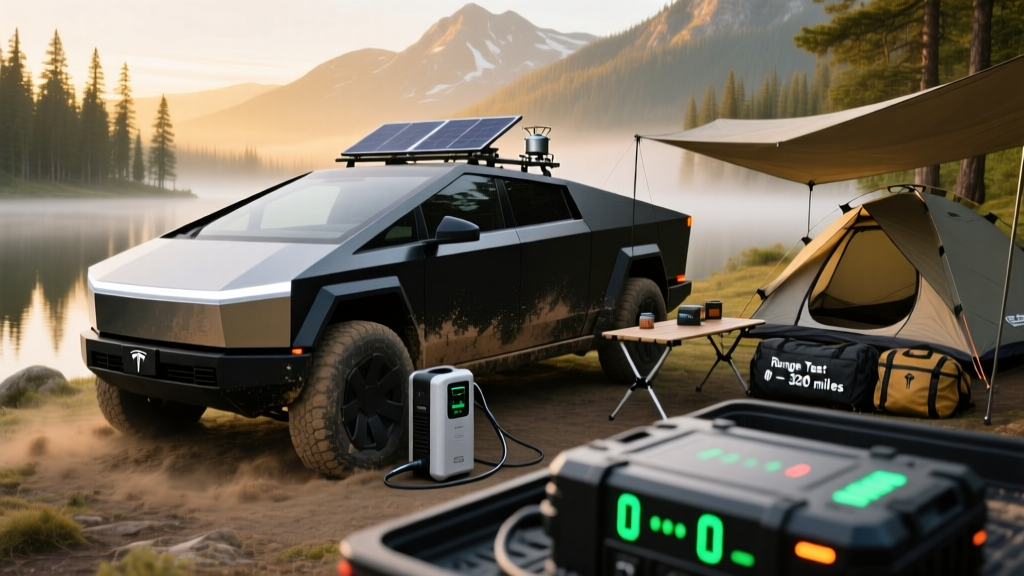
Using a 7,000-pound electric pickup truck as a basecamp sounds counterintuitive until you spend a night in the Tesla Cybertruck. The angular stainless-steel exoskeleton, 2,400-watt bed outlets, and available Powershare vehicle-to-home capability transform this EV from a daily driver into a rolling power station. But before you load up the rooftop tent and head for the backcountry, you need hard data on how camping affects range, where you can actually charge off-grid, and whether the Cybertruck's utility holds up when the pavement ends.
This guide covers the 2025 Tesla Cybertruck lineup (AWD and Cyberbeast trims) through the lens of camping and overlanding, combining official EPA figures with real-world range expectations, charging logistics at remote campsites, and the practical pros and cons of using the Cybertruck as your adventure rig.
2025 Tesla Cybertruck: Core Specs at a Glance
| Spec | Cybertruck AWD | Cyberbeast |
|---|---|---|
| EPA Range | 340 miles | 320 miles |
| Battery Capacity (usable) | ~123 kWh (NMC) | ~123 kWh (NMC) |
| Drivetrain | Dual-Motor AWD | Tri-Motor AWD |
| Horsepower | 600 hp | 845 hp |
| 0-60 mph | 4.1 seconds | 2.6 seconds |
| Max DC Fast Charge | ~350 kW peak | ~350 kW peak |
| 10-80% DC Fast Charge | ~15 minutes | ~15 minutes |
| Level 2 Home Charge | 11.5 kW (~44 mi/hr) | 11.5 kW (~44 mi/hr) |
| Efficiency | ~54 MPGe / ~58 kWh/100mi | ~50 MPGe / ~63 kWh/100mi |
| Towing Capacity | 11,000 lbs | 11,000 lbs |
| Payload Capacity | 2,500 lbs | 2,500 lbs |
| Bed Length | 6 ft (72 in) | 6 ft (72 in) |
| Battery/Powertrain Warranty | 8 yr / 120,000 mi | 8 yr / 120,000 mi |
| Base MSRP | $79,990 | $99,990 |
The Cybertruck's 4680-format NMC (nickel manganese cobalt) battery pack is among the largest in any consumer EV. That 123 kWh usable capacity is what makes Cybertruck camping viable — it provides both driving range and a substantial energy reserve for powering campsite devices through the bed's 120V and 240V outlets.
Real-World Range When Loaded for Camping
Real-World Camping Load: Expect 230–280 miles with a loaded bed, rooftop tent, and 2-3 passengers at highway speeds (70-75 mph). Cold weather (below 40°F) can push range down to 200–240 miles under the same conditions.
The gap between EPA estimates and actual camping range comes from physics, not a Cybertruck-specific flaw. The truck's slab-sided aerodynamics already produce a high drag coefficient. Add a rooftop tent (even a low-profile wedge-style), bed cargo, and passengers, and you're increasing both weight and frontal drag area significantly.
According to fueleconomy.gov, the Cybertruck AWD achieves approximately 54 MPGe combined. In our highway driving experience at sustained 75 mph, efficiency drops to roughly 60-65 kWh/100mi — meaning that 123 kWh battery delivers closer to 190-205 miles of pure highway range even without cargo. Load it up for a camping trip and you're looking at 180-200 miles of comfortable highway range before needing to find a charger.
This is the single biggest planning factor for Cybertruck camping: you must map your route around DC fast chargers spaced no more than 150 miles apart when fully loaded. Apps like A Better Routeplanner (ABRP) let you input vehicle load, elevation gain, and temperature for more accurate predictions.
Cold Weather Impact on Range
The Cybertruck uses a heat pump for cabin climate control, which is more efficient than resistive heating. However, battery chemistry still suffers in cold temperatures. Expect 20-30% range loss in sub-freezing conditions, compounded by the energy cost of warming the battery pack. Preconditioning the battery while still plugged in at home or at a hotel charger is essential before heading into cold backcountry routes.
Charging the Cybertruck at Campsites and on the Road
Charging logistics define whether Cybertruck camping is practical or frustrating. Here's the breakdown by charging level:
| Charging Level | Power | Rate (approx.) | Camping Use Case |
|---|---|---|---|
| Level 1 (120V standard outlet) | ~1.4 kW | ~5 miles/hour | Emergency trickle at campgrounds with shore power; adds ~50 miles overnight |
| Level 2 (240V, 48A) | 11.5 kW | ~44 miles/hour | Best option at RV parks with 50-amp service; full charge in ~10 hours |
| DC Fast Charge (Supercharger) | Up to 350 kW peak | ~15 min (10-80%) | Road-trip charging; Supercharger network covers most highway corridors |
The Charge Curve Reality
Tesla advertises a peak DC fast-charge rate of approximately 350 kW on V4 Superchargers. However, that peak is sustained only briefly at low states of charge (roughly 10-25% SoC). The charge curve tapers progressively — by 50% SoC, you're likely seeing 150-200 kW, and above 80% SoC, speeds drop below 75 kW. The 10-80% time of roughly 15 minutes assumes you arrive at a low state of charge at a V4 stall. At older V3 Superchargers (250 kW max), expect 20-25 minutes for the same 10-80% session.
RV Parks and Campground Charging
Many established campgrounds and RV parks offer 50-amp (240V) electrical hookups. With the Cybertruck's Mobile Connector and a NEMA 14-50 adapter, you can pull up to 48 amps (11.5 kW), adding roughly 44 miles of range per hour. A full overnight charge (10 hours) at an RV site can restore 300+ miles — enough for most weekend camping loops.
The challenge is that dispersed camping (BLM land, national forest roads, boondocking) offers zero charging infrastructure. If you're heading to a remote site 100 miles from the nearest Supercharger, plan to arrive with at least 60% battery to ensure a comfortable return trip. Solar trickle charging is not viable for a 123 kWh battery — even a 400W portable solar panel produces roughly 1.5-2 kWh per day in ideal conditions, adding maybe 3-4 miles of range.
Tesla Supercharger Network Advantage
As of 2025, the Cybertruck uses the NACS (North American Charging Standard) connector natively and has full access to the Tesla Supercharger network, which now exceeds 6,000 stations in North America. For camping trips along established highway corridors, Supercharger coverage is excellent. The gaps appear on forest service roads, remote desert routes, and in national parks — exactly where camping often happens.
Campsite Power: Using the Cybertruck as a Generator
This is where the Cybertruck genuinely shines for camping. The truck's Powershare system provides up to 2,400 watts continuous from the bed-mounted 120V outlets and up to 9.6 kW from the 240V outlet (with the optional Powershare Pro adapter). That 123 kWh battery can theoretically power campsite devices for days.
What 123 kWh Actually Powers at Camp
- Portable fridge/freezer (60W average): ~2,000 hours (83 days) — effectively unlimited
- LED camp lighting (20W): ~6,000 hours — unlimited for practical purposes
- Laptop charging (65W, 2 hours/day): ~940 charge cycles
- Electric camp stove/induction burner (1,500W): ~80 hours of cooking
- CPAP machine (40W, 8 hours/night): ~380 nights
- Electric space heater (1,500W): ~80 hours — but this drains range significantly if you also need to drive
The practical implication: for a 3-day camping trip, you can comfortably run a fridge, lights, device charging, and an induction cooktop without meaningful impact on your driving range. Budget approximately 5-8 kWh per day for moderate campsite use, which translates to roughly 10-15 miles of lost driving range over a weekend.
Vehicle-to-Home (V2H) Capability
Tesla's Powershare Home integration (requires the Wall Connector and Powershare Pro gateway) allows the Cybertruck to back-feed up to 9.6 kW to your home during outages. While not a camping feature per se, it means your camping rig doubles as a home backup battery — a unique value proposition that justifies the truck's premium for some buyers.
Cargo, Bed, and Interior Space for Camping Gear
The Cybertruck's 6-foot bed is shorter than the 6.5- or 8-foot beds found on full-size pickups like the Ford F-150 Lightning or Rivian R1T. This matters for camping gear. Here's what fits and what doesn't:
Bed Dimensions and Capacity
- Bed length: 72 inches (with tailgate closed)
- Bed width (between wheel wells): ~48 inches
- Payload capacity: 2,500 lbs
- Powered tonneau cover: Standard, locks and seals — usable as a dry storage area
The powered retractable tonneau is a genuine camping asset. Closed, it creates a secure, weather-resistant storage area for gear. Open, the bed accommodates a standard 6-foot truck-bed tent or a compact rooftop tent mounted to the bed rails. The 2,500-lb payload is more than sufficient for loaded camping setups, including a rooftop tent (typically 120-180 lbs), bed cargo, and passengers.
Interior and Passenger Space
The Cybertruck seats up to six (three-across front bench on some configurations, or five with front buckets). Rear legroom measures approximately 36 inches — adequate for adults on a day trip but tight for multi-day overlanding where rear passengers also manage gear. Behind the rear seats, there's limited in-cabin storage compared to an SUV, so most camping gear will ride in the bed.
The front trunk (frunk) offers roughly 7 cubic feet of lockable storage — useful for securing valuables at a campsite or storing tools and recovery gear separately from the main bed cargo.
Off-Road Capability for Backcountry Camping
The Cybertruck AWD and Cyberbeast both feature adaptive air suspension with up to 16 inches of ground clearance in Extract Mode (12.9 inches in standard ride height). Approach, departure, and breakover angles are competitive for light off-road use, though the truck's 6,800+ lb curb weight limits its capability in soft sand, deep mud, and tight technical trails.
What the Cybertruck Handles Off-Road
- Forest service roads and graded dirt roads: Excellent
- Moderate rock crawling with air suspension raised: Capable
- Snow-covered mountain passes: Strong (AWD traction, weight over drive axles)
- Deep sand and washouts: Poor (weight works against flotation)
- Narrow single-track trails: Limited (83.5-inch width without mirrors)
For most established campgrounds and dispersed camping along maintained forest roads, the Cybertruck's off-road capability is more than sufficient. If your camping style involves technical trails, the Rivian R1T (with its shorter wheelbase and lighter weight) may be a better fit.
Pricing, Tax Credits, and Ownership Costs
| Trim | Base MSRP | Federal §30D Credit | Effective Price (if eligible) |
|---|---|---|---|
| Cybertruck AWD | $79,990 | See eligibility below | Varies |
| Cyberbeast | $99,990 | See eligibility below | Varies |
Federal EV Tax Credit: §30D Eligibility for Cybertruck
- MSRP Cap: Pickup trucks must have an MSRP at or below $80,000 to qualify. The Cybertruck AWD ($79,990) meets this threshold. The Cyberbeast ($99,990) does NOT qualify.
- Buyer Income Limits: Modified AGI must not exceed $300,000 (joint filers), $225,000 (head of household), or $150,000 (individual).
- Battery Sourcing: The vehicle must meet critical minerals and battery component requirements set by the IRS under §30D. Tesla's supply chain has shifted to meet these rules for many configurations, but eligibility can change as sourcing evolves. Always verify current eligibility on the IRS qualified vehicle list before purchasing.
- Point-of-Sale Transfer: As of 2024, eligible buyers can transfer the credit to the dealer at purchase, reducing the upfront price rather than waiting for a tax refund.
In practice, the Cybertruck AWD at $79,990 may qualify for up to $7,500 in federal tax credits if the buyer meets income requirements and the specific vehicle's battery sourcing satisfies current IRS rules. The Cyberbeast at $99,990 exceeds the MSRP cap and does not qualify for the federal credit regardless of buyer income.
Always confirm eligibility with your tax professional and the IRS §30D guidance before relying on the credit in your purchase decision. Rules and qualified-vehicle lists are updated periodically.
Insurance and Depreciation Considerations
The Cybertruck carries higher-than-average insurance premiums due to its stainless-steel body (expensive to repair), high performance, and relatively limited collision-repair network. Expect annual insurance costs of $2,500-$4,000+ depending on your profile and location. Depreciation data is still limited given the truck's 2023 launch, but early resale values have softened from initial markups. Budget accordingly if planning a 3-5 year ownership cycle.
Pros and Cons: Cybertruck as a Camping Platform
Pros
- Massive 123 kWh battery powers campsite for days without range impact
- 2,400W bed outlets eliminate the need for a separate gas generator
- Supercharger network provides reliable road-trip charging infrastructure
- 11,000-lb towing capacity handles camping trailers and boat trailers
- Powered tonneau cover secures gear without aftermarket accessories
- Air suspension provides up to 16 inches of ground clearance for rough roads
- V2H capability doubles the truck as a home backup power source
Cons
- Real-world loaded range drops to 180-220 miles on highway — requires careful route planning
- 83.5-inch width limits access to narrow forest trails and tight campsite roads
- 6-foot bed is shorter than competing pickups — limits larger camping setups
- 6,800+ lb weight is a liability in sand, mud, and soft terrain
- No native support for aftermarket camper shells (limited third-party options as of 2025)
- Cyberbeast exceeds $80K MSRP cap — no federal tax credit on top trim
- High insurance premiums add to total ownership cost
Who Should Use the Cybertruck for Camping?
Best for: Weekend warriors who camp at established sites with electrical hookups or within 100-150 miles of Supercharger corridors. The Cybertruck excels as a basecamp power source for car camping — running fridges, induction stoves, lighting, and electronics without a noisy gas generator. It's also ideal for tailgating, outdoor events, and as a dual-purpose daily driver / adventure vehicle.
Look elsewhere if: Your camping style involves extended off-grid overlanding (7+ days without charging access), technical backcountry trails, or remote desert/mountain routes far from any charging infrastructure. For those use cases, the Rivian R1T (better trail capability, 90 miles of range added per hour on Level 2) or a traditional PHEV/ICE truck may be more practical.
Frequently Asked Questions
What is the real-world range of the Cybertruck when loaded for camping?
With a loaded bed, rooftop tent, and highway driving at 70-75 mph, expect 230-280 miles from the AWD trim and 210-260 miles from the Cyberbeast. In cold weather (below 40°F), subtract another 20-30%. Plan routes with chargers no more than 150 miles apart when fully loaded for a comfortable buffer.
How fast does the Cybertruck charge at home and on the road?
On a DC fast charger (V4 Supercharger), the Cybertruck peaks at ~350 kW and charges from 10-80% in approximately 15 minutes, though the charge curve tapers significantly above 80%. At home on Level 2 (240V, 48A), it charges at 11.5 kW, adding about 44 miles of range per hour — a full charge takes roughly 10-11 hours.
Does the Cybertruck qualify for the $7,500 federal EV tax credit?
The Cybertruck AWD at $79,990 MSRP is below the $80,000 truck cap and may qualify if the buyer meets income limits ($300K joint / $150K individual) and the vehicle's battery sourcing meets current IRS §30D requirements. The Cyberbeast at $99,990 does NOT qualify due to the MSRP cap. Always verify on the IRS qualified vehicle list before purchasing.
Can I run camping appliances directly from the Cybertruck?
Yes. The Cybertruck's Powershare system provides up to 2,400 watts continuous from the 120V bed outlets — enough for portable fridges, induction cooktops, lights, CPAP machines, and device charging. With a 123 kWh battery, you can run moderate campsite loads for a week without meaningfully impacting driving range.
Is the Cybertruck better for camping than the Rivian R1T or F-150 Lightning?
It depends on your camping style. The Cybertruck has the largest battery (123 kWh vs. ~141 kWh for the R1T Max Pack or ~131 kWh for the Lightning Extended Range), but its heavier weight and wider body reduce efficiency and trail capability. The R1T is more capable on technical trails and offers a more mature camping accessory ecosystem. The F-150 Lightning has a longer bed (5.5 or 6.5 ft depending on config) and broader dealer service network. For car camping with shore power access, the Cybertruck's Powershare output is a genuine advantage.
How do I charge the Cybertruck at a remote campsite with no EV infrastructure?
Your best options are: (1) camp at an RV park with 50-amp (240V) service and use the Mobile Connector with a NEMA 14-50 adapter for ~44 miles/hour of charging; (2) plan a mid-trip Supercharger stop to top up before heading to a dispersed site; (3) use a portable Level 1 (120V) charger on a standard outlet for emergency trickle charging (~5 miles/hour). Solar charging is not practical for meaningful range recovery on a 123 kWh battery.
What's the Cybertruck's warranty coverage for off-road and camping use?
Tesla covers the battery and drive units for 8 years or 120,000 miles (whichever comes first), with a minimum 70% battery capacity retention threshold. The limited vehicle warranty is 4 years or 50,000 miles. Note that damage from off-road use, water submersion beyond rated fording depth, or aftermarket modifications may not be covered. Review Tesla's warranty terms before subjecting the truck to extreme off-road conditions.