The Tesla Cybertruck was engineered as much for off-grid utility as for on-road performance, and nowhere is that clearer than in its onboard power and climate systems. For overlanders, weekend car-campers, and boondockers, the Cybertruck's combination of a stainless-steel exoskeleton, integrated Powershare outlets, and climate-controlled cabin makes it one of the most capable electric platforms for remote stays. But how much usable energy does it actually provide once you leave the pavement, and what does a multi-night camping trip do to your range budget?
This review evaluates the Cybertruck specifically through the lens of off-grid camping use — covering real-world range under load, Powershare power output, bed and cabin dimensions for sleeping, charging logistics in remote areas, and total ownership cost. We focus on the Dual Motor AWD and Cyberbeast trims, which are the most relevant for overland buyers in 2026.
Tesla Cybertruck Specs at a Glance
| Specification | Dual Motor AWD | Cyberbeast (Tri-Motor) |
|---|---|---|
| EPA Range | 340 miles | 320 miles |
| Battery (usable) | ~123 kWh (NMC) | ~123 kWh (NMC) |
| Peak DC Fast Charge | 250 kW (V3 Supercharger) | 250 kW (V3 Supercharger) |
| 10–80% DC Charge Time | ~30 minutes | ~30 minutes |
| Level 2 Home Charge Rate | 11.5 kW (~34 mi/hr) | 11.5 kW (~34 mi/hr) |
| 0–60 mph | 3.9 seconds | 2.6 seconds |
| Horsepower | 600 hp | 845 hp |
| Drivetrain | Dual Motor AWD | Tri-Motor AWD |
| Towing Capacity | 11,000 lbs | 11,000 lbs |
| MPGe (combined) | 72 MPGe | 69 MPGe |
| Efficiency | 47 kWh/100 mi | 49 kWh/100 mi |
| Base MSRP (2025) | $79,990 | $99,990 |
| Battery/Drive Unit Warranty | 8 yr / 120,000 mi | 8 yr / 120,000 mi |
Real-World Range for Overland and Camping Trips
Real-World Highway (70 mph): ~260–285 miles
Off-Road / Low-Speed Trail: ~290–320 miles (regen-heavy driving recovers energy)
Cold Weather (below 32°F): Expect 20–30% range reduction; ~220–260 miles on the highway
The Cybertruck's angular stainless-steel body generates more aerodynamic drag than a conventional rounded pickup, which hits efficiency hard at sustained highway speeds. In real-world highway testing at 70–75 mph, owners consistently report 260–285 miles of range on the Dual Motor trim before needing to charge. At lower off-road speeds (15–35 mph on forest service roads), efficiency improves significantly because regenerative braking recovers energy on descents and the aero penalty drops.
For a typical camping scenario — driving 150 miles on the highway to a trailhead, then 20 miles of dirt road — plan for roughly 180–200 miles of range consumed one way. That leaves enough buffer for a return trip without needing a charge at the campsite, but multi-day trips with Powershare usage will require careful energy budgeting.
If you're running Cybertruck camping mode overnight (climate control maintaining 65–70°F in the cabin), expect to use roughly 1–2% of the battery per hour depending on outside temperature. Over an 8-hour sleep cycle, that's 8–16% of your total battery — approximately 12–20 kWh, or the equivalent of 27–55 miles of driving range. In mild weather (50–65°F), energy draw drops to the lower end of that range.
Powershare: The Cybertruck's Built-In Generator
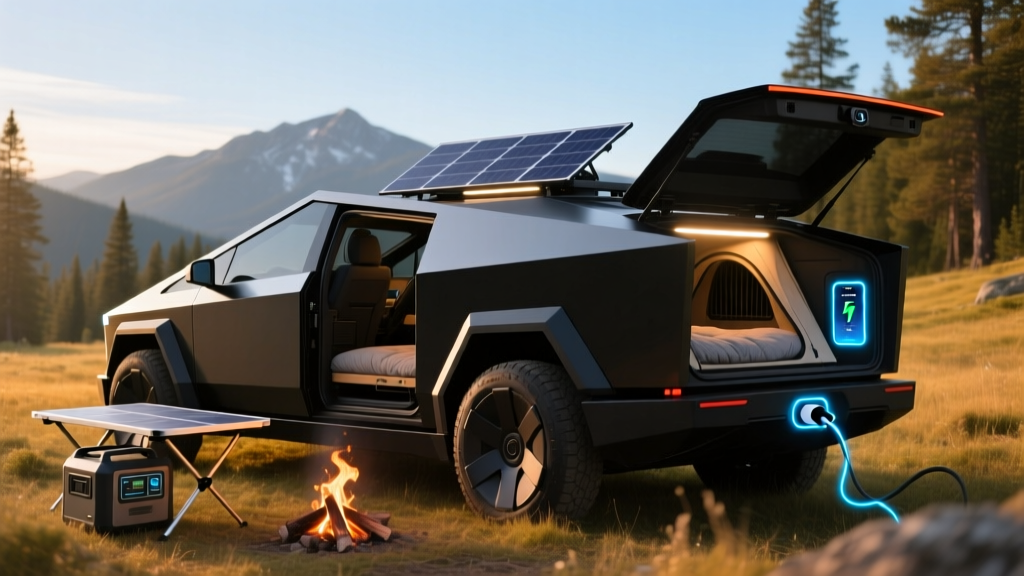
Tesla's Powershare system turns the Cybertruck's 123 kWh battery into a mobile power station, which is the centerpiece of its camping capability. The truck offers both 120V and 240V outlets:
- Bed outlets (120V): Two 20A NEMA 5-20 receptacles providing up to 2.4 kW continuous (9.6 kW peak)
- Cabin USB-C: Multiple USB-C ports (up to 65W each) for laptops and devices
- 240V outlet (bed): NEMA 14-50 receptacle providing up to 11.5 kW continuous — enough to run power tools, a full-size refrigerator, or supply backup power to a home panel
For camping, the 120V bed outlets are the most practical. You can run an induction cooktop (1,800W), a portable refrigerator/freezer (60–80W average), LED camp lighting (20–50W), and charge laptops and cameras simultaneously — all well within the 2.4 kW continuous output. A typical evening of cooking, lighting, and device charging might consume 3–5 kWh, which is only 2.5–4% of the total battery.
The 240V NEMA 14-50 outlet opens up heavier-duty applications: running a welder at a remote job site, powering an air compressor for trail repairs, or connecting to a home transfer switch for emergency backup during outages. At 11.5 kW, the Cybertruck can sustain essential home circuits for roughly 3–5 days depending on load.
Charging the Cybertruck: Home, Supercharger, and Remote Options
| Charging Method | Power (kW) | Miles Added per Hour | Notes |
|---|---|---|---|
| Level 1 (120V household) | ~1.4 kW | ~3 mi/hr | Emergency only; full charge takes 4+ days |
| Level 2 (240V / 48A Wall Connector) | 11.5 kW | ~34 mi/hr | Full charge overnight (~10–11 hours from 10%) |
| DC Fast Charge (V3 Supercharger) | 250 kW peak | ~1,000 mi/hr (peak) | 10–80% in ~30 min; tapers above 80% |
| DC Fast Charge (V4 Supercharger) | 325 kW peak | ~1,300 mi/hr (peak) | Available at select new stations; verify availability |
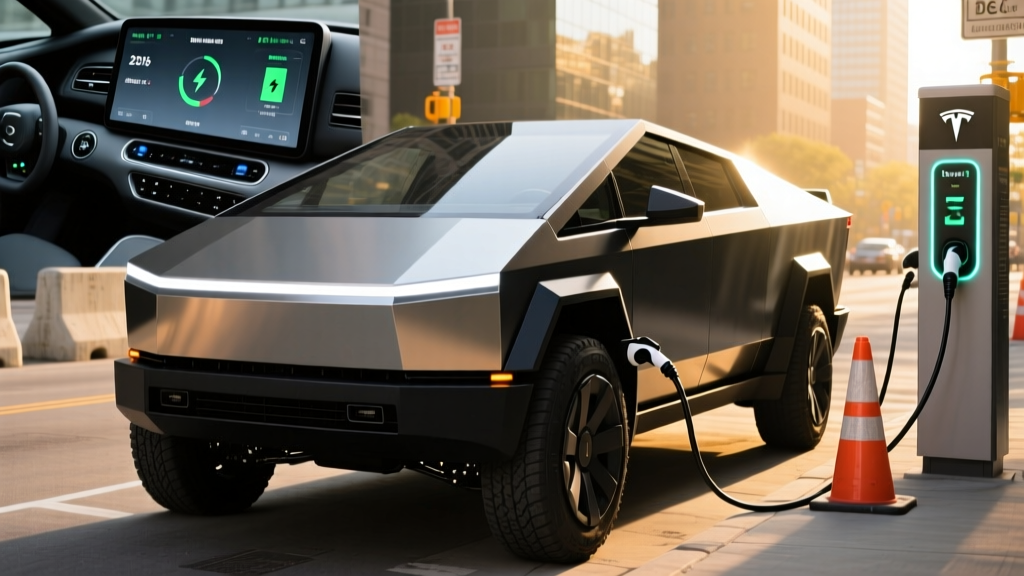
The Cybertruck charges at up to 250 kW on Tesla's V3 Supercharger network, which is widely available across the US. On newer V4 Supercharger stalls (rolling out through 2025–2026), peak speeds reach approximately 325 kW, cutting 10–80% charge time to roughly 20–25 minutes. However, V4 availability is still limited to select corridors.
At home, a Tesla Wall Connector on a 60A circuit delivers 11.5 kW, adding about 34 miles of range per hour. A full charge from near-empty takes 10–11 hours — plan for overnight charging on a dedicated 240V/60A circuit. Installation costs for a home Level 2 setup typically range from $800 to $2,500 depending on panel proximity and local permitting, according to Tesla's home charging guidelines.
For remote camping trips far from Superchargers, the Cybertruck's NACS (North American Charging Standard) port is now compatible with non-Tesla DC fast chargers at networks like Electrify America and EVgo using Tesla's included adapter. This expands your charging options significantly when exploring national forests or BLM land in the American West.
Preconditioning tip: Always navigate to a Supercharger using the truck's built-in routing. This activates battery preconditioning — warming or cooling the pack to optimal temperature for faster charging. Skipping preconditioning can add 5–10 minutes to your 10–80% session, especially in cold weather.
Cabin, Bed, and Sleeping Arrangements
The Cybertruck's 6-foot bed (6' × 4' between the wheel wells) and vault-like tonneau cover create a weatherproof storage area, but the bed itself isn't flat enough for sleeping without a platform. Most Cybertruck campers use one of these configurations:
- Bed platform with mattress: A custom plywood or aluminum platform raises the sleeping surface above the wheel wells, creating a flat 72" × 48" sleeping area. Combined with the powered tonneau cover, this creates a secure, enclosed sleeping pod.
- Cabin sleeping: With the front seats folded forward, the cabin offers a roughly 6-foot flat surface. Tighter for two adults but viable for solo campers. The climate system runs quietly overnight in camping mode.
- Rooftop tent: The Cybertruck's bed rails support rooftop tent mounts, though the truck's height (75.7 inches without accessories) means you'll need a step or ladder. This is the most spacious option for two-plus campers.
Interior passenger space is generous for a midsize truck: front legroom measures 41.5 inches and rear legroom comes in at 38.2 inches. Rear seats fold flat to expand interior cargo volume. The frunk (front trunk) adds approximately 7 cubic feet of lockable, weatherproof storage — ideal for food, cameras, or gear you want to keep separate from the bed.
Total bed cargo volume with the tonneau closed is approximately 54.9 cubic feet. The bed's 2,500-pound payload capacity easily handles camping gear, coolers, portable kitchens, and overland accessories.
Camping Mode: How Tesla's Climate System Works Off-Grid
When you activate Camping Mode via the touchscreen, the Cybertruck maintains a set cabin temperature continuously, keeps the USB ports powered, and leaves the touchscreen on for media playback. The heat pump system (standard on all Cybertruck trims) is significantly more efficient than resistive heating, drawing roughly 1–3 kW depending on the temperature differential between inside and outside.
In moderate conditions (50°F outside, 68°F inside), camping mode consumes approximately 1.2–1.5 kWh per hour. Over an 8-hour night, that totals 10–12 kWh — roughly 8–10% of the battery. In extreme cold (20°F or below), consumption can climb to 2.5–3.5 kWh per hour, using 20–28 kWh overnight (16–23% of the battery).
The Cybertruck's cabin air filtration system (HEPA-grade Bioweapon Defense Mode) is a standout feature for camping in dusty, smoky, or pollen-heavy environments. Run it on recirculate mode overnight to keep particulates out of the sleeping area.
Pricing, Trims, and Federal Tax Credit Eligibility
| Trim | Base MSRP | Federal §30D Credit Eligible? | Effective Price (if eligible) |
|---|---|---|---|
| Dual Motor AWD | $79,990 | No — exceeds $80,000 truck MSRP cap | $79,990 |
| Cyberbeast (Tri-Motor) | $99,990 | No — exceeds $80,000 truck MSRP cap | $99,990 |
Under current IRS §30D rules, new clean vehicle tax credits are capped at $80,000 MSRP for trucks, vans, and SUVs. The Cybertruck Dual Motor AWD is priced at $79,990 — technically one dollar under the cap — but destination charges, mandatory options, or trim-level adjustments can push the effective MSRP above the threshold. As of early 2026, Tesla lists the Dual Motor AWD starting at $79,990 before delivery fees. The Cyberbeast at $99,990 does not qualify.
Even if the Dual Motor AWD qualifies on MSRP, buyers must also meet income caps ($150,000 single / $300,000 joint modified AGI) and the vehicle must satisfy critical mineral and battery component sourcing requirements that tighten annually. Check the fueleconomy.gov credit eligibility tool for the most current status before purchasing.
Buyers who don't qualify for the new-vehicle credit may explore the used EV credit (up to $4,000 or 30% of sale price, whichever is less) once Cybertrucks begin appearing on the secondary market. Income caps for the used credit are lower: $75,000 single / $150,000 joint.
Cybertruck vs. Competitors for Camping and Overlanding
How does the Cybertruck stack up against other electric trucks for camping use?
- Ford F-150 Lightning: Offers Pro Power Onboard (up to 9.6 kW), a larger bed, and a lower starting price (~$55,000). Range is lower (240–320 mi EPA depending on battery). Better value for budget-conscious campers, but less off-road ground clearance than the Cybertruck's adaptive air suspension (up to 16 inches).
- Rivian R1T: Purpose-built for adventure with a gear tunnel, camp kitchen accessory, and strong off-road capability. Range up to 420 miles (Max Pack). Starting price is higher (~$80,000+), and onboard power output is lower than the Cybertruck's 240V system. Better for dedicated overlanders who prioritize trail performance.
- Chevrolet Silverado EV: Offers up to 450 miles of range (4WT trim) and competitive power output, but availability and real-world camping accessories are still maturing as of 2026.
The Cybertruck's unique advantage is the combination of high onboard power (11.5 kW 240V), adaptive air suspension for variable ground clearance, stainless-steel body panels that resist trail scratches, and Tesla's Supercharger network for long-distance trip logistics. Its disadvantages are the polarizing design, higher price point, limited rear-seat comfort for extended travel, and a bed that requires aftermarket modification for flat sleeping.
Pros, Cons, and Verdict
Pros
- 11.5 kW 240V Powershare output — class-leading onboard power
- Adaptive air suspension with up to 16" ground clearance for trail access
- Stainless-steel body resists dents, scratches, and corrosion on trails
- 340-mile EPA range (Dual Motor) is strong for an electric truck
- Heat pump makes overnight camping mode energy-efficient
- Supercharger network provides reliable long-distance charging
- HEPA cabin filtration excellent for dusty/smoky environments
- 11,000-lb towing capacity for trailers and boats
Cons
- Highway range drops significantly due to angular aerodynamics (~260–285 mi real-world)
- Bed requires a platform or insert for flat sleeping
- Base price near $80,000; Cyberbeast at $100,000
- Federal tax credit eligibility uncertain due to MSRP cap proximity
- Rear seat comfort is limited for tall adults on long trips
- No Apple CarPlay or Android Auto — Tesla-only infotainment
- Stainless-steel panels show fingerprints and are difficult to wrap or modify
- Service center wait times remain long in some regions
Who the Cybertruck suits best: The Cybertruck is ideal for tech-forward campers and overlanders who need serious onboard power for tools, cooking, and devices, want the security of Tesla's Supercharger network for long approaches to remote areas, and value the adaptive suspension for transitioning between highway comfort and trail clearance. It's less suited for budget-focused buyers, families needing spacious rear seating, or campers who prefer a traditional bed configuration without aftermarket modifications.
Frequently Asked Questions
How long can the Cybertruck run camping mode overnight?
In moderate weather (50°F outside), camping mode uses approximately 10–12 kWh over 8 hours — about 8–10% of the 123 kWh battery. In extreme cold (20°F or below), plan for 20–28 kWh (16–23% of the battery). You can comfortably run camping mode for 2–3 consecutive nights in mild weather without recharging, assuming you aren't also driving extensively.
Can I run an air conditioner or heater from the Cybertruck's bed outlets?
The 120V bed outlets provide 2.4 kW continuous — enough for a small portable AC unit (5,000–8,000 BTU drawing 500–900W) or a space heater on a low setting (1,500W). For larger RV-style air conditioners (13,500+ BTU drawing 1,500–2,000W startup), use the 240V NEMA 14-50 outlet at 11.5 kW to avoid tripping the 120V circuit.
Does the Cybertruck qualify for the $7,500 federal EV tax credit?
The Dual Motor AWD at $79,990 MSRP is technically under the $80,000 truck cap for §30D, but destination fees and options may push it over. The Cyberbeast at $99,990 does not qualify. Additionally, buyers must meet income caps and the vehicle must satisfy critical-mineral and battery-component sourcing rules. Verify current eligibility on fueleconomy.gov before purchasing.
What's the real-world range when towing a camping trailer?
Towing a 5,000-pound travel trailer reduces the Cybertruck's range by approximately 40–50%, bringing effective range down to 160–200 miles depending on speed, terrain, and wind. Towing a lighter teardrop trailer (2,000–3,000 lbs) reduces range by roughly 25–35%. Plan charging stops accordingly and note that not all Supercharger stalls accommodate truck-and-trailer configurations without unhitching.
Is the Cybertruck's adaptive air suspension reliable for rough trails?
The air suspension provides up to 16 inches of ground clearance in Extract Mode and automatically adjusts based on terrain. Early 2024–2025 production models had some reported air suspension issues, but Tesla has issued firmware and hardware updates through 2025–2026. The system is covered under the 8-year/120,000-mile warranty. For extreme rock crawling, a dedicated off-road vehicle remains more capable, but for forest service roads, sand, and moderate trails, the Cybertruck performs well.
How does the Cybertruck handle in snow and ice for winter camping?
The dual- and tri-motor AWD systems provide excellent traction in snow, and the truck's weight (approximately 6,600–6,800 lbs) helps with stability. The heat pump efficiently manages cabin heating without the extreme range penalty that resistive heaters cause. However, expect 20–30% range loss in sustained below-freezing temperatures. Winter tires (the Cybertruck accepts 35-inch all-terrain or dedicated winter tires) significantly improve snow and ice performance over the stock all-season tires.