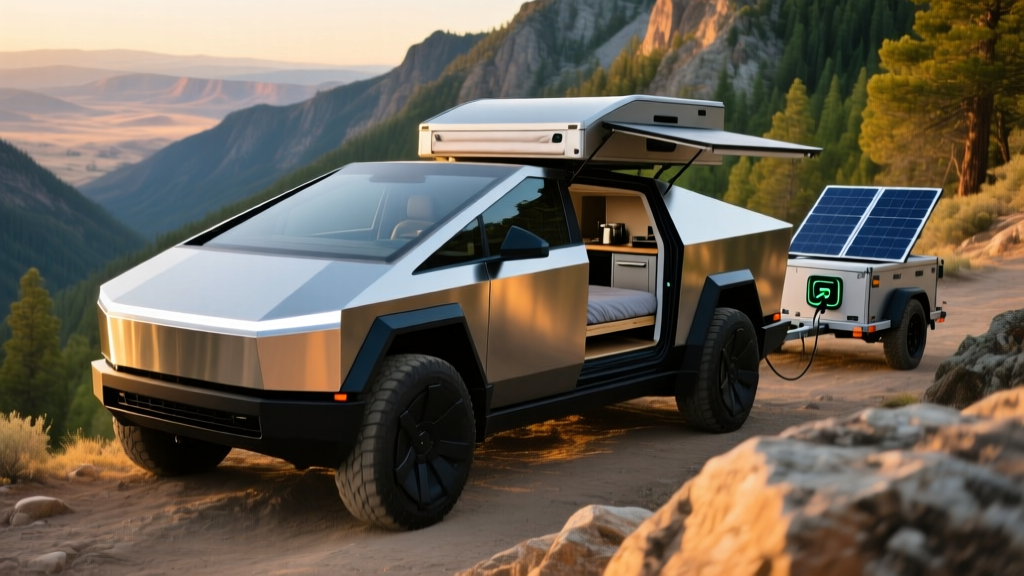
Adding a camper shell to the Tesla Cybertruck is one of the most popular overlanding modifications in the EV truck segment — but bolting a topper onto a stainless-steel, 7,000-pound electric pickup changes its range, efficiency, and charging behavior in ways that gas-truck owners never have to think about. This guide breaks down exactly what happens to the Cybertruck's EPA range, payload, and charging speed when you add a camper shell, and whether the math works for off-grid camping in 2026.
Cybertruck Specs at a Glance: The Overlanding Baseline
Before layering on a camper shell, you need to know what you're starting with. The 2025/2026 Tesla Cybertruck is sold in three trims, all built on an 800-volt architecture with a structural stainless-steel exoskeleton and a 6.5-foot composite bed. Here are the figures that matter for an overland build:
| Spec | Long Range AWD | Cyberbeast (Tri-Motor) |
|---|---|---|
| EPA Range | 340 miles | 320 miles |
| Battery (usable) | ~123 kWh (NMC) | ~123 kWh (NMC) |
| Peak DC Fast Charge | 250 kW (V3 Supercharger) | 250 kW (V3 Supercharger) |
| 10-80% DCFC Time | ~28 minutes | ~28 minutes |
| Level 2 Home Charging | 11.5 kW (~37 mi/hr) | 11.5 kW (~37 mi/hr) |
| 0-60 mph | 3.9 sec | 2.6 sec |
| Horsepower | 600 hp | 845 hp |
| Towing Capacity | 11,000 lbs | 11,000 lbs |
| Payload Capacity | 2,500 lbs | 2,500 lbs |
| Bed Length / Width | 6.5 ft / 47 in (between wells) | 6.5 ft / 47 in (between wells) |
| MPGe (combined) | 72 MPGe (2.0 kWh/mi) | 69 MPGe (2.1 kWh/mi) |
| Base MSRP (2025) | $79,990 | $99,990 |
| Battery / Powertrain Warranty | 8 yr / 120,000 mi | 8 yr / 120,000 mi |
The battery pack uses NMC (nickel manganese cobalt) chemistry, which offers higher energy density than LFP but is more sensitive to sustained 100% state-of-charge storage — something overlanders should keep in mind if the truck sits loaded for days between trips. Tesla recommends daily charging to 80-90% and only using 100% immediately before a long drive.
Real-World Range With a Camper Shell: What Actually Happens
Real-World Unloaded (highway, 70 mph, 70°F): ~270-290 miles
Real-World With Camper Shell (hard topper, 70 mph): ~230-260 miles
Cold Weather (30°F, camper loaded): ~180-210 miles
Any topper — whether a lightweight aluminum canopy from SpaceKap, a fiberglass shell from LEER, or a heavy integrated camper like the Basecamp or upcoming Cybertruck-specific builds from Scout and others — adds both weight and aerodynamic drag. For the Cybertruck, aero matters more than weight at highway speeds. The truck's angular stainless-steel body already has a relatively high drag coefficient for a modern EV, and a topper that disrupts the tapering bed cover profile can knock 10-18% off highway range.
In practical terms: a Long Range AWD Cybertruck with a 350-pound hard camper shell, loaded with 400 pounds of gear, will realistically deliver 230-260 miles of highway range at 70 mph in moderate temperatures. Drop the ambient temperature to 30°F — where battery internal resistance rises and cabin heating draws 3-5 kW continuously — and you're looking at 180-210 miles before needing a charge.
This is where route planning becomes critical. On corridors with dense Supercharger coverage (I-5, I-10, I-70), a 230-mile effective range is manageable with 20-25 minute stops. On remote forest roads in Montana or the Mojave, it means carrying a portable generator or carefully timing legs around destination chargers.
How Fast Does the Cybertruck Charge on the Road and at Home?
| Charging Level | Power | Miles Added per Hour | Notes |
|---|---|---|---|
| Level 1 (120V outlet) | 1.4 kW | ~3 mi/hr | Emergency/trickle only |
| Level 2 (240V, 48A) | 11.5 kW | ~37 mi/hr | Full charge in ~11 hrs |
| DC Fast (V3 Supercharger) | 250 kW peak | ~1,000+ mi/hr (peak) | 10-80% in ~28 min |
| DC Fast (V4 Supercharger) | 350 kW capable* | TBD — faster taper curve | *Requires compatible hardware |
The Cybertruck peaks at 250 kW on Tesla's V3 Superchargers, which is competitive but not class-leading — the Rivian R1T and Ford F-150 Lightning can accept similar or slightly higher rates depending on conditions. The key insight for overlanders: the charge curve tapers significantly above 80% SoC. Charging from 80% to 100% can add another 25-30 minutes. For road trips, the efficient strategy is to charge to 80% and drive, rather than waiting for a full pack.
At a campsite with a standard 240V/50A NEMA 14-50 outlet (common at RV parks), the Cybertruck pulls up to 11.5 kW, adding roughly 37 miles of range per hour — enough to fully replenish overnight. For dry camping, Tesla's Powershare feature turns the truck into a mobile power station, delivering up to 9.6 kW of 120V/240V output through the bed and cabin outlets. That's enough to run a rooftop AC unit, induction cooktop, and LED lighting simultaneously for hours.
Camper Shell Options: Weight, Payload, and Fitment
The Cybertruck's 2,500-pound payload capacity is generous but not infinite. Here's how common camper-shell categories stack up against that budget:
- Lightweight aluminum canopy (e.g., SpaceKap, SnugTop): 200-350 lbs. Leaves 2,150+ lbs for passengers, gear, and tongue weight. Best for minimalist overlanding.
- Fiberglass hard topper with interior build-out: 400-650 lbs. Allows slide-out kitchens, drawer systems, and roof-top tent mounting. Still comfortable within payload.
- Integrated truck camper (e.g., Scout Kenai, Color Camper): 800-1,400 lbs. Full galley, wet bath, sleeping for two. Payload gets tight when you add passengers and water.
- Heavy slide-in camper: 1,500-2,500+ lbs. Generally not recommended — maxes out payload, compromises handling, and reduces regenerative braking efficiency.
A critical fitment note: the Cybertruck's motorized tonneau cover (the "sail pillars" and retractable vault lid) must be removed or modified for most aftermarket toppers. Tesla's bed rails and L-track system are proprietary, so look for camper-shell manufacturers offering Cybertruck-specific mounting hardware rather than universal kits.
Pricing, Tax Credits, and the True Cost of a Cybertruck Overland Build
| Item | Estimated Cost |
|---|---|
| Cybertruck Long Range AWD (base MSRP) | $79,990 |
| Cyberbeast (base MSRP) | $99,990 |
| Federal §30D Tax Credit (Long Range) | Not eligible (MSRP > $80K truck cap) |
| Aftermarket camper shell (mid-range) | $3,500 - $12,000 |
| Suspension upgrade / air bags (if needed) | $1,500 - $3,000 |
| Roof-top tent | $1,800 - $4,500 |
| Total realistic overland build | $87,000 - $119,000+ |
Here's the tax-credit reality check: under current IRS §30D rules, the Cybertruck does not qualify for the $7,500 federal EV tax credit. The reason is the MSRP cap — trucks are capped at $80,000, and the Long Range AWD starts at $79,990 (technically under, but destination charges push it over), while the Cyberbeast is well above the limit. Even if you found a base Long Range under the cap, you'd still need to meet adjusted gross income limits ($150K single / $300K joint) and the battery must satisfy critical-mineral and component sourcing requirements that shift annually. Consult a tax professional before banking on any credit.
For the overland build itself, budget $5,000-$20,000 beyond the truck depending on how integrated you want the camper system to be. The Powershare capability means you can skip a separate goal-zero-style power station — the truck's 123 kWh battery is, by itself, the largest portable power bank you'll ever own.
Towing a Camper Trailer vs. Truck-Bed Camper: The Range Tradeoff
Some Cybertruck owners opt to tow a small travel trailer (Airstream Basecamp, Taxa Cricket) rather than mount a bed camper. The Cybertruck's 11,000-lb towing capacity handles this easily, but the range penalty is severe:
- Bed-mounted camper shell (400 lbs): ~15-20% range reduction
- Towing a 3,000-lb trailer: ~35-45% range reduction
- Towing a 5,000-lb trailer: ~50-60% range reduction
A 340-mile EPA truck towing a 3,500-pound Airstream will realistically deliver 170-200 miles of range at highway speed. That's workable on I-5 with Superchargers every 120 miles, but it eliminates most remote camping routes. For true off-grid overlanding, a lightweight bed-mounted shell is the more range-efficient choice.
Tech, Driver Assists, and Camping Features That Matter
The Cybertruck's tech stack includes features that are genuinely useful for overlanding — and some that are overhyped:
- Powershare (V2L/V2H): Up to 9.6 kW of bidirectional power from bed and cabin outlets. This is the killer feature for camping — run appliances, charge e-bikes, power tools at a remote site.
- Adaptive Air Suspension: Up to 16 inches of ground clearance in Extract mode, with automatic load leveling when the bed is loaded. Critical for uneven campsite terrain.
- Autopilot / FSD (Supervised): SAE Level 2 driver-assist system. Reduces fatigue on long highway stretches to trailheads but requires continuous driver attention. This is not self-driving.
- 18.5" Front Touchscreen + Rear Screen: Navigation with Supercharger routing automatically accounts for current load and elevation changes — essential for range prediction with a loaded bed.
- Sentry Mode / Dog Mode / Camp Mode: Camp Mode maintains climate control and powers USB/outlets overnight. Dog Mode keeps pets safe while you're away from the truck.
Pros and Cons: Cybertruck as an Overlanding Platform
Pros
- Powershare 9.6 kW output eliminates need for separate generator or power station
- 11,000-lb towing capacity handles any light travel trailer
- Adaptive air suspension with Extract mode provides class-leading ground clearance
- Stainless-steel exoskeleton resists trail pinstriping and dents
- 123 kWh battery is a massive off-grid energy reserve
- Supercharger network access for reliable road-trip charging
Cons
- No federal tax credit due to MSRP cap — effective price is high
- Real-world range with camper drops to 230 mi or less on highway
- Proprietary bed rails limit aftermarket camper-shell compatibility
- Cold-weather range loss compounds with camper weight (180-210 mi at 30°F)
- 250 kW peak DC charging is slower than some competitors on CCS networks
- Build quality and panel alignment remain inconsistent on some units
Who Should Build a Cybertruck Camper — And Who Shouldn't
- You want a single vehicle that commutes during the week and overlands on weekends
- You value Powershare for off-grid power and already camp near Supercharger corridors
- You prefer a truck-bed camper over towing a trailer (better range, easier parking)
- You need true remote camping 200+ miles from any charger
- You require the $7,500 federal tax credit to make the math work
- You regularly tow heavy trailers and need maximum sustained range
- You want proven long-term reliability data (the Cybertruck is still early in its lifecycle)
Frequently Asked Questions
What is the real-world range of the Cybertruck with a camper shell?
Expect 230-260 miles of highway range at 70 mph in moderate temperatures with a typical 350-500 lb hard topper and camping gear. In cold weather (below 35°F), plan for 180-210 miles. The EPA sticker of 340 miles (Long Range) is not achievable with a loaded camper.
Does the Cybertruck qualify for the federal EV tax credit?
Generally no. Under current IRS §30D rules, trucks must have an MSRP at or below $80,000 to qualify. The Cybertruck Long Range starts at $79,990 but destination fees push it over, and the Cyberbeast is well above the cap. Income limits ($150K single / $300K joint) and battery-sourcing requirements add further restrictions. Always verify with a tax professional.
Can I run my camping appliances directly from the Cybertruck?
Yes. Tesla's Powershare feature provides up to 9.6 kW of continuous 120V/240V output through outlets in the bed and cabin. That's enough to simultaneously power a portable induction cooktop (~1.8 kW), LED lighting (~0.1 kW), a 12V fridge via inverter (~0.05 kW), and charge laptops or e-bikes — all without a separate generator.
How fast does the Cybertruck charge at a campground?
At an RV park with a 240V/50A outlet (NEMA 14-50), the Cybertruck charges at up to 11.5 kW, adding about 37 miles of range per hour. A full charge from 10% to 100% takes roughly 11 hours — perfect for overnight camping. On a DC fast charger, 10-80% takes approximately 28 minutes at 250 kW peak.
Is the Cybertruck better for overlanding than the Rivian R1T?
It depends on your priorities. The Cybertruck offers a larger battery (~123 kWh vs. Rivian's ~106-149 kWh depending on pack), Powershare V2L capability, and a stainless-steel body that resists trail damage. The R1T offers a more refined interior, a dedicated gear tunnel for storage, available quad-motor torque vectoring for technical trails, and may qualify for the federal tax credit depending on trim and sourcing. For pure off-grid power capability, the Cybertruck wins. For refinement and trail agility, the R1T has the edge.
Will a camper shell void my Cybertruck warranty?
An aftermarket camper shell itself won't void Tesla's 8-year/120,000-mile battery and powertrain warranty, but any damage caused by improper installation, overloading beyond the 2,500-lb payload, or electrical modifications tied to the Powershare system could give Tesla grounds to deny a specific claim. Use a reputable installer and stay within rated capacities.