The Tesla Cybertruck was never designed to be a conventional pickup. Its stainless-steel exoskeleton, 48-volt architecture, and steer-by-wire system already set it apart from the F-150 Lightning and Rivian R1T. But for overlanders and car campers, the question isn't about 0-60 times — it's whether Cybertruck Camp Mode transforms this polarizing EV into a viable backcountry basecamp. After examining the specs, real-world energy consumption, and charging logistics, here's what you need to know before taking the Cybertruck off-grid.
What Is Cybertruck Camp Mode and How Does It Work?
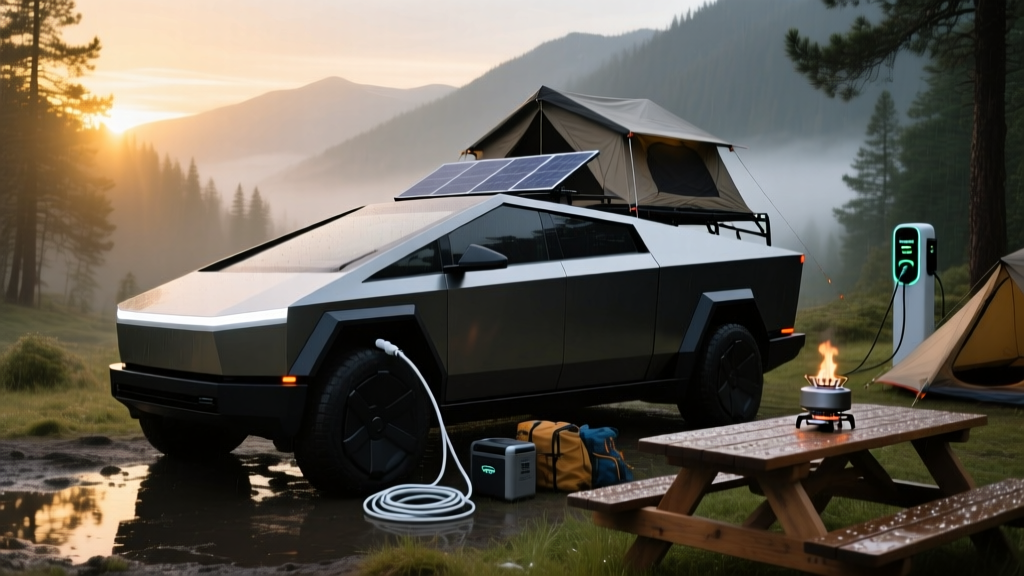
Camp Mode is a climate-control feature accessible through the Cybertruck's 18.5-inch front touchscreen (and the rear 9.4-inch display). When activated, it maintains a set cabin temperature indefinitely while the vehicle is parked, drawing power from the high-voltage traction battery. It also keeps the USB ports and 120V/240V bed outlets live, disables the automatic walk-away lock, and suppresses the cabin alarm — essential for sleeping without interruption.
Unlike simply leaving climate control on, Camp Mode is optimized for sustained, low-draw operation. Tesla estimates Camp Mode consumes roughly 1–2 kWh per hour in mild conditions (60–75°F), though this can climb to 3–4 kWh/hour in extreme cold or heat when the heat pump and resistance heaters work harder. For an overnight stint of 8 hours in moderate weather, expect to use approximately 12–16 kWh — roughly 5–7% of the usable battery on the Dual Motor AWD variant.
Cybertruck Battery, Range, and Efficiency Specs
The Dual Motor AWD Cybertruck carries an EPA-estimated 340 miles of range. In real-world highway testing at 70–75 mph, expect 270–300 miles. Add a bed tent, rooftop cargo, or cold-weather driving (below 32°F), and range can drop to 220–250 miles. The Cyberbeast trim, with its tri-motor setup, is rated at 320 miles EPA but delivers closer to 250–280 miles in mixed real-world driving.
| Spec | Dual Motor AWD | Cyberbeast (Tri-Motor) |
|---|---|---|
| EPA Range | 340 miles | 320 miles |
| Battery (usable) | ~123 kWh (NMC) | ~123 kWh (NMC) |
| MPGe (combined) | 72 MPGe | 68 MPGe |
| kWh / 100 mi | 47 kWh | 50 kWh |
| 0–60 mph | 4.1 seconds | 2.6 seconds |
| Horsepower | 600 hp | 845 hp |
| Drivetrain | Dual-Motor AWD | Tri-Motor AWD |
| Towing Capacity | 11,000 lbs | 11,000 lbs |
| Payload | 2,500 lbs | 2,500 lbs |
The Cybertruck uses an NMC (nickel manganese cobalt) lithium-ion battery pack. NMC chemistry offers higher energy density than LFP, which is critical in a vehicle this heavy (curb weight exceeds 6,600 lbs on the Cyberbeast). However, NMC cells are more sensitive to sustained 100% states of charge, so Tesla recommends daily charging to 80–90% and reserving 100% for trips. For Camp Mode use, starting with an 80% charge still leaves ample buffer for overnight climate control plus a morning departure.
Charging Speed: DC Fast, Level 2, and Off-Grid Reality
Charging infrastructure access is the make-or-break factor for any EV overlanding trip. The Cybertruck's 48-volt electrical architecture enables impressive DC fast-charge acceptance, but the curve tapers significantly past 80%.
| Charging Level | Power (kW) | Speed / Notes |
|---|---|---|
| Level 1 (120V household) | ~1.4 kW | ~3–4 mi/hr — emergency trickle only |
| Level 2 (240V / 48A Wall Connector) | 11.5 kW | ~30 mi/hr — full charge in ~11 hours |
| DC Fast Charge (V4 Supercharger) | Peak 350 kW | 10–80% in ~18 min; tapers sharply above 80% |
| DC Fast Charge (CCS adapter, 3rd-party) | Up to 250 kW | 10–80% in ~25 min at compatible stations |
The peak 350 kW figure is achievable only at Tesla's newest V4 Supercharger stalls with the Cybertruck's native NACS connector, and only when the battery is preconditioned and between roughly 10–30% state of charge. Sustained charging from 10–80% averages closer to 180–220 kW, which still makes the 18-minute 10–80% claim realistic. Above 80%, the charge rate drops to under 50 kW to protect cell health — plan your road-trip stops around the 10–80% sweet spot.
For camping specifically, Level 2 charging at a campground pedestal (often 30A or 50A 240V) can add 15–30 miles of range per hour overnight — enough to replenish a night of Camp Mode use and then some. Many RV parks and KOA locations now offer 240V outlets, though you'll need a Tesla Mobile Connector with the appropriate NEMA adapter.
Bed Dimensions, Cargo, and Camping Setup
The Cybertruck's 6-foot vault (bed) measures 72 inches long, 43 inches wide between the wheel wells, and 48 inches wide at the bed floor. With the motorized tonneau cover deployed, the bed is fully enclosed and lockable — a significant advantage for gear security at trailheads.
- Bed volume: 67 cu ft (with tonneau closed)
- Front trunk (frunk): ~7 cu ft — useful for charging cables and small gear
- Rear-seat legroom: 41.3 inches — adequate for adults on shorter trips
- Rear-seat headroom: 38.2 inches — compromised by the angular roofline for taller passengers
- Ground clearance: Up to 17.4 inches (Extract Mode, off-road)
- Approach / departure angle: 35° / 28° (with adaptive air suspension raised)
The 120V and 240V bed outlets (up to 9.6 kW combined output via Powershare) let you run appliances — electric coolers, induction cooktops, lights, or even a small space heater — without a separate generator. This Vehicle-to-Load (V2L) capability is arguably the Cybertruck's strongest camping asset, rivaling the F-150 Lightning's Pro Power Onboard.
Pricing, Trims, and Federal Tax Credit Eligibility
The Cybertruck's pricing has shifted since its 2023 unveiling. As of the 2026 model year, here's where trims land before and after potential incentives.
| Trim | Base MSRP | As-Tested (typical) | §30D Credit Eligible? |
|---|---|---|---|
| Rear-Wheel Drive (announced) | ~$60,990 | N/A — limited availability | Expected; subject to MSRP cap |
| Dual Motor AWD | $79,990 | $84,000–$90,000 | Partial or full, depending on sourcing |
| Cyberbeast | $99,990 | $105,000–$115,000 | Likely ineligible (MSRP exceeds $80K truck cap) |
The IRS §30D federal tax credit provides up to $7,500, split into two halves: $3,750 for battery-component manufacturing (North America) and $3,750 for critical-minerals sourcing (FTA-partner countries). The Cybertruck qualifies as a truck, so the MSRP cap is $80,000. Buyer income caps also apply ($300K joint / $150K single modified AGI). The Dual Motor AWD at $79,990 squeaks under the cap, but options and packages can push it over. The Cyberbeast at $99,990 exceeds it outright. Point-of-sale transfer is available if you meet all criteria — confirm eligibility with a tax professional and check the latest fueleconomy.gov listings before purchasing.
Warranty, Battery Longevity, and Degradation
Tesla covers the Cybertruck's battery and drive units with an 8-year / 120,000-mile warranty (whichever comes first), guaranteeing a minimum of 70% capacity retention over that period. The vehicle's limited warranty covers 4 years / 50,000 miles.
NMC batteries in Tesla's fleet historically show 8–12% degradation over 100,000 miles, based on aggregated fleet data. For a camping-focused owner who drives 12,000–15,000 miles annually and avoids routine 100% charges, the battery should comfortably exceed 150,000 miles before approaching the 70% threshold. Camp Mode's low, steady draw is far less stressful on cells than repeated DC fast-charging cycles, so overnight camping use has negligible impact on long-term State of Health (SoH).
Cybertruck Camp Mode: Pros and Cons
Pros
- Silent, emission-free overnight climate control — no generator noise or fumes
- 9.6 kW V2L output via bed outlets powers appliances without extra equipment
- Lockable vault with motorized tonneau secures gear at remote sites
- 340-mile EPA range (Dual Motor) covers most round-trip camping routes
- Adaptive air suspension with Extract Mode handles rough fire roads
- 350 kW peak DC charging gets you back on the road fast between trips
Cons
- Real-world range drops to 220–250 mi with cargo, towing, or cold weather
- Cyberbeast exceeds the $80K MSRP cap — no federal tax credit
- Charging infrastructure remains sparse near popular wilderness areas
- Stainless-steel body panels are prone to fingerprints and difficult to repair
- Rear-seat headroom is tight for passengers over 6 feet
- No Apple CarPlay / Android Auto — Tesla's native UI only
How the Cybertruck Stacks Up Against Rivals
The Cybertruck isn't the only EV pickup vying for overlanding duty. Here's how it compares to the two most relevant alternatives on the metrics that matter for camping.
| Spec | Cybertruck AWD | F-150 Lightning (Ext. Range) | Rivian R1T (Dual Max) |
|---|---|---|---|
| EPA Range | 340 mi | 320 mi | 410 mi |
| Battery | ~123 kWh NMC | ~131 kWh NMC | ~149 kWh NMC |
| Peak DC Charge | 350 kW | 150 kW | 220 kW |
| 10–80% Time | ~18 min | ~41 min | ~30 min |
| V2L Output | 9.6 kW (240V) | 9.6 kW (240V) | 3.6 kW (120V only) |
| Ground Clearance | 17.4 in (max) | 8.9 in | 14.9 in (max) |
| Base MSRP | $79,990 | $77,995 | $87,900 |
The Rivian R1T wins on range and off-road pedigree (quad-motor available, superior departure angle), but costs more and charges slower. The F-150 Lightning offers a familiar truck experience and the widest dealer network, but its 150 kW peak charge rate is a clear weakness for road-trip charging. The Cybertruck's combination of 350 kW charging, 9.6 kW V2L, and adaptive air suspension occupies a unique middle ground — if you can tolerate its polarizing design and Tesla-only service network.
Who Should Buy the Cybertruck for Camping?
Choose the Cybertruck if: You prioritize fast DC charging, need high V2L output for powered camping setups, value a lockable enclosed bed, and mostly camp within 150 miles of home or along Supercharger corridors.
Choose the Rivian R1T if: Maximum range, serious off-road capability, and a growing adventure-focused community matter more than peak charge speed.
Choose the F-150 Lightning if: You want a conventional truck feel, need broad dealer support for remote-area service, and don't mind slower DC charging.
Frequently Asked Questions
How much battery does Cybertruck Camp Mode use overnight?
In mild conditions (60–75°F), Camp Mode draws approximately 1–2 kWh per hour, totaling 8–16 kWh over an 8-hour night. In extreme cold (below 20°F), expect 3–4 kWh/hour, or 24–32 kWh overnight — roughly 10–15% of the Dual Motor's usable battery.
Can I run a CPAP machine or electric blanket from the Cybertruck overnight?
Yes. The bed's 120V outlets support continuous loads, and Camp Mode keeps them energized. A typical CPAP draws 30–60 watts — negligible against the battery's 123 kWh capacity. An electric blanket at 100–150 watts over 8 hours uses roughly 1 kWh total.
Does the Cybertruck qualify for the $7,500 federal EV tax credit?
The Dual Motor AWD at $79,990 MSRP falls under the $80,000 truck cap and may qualify for partial or full credit depending on battery-sourcing compliance and your income. The Cyberbeast at $99,990 exceeds the MSRP cap and is ineligible. Always verify current rules at IRS.gov and consult a tax professional.
Is Cybertruck Camp Mode better than just leaving climate control on?
Yes. Camp Mode is specifically optimized for extended stationary use — it suppresses alarms, prevents auto-lock, maintains USB and outlet power, and manages energy draw more efficiently than standard climate control, which may cycle on and off less intelligently.
Can the Cybertruck handle off-road trails to remote campsites?
With up to 17.4 inches of ground clearance in Extract Mode and 35°/28° approach/departure angles, the Cybertruck handles fire roads, sand, and moderate rock crawling competently. However, its 6,600+ lb curb weight and low-slung battery pack mean you should avoid deep ruts and extreme side-angle terrain. It's best suited for established forest roads and maintained trailheads rather than technical rock crawling.