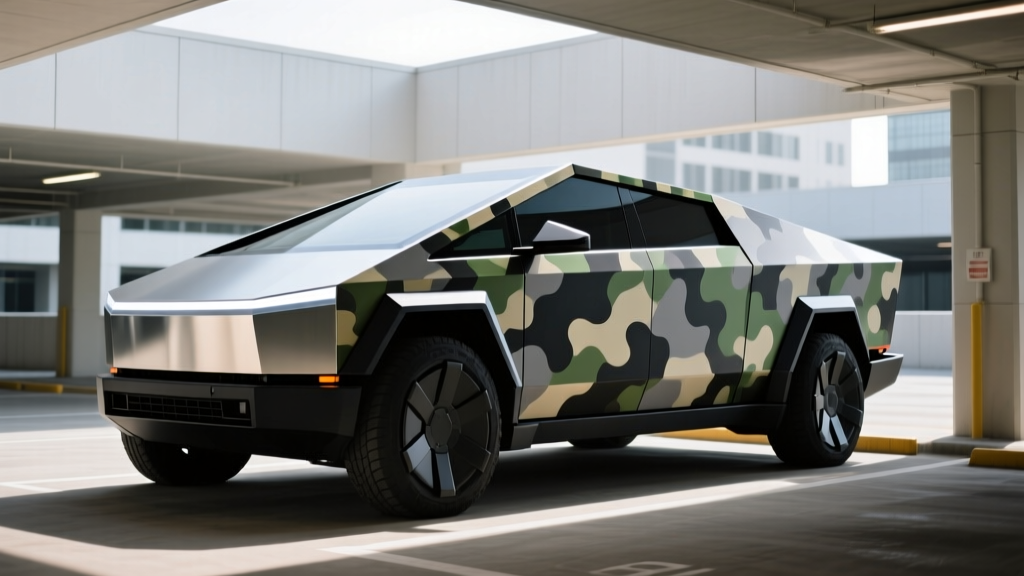
If you've scrolled through EV forums or truck meets in 2025–2026, you've seen it: the Cybertruck camo treatment. Owners are wrapping their stainless-steel pickups in military-style camouflage vinyl, desert tan patterns, and woodland digital prints. But beyond aesthetics, a camo wrap raises practical questions for EV buyers: Does it affect range? Can it survive fast-charging heat cycles? And does the underlying truck justify the investment?
This review covers the Tesla Cybertruck platform in detail — the vehicle you're wrapping — with real numbers on range, charging, pricing, and federal tax credit eligibility. We'll also address the wrap itself: cost, durability, and whether it impacts thermal management or resale value.
2026 Cybertruck Trims: EPA Range, Battery & Performance Specs
Tesla offers the Cybertruck in three primary configurations for the 2026 model year. Here's what the spec sheet looks like before you consider any aftermarket wrap:
| Spec | Long Range AWD | All-Wheel Drive (Dual Motor) | Cyberbeast (Tri-Motor) |
|---|---|---|---|
| EPA Range | 340 mi | 318 mi | 301 mi |
| Battery (usable) | ~123 kWh (NMC) | ~123 kWh (NMC) | ~123 kWh (NMC) |
| Drivetrain | Dual-Motor AWD | Dual-Motor AWD | Tri-Motor AWD |
| Horsepower | ~600 hp | ~600 hp | 845 hp |
| 0–60 mph | 4.1 sec | 3.9 sec | 2.6 sec |
| Towing Capacity | 11,000 lbs | 11,000 lbs | 11,000 lbs |
| Payload | 2,500 lbs | 2,500 lbs | 2,500 lbs |
| Base MSRP | $79,990 | $99,990 | $119,990 |
Sources: fueleconomy.gov, tesla.com/cybertruck/specs
All trims use a large-format NMC (nickel manganese cobalt) lithium-ion pack. Tesla has not published an official usable kWh figure; independent teardowns and range-back calculations point to roughly 123 kWh usable from a ~135 kWh gross pack. The stainless-steel exoskeleton adds significant curb weight (roughly 6,600–6,800 lbs depending on trim), which directly impacts efficiency.
Real-World Range: What the EPA Number Doesn't Tell You
The Cybertruck's angular shape creates a high drag coefficient (estimated ~0.38–0.40 Cd), which punishes efficiency at highway speeds. City driving with frequent regenerative braking opportunities gets you closer to the EPA number, sometimes exceeding it in stop-and-go traffic. But this is a truck, and most owners use it for highway commuting, road trips, or hauling — scenarios where the real range falls well short of the sticker.
Efficiency lands around 56–60 MPGe combined (roughly 58–62 kWh/100 mi), making the Cybertruck one of the least efficient EVs on the market. For comparison, the Rivian R1T with the Large Pack achieves 73 MPGe combined. If electricity costs $0.15/kWh at home, you're spending roughly $9–$10 per 100 miles; at DC fast-charger rates of $0.40/kWh, that jumps to $23–$25 per 100 miles.
Charging Speed: DC Fast Charge, Home Level 2 & Wrap Considerations
| Charging Level | Max Rate | Speed / Time |
|---|---|---|
| DC Fast Charge (peak) | ~250 kW (V3 Supercharger) | 10–80% in ~28 min (sustained avg ~170 kW) |
| Level 2 (240V, 48A) | 11.5 kW | ~30 mi/hr added; full charge in ~12–14 hr |
| Level 1 (120V, 12A) | 1.4 kW | ~3–4 mi/hr added (emergency use only) |
The Cybertruck uses the NACS (North American Charging Standard) connector natively — no adapter needed at Tesla Superchargers. With the industry's shift to NACS, non-Tesla networks like Electrify America and EVgo are adding NACS cables, though CCS-to-NACS adapters remain an option for legacy stations.
Charging-curve reality: The 250 kW peak only holds from roughly 10–30% State of Charge (SoC). Above 50%, the rate tapers significantly — you'll see ~100 kW at 60% and ~50 kW above 80%. This is why the 10–80% time of ~28 minutes is the more useful metric than the peak kW number. For road-trip planning, budget 30–35 minutes per stop if you're charging from 10% to 80%.
Does a camo wrap affect charging? Vinyl wraps are thin (typically 3–4 mil / 0.08–0.1 mm) and do not meaningfully insulate the battery or interfere with the thermal management system. The Cybertruck's active liquid cooling handles battery temperature regulation. However, dark-colored camo wraps (woodland green/black) can increase surface temperatures on the stainless panels in direct sun, which may slightly increase cabin cooling load in hot climates. This is a marginal effect — expect less than 1–2% range impact in extreme heat.
Pricing, Tax Credits & the Camo Wrap Cost
Here's where the math gets complicated for Cybertruck buyers eyeing a camo treatment:
| Item | Long Range AWD | AWD (Dual Motor) | Cyberbeast |
|---|---|---|---|
| Base MSRP | $79,990 | $99,990 | $119,990 |
| §30D Credit Eligible? | ⚠️ MSRP over $80K truck cap | ❌ Over $80K truck cap | ❌ Over $80K truck cap |
| Typical Wrap Cost | $4,500–$8,000 (full camo PPF/vinyl) | ||
Federal tax credit breakdown (IRS §30D, 2026 rules): The new-vehicle EV credit offers up to $7,500, but trucks face an $80,000 MSRP cap. The Long Range AWD at $79,990 sits right at the threshold — but any dealer-installed options, destination fees, or upgrades that push the MSRP above $80,000 disqualify it. The AWD and Cyberbeast trims exceed the cap outright.
Additionally, §30D requires:
- Buyer income caps: $150,000 single / $300,000 joint modified AGI
- Battery sourcing: Critical minerals and battery components must meet phased-in percentages from US or FTA-partner countries (per IRS guidance)
- Point-of-sale transfer: Eligible buyers can apply the credit as a down-payment reduction at the dealer
In practice, most Cybertruck buyers in 2026 will not qualify for the federal credit due to the MSRP cap. State incentives (like California's CVRP or Colorado's innovative motor vehicle credit) may apply — check your state's energy office for current amounts.
Camo wrap cost breakdown: A quality camo wrap on the Cybertruck's large, angular panels runs $4,500–$8,000 depending on material (cast vinyl vs. paint protection film with printed camo), pattern complexity, and installer reputation. The stainless-steel body actually makes wrapping easier than painted surfaces — no risk of paint damage on removal. Budget for a 5–7 year wrap lifespan before replacement.
Cargo, Interior Space & Daily Practicality
The Cybertruck's 6-foot vault (bed) offers 67 cu ft of lockable cargo space, with a motorized retractable hard tonneau cover. The bed is 43 inches wide between wheel wells — enough for a standard 4×8 sheet of plywood only if loaded at an angle or on top of the wells. A front trunk (frunk) adds ~7 cu ft of sealed storage.
Inside, the cabin seats five with a bench-style front row (three-across seating). Rear legroom measures approximately 38.4 inches — adequate for adults but tighter than a Ford F-150 Lightning's 40.9 inches. Headroom is generous thanks to the tall roofline. The 18.5-inch center touchscreen handles nearly all vehicle controls, with a secondary 9.4-inch rear touchscreen for passengers.
Notable drawbacks: The wiper blade design (a single large blade) struggles with heavy rain at highway speeds. Panel-gap quality remains inconsistent across production units. The steer-by-wire system, while innovative, has a learning curve — the yoke-style steering wheel requires adaptation, particularly at low speeds and during parking maneuvers. Visibility rearward is limited; you'll rely heavily on the digital rearview camera.
Driver Assistance, Tech & Safety
The Cybertruck ships with Tesla's HW4 (Hardware 4) computer and a camera-only vision suite (no radar or ultrasonic sensors). Autopilot includes adaptive cruise control and lane centering. FSD (Supervised) adds automatic lane changes, traffic-light recognition, and city-street navigation — for an additional $8,000 one-time purchase or $99/month subscription in 2026.
Safety ratings from NHTSA are pending for some crash-test categories as of early 2026. The stainless-steel exoskeleton provides substantial structural rigidity, and Tesla claims a low center of gravity from the under-floor battery pack. Standard active safety includes automatic emergency braking, blind-spot monitoring, and lane-departure warning.
Warranty & Long-Term Ownership
| Coverage Area | Term |
|---|---|
| Basic Vehicle | 4 years / 50,000 miles |
| Battery & Drive Units | 8 years / 120,000 miles (min 70% retention) |
| Roadside Assistance | 4 years / 50,000 miles |
The 8-year/120,000-mile battery warranty guarantees at least 70% capacity retention. NMC chemistry in a large pack like this typically degrades 8–12% over the first 100,000 miles under normal use — meaning most owners should remain well within warranty coverage. Avoid frequent DC fast-charging above 90% SoC and prolonged storage at 100% or 0% to maximize battery longevity.
Insurance costs are elevated: expect $250–$400/month depending on your state, driving record, and coverage level. The Cybertruck's repair complexity (stainless panels, steer-by-wire, large battery) drives higher premiums. Get quotes before purchasing.
Pros, Cons & the Camo-Wrap Verdict
✅ Pros
- Unmatched acceleration for a pickup (2.6s Cyberbeast)
- 11,000-lb towing capacity with integrated trailer tech
- Stainless-steel body resists dents; wraps adhere well and remove cleanly
- Native NACS charging — widest Supercharger network access
- Lockable vault bed with powered tonneau
- Over-the-air updates continuously add features
❌ Cons
- Poor efficiency (56–60 MPGe) — highest cost-per-mile in its class
- Real-world highway range 20–25% below EPA sticker
- MSRP exceeds §30D truck cap on most trims — no federal credit
- Steep insurance premiums ($250–$400/mo typical)
- Rear visibility poor; yoke steering has a learning curve
- Bed width between wheel wells won't flat-fit a 4×8 sheet
Is a Camo-Wrapped Cybertruck Worth It vs. the Competition?
Decision Framework
Choose the Cybertruck (with or without camo wrap) if: You want maximum acceleration and towing in an EV pickup, you have home Level 2 charging, you value the Supercharger network for road trips, and the stainless/wrap aesthetic is a priority.
Choose the Rivian R1T if: Efficiency matters (73 MPGe vs. 56 MPGe), you need a wider bed for flat cargo, you want a more conventional steering wheel, and you prefer a proven adventure-oriented platform with better real-world range.
Choose the Ford F-150 Lightning if: You need maximum interior space, Pro Power Onboard for job-site use, lower insurance costs, and a more traditional truck experience. The Lightning's efficiency (66–70 MPGe) and available $7,500 tax credit (MSRP under $80K on XLT/Lariat trims) make it the value play.
The camo wrap itself is a personalization choice that doesn't change the truck's fundamentals. If you love the Cybertruck's capability and can accept its efficiency and pricing trade-offs, a $5,000–$7,000 camo wrap transforms the already-polarizing design into something even more distinctive. Just know that you're wrapping a truck that costs $80,000–$120,000 before the wrap — and likely won't see a dime of federal tax credit.
Frequently Asked Questions
What is the real-world range of the Cybertruck?
The Long Range AWD is EPA-rated at 340 miles, but expect 260–290 miles on the highway at 70 mph, and 210–240 miles in freezing temperatures. The Cyberbeast (301 mi EPA) delivers roughly 230–260 miles in real-world highway use.
How fast does the Cybertruck charge?
Peak DC fast-charge rate is ~250 kW on a V3 Supercharger, with a 10–80% time of approximately 28 minutes. At home on a 48A Level 2 charger (11.5 kW), you'll add about 30 miles per hour, fully recharging overnight in 12–14 hours.
Does the Cybertruck qualify for the federal EV tax credit?
Likely not. The §30D credit caps truck MSRP at $80,000. The Long Range AWD at $79,990 barely qualifies on paper, but any options or fees that push MSRP above $80K disqualify it. The AWD and Cyberbeast trims are over the cap. Buyer income limits ($150K single / $300K joint) and battery-sourcing rules also apply. Always verify on IRS.gov before purchase.
Does a camo wrap damage the Cybertruck's stainless-steel body?
No. High-quality cast vinyl or PPF wraps adhere to stainless steel without issue and remove cleanly without residue. Unlike painted vehicles, there's no risk of clear-coat damage during removal. Expect 5–7 years of wrap life before replacement.
How much does a Cybertruck camo wrap cost?
A full-body camo wrap in cast vinyl runs $4,500–$6,500. Paint protection film (PPF) with a printed camo pattern costs $6,000–$8,000 but adds rock-chip protection. Prices vary by installer, pattern complexity, and region.
Is the Cybertruck good for towing?
Yes — 11,000 lbs of rated towing capacity is class-leading for an EV pickup. However, towing near max capacity reduces range to roughly 120–150 miles. Plan frequent charge stops and use Tesla's integrated trailer brake controller and hitch-assist camera.