The Cybertruck Meets the Playa: An Off-Grid EV Stress Test
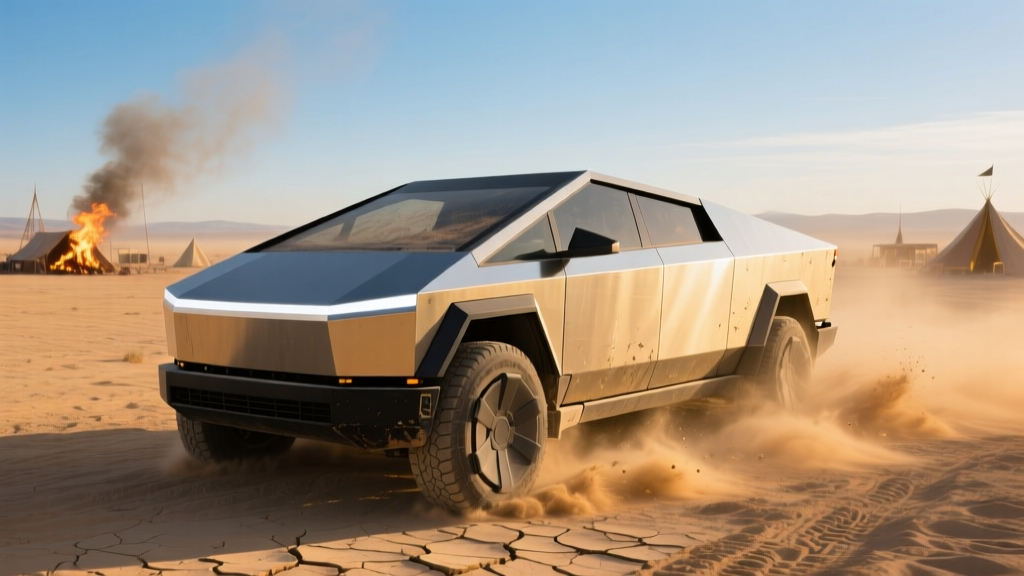
Burning Man is one of the most hostile environments for any vehicle — let alone a battery-electric truck. The Black Rock Desert playa delivers 100°F+ heat, ultra-fine alkaline dust that infiltrates every seal, and zero charging infrastructure within 120 miles. Yet every year, EVs show up in Black Rock City, and the Tesla Cybertruck has become one of the most talked-about rigs on the playa. This profile examines whether the Cybertruck's specs actually translate to desert survival — and what real-world ownership looks like when you're 120 miles from the nearest Supercharger.
For 2026, Tesla offers the Cybertruck in three trims: the Long Range AWD, the Cyberbeast (tri-motor), and the base RWD (limited availability). We'll focus primarily on the Long Range AWD — the most common configuration buyers actually take delivery of — while noting where the Cyberbeast diverges.
Spec Sheet: 2026 Tesla Cybertruck at a Glance
| Attribute | Long Range AWD | Cyberbeast (Tri-Motor) |
|---|---|---|
| EPA Range | 340 miles | 320 miles |
| Battery (usable) | ~123 kWh (NMC) | ~123 kWh (NMC) |
| Drivetrain | Dual-Motor AWD | Tri-Motor AWD |
| Horsepower | 600 hp | 845 hp |
| 0–60 mph | 3.9 sec | 2.6 sec |
| Max DC Fast Charge | 250 kW (V3 Supercharger) | 250 kW |
| 10–80% DCFC Time | ~28 min | ~28 min |
| Level 2 Home Charge | 11.5 kW (~37 mi/hr) | 11.5 kW (~37 mi/hr) |
| MPGe (combined) | 72 MPGe | 68 MPGe |
| Efficiency | 47 kWh/100 mi | 50 kWh/100 mi |
| Towing Capacity | 11,000 lbs | 11,000 lbs |
| Bed Length | 6 ft (72 in) | 6 ft (72 in) |
| Cargo (bed + frunk) | ~67 cu ft bed + 7 cu ft frunk | ~67 cu ft bed + 7 cu ft frunk |
| Base MSRP (2026) | $79,990 | $99,990 |
| Battery/Drive Warranty | 8 yr / 120,000 mi | 8 yr / 120,000 mi |
Real-World Range: What the EPA Sticker Doesn't Tell You
Real-World Highway (70–80 mph): ~260–285 miles
Playa/Off-Road (low speed, sand/dust): ~240–270 miles (high A/C load, soft terrain)
Cold-Weather Note: Not applicable to Burning Man's August heat, but expect ~15–25% range loss below 32°F in winter conditions.
The Cybertruck's stainless-steel exoskeleton and angular profile create a drag coefficient that hurts at highway speeds. At 75 mph on a flat Nevada interstate, expect roughly 260–285 miles of usable range before you need to find a charger — well below the 340-mile EPA figure. The EPA test cycle includes substantial low-speed and city driving, which favors EVs thanks to regenerative braking.
On the playa itself, speeds rarely exceed 15 mph, which would normally be ideal for EV efficiency. However, the soft alkaline surface increases rolling resistance significantly, and you'll be running the cabin A/C continuously in 100°F+ heat. The thermal management system also works overtime to keep the battery pack cool. Combined, these factors compress real-world playa range to roughly 240–270 miles from a full charge — still enough for most camp logistics, but tight if you're also driving to and from the event from Reno or the Bay Area.
The Reno-to-Black-Rock-City route is approximately 120 miles each way via I-80 and NV-447. That's 240 miles round trip, plus whatever you drive on-playa. You'll want to arrive with a full charge and plan at least one charging stop in Fernley or Lovelock on the return leg.
Charging the Cybertruck: Speed, Logistics, and the Desert Problem
| Charging Level | Power (kW) | Speed (mi/hr added) | Notes |
|---|---|---|---|
| Level 1 (120V outlet) | ~1.4 kW | ~3–4 mi/hr | Emergency only; generator fallback |
| Level 2 (240V, 48A) | 11.5 kW | ~37 mi/hr | Home Wall Connector; full charge in ~11 hr |
| DC Fast Charge (V3 Supercharger) | 250 kW peak | ~220 mi in 15 min (peak) | 10–80% in ~28 min; tapers sharply above 80% |
| DC Fast Charge (CCS adapter, non-Tesla) | ~150–200 kW typical | Varies by station | Requires Tesla CCS adapter (included) |
The Cybertruck charges at up to 250 kW on Tesla V3 Superchargers, but — critically — that peak rate is only sustained between roughly 10% and 35% State of Charge. Above 50% SoC, the charge curve tapers to ~100–120 kW, and above 80% it drops below 50 kW. This is standard lithium-ion behavior to protect cell longevity, but it means a "15-minute charge" only applies if you're starting from a very low SoC.
At Burning Man, there are zero public chargers within Black Rock City or on the surrounding playa. The nearest Tesla Superchargers are in Fernley (~65 miles from the event gate) and Winnemucca (~95 miles). This creates a genuine logistical challenge:
- Pre-condition before departure: Charge to 100% at home or your last hotel. The Cybertruck's ~123 kWh usable battery gives you enough buffer for the round trip plus playa driving — but only if you're disciplined.
- Generator charging is impractical: A typical 3,500W portable generator delivers roughly 3.5 kW — adding only ~10 miles of range per hour. You'd need 30+ hours of generator runtime for a meaningful charge. Burning Man's "Leave No Trace" principles also discourage generator use for this purpose.
- Solar trickle charging: Some playa camps deploy portable solar arrays (1–3 kW), which can offset vampire drain and power accessories, but won't meaningfully recharge the traction battery in a useful timeframe.
- The smart play: Treat the Cybertruck as a base camp vehicle. Drive it in fully charged, use it for on-playa transport at low speeds (which is efficient), and charge on the way home at a Fernley or Reno Supercharger.
At home, a Tesla Wall Connector on a 60A circuit delivers 11.5 kW (48A continuous), adding roughly 37 miles of range per hour. A full 0–100% charge takes approximately 11 hours — plan overnight charging for daily use.
Performance and Drivetrain: Overkill for the Playa, Ideal for the Highway
The Long Range AWD Cybertruck produces 600 horsepower from its dual-motor setup, hitting 0–60 mph in 3.9 seconds. The Cyberbeast's tri-motor layout pushes that to 845 hp and 2.6 seconds — numbers that are absurd for a 6,800-pound truck but genuinely thrilling when merging onto I-80.
For Burning Man specifically, the performance that matters is low-speed torque and traction control. The dual-motor AWD system provides precise torque vectoring to each axle, which helps on soft playa surfaces. The Cybertruck's adaptive air suspension can raise the ride height by up to 16 inches of ground clearance in Extract mode — useful for navigating deep dust ruts and uneven terrain at camp.
However, the stainless-steel body panels are a dust magnet. The electrostatic charge generated by driving through alkaline dust causes fine particles to cling aggressively to the flat steel surfaces. Expect to spend significant time cleaning the truck post-event. The tonneau-style bed cover (the "sail" panel) seals the bed reasonably well, but playa dust is notoriously fine — it will find its way into the bed, the frunk seals, and potentially the cabin air filter.
Pricing, Tax Credits, and Total Cost
| Trim | Base MSRP | §30D Credit Eligible? | Est. Net Price |
|---|---|---|---|
| Long Range AWD | $79,990 | No (exceeds $80,000 truck cap) | $79,990 + dest. |
| Cyberbeast | $99,990 | No (exceeds $80,000 truck cap) | $99,990 + dest. |
The IRS §30D federal EV tax credit has a $80,000 MSRP cap for trucks, vans, and SUVs. The Cybertruck Long Range AWD starts at $79,990, which technically falls under the cap — however, once you add the mandatory $1,995 destination fee and any factory options (which push nearly every build above $80,000), the vehicle exceeds the cap and becomes ineligible. The Cyberbeast, at $99,990, is well above the threshold regardless of configuration.
Additionally, §30D has buyer income caps ($150,000 single / $300,000 joint MAGI) and battery critical-mineral sourcing requirements that change annually. Always verify current-year eligibility at IRS.gov before purchase. The Cybertruck's battery sourcing has been a moving target as Tesla shifts supply chains, and as of 2026, buyers should confirm eligibility at point of sale with their dealer.
For context, the competing Rivian R1T Dual-Motor (starting ~$75,900) faces similar credit challenges depending on configuration, while the Ford F-150 Lightning (discontinued in 2025 but available used) previously qualified in lower trims.
Interior, Tech, and Livability at Camp
The Cybertruck's cabin seats five (or six with the optional front bench). Rear legroom is 38.4 inches — adequate for adults on long drives. The 18.5-inch front touchscreen handles all infotainment, climate, and vehicle controls. There are no physical buttons for climate or media, which can be frustrating when your hands are dusty or gloved.
Standout tech features relevant to off-grid events:
- Camp Mode: Maintains cabin climate control overnight using the traction battery. At 100°F outside, expect Camp Mode to consume roughly 1–2 kWh per hour (~3–5 miles of range lost per hour). Over a 10-hour night, that's 30–50 miles of range sacrificed for air-conditioned sleeping — a worthwhile trade for most playa campers.
- Powershare (V2L): The Cybertruck's bed outlets can deliver up to 9.6 kW of 120V/240V power to external devices. This is genuinely useful at Burning Man — you can power LED light arrays, sound systems, blenders, or even a small camp kitchen without a generator. At 9.6 kW, you could run a moderate camp setup for 10+ hours before significantly impacting range.
- HEPA Cabin Air Filtration: Tesla's "Bioweapon Defense Mode" uses a large HEPA filter that is exceptionally effective at filtering playa dust from cabin air. This is one of the Cybertruck's most underrated features for desert events.
- Autopilot / FSD (Supervised): Tesla's driver-assistance system is SAE Level 2 — you must remain engaged and hands-on the yoke at all times. On the long, straight, monotonous stretch of I-80 between Reno and Gerlach, Autopilot reduces fatigue significantly. It is not self-driving.
Notable drawbacks: The yoke steering is divisive and can be awkward at low playa speeds when making tight camp turns. The stainless-steel interior trim shows fingerprints and dust constantly. Rear visibility is compromised by the sail panel, making the backup camera essential. And the ride quality on washboard dirt roads (common on NV-447 approaching the event) is firmer than body-on-frame competitors like the Rivian R1T.
Pros and Cons: The Honest Verdict
- 340-mile EPA range provides genuine buffer for remote events
- 9.6 kW Powershare (V2L) eliminates camp generator need
- HEPA cabin filtration excels in dust
- Air suspension Extract mode for 16" ground clearance
- 250 kW DCFC for quick highway charging stops
- Stainless body resists dents from camp bumps
- Camp Mode enables climate-controlled sleeping
- No federal tax credit on most configurations (MSRP cap)
- Stainless panels attract and hold playa dust aggressively
- Real-world highway range ~260–285 mi, well below EPA
- Yoke steering awkward at low speeds
- No Apple CarPlay / Android Auto
- Build quality inconsistencies persist on some deliveries
- Insurance premiums run 30–50% above comparable trucks
Who Should Bring a Cybertruck to Burning Man (And Who Shouldn't)
Bring the Cybertruck if: You need a high-power V2L source for camp (sound, lights, kitchen), you want climate-controlled sleeping without a generator, you're driving from a location within ~250 miles of the event, and you value the HEPA filtration in dust storms.
Skip the Cybertruck if: You're on a budget (the $80K+ price and high insurance hurt), you need maximum cargo flexibility (the 6-foot bed is short for a full-size truck), you're towing a large art car or trailer (11,000-lb capacity is good, but range drops dramatically when towing — expect 150–180 miles at highway speeds with a loaded trailer), or you're driving from Southern California or the Pacific Northwest without planning multiple charge stops.
Frequently Asked Questions
What is the real-world range of the Cybertruck at Burning Man?
On the playa at low speeds with A/C running, expect roughly 240–270 miles from a full charge. For the highway drive to and from the event (I-80 at 70–80 mph), plan for 260–285 miles. The 340-mile EPA estimate assumes a mix of low-speed and moderate-speed driving that doesn't match either scenario.
How fast does the Cybertruck charge at home and on the road?
At home on a Level 2 Tesla Wall Connector (11.5 kW), the Cybertruck adds about 37 miles of range per hour, with a full charge taking ~11 hours. On a V3 Supercharger (250 kW peak), a 10–80% charge takes approximately 28 minutes, but the rate tapers significantly above 80% SoC.
Does the Cybertruck qualify for the federal EV tax credit?
Technically, the Long Range AWD at $79,990 MSRP falls just under the $80,000 truck cap. However, destination fees and common options push most builds above the threshold, making them ineligible. The Cyberbeast at $99,990 never qualifies. Buyer income limits (§150K single / $300K joint) and battery-sourcing rules also apply. Verify at IRS.gov.
Can I charge the Cybertruck at Burning Man with solar panels or a generator?
Solar trickle charging (1–3 kW portable arrays) can offset vampire drain but won't meaningfully recharge the 123 kWh battery in a useful timeframe. A portable generator at 3.5 kW adds only ~10 miles per hour and is discouraged under Leave No Trace principles. Plan to arrive fully charged and charge at a Supercharger on the return trip.
Is the Cybertruck worth buying vs. the Rivian R1T for off-grid events?
The Cybertruck wins on V2L power output (9.6 kW vs. Rivian's ~3.6 kW) and HEPA cabin filtration. The Rivian R1T offers a longer bed, more conventional controls, better rear-seat comfort, and — depending on configuration and current sourcing rules — potential §30D eligibility. For pure camp utility and power delivery, the Cybertruck has an edge. For overall livability and build consistency, the R1T remains competitive. See fueleconomy.gov for official efficiency comparisons.
Will playa dust damage the Cybertruck's battery or motors?
The battery pack and drive units are sealed to IP67 standards and are well-protected from dust ingress. The main concern is cabin air filtration (handled well by the HEPA system) and cosmetic dust accumulation on the stainless exterior. Post-event, plan a thorough wash, including underneath the vehicle, and replace the cabin air filter if it's heavily loaded with dust.
What's the Cybertruck's towing range when pulling a trailer to the event?
With a loaded 5,000–7,000 lb trailer at highway speeds, expect range to drop to approximately 150–180 miles. Towing at Burning Man is feasible for short on-playa moves, but highway towing to the event requires careful charge planning and multiple Supercharger stops.
Sources: fueleconomy.gov (EPA efficiency data), IRS.gov §30D Clean Vehicle Credits, Tesla specifications (tesla.com/cybertruck/design).