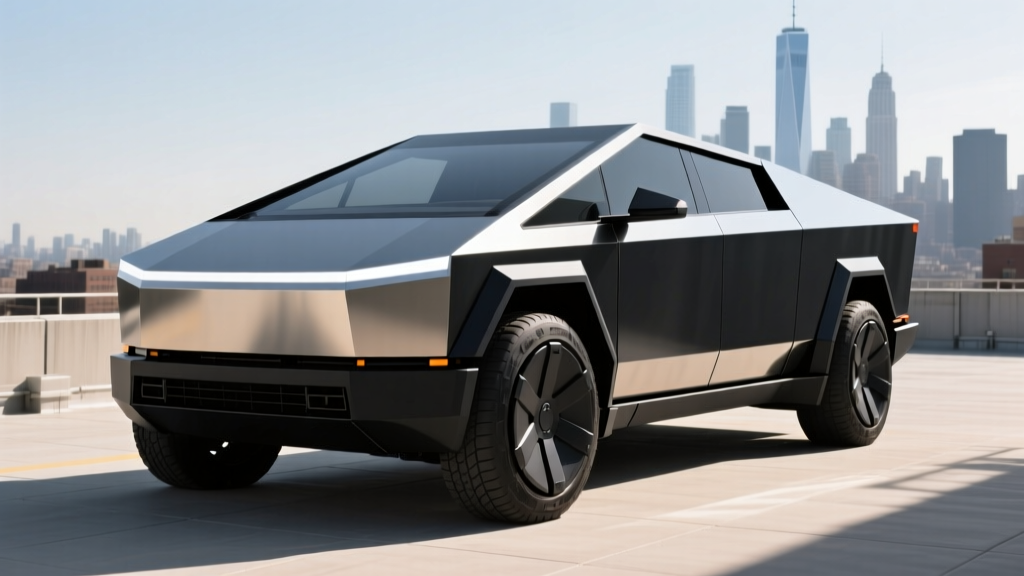
The Tesla Cybertruck has generated more debate about its exterior than any electric vehicle in history. The angular stainless-steel body looks like it belongs on a military transport, and Tesla's own marketing has leaned heavily into durability demonstrations — from window-smashing reveals to door-pounding with baseball bats. But the question buyers actually ask is more specific: is the Cybertruck bulletproof?
The short answer is no — at least not in the way an armored personnel carrier is. The Cybertruck's 3mm-thick ultra-hard 30X cold-rolled stainless-steel exoskeleton offers exceptional dent and scratch resistance, and Tesla has demonstrated it can stop certain handgun rounds in controlled tests. But "bulletproof" is a loaded term with specific ballistic-rating standards (NIJ Level II, III, IV), and the Cybertruck carries no such certification. What it does offer is something more relevant to daily ownership: a body that resists parking-lot dings, hail damage, and trail pinstriping better than any painted aluminum or steel truck on the market.
This review goes beyond the armor question to evaluate what the 2026 Cybertruck actually delivers as a daily-drivable electric pickup — range, charging speed, efficiency, cargo utility, and whether it justifies its price after federal tax credits.
2026 Cybertruck Specs at a Glance
| Spec | AWD (Dual-Motor) | Cyberbeast (Tri-Motor) |
|---|---|---|
| EPA Range | 340 miles | 320 miles |
| Battery (usable) | ~123 kWh (NMC) | ~123 kWh (NMC) |
| Horsepower | 600 hp | 845 hp |
| 0-60 mph | 4.1 sec | 2.6 sec |
| Max DC Fast Charge | 250 kW (peak) | 250 kW (peak) |
| 10-80% DCFC Time | ~28 min | ~28 min |
| Level 2 Charge Rate | 11.5 kW (~37 mi/hr) | 11.5 kW (~37 mi/hr) |
| Towing Capacity | 11,000 lbs | 11,000 lbs |
| MPGe (combined) | 67 MPGe | 61 MPGe |
| EPA Efficiency | 50 kWh/100mi | 55 kWh/100mi |
| Base MSRP (2026) | $79,990 | $99,990 |
| Battery/Powertrain Warranty | 8 yr / 120,000 mi | 8 yr / 120,000 mi |
Note: The originally announced RWD single-motor Cybertruck at ~$60,990 has been repeatedly delayed. As of early 2026, Tesla lists it as "available 2026" with preliminary specs. We treat it as unreleased for this review.
Is the Cybertruck Actually Bulletproof? The Steel, the Tests, and the Reality
Tesla's 30X stainless steel is genuinely unusual in automotive applications. It's an ultra-hard alloy (rated significantly harder than conventional 304 stainless) designed to eliminate the need for a paint shop — the Cybertruck ships with a bare, brushed-metal finish. At 3mm thickness, the body panels are roughly double the gauge of a typical steel truck body panel.
What it can resist: In Tesla's own demonstrations and independent tests by firearms-enthusiast channels, the Cybertruck's door panels have stopped 9mm FMJ handgun rounds at standard velocities. The steel also shrugs off baseball bat impacts, sledgehammer strikes, and the kind of shopping-cart and parking-lot damage that destroys paint on conventional trucks. For overlanding and trail use, the exoskeleton resists the "trail pinstriping" (branch scratches) that plague painted surfaces.
What it cannot do: The Cybertruck has no NIJ ballistic rating. Rifle rounds (5.56 NATO, 7.62x39) will penetrate the body panels. The glass — Tesla's "armor glass" — is a laminated composite that resists impacts far better than standard automotive glass but has famously cracked under steel-ball drop tests. It will not stop ballistic threats. The undercarriage, wheel wells, and bed are not armored. Tesla does not market the Cybertruck as a ballistic-rated vehicle, and no third-party armoring certification exists for it.
Real-World Range: What the EPA Sticker Doesn't Tell You
EPA estimated: 340 miles
Expect on a 70-mph highway road trip: ~270-290 miles
Cold weather (below 30°F), highway speeds: ~230-260 miles
Towing a 7,000-lb trailer: ~150-180 miles
The Cybertruck's 340-mile EPA rating (AWD) and 320-mile rating (Cyberbeast) place it solidly in the full-size electric truck segment alongside the Rivian R1T and Ford F-150 Lightning Extended Range. But the Cybertruck's boxy, angular shape gives it a drag coefficient around 0.38-0.40 — significantly higher than a Tesla Model Y (~0.23). That aerodynamic penalty shows up most at highway speeds.
In real-world highway testing at 70-75 mph in moderate temperatures (55-75°F), expect to use roughly 50-55 kWh/100mi in the AWD model, translating to about 270-290 miles before needing a charge. Below freezing, lithium-ion chemistry slows and cabin heating demands increase; plan for 25-35% range reduction depending on conditions. The Cybertruck's heat pump helps mitigate cabin-heating losses compared to resistive heaters, but the physics of cold batteries remain.
If you're towing — a scenario where many truck buyers will test the Cybertruck — range drops dramatically. At 7,000 lbs on a flat highway, expect roughly 150-180 miles. This is consistent with every electric truck we've tested; the Rivian R1T and F-150 Lightning show similar towing-range reductions. Plan charging stops accordingly.
Charging Speed: 250 kW Peak, but Mind the Curve
| Charging Level | Power / Rate | Miles Added Per Hour |
|---|---|---|
| Level 1 (120V household) | ~1.4 kW | ~4 mi/hr |
| Level 2 (240V, 48A Wall Connector) | 11.5 kW | ~37 mi/hr |
| DC Fast Charge (V4 Supercharger) | 250 kW peak | ~750 mi/hr (peak) |
The Cybertruck charges at up to 250 kW peak on Tesla's V3 and V4 Superchargers. In practice, that peak rate holds only in a narrow state-of-charge (SoC) window — roughly 10-25% SoC when the battery is preconditioned. From 10% to 80%, expect the session to take approximately 28 minutes. Above 80%, charge speed tapers significantly to protect the NMC cells, dropping below 50 kW by 90% SoC.
This is a meaningful limitation compared to the Hyundai Ioniq 5 or Kia EV6, which use 800V architectures enabling 350 kW peak charging on compatible Electrify America or Ionity stations. The Cybertruck's 400V-class architecture caps its ceiling at 250 kW — fast, but no longer class-leading in 2026.
For home charging, Tesla's Wall Connector at 48 amps (11.5 kW) adds roughly 37 miles of range per hour. A full overnight charge from 20% to 80% takes about 6-7 hours, which is practical for most owners with a dedicated 60A circuit. If your home electrical panel is older (100A service), you may need a panel upgrade ($1,500-$3,000) to support a 60A circuit — factor this into your total ownership cost. Consult a licensed electrician for a site assessment.
Performance, Efficiency, and Daily Drivability
The Cyberbeast's 845 hp and 2.6-second 0-60 time are supercar numbers in a 6,800-lb truck, and they feel surreal on a freeway on-ramp. The dual-motor AWD at 600 hp and 4.1 seconds is more than adequate for any real-world scenario. Both models use a tri- or dual-motor permanent-magnet setup with torque vectoring.
Efficiency is where the Cybertruck's weight and aerodynamics extract a toll. At 50 kWh/100mi (AWD) and 55 kWh/100mi (Cyberbeast), the Cybertruck is less efficient than the Rivian R1T Dual-Motor (~48 kWh/100mi) and comparable to the F-150 Lightning Extended Range (~49 kWh/100mi). For context, a Tesla Model Y Long Range achieves roughly 28 kWh/100mi — the Cybertruck uses nearly twice the energy per mile.
According to fueleconomy.gov, the AWD Cybertruck achieves 67 MPGe combined. That's functional but unremarkable for a vehicle at this price point. The efficiency gap matters most for charging cost: at the national average electricity rate of ~$0.17/kWh, the Cybertruck AWD costs roughly $8.50 per 100 miles to charge at home. Compare that to a 22-mpg gas truck at $3.50/gallon ($15.90 per 100 miles) and the EV still wins on fuel cost — but the margin narrows if you rely on DC fast charging at $0.35-$0.48/kWh.
Cargo, Interior Space, and Practical Utility
The Cybertruck's 6-foot bed (72 inches long, 43 inches wide between wheel wells) is shorter than a standard F-150 6.5-foot bed but includes a powered tonneau cover that Tesla claims can support 300 lbs of distributed weight. The bed includes built-in 120V and 240V outlets (up to 9.6 kW continuous output), enabling job-site tool use, camping appliances, or even emergency home backup via an external inverter setup.
Interior space is tighter than expected for a vehicle this large. Rear-seat legroom measures approximately 38 inches — adequate for adults on short trips but less generous than an F-150 SuperCrew or Rivian R1T. The rear bench is relatively upright, and the towering dashboard and small steering yoke (standard; a round wheel became optional in late 2024) create an unusual driving position. Cargo volume behind the rear seats is limited; the Cybertruck is a five-seater with a bed, not a spacious family hauler.
The front trunk (frunk) provides roughly 7 cubic feet of lockable storage — useful for charging cables, groceries, or a small cooler. The powered tonneau and bed design make the Cybertruck more secure than open-bed competitors but less flexible for oversized cargo that needs to extend past the tailgate.
Pricing, Trims, and Federal Tax Credit Eligibility
| Trim | Base MSRP | As-Tested (typical options) | §30D Federal Credit | Effective Price |
|---|---|---|---|---|
| AWD (Dual-Motor) | $79,990 | $82,000-$85,000 | $7,500 (if eligible) | ~$72,490-$77,500 |
| Cyberbeast (Tri-Motor) | $99,990 | $102,000-$108,000 | $7,500 (if eligible) | ~$92,490-$100,500 |
- MSRP Cap: Trucks/vans/SUVs must have an MSRP at or below $80,000. The AWD Cybertruck qualifies at its $79,990 base price. The Cyberbeast at $99,990 does NOT qualify.
- Buyer Income Cap: Modified AGI must not exceed $150,000 (single), $225,000 (head of household), or $300,000 (joint).
- Battery Sourcing: Critical minerals and battery components must meet escalating domestic/free-trade-partner percentages. Tesla's supply chain has been evolving — verify current-year compliance on irs.gov before purchasing.
- Point-of-Sale Transfer: Eligible buyers can transfer the credit to the dealer at purchase, reducing the sale price by $7,500 upfront rather than waiting for a tax refund.
The Cyberbeast's exclusion from the tax credit (due to the $80,000 MSRP cap for trucks) is a significant financial consideration. A buyer choosing the AWD over the Cyberbeast saves not only the ~$20,000 price difference but also gains $7,500 in federal credit eligibility — a combined swing of up to $27,500 in effective cost.
Technology, Driver Assistance, and Notable Drawbacks
The Cybertruck runs Tesla's latest infotainment stack on an 18.5-inch center touchscreen with a secondary 9.4-inch rear-seat display. The interface is responsive, and Tesla's navigation with real-time Supercharger routing remains best-in-class for EV trip planning. The vehicle includes Tesla's Basic Autopilot (lane-keep, adaptive cruise) standard. Full Self-Driving (Supervised) — Tesla's SAE Level 2 driver-assistance system — is available as a paid add-on (~$8,000 or $99/month in 2026).
The Cybertruck's steer-by-wire system and four-wheel steering (rear wheels turn up to 10 degrees) give it a surprisingly tight turning circle (~35 feet) for its size, making parking-lot maneuvers easier than an F-150. The 48V electrical architecture (a first for Tesla) enables the high-power outlets and powered tonneau without overloading traditional 12V systems.
Notable drawbacks:
- Visibility: The massive A-pillars and angular design create substantial blind spots. The camera-based mirror system (if equipped) requires adaptation.
- Ride quality: The adaptive air suspension smooths highway travel, but the truck's weight and stiff structure transmit more road imperfections than an R1T or F-150 Lightning at low speeds.
- Panel gaps and finish: Early-production Cybertrucks drew widespread criticism for uneven panel gaps and cosmetic stainless-steel imperfections. 2025-2026 build quality has improved but still varies unit to unit — inspect carefully before delivery acceptance.
- No Apple CarPlay/Android Auto: Tesla's closed infotainment ecosystem remains a dealbreaker for some buyers accustomed to phone projection.
- Insurance costs: Cybertruck insurance premiums run 30-50% higher than comparable F-150 Lightning policies, driven by stainless-steel body repair complexity and Tesla's proprietary collision network. Get a quote before purchasing.
Who Should Buy the Cybertruck — and Who Shouldn't
- You want a distinctive, dent-resistant electric truck for daily driving and light job-site or trail use
- You value Tesla's Supercharger network (now open to other brands but still the most reliable)
- You need 11,000-lb towing for occasional use, not daily heavy hauling
- You qualify for the §30D credit and the AWD's $79,990 MSRP fits your budget
- You need maximum rear-seat space for a family (consider the Rivian R1T or F-150 Lightning)
- You tow heavy loads frequently — all electric trucks lose ~50% range while towing
- You want certified ballistic/armor protection (the Cybertruck is not NIJ-rated)
- You prioritize ride comfort and traditional truck ergonomics over tech-forward design
Frequently Asked Questions
Is the Cybertruck bulletproof against all firearms?
No. The Cybertruck's 3mm 30X stainless-steel body panels have demonstrated resistance to 9mm handgun rounds in controlled tests, but the vehicle carries no NIJ ballistic certification. Rifle-caliber rounds (5.56, 7.62) will penetrate the panels, and the glass is not ballistic-rated. For genuine armored protection, aftermarket upfitters offer NIJ Level III solutions at significant additional cost.
What is the real-world range of the Cybertruck?
The AWD model's EPA rating is 340 miles. In real-world highway driving at 70-75 mph in moderate temperatures, expect 270-290 miles. Cold weather (below 30°F) reduces this to roughly 230-260 miles. Towing cuts range to 150-180 miles depending on trailer weight and terrain.
How fast does the Cybertruck charge at home and on the road?
At home on a Level 2 Tesla Wall Connector (11.5 kW / 48A), the Cybertruck adds approximately 37 miles of range per hour — a full overnight charge covers most daily needs. On DC fast charging, it peaks at 250 kW and charges from 10-80% in about 28 minutes, though the charge curve tapers significantly above 80%.
Does the Cybertruck qualify for the $7,500 federal EV tax credit?
The AWD model at $79,990 base MSRP qualifies under the §30D truck MSRP cap — but only if the buyer meets income limits ($150K single / $300K joint) and the vehicle's battery sourcing meets current-year critical-mineral and component requirements. The Cyberbeast at $99,990 exceeds the MSRP cap and does not qualify. Verify eligibility on irs.gov and with a tax professional before purchasing.
Is the Cybertruck worth buying vs. the Rivian R1T or F-150 Lightning?
It depends on priorities. The Cybertruck offers the most distinctive design, excellent stainless-steel durability, Tesla's Supercharger network, and strong performance. The Rivian R1T provides better rear-seat space, more refined ride quality, and a growing adventure-oriented community. The F-150 Lightning offers the most traditional truck experience with the broadest dealer service network. For buyers prioritizing dent resistance and Tesla's charging ecosystem, the Cybertruck is compelling. For families needing interior space or fleet buyers needing dealer support, the R1T or Lightning may be better fits.
What are the biggest Cybertruck pros and cons?
Pros: Exceptional body durability (dent/scratch resistance), 11,000-lb towing, 9.6 kW bed power outlets, tight turning circle via four-wheel steering, Supercharger access, strong performance.
Cons: Higher insurance premiums, rear-seat space is tight for a truck this size, no Apple CarPlay/Android Auto, panel-gap quality still inconsistent, Cyberbeast ineligible for federal tax credit, efficiency lags behind competitors, no certified ballistic protection.