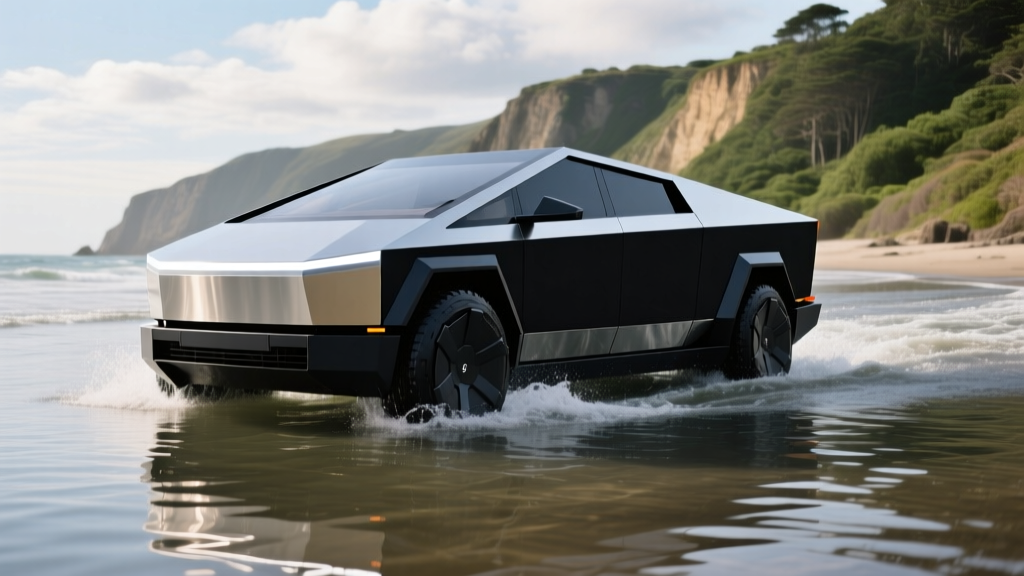
The Tesla Cybertruck has generated endless headlines since its launch, but one claim continues to surface in forums and social media threads: the idea of a Cybertruck boat mode that lets the electric pickup float across water. Elon Musk teased this concept years ago, and while the production Cybertruck does not ship as a marine vessel, it does offer genuine water fording capability that outstrips most stock pickups. This review breaks down the Cybertruck's real-world water fording specs, full powertrain performance, charging architecture, pricing, and whether this stainless-steel EV makes sense as an adventure-ready truck that can handle stream crossings and flooded trails.
Cybertruck Water Fording: How Deep Can It Really Go?
The production Tesla Cybertruck (AWD and Cyberbeast trims) carries an official water fording rating of 30 inches (762 mm). This is competitive with purpose-built off-road trucks and significantly deeper than most stock crossovers or sedans. Tesla achieved this through sealed battery enclosures, elevated air intake routing, and the absence of a traditional front-mounted combustion engine that could hydrolock.
However, it is critical to understand what this rating means and what it does not. The Cybertruck is not a boat. It will not float, propel itself through open water, or sustain submerged operation beyond its rated fording depth. Attempting to drive into deep lakes, rivers with strong current, or any body of water exceeding 30 inches risks catastrophic battery and electronics damage — damage that Tesla's warranty explicitly may not cover if deemed owner misuse.
Full Cybertruck Specs: Range, Battery, and Powertrain
Beyond water fording, the Cybertruck delivers serious electric-truck credentials. Here is the complete spec breakdown for the current 2025/2026 model year lineup:
| Specification | AWD | Cyberbeast |
|---|---|---|
| EPA Range | 340 miles | 320 miles |
| Battery Capacity | ~123 kWh usable (est.) | ~123 kWh usable (est.) |
| Battery Chemistry | NMC (Nickel Manganese Cobalt) | NMC |
| Drivetrain | Dual-Motor AWD | Tri-Motor AWD |
| Horsepower | 600 hp | 845 hp |
| 0-60 mph | 4.1 seconds | 2.6 seconds |
| Max DC Fast Charge | 250 kW (peak) | 250 kW (peak) |
| 10-80% DC Time | ~30 minutes | ~30 minutes |
| Level 2 Home Charge | 11.5 kW (~37 mi/hr) | 11.5 kW (~37 mi/hr) |
| Efficiency (MPGe) | ~71 MPGe combined | ~67 MPGe combined |
| Efficiency (kWh/100mi) | ~47 kWh/100mi | ~50 kWh/100mi |
| Water Fording Depth | 30 inches | 30 inches |
| Towing Capacity | 11,000 lbs | 11,000 lbs |
| Bed Length | 6 ft (72 in) | 6 ft (72 in) |
| Cargo Volume (bed + frunk) | ~67 cu ft bed + ~7 cu ft frunk | ~67 cu ft bed + ~7 cu ft frunk |
| Rear Legroom | ~38.2 inches | ~38.2 inches |
| Battery/Drive Unit Warranty | 8 years / 120,000 miles | 8 years / 120,000 miles |
Source: Tesla Cybertruck official specifications; EPA fueleconomy.gov (efficiency figures estimated at time of publication).
Real-World Range vs. EPA Estimates
The EPA rates the Cybertruck AWD at 340 miles and the Cyberbeast at 320 miles. In practice, real-world range diverges significantly from these stickers depending on driving conditions:
- Highway driving (70-80 mph): Expect 260-290 miles. The Cybertruck's angular stainless-steel body generates substantial aerodynamic drag, and efficiency drops sharply above 65 mph. At a sustained 75 mph, you may see as low as 250 miles in warm conditions.
- Cold weather (below 32°F): Range loss of 20-35% is typical for NMC chemistry in freezing temperatures. Combine cold air density (more drag) with cabin heating demands and you may see 200-240 miles on a full charge in deep winter.
- Towing: With an 11,000-pound trailer, range can drop below 150 miles. This is consistent with all electric trucks under tow load and is a critical planning factor for long-distance hauling.
- City/stop-and-go: Regenerative braking recovers energy efficiently here. Expect range closest to EPA figures, potentially 310-340 miles in mild weather.
Charging Speed and Infrastructure
The Cybertruck supports Tesla's 800-volt architecture and can accept a peak DC fast-charge rate of 250 kW at V4 Superchargers. However, as with all EVs, peak rate is not sustained rate. The charging curve tapers significantly above 80% state of charge (SoC) to protect the battery cells from lithium plating and thermal stress.
| Charging Level | Power (kW) | Miles Added per Hour | Notes |
|---|---|---|---|
| Level 1 (120V outlet) | 1.4 kW | ~3-4 mi/hr | Emergency/trickle only; full charge takes days |
| Level 2 (240V, 48A) | 11.5 kW | ~37 mi/hr | Home Wall Connector; overnight full charge ~10 hrs |
| DC Fast (V4 Supercharger) | 250 kW peak | ~180+ mi in 15 min | 10-80% in ~30 min; tapers sharply above 80% |
Preconditioning matters. The Cybertruck will automatically precondition its battery when a Supercharger is set as your navigation destination. This heats or cools the battery pack to the optimal temperature for maximum charge acceptance. Skipping preconditioning (for example, navigating to a non-Tesla DC charger without telling the car) can add 10-15 minutes to your charge session in cold weather. Always use the nav system for fastest charging.
The Cybertruck uses the NACS (North American Charging Standard) connector natively — the same Tesla connector now being adopted industry-wide. This gives you seamless access to the entire Tesla Supercharger network, which remains the most reliable and extensive DC fast-charging network in North America.
Pricing, Tax Credits, and Ownership Cost
As of the current model year, Cybertruck pricing has shifted considerably from the originally announced figures. Here is where the lineup stands:
| Trim | Base MSRP | §30D Federal Credit | Effective Price (if eligible) |
|---|---|---|---|
| RWD (announced, not yet available) | ~$60,990 | Eligibility TBD | TBD |
| AWD (Dual-Motor) | $79,990 | $0 (exceeds MSRP cap) | $79,990 |
| Cyberbeast (Tri-Motor) | $99,990 | $0 (exceeds MSRP cap) | $99,990 |
Insurance note: Cybertruck insurance premiums have been notably higher than competing electric trucks, with some owners reporting $3,000-$5,000+ annually depending on location and driving record. The stainless-steel exoskeleton is expensive to repair, and Tesla's limited body-shop network contributes to elevated claims costs. Get an insurance quote before committing to a purchase.
Technology, Driver Assistance, and Interior
The Cybertruck's interior is minimalist even by Tesla standards. A single 18.5-inch center touchscreen handles infotainment, climate, vehicle controls, and navigation. A rear 9.4-inch touchscreen serves second-row passengers. There is no traditional instrument cluster — all driving information displays on the central screen.
Autopilot and FSD (Supervised):
Standout tech features include:
- 48-volt electrical architecture (industry first for a production truck — reduces wiring weight and enables more powerful accessories)
- Steer-by-wire system with variable ratio (no mechanical connection between yoke and wheels)
- Rear-wheel steering for a tighter turning circle than its length suggests
- Adaptive air suspension with up to 16 inches of ground clearance in Extract mode
- Powered tonneau cover that doubles as a load-bearing surface (rated to 300 lbs)
- V2L (vehicle-to-load) capability — 120V and 240V outlets in the bed and cabin for powering tools, appliances, or job-site equipment
- Stainless-steel exoskeleton body panels — dent-resistant but fingerprint-prone
Notable drawbacks:
- The yoke-style steering wheel (standard on early deliveries, now offered with a round wheel option) is polarizing and complicates low-speed maneuvering for some drivers
- Visibility is compromised by the angular roofline and thick rear pillars; the camera-based rear view is essential
- Build quality has been inconsistent — early delivery vehicles reported panel gaps, squeaks, and 12V battery issues
- The massive 6,800+ lb curb weight (Cyberbeast: ~6,850 lbs) accelerates tire wear and increases stopping distances
- Cargo bed is shorter than competing full-size trucks (6 ft vs. the typical 6.5-8 ft)
Cybertruck vs. Key Competitors: Which Electric Truck Wins?
✓ Pros
- 30-inch water fording — genuine trail capability
- 11,000-lb towing capacity with integrated trailer brake controller
- Tri-motor Cyberbeast: 2.6-second 0-60 is supercar territory in a truck
- 48V architecture and V2L for job-site and camping power
- Supercharger network access (most reliable DC charging in the US)
- Stainless-steel body resists dents, scratches, and corrosion
- Frunk adds secure, weatherproof cargo space
✗ Cons
- No federal tax credit on Cyberbeast; AWD credit eligibility is borderline
- High insurance premiums relative to competitors
- Real-world highway range drops significantly below EPA estimate
- Steer-by-wire and yoke require adaptation; not for every driver
- Build quality inconsistency, especially on early production units
- Short 6-foot bed limits utility vs. F-150 Lightning or Silverado EV
- Heavy curb weight eats tires and reduces efficiency
- "Boat mode" does not exist — water fording only, no flotation
Key competitors to cross-shop:
- Ford F-150 Lightning: Lower starting price (~$55,000), qualifies for the $7,500 credit, larger bed, more conventional driving experience. Range tops out around 320 miles (extended range). Water fording rated to ~30 inches on select trims. Better value for traditional truck buyers.
- Rivian R1T: More refined interior, quad-motor option, excellent off-road capability with ~33 inches of water fording. Priced similarly to Cybertruck AWD. No Supercharger access (uses CCS with NACS adapter). Stronger build quality reputation.
- Chevrolet Silverado EV: Longest available range in an electric truck (up to ~440 miles on the 4WT trim), massive 10-foot bed on some configurations (with midgate open), GM's Ultium platform. Pricing varies widely by trim.
Choose the Cybertruck If:
- You want the most distinctive design and conversation-starting truck on the road
- Supercharger network access is a priority for your road-trip routes
- You need V2L power for job-site tools or overlanding/camping setups
- Water fording and off-road capability matter, but you prefer EV instant torque over a Wrangler or Gladiator
- You can absorb the higher insurance cost and potential build-quality quirks
Choose a Competitor If:
- Budget and federal tax credit eligibility are top priorities → F-150 Lightning
- Interior refinement and off-road sophistication matter most → Rivian R1T
- Maximum range and bed length are your primary truck requirements → Silverado EV
- You want a conventional steering wheel and familiar truck ergonomics → any competitor
Who Is the Cybertruck Actually For?
The Cybertruck occupies a unique niche. It is not the most practical electric truck, the most efficient, or the best value. It is a statement vehicle with genuine capability underneath the polarizing design. Here is who benefits most:
- Adventure/overlanding enthusiasts: The air suspension, 30-inch fording, V2L power, and Supercharger access make it a compelling base for overland builds — if you accept the range limitations under load.
- Tech-forward early adopters: The 48V architecture, steer-by-wire, and stainless-steel construction appeal to buyers who want cutting-edge engineering regardless of convention.
- Job-site professionals needing mobile power: V2L at 240V can run welders, compressors, and power tools without a separate generator. This is a legitimate work advantage.
- Performance seekers: The Cyberbeast's 2.6-second 0-60 is absurd in a 6,850-pound truck and genuinely thrilling.
Who should skip it: Budget-conscious buyers (the Lightning is significantly cheaper after credits), families prioritizing interior space and comfort (rear seat is tighter than competitors), fleet buyers (insurance and repair costs are prohibitive), and anyone expecting an actual boat.
Frequently Asked Questions
Can the Tesla Cybertruck float like a boat?
No. The Cybertruck is not a boat and does not have a "boat mode" that enables water propulsion or flotation. It has a 30-inch water fording rating, meaning it can drive through shallow, still water up to that depth. Attempting to float the Cybertruck in deeper water will flood the cabin and potentially damage the battery pack. Elon Musk's earlier social media references to a "boat mode" were conceptual and never made it to production.
What is the real-world range of the Cybertruck?
EPA rates the AWD at 340 miles and the Cyberbeast at 320 miles. Real-world highway driving at 70-80 mph yields approximately 260-290 miles. Cold weather (below freezing) can drop range to 200-240 miles on the highway. Towing reduces range to under 150 miles depending on trailer weight and conditions.
How fast does the Cybertruck charge at home and on the road?
At home on a Level 2 Tesla Wall Connector (11.5 kW / 48A), the Cybertruck adds approximately 37 miles of range per hour — a full overnight charge from empty takes roughly 10 hours. On a V4 Supercharger, it peaks at 250 kW and can add ~180+ miles in 15 minutes, with a 10-80% charge taking approximately 30 minutes. Charging slows significantly above 80% SoC to protect battery health.
Does the Cybertruck qualify for the $7,500 federal EV tax credit?
It depends. Under IRS §30D rules, trucks must have an MSRP at or below $80,000. The Cybertruck AWD at $79,990 is at the absolute cap — any added destination fees or options can push it over, disqualifying it. The Cyberbeast at $99,990 is ineligible regardless. Buyers must also meet income caps ($300,000 joint / $150,000 single) and the vehicle must satisfy battery component and critical mineral sourcing requirements. Always verify current eligibility on irs.gov and with a tax professional before purchasing.
Is the Cybertruck worth buying over the F-150 Lightning or Rivian R1T?
It depends on your priorities. The Cybertruck offers unmatched design, Supercharger access, V2L capability, and Cyberbeast performance. The F-150 Lightning is cheaper, qualifies for the full tax credit, has a larger bed, and is more conventional. The Rivian R1T has a more refined interior, better build quality reputation, and superior off-road geometry. If you value uniqueness, Tesla's charging network, and raw performance, the Cybertruck has no equal. If you value value, comfort, and practicality, the Lightning or R1T are stronger choices.
What is the Cybertruck's water fording warranty coverage?
Tesla's battery and drive unit warranty covers 8 years or 120,000 miles (whichever comes first) with a minimum 70% capacity retention threshold. However, water damage from exceeding the 30-inch fording depth, driving in saltwater, or submerging the vehicle beyond rated limits may be classified as owner misuse and excluded from warranty coverage. Always check your specific warranty terms and avoid crossings where depth is uncertain.
Does the Cybertruck have a frunk?
Yes. The Cybertruck includes a front trunk (frunk) with approximately 7 cubic feet of lockable, weatherproof storage. This is useful for charging cables, groceries, or gear you want to keep secure and separate from the bed.
Editorial note: Specifications, pricing, and tax credit rules are current as of publication and subject to change. Always verify with Tesla's official site, fueleconomy.gov, and irs.gov before making a purchase decision.