The Quest for a Blue Cybertruck: What You Need to Know in 2026
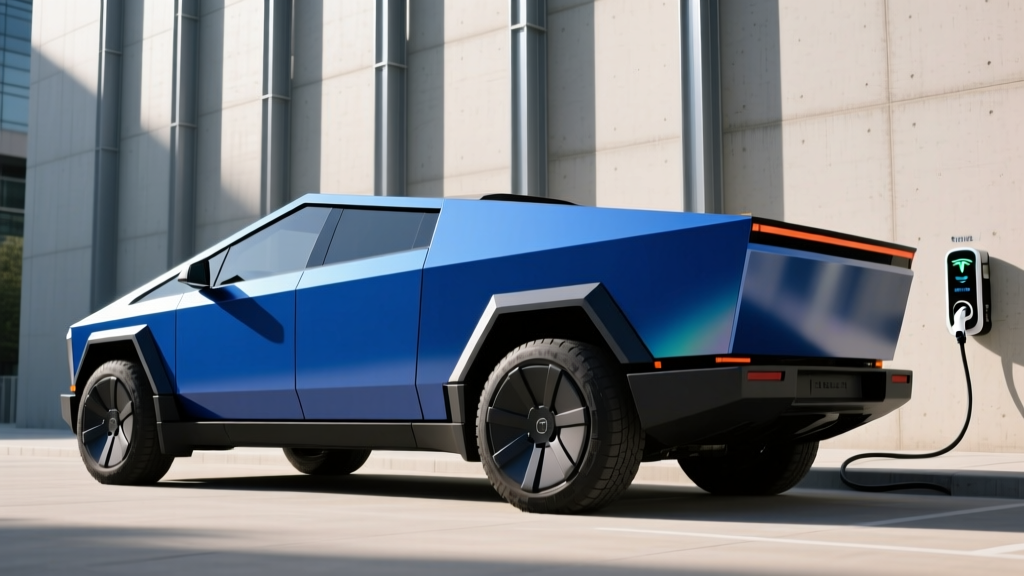
The Tesla Cybertruck launched in a single unpainted stainless steel finish, but by 2026, Tesla offers factory color options — including a deep blue metallic that has become one of the most sought-after configurations. Whether you're eyeing the factory blue paint or considering a vinyl wrap, the Cybertruck's angular stainless steel body presents unique challenges and opportunities for customization. This review covers everything you need to know about getting a blue Cybertruck, alongside the full performance, range, charging, and ownership picture for the 2026 model year.
Tesla's stainless steel exoskeleton doesn't accept traditional automotive paint in the conventional sense. The factory-applied color options use a specialized PVD (Physical Vapor Deposition) coating process or a paint layer applied over the steel. The blue option — officially called "Deep Blue Metallic" in Tesla's configurator — adds $3,000 to the base price. Alternatively, a high-quality vinyl wrap in blue typically costs between $3,500 and $6,000 from a professional installer, and it can be removed later without damaging the stainless surface.
The dual-motor AWD Cybertruck carries an EPA-estimated 340 miles of range (Long Range trim). However, real-world testing consistently shows 270–300 miles at sustained highway speeds (70–75 mph), and cold-weather driving (below 32°F) can reduce that to 220–250 miles due to battery chemistry limitations and cabin heating demands. The tri-motor Cyberbeast drops to an EPA-est. 320 miles, with real-world highway figures around 250–280 miles.
2026 Cybertruck Specs: Range, Battery, and Efficiency
| Spec | Long Range (Dual Motor) | Cyberbeast (Tri Motor) |
|---|---|---|
| EPA Range | 340 miles | 320 miles |
| Battery Capacity | ~123 kWh usable (NMC) | ~123 kWh usable (NMC) |
| Battery Chemistry | NMC (Nickel Manganese Cobalt) | NMC (Nickel Manganese Cobalt) |
| Drivetrain | Dual Motor AWD | Tri Motor AWD |
| Horsepower | 600 hp | 845 hp |
| 0–60 mph | 4.1 seconds | 2.6 seconds |
| Efficiency | 56 MPGe / 58 kWh/100mi | 54 MPGe / 62 kWh/100mi |
| Towing Capacity | 11,000 lbs | 11,000 lbs |
| Payload | 2,500 lbs | 2,500 lbs |
| Cargo Bed Length | 6 ft (72 in) | 6 ft (72 in) |
| Cargo Volume (bed) | ~67 cu ft | ~67 cu ft |
| Front Trunk (Frunk) | ~7 cu ft | ~7 cu ft |
| Wheelbase | 143.5 in | 143.5 in |
| Length / Width / Height | 231.7 / 81.0 / 70.6 in | 231.7 / 81.0 / 70.6 in |
| Battery Warranty | 8 yr / 120,000 mi | 8 yr / 120,000 mi |
| Vehicle Warranty | 4 yr / 50,000 mi | 4 yr / 50,000 mi |
Tesla uses an NMC (Nickel Manganese Cobalt) battery pack in the Cybertruck, chosen for its high energy density needed to move a vehicle with a curb weight exceeding 6,600 lbs. The ~123 kWh usable pack is among the largest in any consumer EV. NMC chemistry offers excellent energy-per-kilogram but is more sensitive to high-state-of-charge storage than LFP (Lithium Iron Phosphate). Tesla recommends daily charging to 80–90% for routine use and 100% only before long trips.
Efficiency is the Cybertruck's weak point relative to lighter EVs. At 58 kWh per 100 miles (Long Range), it consumes significantly more energy per mile than a Tesla Model Y (28 kWh/100mi). This means higher electricity costs per mile and more frequent charging stops on road trips. According to fueleconomy.gov, the Cybertruck's combined MPGe sits around 56 — functional for a truck, but far from class-leading efficiency.
Charging Speed: DC Fast Charge and Home Level 2
| Charging Level | Power | Speed (Miles/Hour) | Notes |
|---|---|---|---|
| Level 1 (120V) | ~1.4 kW | ~2–3 mi/hr | Emergency/trickle only |
| Level 2 (240V, 48A) | 11.5 kW | ~20 mi/hr | Home overnight standard |
| Level 2 (240V, 80A) | 19.2 kW | ~34 mi/hr | Requires Wall Connector + 100A circuit |
| DC Fast (peak) | 250 kW | ~180 mi/hr (peak) | V3/V4 Supercharger |
| DC Fast (10–80%) | — | ~28 minutes | Real-world with preconditioning |
The Cybertruck supports a peak DC fast-charge rate of 250 kW on Tesla's V3 and V4 Superchargers. In practice, the truck sustains roughly 220–250 kW between 10–40% State of Charge (SoC), then tapers progressively. The 10–80% charge takes approximately 28 minutes when the battery is properly preconditioned (the truck automatically begins preconditioning when you navigate to a Supercharger).
Above 80% SoC, charging slows dramatically — expect 80–100% to take an additional 25–35 minutes. This is the nature of NMC chemistry and large battery packs: the battery management system restricts current to protect cell longevity. For road trips, plan to charge from 10–80% and skip the top-off unless you absolutely need those final miles.
At home, the Tesla Wall Connector on a 60A circuit (48A continuous) delivers 11.5 kW, adding roughly 20 miles of range per hour. An overnight session (10 hours) replenishes about 200 miles — sufficient for most daily driving. The Cybertruck's onboard charger maxes out at 11.5 kW (single-phase), so investing in an 80A circuit only helps if you have three-phase power or a future firmware unlock.
Pricing, Trims, and Federal Tax Credit Eligibility
| Trim | Base MSRP | With Blue Paint (+$3,000) | §30D Credit Eligible? |
|---|---|---|---|
| Long Range (Dual Motor) | $79,990 | $82,990 | No — exceeds $80,000 truck MSRP cap |
| Cyberbeast (Tri Motor) | $99,990 | $102,990 | No — exceeds $80,000 truck MSRP cap |
Here's the critical issue for Cybertruck buyers: neither trim qualifies for the $7,500 federal EV tax credit under IRS §30D. The law caps eligible trucks at an $80,000 MSRP (as defined by the IRS). The Long Range at $79,990 technically sits at the limit, but adding the $3,000 blue paint option pushes the adjusted MSRP to $82,990 — over the cap. Even without the paint option, destination fees and mandatory configurations often push the final MSRP above $80,000.
The Cyberbeast at $99,990+ is well above the ceiling. Additionally, the §30D credit has buyer income caps ($300,000 joint / $150,000 individual MAGI) and critical mineral and battery component sourcing requirements that change annually. Always verify current-year rules at IRS.gov before relying on any credit estimate.
Some buyers have explored the commercial clean vehicle credit (§45W) if the Cybertruck is purchased through a business entity with a GVWR above 14,000 lbs — but the Cybertruck's GVWR falls below this threshold, making it ineligible for this workaround as well.
- Stunning, polarizing design — the blue metallic finish elevates the stainless aesthetic
- 11,000-lb towing capacity with integrated trailer brake controller
- Tri-motor Cyberbeast delivers supercar acceleration (2.6 sec 0–60)
- Stainless steel body resists dents and corrosion
- Access to Tesla Supercharger network (17,000+ stations in North America)
- 48-volt electrical architecture reduces wiring weight
- Steer-by-wire provides variable ratio steering
- No federal tax credit eligibility due to MSRP cap
- Poor efficiency (58 kWh/100mi) means higher charging costs
- 28-minute 10–80% charge is slower than lighter EV competitors
- Rear visibility is severely compromised — relies entirely on cameras
- Sharp exterior edges have drawn pedestrian safety criticism
- Steer-by-wire takes significant adaptation for most drivers
- Blue paint/wrap adds $3,000–$6,000 to an already expensive truck
- Cargo bed access limited by tonneau cover design
Interior, Tech, and Driver-Assist Features
The Cybertruck interior follows Tesla's minimalist playbook: a single 18.5-inch center touchscreen dominates the dash, with a secondary 9.4-inch rear touchscreen for passengers. There are no physical buttons — climate, mirrors, glovebox, and even the windshield wipers are controlled through the screen or steering wheel scroll wheels.
Driver-Assist Technology: The Cybertruck comes with Tesla's basic Autopilot (lane centering + adaptive cruise control) as standard. Full Self-Driving (FSD) Supervised is available as a $8,000 option or $99/month subscription.
Despite the "Full Self-Driving" name, Tesla's FSD Supervised is an SAE Level 2 driver-assistance system. The driver must remain fully engaged, keep hands on the wheel (or demonstrate attention via the cabin camera), and be prepared to take over instantly. This is not autonomous driving. Only Level 4 systems (like Waymo's robotaxi) operate without human supervision in defined areas.
Cargo and Passenger Space: The Cybertruck seats five (two front, three rear) with 41.0 inches of front legroom and 38.3 inches of rear legroom. The 6-foot bed offers approximately 67 cubic feet of volume, and the lockable tonneau cover is standard. The 7 cu ft frunk provides additional secure storage. The vault (bed) includes built-in 120V and 240V outlets, enabling job-site power use or tailgate appliances.
Unique Features: The Cybertruck's 48-volt electrical architecture is an industry first for a production vehicle, reducing wiring harness weight by roughly 70%. The steer-by-wire system eliminates the mechanical connection between the steering yoke and the wheels, enabling variable steering ratios that require less than one full turn lock-to-lock. The armored glass (Tesla calls it "Tesla Armor Glass") is designed to resist impacts, though early production units showed inconsistencies in the lamination.
Blue Cybertruck: Factory Paint vs. Vinyl Wrap
Tesla's Deep Blue Metallic factory option uses a multi-layer coating process designed to bond with the cold-rolled stainless steel body. The result is a deep, reflective blue that shifts tone depending on lighting conditions — darker in shade, vibrant in direct sunlight. The $3,000 upcharge includes the coating and is covered under Tesla's standard paint warranty (4 years / 50,000 miles for paint defects).
A vinyl wrap offers more color flexibility — you can choose from matte blue, satin blue, chrome blue, or color-shifting blue films. Professional wraps for the Cybertruck typically cost $3,500–$6,000 depending on film quality (3M, Avery Dennison, XPEL) and installer expertise. The advantage is reversibility: you can remove the wrap and return to bare stainless steel. The disadvantage is longevity — most wraps last 5–7 years before showing UV degradation, edge lifting, or adhesive residue.
One critical note: the Cybertruck's sharp body lines and folded edges make wrapping more difficult than a conventional curved vehicle. Choose an installer experienced specifically with the Cybertruck's geometry, and expect premium pricing for the complexity.
Who Should Buy a (Blue) Cybertruck?
- Choose the Cybertruck Long Range if: you need a daily-driver truck with genuine towing capability, want Supercharger network access for road trips, and accept the efficiency penalty of a 6,600-lb stainless steel vehicle.
- Choose the Cyberbeast if: performance is paramount, you want a 2.6-second 0–60 truck, and budget is not a primary constraint.
- Look elsewhere if: federal tax credit eligibility matters to your purchase decision, you prioritize energy efficiency, or you need proven long-term reliability data (the Cybertruck is still early in its production lifecycle).
- Consider the Ford F-150 Lightning if: you need a more conventional truck layout, better rear-seat comfort, and potential tax credit eligibility on lower trims.
- Consider the Rivian R1T if: you want a premium adventure truck with a quad-motor option, better off-road capability, and a more refined interior.
Ownership Costs: What to Budget Beyond the Sticker
Insurance for the Cybertruck is notably expensive. Early 2026 data from major carriers shows annual premiums averaging $3,200–$4,800 depending on state, driving record, and coverage level — roughly 40–60% higher than a comparably priced F-150 Lightning. Tesla's own insurance product (available in select states) uses real-time driving data and may offer lower rates for safe drivers.
Charging costs depend on your electricity rate. At the national average of $0.16/kWh, fully charging the 123 kWh battery costs approximately $19.68 — yielding roughly $0.058 per mile (Long Range). Compare this to a gas truck averaging 18 MPG at $3.50/gallon ($0.194/mile). The per-mile savings are real but narrower than lighter EVs due to the Cybertruck's poor efficiency.
Tesla's battery warranty covers 8 years or 120,000 miles (whichever comes first) with a minimum 70% capacity retention threshold. Given the Cybertruck's large pack and NMC chemistry, degradation is expected to be moderate — industry data suggests 10–15% capacity loss over 150,000 miles for NMC packs with proper charging habits (avoiding sustained 100% SoC and frequent DC fast charging).
Frequently Asked Questions
What is the real-world range of the Cybertruck?
The EPA estimates 340 miles for the Long Range and 320 miles for the Cyberbeast. In real-world highway driving at 70–75 mph, expect 270–300 miles (Long Range) and 250–280 miles (Cyberbeast). Cold weather (below freezing) reduces range by an additional 15–25%, dropping highway range to roughly 220–250 miles for the Long Range.
How fast does the Cybertruck charge at home and on the road?
At home on a Level 2 (240V, 48A) Tesla Wall Connector, the Cybertruck charges at 11.5 kW, adding about 20 miles of range per hour. A full overnight charge (10 hours) adds roughly 200 miles. On a Tesla V3/V4 Supercharger, the peak rate is 250 kW, and a 10–80% session takes approximately 28 minutes with proper battery preconditioning.
Does the Cybertruck qualify for the $7,500 federal EV tax credit?
No. Under current IRS §30D rules, trucks must have an MSRP at or below $80,000 to qualify. The Cybertruck Long Range starts at $79,990, but any options (including the $3,000 blue paint) push the MSRP above the cap. The Cyberbeast at $99,990+ is well above the limit. Always check the latest rules at IRS.gov, as regulations can change.
Is a blue Cybertruck worth the extra cost vs. a wrap?
The factory Deep Blue Metallic ($3,000) offers a durable, warranty-backed finish integrated with the stainless steel body. A vinyl wrap ($3,500–$6,000) offers more color options and is reversible, but may degrade over 5–7 years. If you plan to keep the truck long-term and want a clean, factory-backed result, the paint option is preferable. If you want flexibility or a matte/satin finish, go with a wrap.
How does the Cybertruck compare to the F-150 Lightning and Rivian R1T?
The Cybertruck offers more horsepower and faster acceleration than both competitors, plus access to the Supercharger network. The F-150 Lightning provides a more traditional truck experience, better rear-seat comfort, and lower-trim tax credit eligibility. The Rivian R1T excels in off-road capability, interior quality, and adventure-oriented features. The Cybertruck's efficiency and insurance costs are higher than both rivals.
What are the biggest drawbacks of owning a Cybertruck?
The main complaints from owners include poor energy efficiency (high charging costs), limited rear visibility (camera-dependent), the learning curve of steer-by-wire, high insurance premiums, and the inability to qualify for the federal tax credit. Early production build quality has also drawn criticism, though Tesla reports improvements in 2025–2026 production runs.