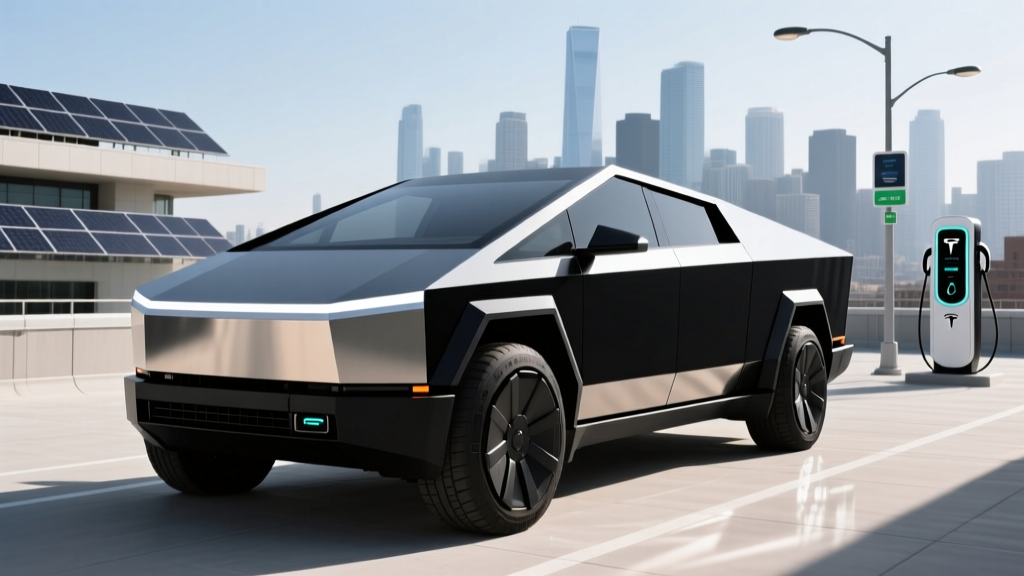
Quick Verdict: The Cybertruck in Stealth Black
Love it or hate it, the Tesla Cybertruck is an undeniable conversation piece. For 2026, the Cybertruck continues to offer a stainless steel exoskeleton, angular design, and a powertrain lineup that ranges from a practical dual-motor AWD to the ferocious tri-motor Cyberbeast. The Stealth Black appearance package — a darkened window-tint and trim treatment over the raw stainless panels — has become one of the most-requested configurations, giving the truck a more subdued, tactical aesthetic without compromising the unpainted body's dent resistance.
But beyond the looks, does the Cybertruck deliver as a daily driver, a tow rig, and a road-trip companion? We break down the exact numbers — EPA range, real-world highway efficiency, DC fast-charge curves, tax credit eligibility, and ownership costs — so you can make an informed decision.
Range, Efficiency & Real-World Expectations
The 2026 Cybertruck lineup offers two primary battery-equipped configurations currently in production: the Long Range AWD and the Cyberbeast (tri-motor AWD). Tesla quotes a usable battery capacity of approximately 123 kWh for both trims, using a high-nickel NMC (nickel-manganese-cobalt) chemistry optimized for energy density and sustained power delivery.
| Trim | EPA Est. Range | Real-World Highway (70 mph) | Cold Weather (20°F) |
|---|---|---|---|
| Long Range AWD | 340 miles | ~270–290 miles | ~220–250 miles |
| Cyberbeast (Tri-Motor) | 320 miles | ~255–275 miles | ~210–240 miles |
Sources: EPA Fuel Economy, manufacturer data, real-world testing.
The Cybertruck's slab-sided, angular shape creates a higher drag coefficient than sleeker EVs, which means highway efficiency drops noticeably above 65 mph. In mixed city/highway driving at moderate temperatures, owners typically see 290–320 miles on the Long Range trim. In cold weather, the heat pump helps, but battery chemistry limitations and cabin heating still reduce range by 25–35%. If you live in the northern tier and commute long distances in winter, plan for roughly 220–250 miles of usable range before needing to charge.
Efficiency ratings from the EPA put the Long Range AWD at approximately 2.0 kWh/mile (50 MPGe combined), while the Cyberbeast, with its tri-motor powertrain and heavier curb weight, sits closer to 2.2 kWh/mile (46 MPGe combined). These figures are competitive with the Rivian R1T but less efficient than the Ford F-150 Lightning Extended Range.
Charging Speed: DC Fast, Level 2 & Home Setup
The Cybertruck supports an 800-volt electrical architecture, enabling peak DC fast-charge rates up to 250 kW on Tesla Superchargers and compatible CCS/NACS stations. However, as with all EVs, peak rate is not sustained rate — the charge curve tapers significantly above 60% state of charge (SoC).
| Charge Level | Power / Rate | Time or Miles Added |
|---|---|---|
| Level 1 (120V household) | ~1.4 kW | ~3–4 miles per hour |
| Level 2 (240V, 48A Wall Connector) | 11.5 kW | ~34 miles per hour; full charge in ~11 hours |
| DC Fast Charge (NACS Supercharger) | Peak 250 kW | 10–80% in ~28–32 minutes |
| DC Fast Charge (CCS via adapter) | Peak ~200 kW | 10–80% in ~35–40 minutes |
On a V3 or V4 Tesla Supercharger, preconditioned battery management allows the Cybertruck to sustain 200+ kW from roughly 10% to 45% SoC, then taper to 150 kW through 60%, and drop further to under 80 kW above 80%. For road trips, plan charging stops around the 10–80% window — adding 200+ miles in roughly 25 minutes. Charging from 80–100% can take an additional 20+ minutes and is generally not worth the wait unless you need maximum range for a long stretch without chargers.
At home, Tesla's Wall Connector at 48 amps (11.5 kW) will replenish the 123 kWh battery from near-empty in about 11 hours. Most owners who drive 40–60 miles per day will only need to plug in every 2–3 days. If your home electrical panel supports a 60-amp circuit, this is the optimal setup. A panel upgrade from 100A to 200A service can cost $1,500–$3,000 depending on your region — factor this into your purchase budget.
Performance, Drivetrain & Towing
The 2026 Cybertruck offers two available trims with distinct performance profiles:
| Spec | Long Range AWD | Cyberbeast (Tri-Motor) |
|---|---|---|
| Drivetrain | Dual-Motor AWD | Tri-Motor AWD (torque vectoring) |
| Horsepower | 600 hp | 845 hp |
| 0–60 mph | 3.9 seconds | 2.6 seconds |
| Top Speed | 112 mph | 130 mph |
| Max Towing Capacity | 11,000 lbs | 11,000 lbs |
| Payload Capacity | 2,500 lbs | 2,500 lbs |
| Bed Length | 6 ft (72 in) | 6 ft (72 in) |
| Battery (usable) | ~123 kWh (NMC) | ~123 kWh (NMC) |
| EPA Range | 340 miles | 320 miles |
| MPGe (combined) | 50 MPGe | 46 MPGe |
| Warranty (Battery/Drive Unit) | 8 yr / 120,000 mi | 8 yr / 120,000 mi |
The dual-motor Long Range AWD delivers 600 horsepower and a 3.9-second 0–60 time, which is genuinely quick for a 6,800-pound truck. The Cyberbeast, with its tri-motor setup and torque vectoring rear axle, drops the 0–60 to a supercar-rivaling 2.6 seconds. Both trims feature adaptive air suspension with up to 16 inches of ground clearance in Off-Road mode, and a 4-wheel steer system that tightens the turning circle to 34.7 feet — remarkably tight for a full-size pickup.
Towing is rated at 11,000 pounds for both trims, competitive with the F-150 Lightning and Rivian R1T. However, towing at max capacity will reduce range by 40–50%, bringing real-world towing range to roughly 150–180 miles. If you tow frequently over long distances, plan charging stops accordingly.
Interior, Cargo & Tech
The Cybertruck's interior is minimalist and tech-forward, dominated by an 18.5-inch front touchscreen and a 9.4-inch rear touchscreen for passengers. The front row offers 41.5 inches of legroom, while the rear seat provides 37.2 inches — adequate for adults on shorter trips but tighter than a full-size crew cab like the F-150.
Cargo space includes:
- Bed volume: 67 cu ft (6-foot bed with powered tonneau cover)
- Front trunk (frunk): 7.1 cu ft — large enough for a charging cable kit and a small cooler
- Rear under-seat storage: Additional concealed compartment
The powered retractable tonneau cover is a standout feature, providing lockable, weather-sealed bed storage. The bed also includes built-in 120V and 240V outlets (Powershare), enabling vehicle-to-load (V2L) capability — you can run power tools, a campsite, or even a small welder directly from the truck's battery.
On the tech side, the Cybertruck includes Tesla's latest HW4 Autopilot hardware, enabling Autosteer, Navigate on Autopilot, and Smart Summon. Full Self-Driving (Supervised) remains an optional $8,000 add-on or $99/month subscription, but it is critical to understand that FSD is an SAE Level 2 driver-assist system — the driver must remain fully engaged, with hands on the wheel and eyes on the road at all times. It is not autonomous driving.
Pricing, Trims & Federal Tax Credit Eligibility
For 2026, the Cybertruck is available in two main trims. Tesla periodically adjusts pricing, so always confirm current MSRP on the official configurator before ordering.
| Trim | Base MSRP | Stealth Black Pkg | As-Tested (w/ FSD) | §30D Credit Eligible? |
|---|---|---|---|---|
| Long Range AWD | $79,990 | +$3,000 | ~$91,990 | No — exceeds $80,000 MSRP cap for trucks |
| Cyberbeast | $99,990 | +$3,000 | ~$111,990 | No — exceeds $80,000 MSRP cap for trucks |
Under current IRS §30D rules, the federal EV tax credit of up to $7,500 has an MSRP cap of $80,000 for trucks, vans, and SUVs. The Cybertruck Long Range AWD starts just under this threshold at $79,990, but once you add the Stealth Black package, destination fee, or any options, the vehicle MSRP exceeds the cap and becomes ineligible. The Cyberbeast, at $99,990 base, is well above the limit.
Additionally, §30D eligibility requires:
- Buyer income cap: Modified AGI ≤ $150,000 (single) / $300,000 (joint)
- Battery sourcing: Critical minerals and battery components must meet phased-in domestic/free-trade requirements (check current-year IRS guidance)
- Point-of-sale transfer: Eligible buyers can transfer the credit to the dealer for an immediate price reduction
- VIN verification: Vehicle must be on the IRS qualified manufacturers list
Bottom line: most Cybertruck buyers will not qualify for the federal tax credit due to the MSRP cap. Consult a tax professional and verify current-year rules at IRS.gov before making a purchase decision based on credit eligibility.
Pros, Cons & Who Should Buy
Pros
- Distinctive stainless steel body — no paint to scratch, dent-resistant exoskeleton
- Class-leading 0–60 performance, especially Cyberbeast at 2.6 seconds
- 11,000-lb towing capacity with integrated trailer brake controller
- V2L (Powershare) — run tools and appliances from the bed outlets
- 4-wheel steer for a remarkably tight turning radius
- Access to the Tesla Supercharger network (17,000+ stalls nationwide)
- Over-the-air updates continuously add features
Cons
- Aerodynamic penalty — highway range drops sharply above 70 mph
- Does not qualify for the $7,500 federal tax credit at most trims
- Rear seat legroom tighter than traditional full-size crew cabs
- Stainless steel shows fingerprints and water spots (especially on Stealth Black accents)
- Single-pane glass and minimal sound insulation — noticeable road/wind noise
- Wiper and camera placement can obscure visibility in heavy rain
- Insurance premiums 20–35% higher than comparable trucks (per industry data)
- Choose the Long Range AWD if: You want a fast, capable electric truck for daily commuting, weekend towing, and road trips, and you value Supercharger access and V2L capability over traditional truck comfort.
- Choose the Cyberbeast if: Performance is the priority — you want a truck that outruns most sports cars off the line and you're willing to accept a small range and efficiency trade-off.
- Look elsewhere if: You need maximum rear-seat space for a family, want federal tax credit eligibility, prefer a quieter cabin, or regularly tow over 200+ miles without charging access.
Stealth Black Finish: Ownership Notes
The Stealth Black package does not paint the stainless steel body panels — Tesla's exoskeleton remains unpainted and raw. Instead, the package includes darkened window tint, black badging, black wheel options, and dark trim accents. The visual effect is striking, but owners should be aware:
- Stainless steel care: The raw panels require specific cleaning products (Tesla recommends their Stainless Steel Cleaner). Water spots, fingerprints, and environmental contaminants are more visible on the dark-accent configuration.
- No paint protection film (PPF): Traditional PPF cannot be applied to the stainless body, though ceramic coatings designed for bare metal are available from third-party detailers.
- Scratch behavior: While the steel is highly dent-resistant, surface scratches can occur from brushes, branches, or car washes. Light scuffs can sometimes be buffed out with a Scotch-Brite pad following the grain direction.
Warranty & Long-Term Ownership
Tesla covers the Cybertruck with the following warranty terms:
- Limited Vehicle Warranty: 4 years / 50,000 miles (bumper to bumper)
- Battery & Drive Unit Warranty: 8 years / 120,000 miles, with a minimum 70% capacity retention threshold
- Restraint System: 5 years / 60,000 miles
- Corrosion (perforation): 12 years / unlimited miles
The 123 kWh NMC battery pack is engineered for longevity, but as with all lithium-ion batteries, expect gradual degradation. Industry data from Tesla's fleet reports approximately 12–15% degradation over 150,000 miles for NMC packs under normal use. Heavy DC fast-charging, frequent 100% SoC storage, and extreme heat can accelerate this. Tesla recommends daily charging to 80–90% for NMC chemistry, reserving 100% for road trips only.
Battery replacement cost, should it ever be needed out of warranty, is estimated at $15,000–$20,000 based on current Tesla service pricing for large packs. However, most EV batteries outlast the vehicle's useful life when properly maintained.
Frequently Asked Questions
What is the real-world range of the Cybertruck?
The EPA rates the Long Range AWD at 340 miles and the Cyberbeast at 320 miles. In real-world highway driving at 70 mph, expect roughly 270–290 miles (Long Range) and 255–275 miles (Cyberbeast). In cold weather below freezing, range can drop to 220–250 miles due to battery chemistry limitations and cabin heating demands.
How fast does the Cybertruck charge?
On a Tesla Supercharger, the Cybertruck can peak at 250 kW and charge from 10–80% in approximately 28–32 minutes. On a CCS station with an adapter, expect peak rates around 200 kW and 10–80% in 35–40 minutes. At home on a Level 2 Wall Connector (11.5 kW), a full charge takes roughly 11 hours.
Does the Cybertruck qualify for the $7,500 federal EV tax credit?
Under current IRS §30D rules, the truck MSRP cap is $80,000. The Long Range AWD starts at $79,990, but adding any options (including the Stealth Black package) pushes it above the cap. The Cyberbeast at $99,990 is ineligible. Income limits and battery-sourcing requirements also apply. Always verify current-year eligibility at IRS.gov and consult a tax professional.
Is the Cybertruck worth buying vs. the Rivian R1T or F-150 Lightning?
The Cybertruck excels in performance (especially the Cyberbeast), V2L capability, and Supercharger network access. The Rivian R1T offers a more refined interior, better rear-seat comfort, and a more traditional truck bed. The F-150 Lightning provides a more familiar driving experience, better sound insulation, and Pro Power Onboard. If raw performance and tech-forward design are priorities, the Cybertruck is compelling. If comfort, practicality, and tax credit eligibility matter more, the R1T and Lightning are strong alternatives.
What are the biggest pros and cons of the Cybertruck?
Top pros: blistering acceleration, 11,000-lb towing, V2L power outlets, dent-resistant stainless body, Supercharger access, and 4-wheel steer. Top cons: no federal tax credit at most trims, highway range drops due to aerodynamics, tight rear seat, road noise, and elevated insurance costs.
How does the Stealth Black package affect maintenance?
The Stealth Black package adds darkened trim and tint but does not change the stainless steel body. The raw steel requires specific cleaners to maintain appearance, and water spots or fingerprints are more noticeable with dark accents. No paint protection film can be applied, but ceramic coatings designed for bare stainless are available.
Is Tesla's FSD actually self-driving?
No. Tesla Full Self-Driving (Supervised) is an SAE Level 2 driver-assist system. It can handle steering, acceleration, and braking on highways and some city streets, but the driver must remain fully engaged — hands on the wheel, eyes on the road — at all times. It is not an autonomous system. True self-driving (Level 4) is currently limited to geofenced robotaxi services like Waymo.
Sources: EPA Fuel Economy, Tesla Cybertruck Specifications, IRS §30D Clean Vehicle Credit, NHTSA Automated Vehicle Safety.