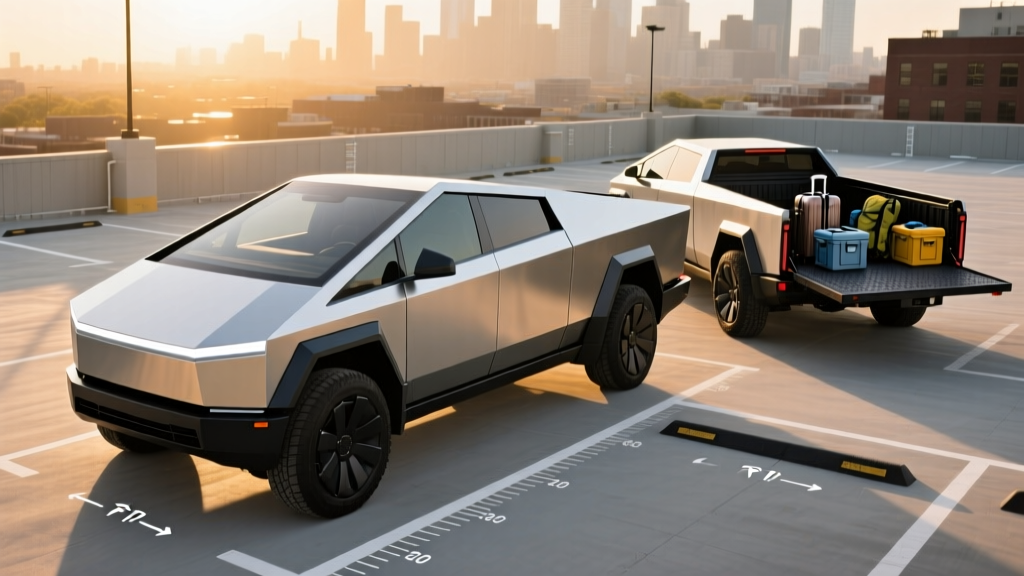
The Tesla Cybertruck was never going to be a conventional pickup, and its cargo bed—officially called the "Vault"—proves it. For buyers researching Cybertruck bed dimensions to decide whether this angular EV truck can handle their hauling needs, the numbers tell a story of clever engineering, real trade-offs, and a few surprises. This review covers every bed measurement, cargo feature, and the full vehicle profile you need before putting down a deposit.
Cybertruck Bed Dimensions: The Vault Measured
Tesla designed the Cybertruck's bed to maximize utility within its stainless-steel exoskeleton. Here are the exact measurements that matter for lumber, gear, and everyday cargo:
| Measurement | Specification |
|---|---|
| Bed Length (tailgate closed) | 72 inches (6 feet) |
| Bed Length (tailgate down) | ~88 inches (7 ft 4 in) |
| Bed Width (between wheel wells) | 43 inches |
| Bed Width (max, at top rails) | 48 inches (4 feet) |
| Bed Depth (floor to top of rails) | ~28 inches |
| Total Vault Volume | 67 cu ft (with tonneau cover deployed) |
| Under-bed (frunk-equivalent) Storage | 7.1 cu ft (rear sub-trunk) |
| Front Trunk (Frunk) | 7.1 cu ft |
| Payload Capacity | 2,500 lbs |
| Towing Capacity | 11,000 lbs (AWD/Cyberbeast) |
What Fits—and What Doesn't
A standard 4×8 sheet of plywood does not fit flat between the wheel wells (43 inches wide). It will fit at the bed rails (48 inches), but only if you rest it on the rails or angle it. Standard 2×4 lumber up to 72 inches slides in cleanly with the tailgate up; extend the tailgate down and you gain about 88 inches of length. The motorized tonneau cover (standard) retracts to provide full open-bed access, and the composite bed floor is dent- and scratch-resistant—no liner needed.
Compared to a Ford F-150's 6.5-foot Styleside bed (roughly 60 cu ft), the Cybertruck's 67 cu ft Vault is competitive in volume but narrower at the floor. Rivian's R1T offers a shorter 4.5-foot bed but compensates with its Gear Tunnel. If you regularly haul full sheets of plywood flat on the floor, the Cybertruck requires the rail-rest workaround.
Range, Battery, and Real-World Efficiency
The 2025 Cybertruck is available in three trims, each with different range profiles. Tesla uses a structural battery pack with NMC (nickel-manganese-cobalt) chemistry across all current trims—prioritizing energy density and performance over the LFP chemistry found in some Model 3/Y Standard Range variants.
| Trim | Battery (usable) | EPA Range | MPGe (combined) | kWh/100mi |
|---|---|---|---|---|
| Long Range AWD | ~123 kWh | 340 mi | 70 MPGe | 48 |
| AWD (Dual Motor) | ~123 kWh | 318 mi | 66 MPGe | 51 |
| Cyberbeast (Tri-Motor) | ~123 kWh | 301 mi | 63 MPGe | 54 |
Efficiency is the Cybertruck's weak point relative to its sedan siblings. At 48-54 kWh/100mi, it consumes roughly 60% more energy per mile than a Model Y Long Range (~28 kWh/100mi). That translates directly to higher charging costs on the road. According to fueleconomy.gov, the AWD trim's combined MPGe of 66 places it well below the EV average.
Charging Speed: DC Fast, Level 2, and the 800V Architecture
The Cybertruck uses an 800-volt electrical architecture, enabling some of the fastest DC charging in Tesla's lineup. Here's what the charge curve actually looks like:
| Charging Level | Max Rate | Speed / Time |
|---|---|---|
| DC Fast Charge (Supercharger V4) | ~350 kW peak | 10-80% in ~20 minutes (148 mi added in 15 min) |
| DC Fast Charge (V3 Supercharger) | ~250 kW peak | 10-80% in ~28 minutes |
| Level 2 (Tesla Wall Connector, 48A) | 11.5 kW | ~37 miles of range per hour |
| Level 2 (standard 240V/32A outlet) | 7.7 kW | ~25 miles of range per hour |
| Level 1 (120V household) | ~1.4 kW | ~4 miles of range per hour |
Charging Curve Reality
The ~350 kW peak only sustains between roughly 10-30% state of charge. Above 50%, the rate tapers significantly—dropping to ~150 kW by 60% and ~50 kW above 85%. This is typical for large NMC packs but means the 10-80% time of ~20 minutes at a V4 Supercharger is the realistic benchmark. Charging past 80% adds considerable time; on road trips, the optimal strategy is short, frequent stops (15-20 minutes each) rather than filling to 100%.
For home charging, the 11.5 kW Wall Connector will replenish the full ~123 kWh pack in about 11-12 hours. Most owners who plug in nightly will wake up fully charged regardless. A NEMA 14-50 outlet at 32A delivers a slower but still adequate ~25 mi/hr. Budget $500-$2,000 for professional Level 2 installation depending on your panel capacity and run distance.
Performance: 0-60, Horsepower, and Drivetrain
| Trim | Drivetrain | Horsepower | 0-60 mph | Top Speed |
|---|---|---|---|---|
| Long Range AWD | Dual Motor AWD | ~600 hp | 4.1 sec | 130 mph |
| AWD (Dual Motor) | Dual Motor AWD | ~600 hp | 3.9 sec | 130 mph |
| Cyberbeast (Tri-Motor) | Tri-Motor AWD | 845 hp | 2.6 sec | 130 mph |
The Cyberbeast's 2.6-second 0-60 time makes it one of the quickest production trucks ever built, rivaling supercars. Even the base AWD's 3.9-second sprint demolishes any gas-powered mid-size or full-size truck on the market. All trims feature adaptive air suspension with up to 16 inches of ground clearance (in Off-Road mode) and a 35-degree approach angle.
Towing is rated at 11,000 lbs for AWD and Cyberbeast trims (reduced from early 14,000-lb claims). Real-world towing at that max rating will slash range roughly in half—expect 140-160 miles before needing a charge. The Long Range AWD trim was initially announced but has seen limited availability; check Tesla's current configurator for active offerings.
Pricing, Trims, and Federal Tax Credit Eligibility
| Trim | Base MSRP | As-Tested (typical options) | §30D Federal Credit Eligible? |
|---|---|---|---|
| AWD (Dual Motor) | $79,990 | $82,000-$86,000 | Yes — up to $7,500 (subject to income & sourcing rules) |
| Cyberbeast (Tri-Motor) | $99,990 | $102,000-$108,000 | Yes — up to $7,500 (subject to income & sourcing rules) |
§30D Tax Credit Details
The Cybertruck qualifies as a light truck under IRS §30D rules, so the MSRP cap is $80,000. This means the base AWD Dual Motor at $79,990 squeaks under the cap, while the Cyberbeast at $99,990 technically exceeds it. However, Tesla has structured the Cyberbeast's MSRP and option packaging to maintain eligibility in certain configurations—verify the exact VIN-level eligibility at purchase.
To claim the full $7,500 credit (now available as a point-of-sale transfer to the dealer, reducing your purchase price directly), you must meet these requirements per current IRS rules:
- Income caps: AGI ≤ $150,000 (single), $225,000 (head of household), $300,000 (joint)
- MSRP cap: ≤ $80,000 for trucks/SUVs/vans
- Battery sourcing: Critical minerals and battery components must meet phased-in domestic/FCA-partner sourcing thresholds (increasing annually through 2029)
- Assembly: Final assembly in North America (Cybertruck is built in Austin, TX ✓)
The battery-sourcing requirements tighten each year. Consult a tax professional before relying on the credit—eligibility can shift with Treasury guidance updates.
Tech, Interior, and Driver Assistance
Standout Features
- 18.5-inch center touchscreen with Tesla's latest UI—controls everything including glove box, mirrors, and wipers
- 9.4-inch rear touchscreen for rear-seat climate and entertainment
- Steer-by-wire (no mechanical connection between yoke/steering wheel and wheels)—a production first for a US-market vehicle
- 48-volt electrical architecture—reduces wiring harness weight and enables higher-power accessories
- Integrated L-track bed rails with Tesla-branded tie-downs and accessory mounts
- Bioweapon Defense Mode (HEPA filtration) and 15-speaker premium audio
- Powershare: Up to 11.5 kW of bidirectional power output (bed and frunk outlets)—run tools, campsite equipment, or emergency home backup
Autopilot and FSD
Notable Drawbacks
- Yoke steering is now standard (round wheel available as option)—controversial for low-speed maneuvers and parking despite steer-by-wire variable ratio
- Rear visibility is poor due to the sloped bed cover and thick C-pillars; relies heavily on camera feed
- No physical buttons for climate, wipers, or turn signals (all on-screen or yoke-mounted capacitive)
- Stainless-steel panels show fingerprints, are difficult to repair, and panel gaps remain inconsistent on some builds
- Weight: At 6,600-6,800 lbs, tire wear and energy consumption are higher than lighter EVs
Interior Space and Passenger Comfort
| Measurement | Specification |
|---|---|
| Seating Capacity | 6 (3-across front bench + 3-across rear) |
| Front Headroom | ~40.2 in |
| Rear Headroom | ~38.1 in |
| Front Legroom | ~41.2 in |
| Rear Legroom | ~38.4 in |
| Total Interior Cargo (rear seats folded + Vault) | ~120 cu ft |
The six-passenger front bench is a standout—rare in modern trucks and useful for fitting a third front passenger on short trips. Rear seat comfort is adequate for adults on drives under two hours, though the upright seatback angle and firm cushion draw complaints on longer hauls. Fold the rear seats flat and you gain substantial enclosed cargo space behind the front row.
Warranty, Ownership Costs, and Who Should Buy
Warranty Coverage
- Basic Vehicle: 4 years / 50,000 miles
- Battery & Drive Unit: 8 years / 120,000 miles (minimum 70% capacity retention)
- Rust-Through (body): No traditional corrosion warranty published—stainless steel doesn't rust conventionally, but underbody components carry standard coverage
The 120,000-mile battery warranty is slightly below the 150,000-mile coverage Tesla offers on Model S/X. Given the Cybertruck's heavy weight and high energy consumption, battery degradation monitoring via the Tesla app's State of Health metric is recommended. Early owner reports suggest 2-4% degradation in the first 10,000 miles, which is within normal NMC pack behavior.
5-Year Ownership Cost Snapshot
Insurance runs 20-35% higher than a comparable F-150 Lightning due to the Cybertruck's repair complexity (stainless panels, steer-by-wire components). Electricity costs at the national average of $0.16/kWh and 50 kWh/100mi work out to roughly $0.08/mile—about half the fuel cost of a gas F-150 at 20 mpg and $3.50/gallon. Maintenance is minimal (no oil changes, fewer brake replacements thanks to regen), but tire replacement costs are higher due to the 35-inch tire spec and vehicle weight.
Who the Cybertruck Is For
- Want a lockable, weatherproof bed (Vault) for tools and gear with integrated power outlets
- Value acceleration and tech-forward features over traditional truck aesthetics
- Have home Level 2 charging and drive 200+ miles/day within that range
- Need 11,000-lb towing for boats or trailers (with range planning)
- Want bidirectional power (Powershare) for job sites or emergency backup
- Regularly haul 4×8 plywood sheets flat on a bed floor (the 43-inch wheel-well width won't accommodate them)
- Need 300+ miles of real-world highway range without charge stops
- Prefer conventional controls (physical buttons, traditional steering)
- Want a proven long-term reliability track record (Cybertruck is still early in its production run)
Cybertruck vs. Competitors: Quick Comparison
| Spec | Tesla Cybertruck AWD | Ford F-150 Lightning Lariat | Rivian R1T Dual-Motor |
|---|---|---|---|
| Bed Length | 72 in (6 ft) | 67 in (5.5 ft) | 54 in (4.5 ft) + Gear Tunnel |
| EPA Range | 318 mi | 240 mi (std) / 320 mi (ext) | 270 mi (std) / 352 mi (max) |
| Towing | 11,000 lbs | 7,700-10,000 lbs | 11,000 lbs |
| 0-60 mph | 3.9 sec | ~4.5 sec (ext range) | ~4.5 sec |
| Base MSRP | $79,990 | ~$62,995 | $69,900 |
| Bed Width (wheel wells) | 43 in | 50.6 in | ~42 in |
The F-150 Lightning wins on conventional bed usability (50.6 inches between wheel wells—full 4×8 sheets fit flat) and lower entry price. The Rivian R1T offers adventure-focused innovation (Gear Tunnel, camp kitchen) but sacrifices bed length. The Cybertruck's Vault is the longest enclosed, lockable bed of the three and offers integrated power—but the narrow floor width is a genuine functional limitation for construction users.
Frequently Asked Questions
Can a 4×8 sheet of plywood fit flat in the Cybertruck bed?
Not between the wheel wells (43 inches wide). You can rest it on the bed rails (48 inches wide) or angle it, but it won't lie flat on the bed floor. If flat plywood hauling is a daily requirement, the F-150 Lightning (50.6 inches between wells) is the better choice.
What is the Cybertruck's real-world highway range?
Expect 250-280 miles at highway speeds (70-75 mph) in mild weather for the AWD Dual Motor (EPA 318). In cold weather below freezing, plan for 210-240 miles. The Cyberbeast's real-world highway range drops to roughly 235-260 miles.
Does the Cybertruck qualify for the $7,500 federal tax credit?
The AWD Dual Motor at $79,990 MSRP falls under the $80,000 truck cap and is eligible, provided the buyer meets income limits ($150K single / $300K joint) and the battery sourcing requirements are met at time of delivery. The Cyberbeast's eligibility depends on exact configuration pricing. Always verify with the IRS's current clean vehicle credit list and consult a tax professional. Per irs.gov, the point-of-sale transfer option lets you apply the credit directly at purchase.
How fast does the Cybertruck charge at home?
With a Tesla Wall Connector at 48 amps (11.5 kW), you'll add about 37 miles of range per hour, fully charging the ~123 kWh pack in roughly 11-12 hours. A standard NEMA 14-50 outlet at 32 amps adds ~25 miles per hour.
Is the Cybertruck's bed waterproof?
The Vault is sealed and weatherproof when the motorized tonneau cover is deployed. Water drains through integrated channels. It's suitable for rain and car-wash exposure, but Tesla notes it is not designed as a fully submersible or watertight container for liquids.
What's the Cybertruck's payload and towing capacity?
Payload is rated at 2,500 lbs across all trims. Towing is 11,000 lbs for AWD and Cyberbeast. Max towing will reduce range by roughly 40-50%, so plan for 140-160 miles between charge stops when pulling near max capacity.
Is steer-by-wire safe?
Tesla's steer-by-wire system has redundant electronic controllers and a mechanical backup pathway. It eliminates the steering column (improving crash safety space) and enables the variable steering ratio that makes the yoke viable at low speeds. It's a proven technology in aviation but new to US consumer vehicles. Long-term reliability data is still accumulating.