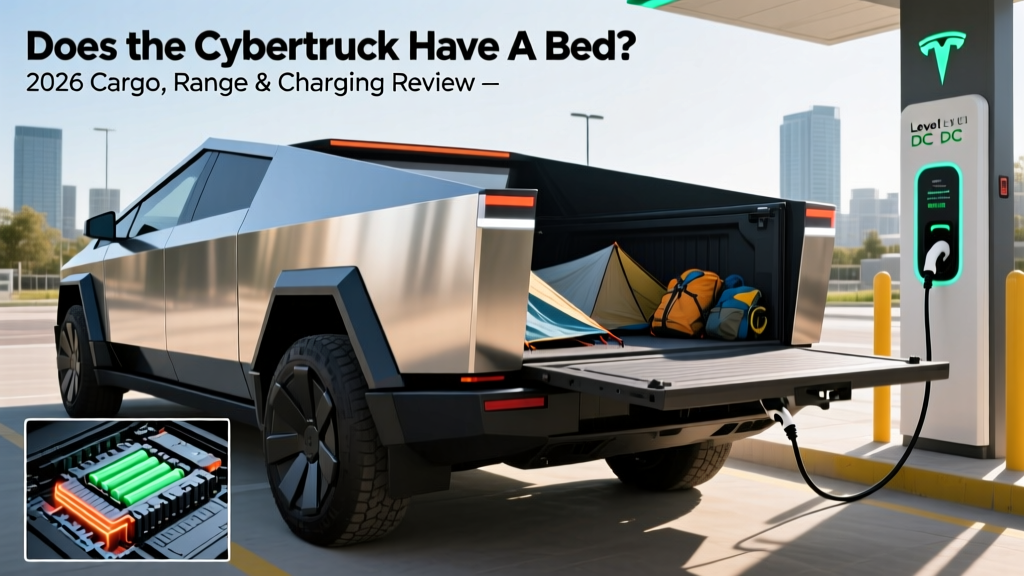
If you've seen the Tesla Cybertruck on the road and wondered, does the Cybertruck have a bed? — the answer is yes, and it's one of the most unconventional cargo boxes ever fitted to a production pickup. Measuring roughly 6.5 feet long with a motorized retractable tonneau cover, the Cybertruck's bed (Tesla calls it the "vault") offers 67 cubic feet of lockable, weather-sealed storage. But a truck is more than its bed. Below, we break down the 2026 Cybertruck's real-world range, DC fast-charging curve, battery chemistry, pricing after federal tax credits, and whether it stacks up against the Rivian R1T and Ford F-150 Lightning for actual truck duty.
Tesla Cybertruck Quick Specs: Range, Battery, and Performance
Before we dig into the bed itself, here's a spec-table snapshot of the 2026 Cybertruck lineup. Tesla offers three trims — Dual Motor All-Wheel Drive, Cyberbeast (tri-motor), and the long-awaited Rear-Wheel Drive (expected later in 2026). All current deliveries use the Dual Motor or Cyberbeast configuration.
| Spec | Dual Motor AWD | Cyberbeast (Tri-Motor) |
|---|---|---|
| EPA Range | 340 miles | 320 miles |
| Battery (usable, est.) | ~123 kWh | ~123 kWh |
| Chemistry | NMC (Nickel Manganese Cobalt) | NMC |
| Horsepower | 600 hp | 845 hp |
| 0-60 mph | 4.1 seconds | 2.6 seconds |
| Drivetrain | Dual Motor AWD | Tri-Motor AWD |
| Max Tow Capacity | 11,000 lbs | 11,000 lbs |
| MPGe (combined) | 67 MPGe | 65 MPGe |
| Efficiency | 50 kWh/100 mi | 52 kWh/100 mi |
| Base MSRP (2026) | $79,990 | $99,990 |
The Cybertruck Bed: Dimensions, Features, and Utility
Now to the question at hand: does the Cybertruck have a bed, and can it actually function as a work truck? The Cybertruck's bed measures approximately 72 inches long (6 feet) × 48 inches wide between the wheel wells, with a depth of roughly 22 inches. Total cargo volume is 67 cubic feet — competitive with short-bed midsize pickups but notably smaller than a full-size F-150's 5.5-foot Styleside box (52.8 cu ft) or its 6.5-foot option (62.3 cu ft), though the Cybertruck's enclosed design changes the calculus.
Key bed features that set the Cybertruck apart:
- Motorized retractable tonneau cover: The bed is fully enclosed by default. The cover rolls open and closed electrically, and it's rated to support up to 300 lbs of distributed weight on top — useful for roof-top tent camping or hauling long items like lumber or kayaks on the roof of the bed.
- Integrated 120V and 240V power outlets: The bed includes two 120V household outlets and one 240V NEMA 14-50 outlet, enabling the Cybertruck to power tools, appliances, or even supply backup power to a home via Tesla's PowerShare V2H system (up to 11.5 kW continuous output).
- Lockable and weather-sealed: Unlike an open pickup bed, the Cybertruck's vault is completely enclosed when the tonneau is shut, making it theft-resistant and waterproof — a significant advantage for contractors carrying expensive equipment or commuters who leave gear in the truck overnight.
- Integrated ramp: Tesla sells an optional aluminum loading ramp that tucks under the bed floor, rated for ATV and motorcycle loading.
- Compressed air outlet: A built-in air compressor with a bed-mounted outlet supports tire inflation and pneumatic tools.
The tradeoff? The enclosed design means you cannot easily load items taller than roughly 22 inches unless the tonneau is open. For traditional truck users who toss in tall equipment, lumber stacks, or use a bed-mounted crane, this requires adaptation. The 6-foot length also falls short of the 6.5- and 8-foot beds common on full-size trucks, so 4×8 sheets of plywood will not lie flat between the wheel wells — they must ride on top of the closed tonneau or be loaded at an angle.
Charging Speed: DC Fast Charge, Level 2, and the Charge Curve
Charging speed is where the Cybertruck's 800-volt architecture earns its keep. On a Tesla V4 Supercharger or compatible 350-kW CCS station (with adapter), the Cybertruck peaks at approximately 325 kW of DC fast-charge power. Here's what that looks like in practice:
| Charging Level | Max Power | Speed (Miles Added per Hour) | Notes |
|---|---|---|---|
| Level 1 (120V household) | 1.4 kW | ~3 mi/hr | Emergency/trickle only |
| Level 2 (240V, 48A) | 11.5 kW | ~30 mi/hr | Home Wall Connector; full charge overnight |
| DC Fast Charge (V4 Supercharger) | 325 kW peak | ~150 mi in 15 min | 10-80% in ~22 minutes |
| DC Fast Charge (250-kW V3) | 250 kW peak | ~120 mi in 15 min | 10-80% in ~28 minutes |
Understanding the charge curve: The Cybertruck does not sustain 325 kW for the entire session. Peak power is available between roughly 10-30% State of Charge (SoC), after which the rate tapers. By 60% SoC, expect ~180 kW; above 80%, charging slows dramatically to ~50-70 kW to protect the NMC battery cells. This is why Tesla (and every EV manufacturer) quotes 10-80% times rather than 0-100%. For road trips, plan your stops around the 10-80% window — roughly 22 minutes at a V4 Supercharger — and you'll add about 200 miles per stop.
For home charging, a Tesla Wall Connector on a 60-amp circuit delivers up to 11.5 kW (48 amps continuous). With the Cybertruck's ~123 kWh battery, a full charge from empty takes roughly 11-12 hours — practical for overnight top-ups. Most owners will arrive home at 40-60% SoC and wake up at 80-90%, which takes 5-7 hours. Tip: Set your daily charge limit to 80% to prolong NMC battery health; charge to 100% only before long trips.
Battery Chemistry, Degradation, and Warranty Coverage
The Cybertruck uses an NMC (nickel manganese cobalt) lithium-ion battery pack with an estimated usable capacity of ~123 kWh. NMC chemistry is chosen here for its high energy density — necessary to push a 6,600+ lb stainless-steel truck past 300 miles of range. The tradeoff versus LFP (lithium iron phosphate) is that NMC degrades faster if routinely charged to 100% or exposed to extreme heat, which is why Tesla recommends an 80% daily limit.
Tesla's battery and drive unit warranty for the Cybertruck:
- Battery: 8 years / 150,000 miles, whichever comes first, with a minimum 70% capacity retention guaranteed over the warranty period.
- Drive Unit (motors and inverter): 8 years / 150,000 miles.
- Vehicle Limited Warranty: 4 years / 50,000 miles bumper-to-bumper.
Based on data from Tesla's higher-volume Model 3 and Model Y packs (which share similar NMC cell suppliers), real-world degradation typically runs 8-12% over the first 100,000 miles, with the steepest drop occurring in the first 10,000-20,000 miles before leveling off. At 150,000 miles, most Tesla NMC packs retain 85-90% of original capacity — well above the 70% warranty threshold. The Cybertruck's thermal management system (active liquid cooling and heating) further protects longevity, especially during repeated DC fast-charging sessions or heavy towing.
Pricing, Trim Levels, and Federal Tax Credit Eligibility
The 2026 Cybertruck lineup has simplified after Tesla discontinued the limited "Foundation Series" packages that inflated early-delivery prices in 2024. Here's where pricing stands:
| Trim | Base MSRP | Federal §30D Credit | Effective Price (if eligible) |
|---|---|---|---|
| Dual Motor AWD | $79,990 | Up to $7,500 | ~$72,490 |
| Cyberbeast (Tri-Motor) | $99,990 | Up to $7,500 | ~$92,490 |
| Rear-Wheel Drive (expected late 2026) | $59,990 (announced) | Up to $7,500 | ~$52,490 |
Federal EV tax credit (§30D) rules for 2026 — key caveats:
- MSRP cap for trucks: The Cybertruck qualifies as a light truck under IRS rules, so the MSRP cap is $80,000. This means the Dual Motor AWD at $79,990 qualifies, but the Cyberbeast at $99,990 does not.
- Buyer income limits: Adjusted gross income must not exceed $150,000 (single), $225,000 (head of household), or $300,000 (married filing jointly).
- Battery sourcing requirements: A percentage of critical minerals and battery components must be sourced from the U.S. or free-trade-agreement partners. Tesla has significantly localized its supply chain, and the Dual Motor Cybertruck currently qualifies for the full $7,500 — but sourcing rules tighten annually. Always verify current eligibility on fueleconomy.gov before purchasing.
- Point-of-sale transfer: Under current IRS rules, you can transfer the credit to the dealer at purchase, reducing your out-of-pocket cost immediately rather than waiting to claim it on your tax return. This requires the dealer to be registered with the IRS Energy Credits Online portal.
For a comprehensive breakdown of current-year eligibility, consult the IRS clean vehicle credit page or speak with a tax professional.
Driver Assistance, Tech, and Interior
The Cybertruck's cabin is minimalist even by Tesla standards — a single 18.5-inch front touchscreen and a 9.4-inch rear touchscreen handle virtually all vehicle functions, climate controls, and entertainment. There are no physical gauges, no traditional stalks (turn signals are steering-wheel-mounted buttons), and no physical door handles (electronic push-buttons inside and out).
Notable tech features:
- Steer-by-wire: The Cybertruck eliminates the mechanical connection between the yoke and the wheels, using electronic actuators instead. This enables the variable-ratio steering rack (fewer turns lock-to-lock at low speeds) and a yoke that never obstructs the display. Redundant systems back up the primary actuators.
- 48-volt electrical architecture: A first in a production vehicle, reducing wiring harness weight by ~70% and enabling higher-power accessories (including the bed's 240V outlet).
- Adaptive air suspension: Up to 12 inches of ground clearance adjustment; the truck can raise for off-road obstacles and lower for highway efficiency and easier bed loading.
- Bioweapon Defense Mode: A HEPA-grade cabin air filtration system with positive pressurization.
Notable drawbacks include the yoke-style steering wheel, which remains polarizing for low-speed maneuvers and three-point turns; limited rear-seat headroom due to the angular roofline (35.2 inches rear legroom — adequate but not generous for a $80K+ truck); and panel-gap inconsistencies that, while improved since 2024 launch, still fall short of luxury-truck standards set by Rivian and the F-150 Lightning.
How the Cybertruck Compares: Rivian R1T and Ford F-150 Lightning
The Cybertruck's bed, range, and price place it squarely against two established electric pickups. Here's how they stack up:
| Spec | Cybertruck Dual Motor | Rivian R1T Dual Max (2026) | F-150 Lightning Lariat (2026) |
|---|---|---|---|
| EPA Range | 340 mi | 420 mi | 320 mi |
| Bed Length | 6.0 ft (enclosed) | 4.5 ft (open) + gear tunnel | 5.5 ft (open) |
| Max Tow | 11,000 lbs | 11,000 lbs | 10,000 lbs |
| 0-60 mph | 4.1 sec | 3.5 sec | 4.5 sec |
| DC Fast Charge Peak | 325 kW | 220 kW | 150 kW |
| Base MSRP | $79,990 | $87,900 | $67,990 |
| §30D Tax Credit | $7,500 (Dual Motor) | $7,500 | $7,500 |
The takeaway: The Cybertruck charges faster than either rival (325 kW vs. 220/150 kW), but the R1T offers significantly more range (420 miles on the Max pack) and a more practical open bed plus a unique gear tunnel for long-item storage. The F-150 Lightning is the value pick, undercutting both by $12,000+ while offering a conventional truck experience with a familiar form factor. The Cybertruck's enclosed, lockable bed is its unique advantage — ideal for urban professionals and contractors who need secure, weatherproof cargo space without a camper shell.
Pros
- Fastest-charging electric pickup (325 kW peak)
- Enclosed, lockable, weatherproof bed
- 240V bed outlet + V2H capability (11.5 kW)
- Stainless-steel exoskeleton — dent and corrosion resistant
- 11,000-lb towing with integrated trailer tech
- Steer-by-wire enables tight turning circle for its size
Cons
- 6-foot bed is shorter than most full-size trucks
- Enclosed bed limits tall-item loading
- Cyberbeast trim exceeds $80K MSRP cap — no tax credit
- Yoke steering is divisive and takes adaptation
- Highway range drops significantly due to aero drag
- Rear seat headroom is tight for taller passengers
Who Should Buy the Cybertruck?
The Cybertruck is best suited for buyers who want a secure, tech-forward electric truck for mixed urban and light-duty use — think architects, tech professionals, contractors who carry high-value tools, and outdoor enthusiasts who want V2H/V2L capability for camping. Its enclosed bed is a genuine differentiator for anyone who's ever wished their pickup had a trunk.
It's less ideal for traditional truck buyers who need an 8-foot bed for job-site materials, frequently tow at max capacity in cold climates (towing cuts range by 30-50%), or prioritize rear-seat passenger comfort. If range is your top priority, the Rivian R1T Dual Max at 420 miles EPA is the clear winner. If budget matters most, the F-150 Lightning at ~$60K after the tax credit is hard to beat.
Frequently Asked Questions
Does the Cybertruck have a bed that fits a 4×8 sheet of plywood?
Not flat on the bed floor. The 48-inch width between the wheel wells is sufficient, but the 72-inch (6-foot) bed length falls short of the 96 inches needed. You can carry a 4×8 sheet on top of the closed tonneau cover (rated for 300 lbs distributed), or angle it with the tailgate-style vault door open, but it won't lie flat inside the enclosed bed.
What is the real-world range of the Cybertruck on a road trip?
Expect 275-295 miles at highway speeds (70-75 mph) in moderate weather. In winter conditions below 30°F, plan for 230-260 miles. Preconditioning the battery while navigating to a Supercharger helps recover some cold-weather efficiency.
How fast does the Cybertruck charge at home?
On a Tesla Wall Connector (240V, 48 amps / 11.5 kW), the Cybertruck adds approximately 30 miles of range per hour. A typical overnight session (8 hours) adds ~240 miles — more than enough for daily use and most road-trip recovery.
Does the Cybertruck qualify for the $7,500 federal EV tax credit?
The Dual Motor AWD ($79,990 MSRP) qualifies for the full $7,500 credit under current §30D rules, provided the buyer meets income limits ($150K single / $300K joint) and the vehicle meets battery-sourcing requirements. The Cyberbeast ($99,990) does not qualify because it exceeds the $80,000 MSRP cap for light trucks. Always verify current eligibility at fueleconomy.gov.
Is the Cybertruck worth buying over the F-150 Lightning?
It depends on priorities. The Cybertruck charges faster (325 kW vs. 150 kW), has a more secure enclosed bed, and offers V2H backup power. The F-150 Lightning is $12,000+ cheaper, has a more conventional truck bed, and provides a more familiar driving experience. If fast charging and bed security are paramount, the Cybertruck wins. If value and practicality lead your decision, the Lightning is the stronger pick.
Can the Cybertruck power my home during an outage?
Yes. With Tesla's PowerShare vehicle-to-home (V2H) system, the Cybertruck can supply up to 11.5 kW of continuous power through its 240V bed outlet. This can sustain essential circuits (refrigerator, lights, HVAC fan, internet) for multiple days depending on usage and the truck's state of charge. A compatible home transfer switch is required.