Quick Verdict: The Cybertruck Beast in 2026
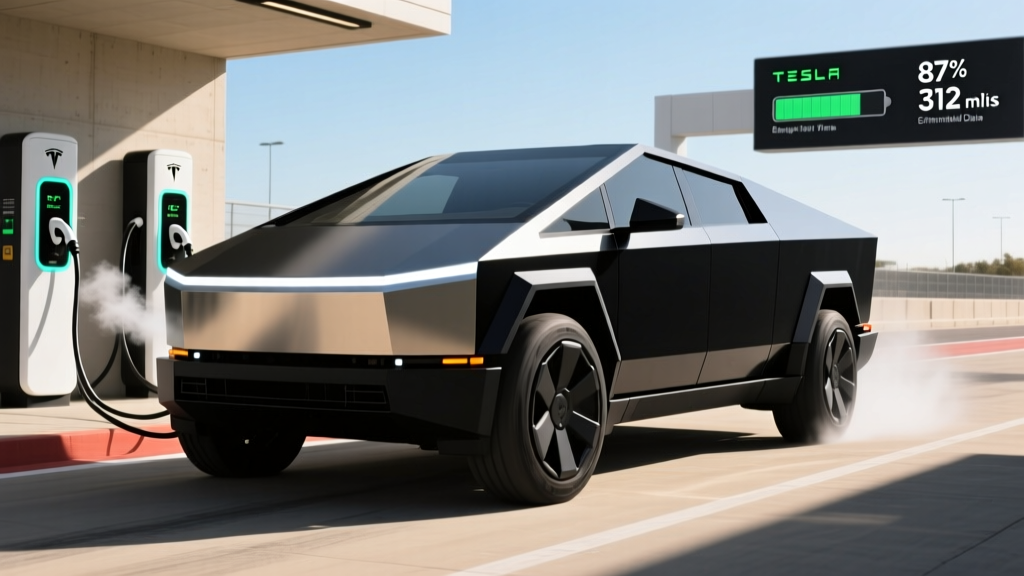
The Tesla Cybertruck Beast (formerly the Cyberbeast trim) remains the performance flagship of Tesla's electric pickup lineup. With 845 horsepower, a 2.6-second 0-60 mph time, and a stainless-steel exoskeleton that turns every parking lot into a car show, it's unlike anything else on the road. But beneath the angular drama lies a serious electric truck with real utility — and real compromises. This review breaks down the Cybertruck Beast's EPA range, charging behavior, pricing after federal incentives, and how it stacks up against the Rivian R1T, Ford F-150 Lightning, and GMC Sierra EV in 2026.
| Spec | Value |
|---|---|
| Base MSRP | $114,990 (before destination) |
| EPA Range | 320 miles |
| Battery Capacity | ~123 kWh usable (NMC chemistry) |
| Drivetrain | Tri-motor AWD |
| Horsepower | 845 hp |
| 0-60 mph | 2.6 seconds |
| Max DC Fast Charge | 250 kW (peak) |
| 10-80% DC Charge Time | ~30 minutes |
| Level 2 Home Charging | 11.5 kW (~37 mi/hr) |
| MPGe (Combined) | 69 MPGe |
| Efficiency | 48 kWh/100 mi |
| Towing Capacity | 11,000 lbs |
| Payload | 2,500 lbs |
| Battery Warranty | 8 years / 120,000 miles |
| Vehicle Warranty | 4 years / 50,000 miles |
Range and Efficiency: EPA vs. Real World
The Cybertruck Beast carries an EPA-estimated 320 miles of range. That figure comes from a roughly 123 kWh usable battery pack using NMC (nickel manganese cobalt) cell chemistry, which offers high energy density suited to the Beast's tri-motor powertrain and 7,000+ lb curb weight. However, as with every EV, the sticker number tells only part of the story.
- EPA Estimate: 320 miles
- Highway (70-75 mph, mild weather): ~265-285 miles
- City/Mixed Driving: ~290-310 miles
- Cold Weather (below 32°F, highway): ~210-240 miles
- Heavy Towing (near max capacity): ~140-170 miles
The Cybertruck's slab-sided, angular design creates more aerodynamic drag than a rounded body. At sustained highway speeds, efficiency drops to roughly 52-56 kWh/100 mi, cutting range significantly. In cold weather, battery preconditioning and cabin heating can reduce range by 25-35%. Tesla's heat pump helps mitigate this compared to resistive heating systems, but the physics of a 7,000-lb steel truck in winter remain unforgiving.
For context, the EPA's combined MPGe rating of 69 translates to 48 kWh per 100 miles. That's notably less efficient than a lighter EV like the Tesla Model Y (28 kWh/100 mi), but competitive with other full-size electric trucks. The EPA's fueleconomy.gov database lists the Cybertruck Beast at 69 MPGe combined, 70 city, and 68 highway.
Charging Speed: DC Fast, Level 2, and the Charge Curve
Charging is where the Cybertruck Beast's massive battery becomes both an asset and a time commitment. The truck supports up to 250 kW peak DC fast charging on Tesla's V3 and V4 Superchargers, as well as NACS-compatible third-party networks (Electrify America, EVgo, and others that now support the Tesla connector standard).
| Charge Level | Max Power | Speed | Typical Use |
|---|---|---|---|
| Level 1 (120V) | ~1.4 kW | ~4-5 mi/hr | Emergency / trickle |
| Level 2 (240V, 48A) | 11.5 kW | ~37 mi/hr | Home overnight |
| DC Fast (V3 Supercharger) | 250 kW peak | ~185 mi in 15 min (peak) | Road trips |
| DC Fast (10-80%) | Variable | ~30 minutes | Typical fast-charge stop |
The critical detail is the charge curve. The Cybertruck Beast hits its 250 kW peak only between roughly 10-25% state of charge (SoC). From 25-50%, power tapers to around 180-200 kW. Above 60%, it drops further to 100-120 kW, and above 80%, charging slows dramatically to protect the NMC cells — sometimes below 50 kW. This means a 10-80% session takes about 30 minutes, but a 10-95% session can stretch past 55 minutes. For road-trip planning, Tesla's navigation system automatically preconditions the battery when a Supercharger is set as your destination, warming the pack to optimize charge acceptance.
At home on a 240V/48A Level 2 wall connector, the Beast adds about 37 miles of range per hour, meaning a full 10-100% charge takes roughly 10-11 hours. Most owners who charge nightly from 30-80% will wake up to a full-adequate range every morning. A home Level 2 installation typically costs $800-$2,500 depending on panel capacity and run length — factor in a potential $500-$2,000 panel upgrade if your home still has a 100A service.
Performance: 845 HP and the Tri-Motor Advantage
The Cybertruck Beast's tri-motor setup places one motor on the front axle and two on the rear, delivering 845 horsepower and an estimated 740+ lb-ft of torque to all four wheels. The result: a 2.6-second 0-60 mph sprint that embarrasses most sports cars, let alone a pickup weighing over three tons.
Beyond straight-line speed, the tri-motor torque vectoring provides genuine off-road and traction benefits. Each rear wheel can receive independent torque, enabling precise control in low-grip scenarios. Tesla's adaptive air suspension offers up to 12.9 inches of ground clearance in Extract Mode and can lower the truck for highway efficiency or loading. The steer-by-wire system eliminates the mechanical connection between the yoke and the wheels, allowing variable steering ratios — fewer turns lock-to-lock at low speeds, more stability at highway pace. It takes adjustment, but most owners report acclimating within a week.
Towing capacity stands at 11,000 lbs, competitive with the F-150 Lightning (10,000 lbs) and Rivian R1T quad-motor (11,000 lbs). However, towing near max capacity roughly halves the Beast's range to 140-170 miles, making long-distance towing a frequent-charging endeavor.
Interior, Cargo, and Technology
The Cybertruck Beast seats five across two rows. Rear legroom measures approximately 38.2 inches — adequate for adults but tighter than a full-size crew cab like the F-150 Lightning (43.6 inches rear). The front trunk (frunk) provides roughly 7 cu ft of lockable storage, while the 6-foot bed offers 74 cu ft of volume. The vault-style tonneau cover is motorized and can support distributed loads, though it limits overhead access compared to a conventional open bed.
Tesla's 18.5-inch front touchscreen runs the latest Tesla OS, handling navigation, media, climate, and vehicle controls. A 9.4-inch rear touchscreen gives back-seat passengers independent climate and entertainment control. The Beast trim includes a premium 17-speaker audio system with Active Road Noise Reduction. Notable tech features:
- Autopilot (standard): Adaptive cruise, lane centering, automatic emergency braking — SAE Level 2 driver assistance requiring full driver engagement
- Full Self-Driving Supervised ($8,000 option or $99/mo): Adds automatic lane changes, navigate-on-Autopilot, traffic light/stop sign recognition, and parking assistance — still SAE Level 2, not autonomous
- Powershare: Up to 11.5 kW of vehicle-to-load (V2L) and vehicle-to-home (V2H) bi-directional power, enough to run essential home circuits during an outage or power tools at a job site
- Armor Glass: Laminated composite glass designed for impact resistance
Drawbacks are real. The yoke steering is polarizing and lacks a round-wheel option. The stainless-steel body is fingerprint-prone and difficult to repair — collision shops with Tesla certification are still limited in some regions. Visibility rearward is compromised by the bed vault design, making the backup camera essential. And the bed, while 6 feet long, is shorter than competitors offering 6.5-8 foot beds.
Pricing, Trims, and Federal Tax Credit Eligibility
| Trim | MSRP | §30D Credit Eligibility | Effective Price (est.) |
|---|---|---|---|
| Long Range (AWD) | $79,990 | Eligible (up to $7,500)* | ~$72,490 |
| Beast (Tri-Motor AWD) | $114,990 | Ineligible (exceeds MSRP cap) | $114,990 |
| RWD (base) | $60,990 | Eligible (up to $7,500)* | ~$53,490 |
*Federal §30D credit eligibility requires buyer income below $150K single / $300K joint, vehicle MSRP under $80,000 for trucks, and compliance with battery critical-mineral and component sourcing rules. Credit can be transferred to the dealer as a point-of-sale discount. See IRS.gov §30D guidelines for current-year rules. The Cybertruck Beast exceeds the $80,000 truck MSRP cap and does not qualify for the federal new-vehicle credit.
This is the hard truth for Beast buyers: at $114,990, the tri-motor flagship exceeds the IRS §30D MSRP cap of $80,000 for pickup trucks. That means no $7,500 federal tax credit, regardless of your income or the battery's sourcing compliance. If the credit is a priority, the Long Range AWD trim at $79,990 falls just under the cap and qualifies — assuming you meet the income thresholds ($150,000 single filer, $225,000 head of household, $300,000 joint) and the vehicle's battery meets the critical-minerals and foreign-entity-of-concern requirements that tighten annually through 2032.
The Beast's as-tested price can climb to $125,000-$130,000 with options like FSD Supervised ($8,000), premium paint colors ($3,000-$5,000), and all-weather floor liners. Destination charges add approximately $1,990.
Cybertruck Beast vs. the Competition
At $114,990, the Beast competes in a narrow band of high-performance electric trucks:
| Vehicle | MSRP | EPA Range | 0-60 mph | HP | Max DC Charge |
|---|---|---|---|---|---|
| Tesla Cybertruck Beast | $114,990 | 320 mi | 2.6 sec | 845 | 250 kW |
| Rivian R1T Tri-Motor | $112,900 | 352 mi | 3.0 sec | 850 | 220 kW |
| GMC Sierra EV Denali | $99,495 | 390 mi | 4.3 sec | 760 | 350 kW |
| Ford F-150 Lightning Platinum | $96,995 | 320 mi | 3.8 sec | 580 | 150 kW |
The Beast wins on acceleration and Tesla's Supercharger network reliability. The Rivian R1T offers more range, a more conventional (and repairable) body, and access to a growing adventure-oriented ecosystem. The Sierra EV Denali provides the most range and the fastest DC charging (350 kW on compatible chargers) at a lower price, though it sacrifices the Beast's sub-3-second theatrics. The F-150 Lightning remains the value and utility king, with a more traditional truck form factor and broader dealer service network.
- 2.6-second 0-60 mph — fastest production pickup ever built
- Tesla Supercharger network: most reliable DC fast-charging ecosystem in North America
- 11.5 kW Powershare bi-directional charging for job sites and home backup
- Stainless-steel exoskeleton resists dents and corrosion
- Steer-by-wire and adaptive air suspension are genuinely innovative
- OTA software updates continuously add features
- $114,990 MSRP exceeds §30D tax credit cap — no $7,500 federal credit
- Real-world highway range drops to ~265-285 miles; cold weather cuts further
- Yoke steering is polarizing with no round-wheel option
- Stainless-steel body panels are difficult and expensive to repair after collisions
- 6-foot bed is shorter than most full-size truck competitors
- Rear visibility is poor; backup camera is essential, not optional
- Insurance premiums run 30-50% higher than comparable gas trucks
Who Should Buy the Cybertruck Beast?
The Cybertruck Beast makes sense for a specific buyer: someone who wants a daily-drivable performance truck, values Tesla's Supercharger network for road trips, needs bi-directional power capability, and can absorb the $115,000+ price without relying on federal incentives. It's a compelling choice for tech-forward truck owners who tow occasionally (a boat, a camper under 8,000 lbs) and want sports-car acceleration when the bed is empty.
It's the wrong choice if your priority is maximum range (the Sierra EV Denaldi offers 390 miles), lowest cost of ownership (the F-150 Lightning is $18,000 cheaper and credit-eligible), traditional truck ergonomics (the Rivian R1T has a conventional steering wheel and more rear-seat room), or easy collision repair in rural areas.
Frequently Asked Questions
What is the real-world range of the Cybertruck Beast?
The EPA rates the Beast at 320 miles, but expect approximately 265-285 miles on the highway at 70-75 mph in mild weather, and as low as 210-240 miles in freezing conditions. City and mixed driving typically yields 290-310 miles. When towing near the 11,000-lb maximum, plan for 140-170 miles between charges.
How fast does the Cybertruck Beast charge?
On a Tesla V3/V4 Supercharger or compatible 250 kW DC fast charger, the Beast charges from 10-80% in approximately 30 minutes. Peak charge rate is 250 kW, but it sustains that rate only briefly (10-25% SoC), then tapers. At home on a 240V/48A Level 2 Wall Connector, charging adds about 37 miles per hour, with a full charge taking roughly 10-11 hours.
Does the Cybertruck Beast qualify for the federal EV tax credit?
No. The Beast's $114,990 MSRP exceeds the IRS §30D cap of $80,000 for pickup trucks. The Long Range AWD trim ($79,990) does qualify, subject to buyer income limits and battery-sourcing requirements. Always verify current rules at IRS.gov and consult a tax professional before purchasing.
Is the Cybertruck Beast worth buying over the Rivian R1T?
It depends on priorities. The Beast offers faster acceleration (2.6 vs. 3.0 sec), Tesla's Supercharger network, and Powershare bi-directional charging. The R1T Tri-Motor provides more EPA range (352 vs. 320 mi), a conventional steering wheel, a longer bed option, and a more repairable aluminum body. Both are priced near $113,000-$115,000. If Supercharger access and raw acceleration matter most, the Beast wins. If range, serviceability, and traditional truck ergonomics matter more, the R1T is the stronger pick.
What are the biggest pros and cons?
Top pros: unmatched acceleration, Supercharger network reliability, Powershare V2L/V2H capability, and OTA feature updates. Top cons: no federal tax credit due to MSRP cap, real-world range falls well short of the EPA sticker on highways and in cold weather, polarizing yoke steering, expensive collision repair, and high insurance premiums.
How long will the Cybertruck Beast battery last?
Tesla warranties the battery and drive unit for 8 years or 120,000 miles, whichever comes first, with a minimum 70% capacity retention threshold. Based on data from Tesla's NMC packs in the Model S and Model X, owners can expect roughly 10-15% degradation over the first 100,000 miles, with the rate slowing significantly afterward. With proper care (avoiding frequent 100% charges, using preconditioning for DC fast charging), the pack should deliver 200,000+ miles before approaching the warranty threshold.
Can I charge a Cybertruck Beast at non-Tesla chargers?
Yes. Since Tesla opened the NACS (North American Charging Standard) connector to the industry, an expanding number of Electrify America, EVgo, and ChargePoint stations support NACS natively. Tesla also provides a CCS adapter for legacy chargers. The Beast can charge on any DC fast charger with NACS or CCS compatibility, though peak speeds may be limited by the station's output.