For prospective Tesla truck buyers tracking the most affordable entry point, the news that the Cybertruck base trim halted production plans has reshaped the purchasing landscape heading into 2026. Originally promised as a sub-$60,000 rear-wheel-drive model, the entry-level Cybertruck has been pushed back indefinitely, leaving the dual-motor All-Wheel Drive and the high-performance Cyberbeast as the only configurations currently available for order and delivery.
This review covers every critical specification of the currently purchasable 2026 Tesla Cybertruck lineup — from real-world range and charging curves to tax credit eligibility under IRS §30D rules — so you can make a data-driven decision without guessing at what Tesla's marketing leaves out.
2026 Cybertruck Lineup: What You Can Actually Buy
Tesla has streamlined the Cybertruck to two core trims for the 2026 model year. The base RWD variant, initially teased at $60,990, remains in announced status with no firm delivery timeline. Here's what's on the order page today:
| Specification | AWD (Dual Motor) | Cyberbeast (Tri-Motor) |
|---|---|---|
| Base MSRP | $79,990 | $99,990 |
| EPA Est. Range | 340 miles | 320 miles |
| Battery (usable, est.) | ~123 kWh (NMC) | ~123 kWh (NMC) |
| Drivetrain | Dual-Motor AWD | Tri-Motor AWD |
| Horsepower | 600 hp | 845 hp |
| 0–60 mph | 3.9 sec | 2.6 sec |
| Max DC Fast Charge | 250 kW (peak) | 250 kW (peak) |
| 10–80% DC Charge | ~30 min | ~30 min |
| Level 2 Home Rate | 11.5 kW (~34 mi/hr) | 11.5 kW (~34 mi/hr) |
| Towing Capacity | 11,000 lbs | 11,000 lbs |
| MPGe (combined) | 72 MPGe | 68 MPGe |
| Efficiency | 47 kWh/100 mi | 50 kWh/100 mi |
Source: fueleconomy.gov (EPA), Tesla specification sheets.
Real-World Range: Beyond the EPA Sticker
AWD: EPA 340 mi → Expect ~280–310 mi on sustained highway driving at 70–75 mph; ~240–270 mi in freezing conditions (below 32°F).
Cyberbeast: EPA 320 mi → Expect ~260–290 mi highway; ~220–250 mi in cold weather.
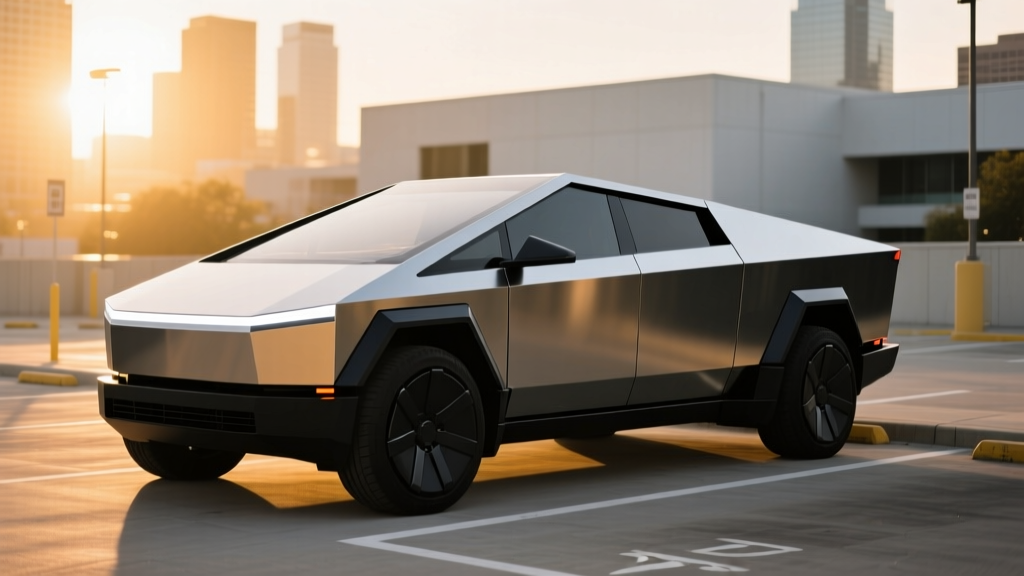
The Cybertruck's angular stainless-steel exoskeleton looks futuristic, but it creates a drag coefficient that hurts highway efficiency compared to more aerodynamic EVs like the Rivian R1T or the Ford F-150 Lightning. In real-world highway testing at 75 mph, energy consumption climbs noticeably — the Cybertruck AWD averages roughly 50–55 kWh/100 mi on flat interstate stretches, which eats into the 123 kWh (usable) battery pack faster than the EPA combined cycle suggests.
Cold weather compounds this. LFP chemistry isn't used here — Tesla opted for NMC (nickel manganese cobalt) cells, which retain capacity better at low state-of-charge but still suffer 15–25% range reduction in sub-freezing temperatures, especially when cabin heating is running. The Cybertruck does include a heat pump, which mitigates some of that loss compared to resistive heating systems, but the physics of a 6,800+ lb steel truck pushing through cold air are unavoidable.
For daily commuting under 80 miles round-trip, both trims offer more than enough buffer. For road trips exceeding 250 miles between charging stops, plan conservatively — and use Tesla's built-in trip planner, which accounts for elevation and temperature better than the dashboard range estimate alone.
Charging Speed: DC Fast, Level 2, and the Curve Reality
Charging is where the Cybertruck's large battery pack becomes a double-edged sword. More capacity means more range, but it also means longer fill times unless you're consistently hitting peak charge rates.
| Charge Level | Power (kW) | Miles Added per Hour | Typical Use Case |
|---|---|---|---|
| Level 1 (120V) | ~1.4 kW | ~3–4 mi/hr | Emergency / trickle |
| Level 2 (240V, 48A) | 11.5 kW | ~34 mi/hr | Home overnight |
| DC Fast (V3 Supercharger) | 250 kW peak | ~200 mi in 15 min | Road trips |
| DC Fast (V4 Supercharger) | 250 kW peak | ~200 mi in 15 min | Road trips (newer stalls) |
A critical nuance: the 250 kW figure is a peak, not a sustained rate. The Cybertruck's charge curve is aggressive at low state-of-charge (10–30%), where it can pull close to 250 kW, but it tapers significantly above 60% SoC. The 10–80% time of approximately 30 minutes reflects this taper — the final 20 percentage points from 80–100% can take an additional 25–35 minutes. For road trips, the practical strategy is to charge to 80% and go, rather than waiting for a full battery.
At home on a Level 2 Wall Connector (11.5 kW / 48 amps on a 60-amp circuit), a full charge from 10% to 100% takes roughly 11–12 hours. This is perfectly adequate for overnight charging but means you need to plan ahead if you arrive home nearly empty and need a full pack by morning. A 200-amp electrical panel is typically sufficient for a Wall Connector installation, but older homes with 100-amp panels may require a costly upgrade ($1,500–$3,500) — factor this into your purchase budget.
The Cybertruck uses the NACS (North American Charging Standard) connector natively, giving it seamless access to Tesla's Supercharger network — widely regarded as the most reliable DC fast-charging network in the U.S., with over 25,000 stalls nationally. Non-Tesla networks (Electrify America, EVgo) require a CCS adapter, which Tesla sells separately.
Performance and Drivetrain
The dual-motor AWD Cybertruck delivers 600 horsepower and a 3.9-second 0–60 mph time — quick by any measure, and startling for a vehicle weighing nearly 7,000 pounds. The tri-motor Cyberbeast pushes 845 hp and 2.6 seconds, placing it in supercar territory despite its truck bed and 11,000-lb towing rating.
Both trims feature adaptive air suspension with up to 17 inches of ground clearance in Off-Road mode, and a rear-wheel steering system ("crab mode") that tightens the turning radius to a manageable 37.4 feet — impressive for a vehicle over 223 inches long. Regenerative braking is aggressive enough for one-pedal driving in most conditions, though the stopping feel takes acclimation given the vehicle's mass.
Towing at the 11,000-lb maximum will reduce range by 40–55% depending on trailer profile and weight. If you plan to tow frequently, expect real-world range to drop to roughly 150–190 miles per charge on the AWD trim.
Pricing, Trims, and Federal Tax Credit Eligibility
With the Cybertruck base trim halted indefinitely, the entry price for a new Cybertruck sits at $79,990 for the AWD model. The Cyberbeast starts at $99,990. Both figures exclude the $1,995 destination fee and any dealer-installed accessories.
| Trim | MSRP | Destination | §30D Credit Eligible? | Effective Price (if eligible) |
|---|---|---|---|---|
| AWD | $79,990 | $1,995 | No — exceeds $80,000 truck MSRP cap | $81,985 |
| Cyberbeast | $99,990 | $1,995 | No — exceeds $80,000 truck MSRP cap | $101,985 |
| Base RWD (announced) | $60,990 | $1,995 | Unlikely — battery sourcing TBD | TBD |
Under current IRS §30D rules, the federal EV tax credit offers up to $7,500 — split between a $3,750 critical-minerals requirement and a $3,750 battery-component requirement. However, eligibility hinges on three constraints that eliminate both available Cybertruck trims:
- MSRP Cap: Trucks, SUVs, and vans must have an MSRP at or below $80,000. The AWD at $79,990 technically squeaks under, but adding any factory options (FSD, wraps, accessories) pushes it over. The Cyberbeast at $99,990 is well above the cap.
- Buyer Income Cap: AGI must not exceed $150,000 (single), $225,000 (head of household), or $300,000 (joint). Many Cybertruck buyers exceed these thresholds.
- Battery Sourcing: Battery components must be manufactured or assembled in North America, and critical minerals must be sourced from the U.S. or a free-trade-agreement country. Tesla's supply chain has been evolving, and specific Cybertruck cell sourcing compliance for 2026 should be verified on the IRS eligible-vehicle list before purchase.
Bottom line: most Cybertruck buyers should not count on the $7,500 federal credit. Consult a tax professional and check the IRS eligible vehicles list at the time of purchase. Some state-level incentives may apply — check your state's energy office for details.
Cargo, Passenger Space, and Daily Practicality
The Cybertruck's 6-foot bed offers 74 cu ft of cargo volume with the tonneau cover closed, plus a front trunk (frunk) providing an additional 7 cu ft of lockable storage. The bed's motorized retractable cover is a standout feature, but it limits the ability to haul tall items that exceed the bed's 53-inch width between the wheel wells.
Inside, the cabin seats five (three-across rear seating is tight for adults on longer drives). Front legroom measures 41.3 inches; rear legroom comes in at 38.2 inches — adequate but not class-leading compared to the Rivian R1T's rear quarters. The 18.5-inch center touchscreen controls virtually every vehicle function, including glove-box release and mirror adjustment, which can be frustrating for passengers unfamiliar with the interface.
Notable daily-use drawbacks: the stainless-steel body shows fingerprints aggressively and is difficult to repair after minor dents (panel replacement is often required). The wiper system, initially a single oversized blade, has been revised but still draws complaints in heavy rain. Visibility is compromised by the angular A-pillars and the lack of a rear window — the digital rearview camera is mandatory for backing up safely.
Tech, Driver Assistance, and Warranty
The Cybertruck comes standard with Tesla's basic Autopilot, which includes Traffic-Aware Cruise Control and Autosteer (lane-centering). Full Self-Driving (Supervised) is a $8,000 option (or $99/month subscription) that adds automatic lane changes, intersection navigation, and parking assist.
Both Autopilot and FSD (Supervised) are SAE Level 2 driver-assistance systems. The driver must remain fully engaged — hands on the wheel, eyes on the road — at all times. These systems do not make the Cybertruck self-driving. Tesla's driver-monitoring camera enforces attention but is not a substitute for active supervision.
The infotainment system runs Tesla's proprietary software with over-the-air updates, a built-in browser, and streaming apps (Netflix, YouTube) available while parked. There is no Apple CarPlay or Android Auto — a deliberate Tesla choice that frustrates some buyers accustomed to phone mirroring.
Warranty coverage:
- Basic Vehicle: 4 years / 50,000 miles
- Battery & Drive Units: 8 years / 120,000 miles (with minimum 70% capacity retention)
- Restraint System: 5 years / 60,000 miles
The 8-year/120,000-mile battery warranty with a 70% retention threshold is competitive with the broader EV truck segment. Full battery replacement out of warranty, however, is estimated at $18,000–$25,000 based on current Tesla service pricing for large packs — a figure worth considering for high-mileage owners.
Pros and Cons
- Class-leading performance (2.6 sec 0–60 Cyberbeast)
- Native NACS / Supercharger network access
- 11,000-lb towing capacity
- Stainless-steel body resists corrosion and minor scratches
- Air suspension with adaptive ride height
- OTA updates continually add features
- Vault-like tonneau bed cover with power operation
- Base RWD trim halted — $80K+ entry price
- No federal tax credit for most buyers (MSRP cap)
- Real-world highway range significantly below EPA
- Poor rear visibility; camera dependency
- Stainless steel shows fingerprints; hard to repair dents
- No Apple CarPlay / Android Auto
- Towing cuts range by 40–55%
- Interior material quality doesn't match $80K+ price
Is the Cybertruck Worth It vs. Key Competitors?
With the base trim unavailable, the Cybertruck AWD at ~$82,000 out-the-door competes directly with the Rivian R1T Dual-Motor (~$79,900) and the Ford F-150 Lightning Lariat (~$72,000). Here's how they stack up on the metrics that matter:
| Metric | Cybertruck AWD | Rivian R1T Dual-Motor | F-150 Lightning Lariat |
|---|---|---|---|
| MSRP | $79,990 | $79,900 | $72,090 |
| EPA Range | 340 mi | 352 mi (Max Pack) | 320 mi (Ext. Range) |
| Max DC Charge | 250 kW | 220 kW | 150 kW |
| 0–60 mph | 3.9 sec | 4.5 sec | 3.8 sec |
| Towing | 11,000 lbs | 11,000 lbs | 10,000 lbs |
| Charging Network | NACS (Supercharger) | NACS (Supercharger) | CCS + NACS adapter |
| Federal Credit | Unlikely | Possible (varies) | Eligible (check sourcing) |
- You prioritize Supercharger network reliability above all else
- Performance and head-turning design matter more than interior refinement
- You want tri-motor upgrade potential (Cyberbeast)
- You need more rear-seat comfort and a refined interior
- You want the Max Pack's 352+ mile range
- You value the Gear Tunnel for enclosed gear storage
- Budget is the priority — it's the cheapest of the three with comparable range
- You want a conventional truck experience with EV benefits
- You value Ford dealer service accessibility in rural areas
Frequently Asked Questions
Why was the Cybertruck base trim halted?
Tesla has not provided a detailed public explanation, but industry analysts point to battery supply constraints, the higher complexity and cost of the rear-wheel-drive powertrain variant at the originally promised $60,990 price point, and a strategic decision to prioritize higher-margin AWD and Cyberbeast trims first. The base RWD remains listed as "announced" on Tesla's website but has no projected delivery date as of early 2026.
What is the real-world range of the Cybertruck?
The AWD trim is EPA-rated at 340 miles, but real-world highway driving at 70–75 mph yields approximately 280–310 miles. In cold weather (below 32°F), expect 240–270 miles. The Cyberbeast's 320-mile EPA rating translates to roughly 260–290 miles highway and 220–250 miles in winter conditions.
How fast does the Cybertruck charge at home and on the road?
On a Level 2 home charger (11.5 kW / 48A), the Cybertruck adds about 34 miles of range per hour, with a full 10–100% charge taking 11–12 hours. On a V3 or V4 Tesla Supercharger, it peaks at 250 kW and charges from 10–80% in approximately 30 minutes, though the charge curve tapers significantly above 60% state-of-charge.
Does the Cybertruck qualify for the federal EV tax credit?
Under current IRS §30D rules, the Cybertruck AWD at $79,990 technically falls under the $80,000 MSRP cap for trucks, but adding any factory options pushes it over. The Cyberbeast at $99,990 is ineligible. Additionally, buyer income caps ($150K single / $300K joint) and battery-sourcing requirements further limit eligibility. Most buyers should not expect to receive the $7,500 credit — verify on the IRS eligible vehicle list before purchasing.
Is the Cybertruck good for towing?
It has an 11,000-lb towing rating, which is competitive. However, towing at or near maximum capacity reduces range by 40–55%, bringing effective range down to 150–190 miles for the AWD trim. Plan charging stops accordingly and use the truck's integrated trailer brake controller for safer handling.
What's the battery replacement cost?
Out-of-warranty battery replacement for the Cybertruck's ~123 kWh NMC pack is estimated at $18,000–$25,000 based on current Tesla service pricing. The battery is warrantied for 8 years / 120,000 miles with a minimum 70% capacity retention guarantee. Historical data from Model S/X packs suggests 10–15% degradation over 150,000 miles is typical, making out-of-warranty replacement a low-probability but high-cost scenario.
Who is the Cybertruck best suited for?
The Cybertruck fits buyers who want a high-performance electric truck with Supercharger network access, don't need maximum interior refinement, and can absorb the $80K+ price without a federal tax credit. It's less ideal for budget-conscious buyers (wait for the base trim or consider the F-150 Lightning), families prioritizing rear-seat comfort (Rivian R1T), or those who tow frequently over long distances where range loss becomes a logistical burden.