The Tesla Cybertruck is one of the most polarizing vehicles ever built — and one of the most searched when it comes to legality. Type "Cybertruck banned" into any search engine and you'll find a tangle of headlines about European prohibitions, UK registration refusals, and pedestrian-safety controversies. But what's actually true, and what's internet noise?
Below, we separate fact from fiction on where the Cybertruck can and cannot be sold, then deliver the full 2026 ownership review: EPA range, real-world efficiency, charging speeds, pricing, tax-credit eligibility, and a head-to-head look at whether this stainless-steel wedge makes sense versus the Ford F-150 Lightning or Rivian R1T.
Is the Cybertruck Actually Banned? The Regulatory Reality
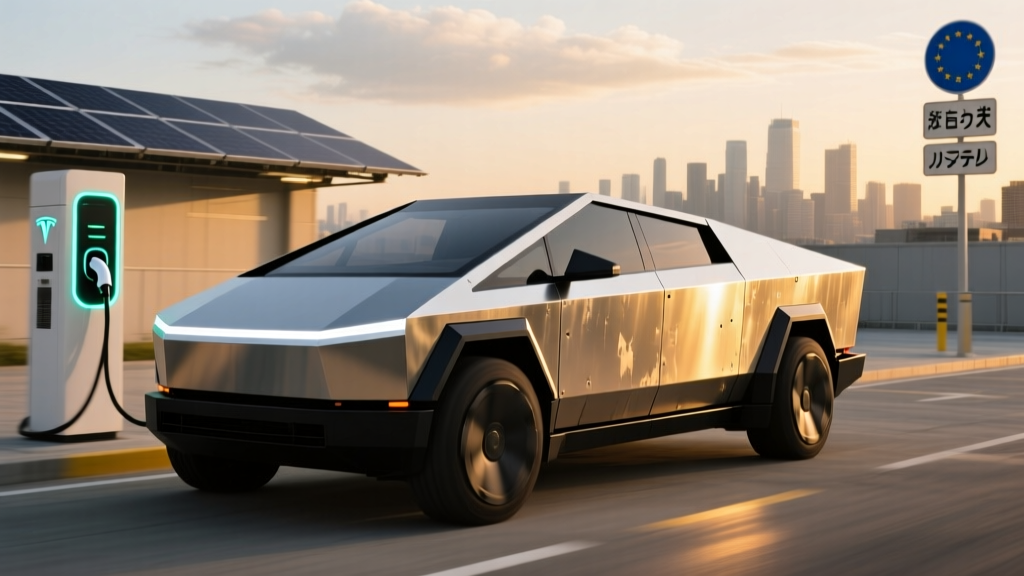
Short answer: The Cybertruck is not banned in the United States. It is fully street-legal in all 50 states and sells freely through Tesla's direct-to-consumer model. However, the Cybertruck is effectively barred from sale in the European Union and the United Kingdom — not through a single dramatic "ban," but because it cannot currently meet regional type-approval standards for pedestrian safety.
The core issue is the Cybertruck's stainless-steel exoskeleton. Under EU Regulation 78/2009 (pedestrian protection) and the broader General Safety Regulation, vehicles must meet specific headform and legform impact thresholds. The Cybertruck's flat, rigid stainless-steel panels and sharp angular edges present a fundamentally different crash profile than conventional crumple-zone vehicles. As of early 2026, Tesla has not submitted the Cybertruck for EU Whole Vehicle Type Approval (WVTA), and multiple European registration authorities — including the UK's DVLA — have confirmed they would not register the vehicle in its current form.
This isn't unique to Tesla. The original Hummer H2 faced similar scrutiny in Europe, and any vehicle with a rigid, non-compliant front-end geometry struggles with EU pedestrian-protection norms. Tesla has not announced plans to redesign the Cybertruck for European compliance.
Key takeaway: The Cybertruck isn't "banned" by name — it simply doesn't meet EU/UK type-approval requirements for pedestrian impact safety. US buyers face no legal restrictions. If you see headlines saying "Cybertruck banned," they're referring to this European regulatory gap, not a US prohibition.
2026 Cybertruck Specs: Range, Battery, and Real-World Efficiency
For 2026, Tesla offers the Cybertruck in three trims: the Long Range AWD, the Cyberbeast (tri-motor AWD), and a base Rear-Wheel Drive model that began limited deliveries in late 2025. Here's the spec breakdown:
| Spec | Long Range AWD | Cyberbeast AWD | RWD (Base) |
|---|---|---|---|
| EPA Range | 340 miles | 320 miles | ~350 miles (est.) |
| Battery (usable) | ~123 kWh (NMC) | ~123 kWh (NMC) | ~100 kWh (LFP est.) |
| Drivetrain | Dual-Motor AWD | Tri-Motor AWD | Rear-Wheel Drive |
| Horsepower | 600 hp | 845 hp | ~315 hp (est.) |
| 0-60 mph | 3.9 sec | 2.6 sec | ~6.5 sec (est.) |
| Efficiency | ~54 MPGe / 48 kWh/100mi | ~51 MPGe / 50 kWh/100mi | ~58 MPGe (est.) |
| Towing Capacity | 11,000 lbs | 11,000 lbs | 7,500 lbs (est.) |
| Base MSRP | $79,990 | $99,990 | $60,990 |
Real-World Range Reality: The EPA's 340-mile figure for the Long Range AWD is achievable in mixed suburban driving at moderate temperatures. Expect ~270-290 miles on sustained highway runs at 75 mph, and as low as ~220-240 miles in sub-freezing winter conditions — the stainless-steel body and large frontal area create significant aerodynamic drag and cold-weather energy loss. Towing a 7,000-lb trailer? Plan for roughly 150-180 miles between charges. Tesla's 48-volt architecture and heat pump help mitigate cold-weather losses, but physics is physics.
The Cybertruck's ~123 kWh usable battery pack uses nickel-manganese-cobalt (NMC) chemistry in the AWD trims, chosen for its higher energy density — necessary given the vehicle's 6,600+ lb curb weight. The base RWD model is expected to use lithium iron phosphate (LFP) cells, which trade some energy density for lower cost, longer cycle life, and the ability to charge routinely to 100% without degradation concerns. Tesla sources cells from its own Austin, TX production line as well as from Panasonic and CATL, depending on the production batch.
Charging Speed: DC Fast Charging and Home Level 2
The Cybertruck supports Tesla's NACS connector natively — no adapter needed at Superchargers. It's also compatible with the growing number of non-Tesla networks (Electrify America, EVgo, ChargePoint) that have added NACS cables, though CCS-to-NACS adapters are still required at some older stations.
| Charging Level | Power (kW) | Speed (miles/hr added) | Notes |
|---|---|---|---|
| Level 1 (120V household) | ~1.4 kW | ~3-4 mi/hr | Emergency/trickle only; full charge takes days |
| Level 2 (240V home, 48A) | 11.5 kW | ~30-34 mi/hr | Full overnight charge in ~10-12 hours; requires 60A circuit |
| DC Fast Charge (peak) | 250 kW (V3 Supercharger) | ~200+ mi/hr at peak | 10-80% in ~28-32 min; tapers significantly above 80% |
| DC Fast Charge (sustained avg) | ~160-180 kW avg | ~130-150 mi/hr avg | Real-world average across 10-80% session |
The Cybertruck peaks at 250 kW on Tesla V3 Superchargers, but as with all EVs, peak kW is not sustained kW. The charge curve holds near peak from roughly 10-40% State of Charge (SoC), then progressively tapers. A 10-80% session typically takes 28-32 minutes at a V3 station. On V4 Superchargers (rolling out through 2025-2026), the Cybertruck may see modestly improved sustained rates due to better thermal management at the cabinet level, but the vehicle-side peak remains 250 kW.
For home charging, the Cybertruck's 11.5 kW onboard charger means you'll want a Tesla Wall Connector on a 60-amp dedicated circuit. Expect roughly 30-34 miles of range per hour of charging — enough to fully replenish the battery overnight for most daily driving. Budget $800-$1,500 for a professional Level 2 installation (electrician, permit, and Wall Connector hardware), and potentially $2,000-$4,000 more if your home's electrical panel needs an upgrade to 200A service. Always get a quote from a licensed electrician before assuming your panel can handle the load.
Pricing, Tax Credits, and Total Cost of Ownership
The Cybertruck's pricing has stabilized somewhat after Tesla's initial delivery-event repricing. Here's where the 2026 trims land before incentives:
| Trim | Base MSRP | Federal §30D Credit | Effective Price (if eligible) |
|---|---|---|---|
| RWD (Base) | $60,990 | $7,500 (if eligible) | ~$53,490 |
| Long Range AWD | $79,990 | $7,500 (if eligible) | ~$72,490 |
| Cyberbeast AWD | $99,990 | $7,500 (if eligible) | ~$92,490 |
Federal tax credit eligibility is not automatic. Under IRS §30D rules (current for 2026), several conditions must be met:
- MSRP cap: Trucks/vans/SUVs must have an MSRP under $80,000. The RWD and Long Range trims qualify; the Cyberbeast at $99,990 does not.
- Buyer income cap: Modified AGI must not exceed $150,000 (single), $225,000 (head of household), or $300,000 (joint filers).
- Battery sourcing: A percentage of critical minerals and battery components must be sourced from the US or free-trade-agreement countries. Tesla's supply chain has progressively met these thresholds, but eligibility can shift by production batch. Verify current compliance on fueleconomy.gov before purchasing.
- Point-of-sale transfer: As of 2024, buyers can transfer the credit to the dealer at purchase, reducing the out-of-pocket price immediately — rather than waiting to claim it on their tax return.
For the Cyberbeast, the $80,000 MSRP cap eliminates federal credit eligibility entirely. Some states offer additional rebates (California's CVRP, Colorado's innovative motor vehicle credit, etc.), but these vary by jurisdiction — check your state's energy office or department of revenue for current programs.
5-year ownership economics: The Cybertruck's efficiency (~48 kWh/100mi for the Long Range) translates to roughly $0.07-$0.09 per mile on home charging at the US average electricity rate of ~$0.16/kWh. Compare that to a gas F-150 at ~18 MPG combined and $3.50/gallon: about $0.19 per mile. Over 60,000 miles, that's a fuel savings of roughly $6,000-$7,200. However, the Cybertruck's insurance premiums run 25-40% higher than a comparable F-150 Lightning in most states, and tire replacement costs are significant given the vehicle's weight and custom 35-inch tire spec.
Interior, Cargo, Tech, and Daily Usability
The Cybertruck's interior is unmistakably Tesla-minimalist: an 18.5-inch central touchscreen dominates the dash, with virtually no physical buttons. A rear 9.4-inch touchscreen serves second-row passengers. The steer-by-wire system (Tesla calls it a "yoke" or round wheel, depending on configuration) is standard across all trims — there is no traditional steering column option.
Cargo dimensions:
- Bed length: 6 feet (with tailgate closed); extends to ~8 feet with the powered tonneau-style "sail" cover retracted and tailgate down
- Bed width: ~47 inches between wheel wells
- Bed volume: ~67 cu ft (tailgate closed)
- Front trunk (frunk): ~7.1 cu ft — enough for a charging cable and a small bag
- Max payload: 2,500 lbs
- Rear-seat legroom: ~41.5 inches (comfortable for adults on shorter trips; the upright seatback angle limits long-haul comfort)
The powered stainless-steel tonneau cover is a standout feature — it retracts into the bed walls, providing lockable, weatherproof storage without sacrificing the full bed when open. Tesla also includes built-in 120V and 240V bed outlets (up to 11.5 kW of vehicle-to-load power output), making the Cybertruck a legitimate mobile generator for job sites or camping.
Tech highlights:
- Steer-by-wire with variable ratio (fewer hand movements lock-to-lock at low speeds)
- Tesla Autopilot standard; Full Self-Driving (Supervised) available as a $8,000 add-on or $99/month subscription
- 48-volt electrical architecture (reduces wiring weight and enables higher-power accessories)
- Adaptive air suspension with up to 16 inches of ground clearance in Extract Mode
- "Armor glass" — laminated composite glass that resists impacts (though early-production units had fitment and seal issues)
Important: Tesla Autopilot and FSD (Supervised) are SAE Level 2 driver-assistance systems. They require continuous driver attention and do not make the Cybertruck self-driving. You are legally and practically responsible for the vehicle at all times. Only Level 4 services like Waymo operate without a human driver in the loop.
Cybertruck vs. F-150 Lightning vs. Rivian R1T
The Cybertruck competes in a small but growing electric-pickup segment. Here's how it stacks up:
| Attribute | Tesla Cybertruck LR AWD | Ford F-150 Lightning Ext. Range | Rivian R1T Dual-Motor Max |
|---|---|---|---|
| EPA Range | 340 mi | 320 mi | 410 mi |
| Battery | ~123 kWh NMC | ~131 kWh NMC | ~149 kWh NMC |
| 0-60 mph | 3.9 sec | ~5.0 sec | ~4.5 sec |
| Towing | 11,000 lbs | 10,000 lbs | 11,000 lbs |
| DC Fast Charge Peak | 250 kW | 150 kW | 220 kW |
| Starting MSRP | $79,990 | ~$76,990 | ~$89,000 |
| §30D Credit Eligible | Yes (if under cap) | Yes | Yes (if under cap) |
| Bed Length | 6 ft | 5.5 ft | 4.5 ft (+ Gear Tunnel) |
Best range: Rivian R1T Max Pack (410 mi EPA)
Best towing: Tie — Cybertruck & R1T (11,000 lbs)
Fastest charging: Tesla Cybertruck (250 kW peak)
Best value: Ford F-150 Lightning (lowest MSRP, broadest dealer network)
Best for tech/performance: Tesla Cybertruck Cyberbeast (2.6-sec 0-60)
Best for off-road/adventure: Rivian R1T (quad-motor option, tank turns)
Warranty, Reliability, and Ownership Considerations
Tesla's warranty coverage for the Cybertruck:
- Basic vehicle: 4 years / 50,000 miles
- Battery & drive unit: 8 years / 120,000 miles (whichever comes first), with a minimum 70% capacity retention guarantee
- Restraint system: 5 years / 60,000 miles
The 8-year/120,000-mile battery warranty is competitive and aligns with industry norms. Tesla guarantees the battery will retain at least 70% of its original capacity during the warranty period. If degradation exceeds that threshold, Tesla will repair or replace the pack. In practice, NMC packs in Tesla vehicles have shown ~5-8% degradation over the first 50,000 miles, then a much slower decline — most owners should never hit the 70% threshold under normal use.
Reliability caveats: As a low-volume, first-generation vehicle with novel construction (stainless-steel exoskeleton, steer-by-wire, 48V architecture), the Cybertruck has experienced more early-production issues than a mature model. Reported problems include panel-gap inconsistencies, tonneau cover seal leaks, 12V battery drain, and steer-by-wire calibration complaints. Tesla has addressed many of these through service bulletins and over-the-air updates, but buyers should expect occasional service visits — and Tesla's service center network, while expanding, is thinner than Ford's or Rivian's in many regions.
Pros and Cons
Pros
- Class-leading 250 kW DC fast charging on the Supercharger network
- 11,000-lb towing and 2,500-lb payload with integrated scale and bed outlets
- Stainless-steel body is dent- and corrosion-resistant
- Steer-by-wire makes the 6,600-lb truck surprisingly maneuverable at low speeds
- 240V bed outlet (up to 11.5 kW) — legitimate V2L for job sites and camping
- Cyberbeast's 2.6-sec 0-60 is supercar territory in a pickup
Cons
- Cannot be sold or registered in the EU or UK due to pedestrian-safety regulations
- Real-world highway range drops significantly (270-290 mi) vs. the 340-mi EPA sticker
- Cyberbeast trim exceeds the $80K MSRP cap — no federal tax credit
- Insurance premiums run 25-40% higher than comparable electric pickups
- Early-production build quality issues (panel gaps, seals, 12V system)
- Custom 35-inch tires are expensive to replace ($400-$600 each)
- Steer-by-wire learning curve and no traditional steering option
Who Should Buy the Cybertruck?
Choose the Cybertruck if:
- You need a work-capable electric truck with 11,000-lb towing and onboard power
- You're deeply embedded in the Tesla Supercharger ecosystem for road trips
- You value performance (the Cyberbeast's 2.6-sec 0-60 is unmatched in trucks)
- You want a stainless-steel body that resists dents, scratches, and corrosion
- You have home Level 2 charging and your daily commute is under 200 miles
Look elsewhere if:
- You need maximum range — the Rivian R1T Max Pack offers 410 EPA miles
- You want a proven dealer service network — the Ford F-150 Lightning has thousands of service points
- You plan to travel to Europe with the vehicle (it literally cannot be registered there)
- You're uncomfortable with first-generation technology and potential early-production issues
- You need a traditional steering wheel or prefer conventional truck ergonomics
Frequently Asked Questions
Is the Cybertruck banned in Europe?
Effectively, yes. The Cybertruck does not meet EU pedestrian-safety type-approval requirements (Regulation 78/2009) due to its rigid stainless-steel exoskeleton and angular front-end geometry. Tesla has not pursued European Whole Vehicle Type Approval, and registration authorities in multiple EU countries and the UK have confirmed they would not register the vehicle. This is a regulatory non-compliance, not a targeted legislative ban.
What is the real-world range of the Cybertruck?
The Long Range AWD carries an EPA rating of 340 miles. In real-world testing, expect approximately 270-290 miles on sustained highway driving at 70-75 mph, and as low as 220-240 miles in freezing temperatures. Towing cuts range roughly in half. The EPA number is a useful baseline, but daily driving conditions — speed, temperature, terrain, and HVAC use — significantly affect actual range.
How fast does the Cybertruck charge?
At a Tesla V3 Supercharger (250 kW peak), the Cybertruck charges from 10-80% in approximately 28-32 minutes. The sustained average rate across that session is around 160-180 kW due to charge-curve tapering. At home on a Level 2 Wall Connector (11.5 kW), you'll add roughly 30-34 miles of range per hour, fully charging overnight in about 10-12 hours.
Does the Cybertruck qualify for the $7,500 federal EV tax credit?
The RWD ($60,990) and Long Range AWD ($79,990) trims fall under the $80,000 MSRP cap for trucks and are potentially eligible for the full $7,500 credit under IRS §30D — provided the buyer meets income limits ($150K single / $300K joint) and the vehicle's battery meets critical-mineral and component-sourcing thresholds. The Cyberbeast ($99,990) exceeds the MSRP cap and is not eligible for the federal credit. Always verify current eligibility on fueleconomy.gov and consult a tax professional.
Is the Cybertruck worth buying vs. the F-150 Lightning or Rivian R1T?
It depends on your priorities. The Cybertruck wins on DC fast-charging speed (250 kW), Supercharger network access, and raw performance. The F-150 Lightning wins on value, dealer service access, and familiarity for traditional truck buyers. The Rivian R1T wins on maximum range (410 mi), off-road capability, and adventure-oriented design. All three are capable electric trucks — the "best" choice depends on your use case, budget, and tolerance for first-generation risk.
What are the biggest drawbacks of owning a Cybertruck?
The main pain points reported by early owners include: higher-than-expected insurance costs, limited service center availability in some regions, early-production build-quality issues (panel gaps, seal leaks), expensive custom tire replacement, and a steep learning curve with steer-by-wire. Additionally, the Cybertruck's large dimensions and poor rear visibility (despite the backup camera) make tight urban parking challenging.