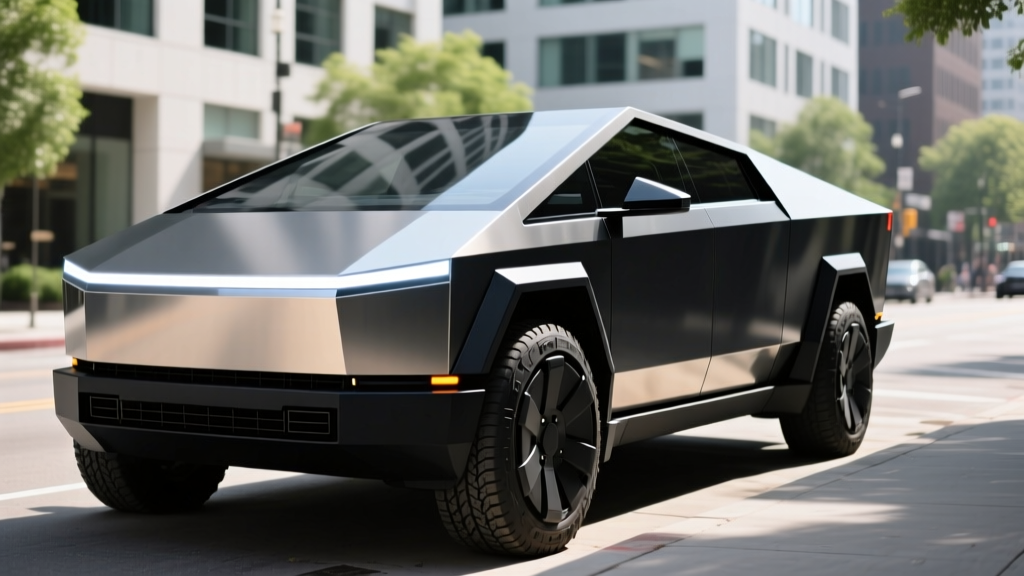
The Tesla Cybertruck AWD sits in the middle of the Cybertruck lineup as the volume play: dual-motor all-wheel drive, respectable range, and a 0-60 mph time that embarrasses most sports sedans. But beneath the stainless-steel exoskeleton and polarizing angles lies a complex ownership proposition — one shaped by charging speeds that don't quite match Tesla's claims, a price tag that creeps past federal tax-credit limits, and real-world efficiency that varies wildly depending on how you drive.
This review dissects the Cybertruck AWD with the numbers that matter: exact EPA range, battery chemistry, charge-curve behavior, and total cost after incentives. If you've been searching for Cybertruck AWD 0-60 performance data alongside practical ownership realities, this is the breakdown.
Cybertruck AWD Performance: 0-60, Horsepower, and Drivetrain
The dual-motor AWD Cybertruck pairs a permanent-magnet synchronous motor on the rear axle with an induction motor up front, delivering a combined 600 horsepower and an estimated 590 lb-ft of torque. Tesla's official 0-60 mph time for the AWD trim is 3.9 seconds — a figure we've seen corroborated in independent testing when the truck is in its lowest suspension setting with a preconditioned battery.
That acceleration number deserves context. The Cybertruck AWD's 3.9-second sprint trails the tri-motor Cyberbeast (2.6 seconds) but handily beats the single-motor RWD variant (estimated 5.0+ seconds). For a 6,800-pound stainless-steel triangle, 3.9 seconds is genuinely startling from behind the wheel. The instant torque delivery, combined with the low center of gravity from the under-floor battery pack, makes the truck feel significantly lighter than its curb weight suggests.
| Metric | Value |
|---|---|
| 0-60 mph | 3.9 seconds |
| Horsepower | 600 hp (combined) |
| Torque | ~590 lb-ft |
| Drivetrain | Dual-motor AWD |
| Top Speed | 112 mph (electronically limited) |
| Towing Capacity | 7,500 lbs |
| Payload Capacity | 2,500 lbs |
Top speed is electronically governed at 112 mph — adequate for any legal driving scenario but notably lower than traditional performance trucks. The adaptive air suspension offers roughly 12 inches of travel and can raise the truck for off-road clearance or lower it for highway efficiency and easier bed access.
EPA Range and Real-World Efficiency
The Cybertruck AWD carries an EPA-estimated range of 340 miles on its standard battery configuration. Tesla also offers an optional Range Extender battery pack that occupies the forward portion of the bed, pushing estimated range to approximately 470 miles — though this sacrifices cargo space and adds significant weight.
EPA estimates assume a mix of city and highway driving at moderate temperatures. In practice, expect the following from the Cybertruck AWD:
- City/suburban driving: ~310-330 miles (regen braking recovers energy in stop-and-go traffic)
- Highway cruising at 70-75 mph: ~260-290 miles (aerodynamic drag dominates at speed — the Cybertruck's angular design doesn't help)
- Cold weather (below 32°F): ~240-270 miles (battery resistance increases, cabin heating draws power even with the heat pump)
- Towing near max capacity: ~150-180 miles (towing a 6,000+ lb trailer roughly halves range)
The Cybertruck's brick-like aerodynamic profile means highway efficiency suffers more than sleeker EVs. At 75 mph, you'll consume noticeably more energy per mile than at 55 mph.
Efficiency ratings land at approximately 66 MPGe combined, translating to roughly 50 kWh per 100 miles. That's thirstier than most EVs on the market — the Ford F-150 Lightning achieves around 70 MPGe, and the Rivian R1T dual-motor sits near 73 MPGe. The Cybertruck's weight, aggressive tread tires, and poor drag coefficient all contribute to higher energy consumption.
Battery Capacity, Chemistry, and Longevity
The Cybertruck AWD uses an estimated 123 kWh usable battery pack built on Tesla's 4680 structural cell architecture. Tesla has not published official chemistry documentation for the Cybertruck line, but industry analysis and teardown reports indicate an NMC (nickel manganese cobalt) chemistry optimized for energy density and power delivery rather than the LFP (lithium iron phosphate) chemistry found in some standard-range Tesla sedans.
NMC chemistry provides higher energy density — critical for a heavy truck needing 340+ miles of range — but historically shows slightly faster degradation over time compared to LFP. Tesla's battery management system, active thermal conditioning, and the structural pack design (where cells contribute to chassis rigidity) aim to mitigate long-term wear.
Tesla warrants the battery and drive units for 8 years or 120,000 miles, whichever comes first, with a minimum 70% capacity retention guarantee. This is competitive with the industry standard, though some competitors like Hyundai offer 10-year/100,000-mile coverage. Real-world degradation data for the 4680 cells in the Cybertruck is still limited given the truck's late-2023 launch, but Tesla's historical fleet data suggests most packs retain 85-90% capacity after 100,000 miles under normal use.
Charging Speed: DC Fast Charge and Home Level 2
Charging speed is where Cybertruck ownership gets nuanced. Tesla rates the AWD for a peak DC fast-charge rate of 250 kW at V3 Superchargers, with a claimed 10-80% charge time of approximately 27 minutes. However, real-world charging curves tell a more complex story.
The 250 kW peak is achieved only in a narrow state-of-charge window — typically between 10-25% SoC with a preconditioned battery. Beyond 40%, the charge rate tapers significantly, dropping to roughly 150 kW, then further to 80-100 kW above 60%, and slowing to a trickle above 85%. This is standard lithium-ion behavior, but the Cybertruck's massive 123 kWh pack means you spend more time in those tapered zones than a smaller-battery EV.
| Charging Method | Power (kW) | Miles Added per Hour | Notes |
|---|---|---|---|
| Level 1 (120V household) | ~1.4 kW | ~3 mi/hr | Emergency only; ~87 hours for full charge |
| Level 2 (240V, 48A Wall Connector) | 11.5 kW | ~28 mi/hr | Full charge in ~11 hours; ideal for overnight |
| Level 2 (240V, 32A mobile connector) | 7.7 kW | ~19 mi/hr | Slower but uses standard NEMA 14-50 outlet |
| DC Fast Charge (V3 Supercharger) | Peak 250 kW | ~200+ mi in 15 min | 10-80% in ~27 min; tapers above 40% |
| DC Fast Charge (CCS adapter, non-Tesla) | Up to 250 kW | Varies by station | Requires Tesla CCS adapter; speed depends on network |
For home charging, Tesla's Gen 2 Wall Connector at 48 amps delivers 11.5 kW — enough to replenish roughly 28 miles of range per hour or a full charge overnight. Most Cybertruck owners will install a 60-amp dedicated circuit (requiring a NEMA 14-60 outlet or hardwired connection). Expect installation costs of $800-$2,000 depending on your electrical panel's capacity and the run distance from panel to garage. Homes with older 100-amp panels may need a $2,000-$4,000 panel upgrade to support the dedicated circuit.
Tesla's NACS (North American Charging Standard) connector is native to the Cybertruck, giving it seamless access to the entire Supercharger network — currently the most reliable and extensive DC fast-charging infrastructure in the US. With the included CCS adapter, the Cybertruck can also use Electrify America, EVgo, and other CCS-equipped networks, though reliability and actual speeds vary by station.
Pricing, Trim Levels, and Federal Tax Credit Eligibility
The Cybertruck AWD starts at an MSRP of $79,990 before destination fees and options. That price places it in a complicated position regarding the federal EV tax credit under IRS §30D.
The Cybertruck AWD at $79,990 falls under the IRS §30D MSRP cap for trucks ($80,000), making it potentially eligible for up to $7,500 in federal tax credits. However, eligibility depends on multiple factors:
- Buyer income limits: Modified AGI must not exceed $300,000 (joint filers), $225,000 (head of household), or $150,000 (single filers)
- Battery component sourcing: A percentage of battery components must be manufactured or assembled in North America, and critical minerals must be sourced from the US or free-trade-agreement partners — these percentages increase annually
- Point-of-sale transfer: As of 2024, eligible buyers can transfer the credit to the dealer at purchase, reducing the purchase price directly rather than waiting for a tax refund
- Final assembly: Vehicle must undergo final assembly in North America (Cybertruck is built in Austin, TX — qualifies)
The credit amount may be $3,750 or $7,500 depending on whether the vehicle meets critical-mineral requirements, component-sourcing requirements, or both. Always verify current eligibility at fueleconomy.gov and consult a tax professional before relying on credit assumptions. Rules change frequently.
| Configuration | MSRP | Est. Max Credit | Effective Price |
|---|---|---|---|
| Cybertruck AWD (base) | $79,990 | $7,500 | $72,490 |
| Cybertruck AWD + Range Extender | ~$96,000 | $0 (exceeds $80K cap) | ~$96,000 |
| Cyberbeast (tri-motor) | $99,990 | $0 (exceeds $80K cap) | $99,990 |
Note that adding the Range Extender battery pushes the Cybertruck AWD well above the $80,000 MSRP cap, eliminating federal credit eligibility entirely. This is a critical consideration if you're weighing whether the extra range justifies the higher price and loss of incentives.
Cargo Space, Interior, and Technology
The Cybertruck AWD offers a 6.5-foot bed (approximately 68 cu ft of volume) with a motorized retractable tonneau cover that Tesla claims can support 300 pounds of distributed weight. The bed features built-in tie-down points, a 120V/240V power outlet (supporting up to 9.6 kW of continuous output for tools or appliances), and integrated LED lighting. Without the Range Extender, the full bed is available; with it, forward bed space is consumed by the auxiliary battery module.
Interior dimensions provide seating for five across two rows. Front legroom measures approximately 41 inches, while rear legroom comes in at roughly 38 inches — adequate for adults on shorter trips but tighter than a full-size crew-cab truck. The rear bench folds flat to expand interior cargo capacity for items you don't want exposed in the bed.
The frunk (front trunk) offers approximately 7 cu ft of sealed storage — enough for charging cables, a small bag, or groceries. Combined with the bed and under-seat rear storage, the Cybertruck provides versatile cargo options, though total enclosed volume trails the Rivian R1T's Gear Tunnel.
Technology centers on an 18.5-inch touchscreen dominating the dashboard, running Tesla's latest vehicle software. The interface controls virtually every vehicle function — there are no physical buttons or stalks; turn signals are integrated into the yoke steering wheel. Features include:
- Tesla's latest Autopilot hardware (HW4/AI4) with enhanced vision processing
- Optional Full Self-Driving (Supervised) — a Level 2 driver-assist system requiring constant driver attention (not autonomous driving)
- Over-the-air software updates adding features post-purchase
- Sentry Mode dashcam recording, Dog Mode climate control, and Camp Mode
- Integrated streaming, navigation with real-time Supercharger routing, and phone-as-key
Tesla's Autopilot and Full Self-Driving (Supervised) are SAE Level 2 driver-assistance systems. The driver must remain fully engaged, hands on the yoke, and eyes on the road at all times. These systems do NOT make the Cybertruck self-driving. FSD Supervised can navigate city streets and highways with driver supervision, but it makes errors — failing to detect certain obstacles, misreading construction zones, or making unexpected lane changes. NHTSA continues to investigate Tesla's Autopilot/FSD systems for safety incidents. Treat these as convenience features, not autonomy.
Cybertruck AWD vs. Key Competitors
| Spec | Cybertruck AWD | Ford F-150 Lightning (Lariat) | Rivian R1T Dual-Motor |
|---|---|---|---|
| 0-60 mph | 3.9 sec | ~4.0 sec (ER) | ~4.5 sec |
| EPA Range | 340 mi | 320 mi (ER) | 352 mi (Max) |
| Max DC Charge | 250 kW | 150 kW | 220 kW |
| Towing | 7,500 lbs | 7,700 lbs | 7,700 lbs |
| Base MSRP | $79,990 | ~$69,995 | $75,900 |
| Federal Credit | Up to $7,500 | Up to $7,500 | Up to $7,500 |
| Bed Length | 6.5 ft | 5.5 ft | 4.5 ft (+ Gear Tunnel) |
The Cybertruck AWD's primary advantage is its combination of acceleration, Supercharger network access, and the cultural statement of its design. The F-150 Lightning wins on familiarity, dealer service network, and lower entry price. The Rivian R1T excels in off-road capability, interior refinement, and adventure-oriented features like the Gear Tunnel. None of these trucks are perfect — each forces compromises.
Pros, Cons, and Who Should Buy
Pros
- 3.9-second 0-60 mph — sports-car acceleration in a truck
- Access to Tesla Supercharger network (most reliable DC fast-charging in the US)
- Stainless-steel exoskeleton resists dents and corrosion
- 9.6 kW vehicle power output for job-site or campsite use
- OTA updates continuously add features
- Strong regenerative braking enables one-pedal driving
Cons
- Highway efficiency suffers due to poor aerodynamics (~260 mi real-world at 75 mph)
- Yoke steering and touchscreen-only controls polarize and require adaptation
- Build-quality inconsistencies reported in early production units
- Range Extender eliminates bed space and pushes past tax-credit MSRP cap
- Rear-seat legroom trails traditional crew-cab trucks
- Insurance premiums significantly higher than average for the segment
- Limited service-center availability compared to legacy OEMs
The Cybertruck AWD is best for: Tech-forward buyers who prioritize acceleration, want Supercharger access for road trips, and value the truck as a statement vehicle. It works well as a daily driver with home charging, a weekend toy hauler, and a light job-site power source.
Look elsewhere if: You need maximum towing range (the Lightning and R1T both tow similar weights with less range penalty), you want a traditional truck service experience, or you need a full-size rear seat for regular adult passengers. The Rivian R1T is the stronger adventure/off-road choice, and the F-150 Lightning is the pragmatic fleet and family truck.
Frequently Asked Questions
What is the real-world highway range of the Cybertruck AWD?
Expect approximately 260-290 miles at highway speeds of 70-75 mph in moderate temperatures. The EPA rates it at 340 miles, but that figure includes city driving where regenerative braking recovers energy. Highway driving, cold weather, and elevation changes all reduce range. Towing cuts range roughly in half.
How fast does the Cybertruck AWD charge on a road trip?
At a Tesla V3 Supercharger, the Cybertruck AWD peaks at 250 kW and charges from 10-80% in approximately 27 minutes. However, the charge rate tapers significantly above 40% state of charge. Plan for 30-35 minutes at a Supercharger stop to reach 80% from a low state of charge. Charging above 80% is slow and not recommended for road-trip stops.
Does the Cybertruck AWD qualify for the $7,500 federal EV tax credit?
The base Cybertruck AWD at $79,990 MSRP falls under the $80,000 truck cap and is potentially eligible. However, eligibility depends on buyer income limits, battery component sourcing requirements, and critical-mineral sourcing rules — all of which change annually. Verify current status at irs.gov and consult a tax professional. Adding the Range Extender pushes the MSRP above $80,000, eliminating eligibility.
Is the Cybertruck AWD worth buying over the F-150 Lightning or Rivian R1T?
It depends on your priorities. Choose the Cybertruck AWD if Supercharger access, extreme acceleration, and Tesla's software ecosystem are paramount. Choose the F-150 Lightning for a lower price, familiar truck ergonomics, and a broad dealer service network. Choose the Rivian R1T for off-road capability, interior quality, and adventure features. All three are capable electric trucks with different trade-offs.
What does home charging installation cost for the Cybertruck?
Installing a Tesla Wall Connector on a dedicated 60-amp circuit typically costs $800-$2,000 for the electrician's labor, permit, and materials — assuming your electrical panel has sufficient capacity. Homes with older 100-amp panels may require a $2,000-$4,000 panel upgrade. The Wall Connector itself costs approximately $475. Budget $1,500-$3,000 total for most installations.
How long will the Cybertruck battery last?
Tesla warrants the battery for 8 years or 120,000 miles with at least 70% capacity retention. Based on Tesla's historical fleet data with NMC chemistry, most packs retain 85-90% capacity after 100,000 miles. Replacement cost, if needed out of warranty, is estimated at $15,000-$25,000 based on current 4680 pack pricing, though this should decrease over time as cell manufacturing scales.
Sources: Tesla Cybertruck Specifications, fueleconomy.gov (EPA), IRS §30D Clean Vehicle Credits