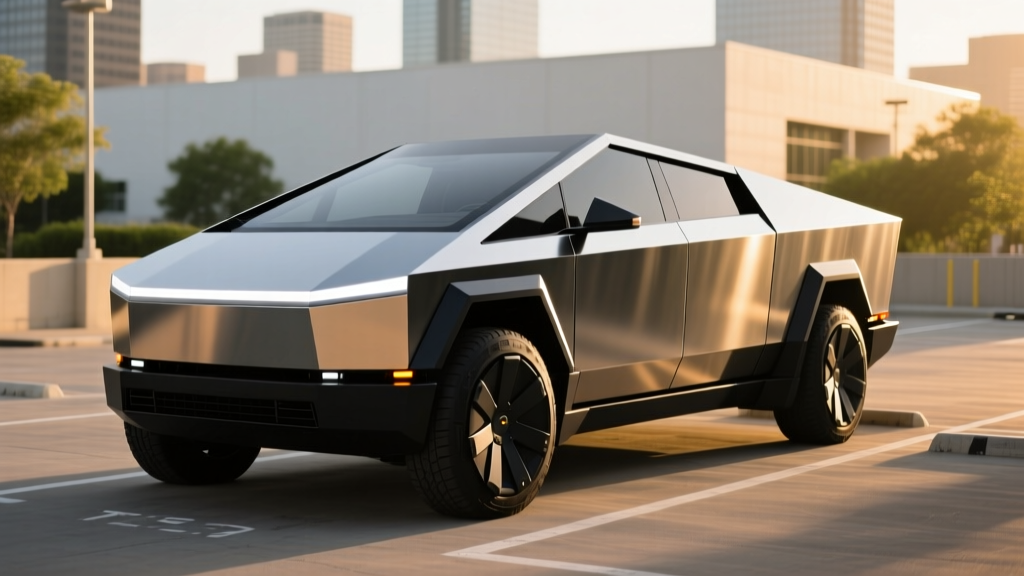
The Tesla Cybertruck remains one of the most polarizing vehicles on the road, but beyond the stainless-steel exoskeleton and angular silhouette, buyers have a practical question: how much is a brand new Cybertruck once you factor in trim levels, options, and federal tax credits? For 2026, Tesla offers the Cybertruck in three primary configurations — Long Range AWD, Dual Motor All-Wheel Drive, and the high-performance Cyberbeast — with prices spanning a wide gap depending on what you need from an electric pickup.
This review dissects every cost layer: base MSRP, destination fees, the impact of the IRS §30D federal tax credit, real-world range versus the EPA sticker, charging speed from DC fast chargers and home Level 2 setups, and whether the Cybertruck's ownership math actually beats rivals like the Ford F-150 Lightning and Rivian R1T. If you're researching before you configure, here's the complete picture.
Cybertruck 2026 Pricing by Trim: What You'll Actually Pay
Tesla simplified the Cybertruck lineup after the initial Foundation Series pricing controversy. For the 2026 model year, the three available trims are positioned to cover different buyer priorities — from maximum range to maximum performance. Below is the MSRP breakdown before any incentives or fees.
| Trim | Base MSRP | Destination Fee | Drivetrain | 0-60 mph | Horsepower |
|---|---|---|---|---|---|
| Long Range AWD | $79,990 | $1,995 | Dual Motor AWD | 4.1 sec | ~600 hp |
| AWD (Dual Motor) | $99,990 | $1,995 | Dual Motor AWD | 3.9 sec | ~600 hp |
| Cyberbeast (Tri-Motor) | $119,990 | $1,995 | Tri-Motor AWD | 2.6 sec | ~845 hp |
The Long Range AWD trim is the value play for buyers who prioritize distance over brute acceleration. The AWD Dual Motor adds torque-vectoring capability and slightly improved performance, while the Cyberbeast's tri-motor setup pushes the Cybertruck into supercar-rivaling territory with a 2.6-second 0-60 mph time — extraordinary for a vehicle with a 6.5-foot bed and over 6,800 pounds of curb weight.
All trims include Tesla's Premium Interior package, a 18.5-inch front touchscreen, a 9.4-inch rear touchscreen, a 15-speaker audio system, and the full hardware suite for Autopilot. Full Self-Driving (Supervised) remains an $8,000 add-on or $99/month subscription — and it's critical to understand that FSD is a Level 2 driver-assist system, meaning you must remain actively engaged at all times. This is not autonomous driving.
Federal Tax Credit Eligibility: Does the Cybertruck Qualify?
The IRS §30D Clean Vehicle Credit offers up to $7,500 for qualifying new EVs, but the Cybertruck faces several hurdles under current rules. Here's the eligibility checklist:
- MSRP Cap: Trucks must have an MSRP at or below $80,000. Only the Long Range AWD trim ($79,990 base) falls under this cap — the AWD and Cyberbeast trims exceed it and are ineligible.
- Buyer Income Cap: Modified adjusted gross income (MAGI) must not exceed $150,000 (single), $225,000 (head of household), or $300,000 (joint filers).
- Battery Sourcing: The $7,500 credit splits into two halves — $3,750 for critical minerals and $3,750 for battery component manufacturing. Tesla's battery supply chain has been evolving rapidly, and the Cybertruck's structural battery pack uses 4680 cells manufactured in Texas. However, critical mineral sourcing requirements tighten annually, and partial credit ($3,750) is more commonly available than the full $7,500.
- Point-of-Sale Transfer: Under current IRS rules, you can transfer the credit to the dealer at purchase, reducing your out-of-pocket cost immediately rather than waiting for tax filing.
Bottom line: If you buy the Long Range AWD trim and meet income requirements, you may qualify for up to $3,750–$7,500 off the purchase price, bringing the effective cost to roughly $72,490–$76,240 before destination. The AWD and Cyberbeast trims receive no federal credit due to their MSRP exceeding the $80,000 truck cap. Always verify current-year eligibility at IRS.gov and consult a tax professional — rules change, and battery sourcing compliance is model-specific and can shift mid-year.
Range and Efficiency: EPA Sticker vs. Real-World Driving
Tesla rates the Cybertruck Long Range AWD at an EPA-estimated 340 miles, the AWD Dual Motor at 315 miles, and the Cyberbeast at 320 miles. But as any seasoned EV owner knows, the EPA number is a laboratory composite — your actual experience depends heavily on driving style, terrain, and temperature.
EPA Estimated: 340 miles
Highway (70 mph, moderate temps): ~270–290 miles
City / mixed driving: ~300–320 miles
Cold weather (below 32°F): ~230–260 miles (20–30% reduction typical for large-battery EVs)
The Cybertruck's massive frontal area and angular design create significant aerodynamic drag at highway speeds, which is the primary range killer on road trips. If your commute is mostly city driving, you'll land closer to the EPA number.
Efficiency ratings tell the same story. The Long Range AWD achieves approximately 56 MPGe combined (roughly 59 kWh/100 miles), which is poor by EV standards but expected for a 6,800+ pound truck with the aerodynamics of a brick. For context, the Ford F-150 Lightning Extended Range achieves 66 MPGe combined, and the Rivian R1T Dual-Motor Max lands around 65 MPGe.
The Cybertruck's battery pack uses Tesla's 4680 cells in a structural configuration. The usable capacity is approximately 123 kWh (Long Range) to 123 kWh (AWD/Cyberbeast), with the chemistry being an NMC (nickel manganese cobalt) variant optimized for energy density and high discharge rates. Tesla does not publish exact usable kWh figures, but teardown analysis and charging data confirm the pack sits in the 120–125 kWh usable range.
Charging Speed: DC Fast Charging and Home Level 2
The Cybertruck supports a maximum DC fast-charge rate of 250 kW on V3 Superchargers and compatible CCS/NACS stations. However, peak rate is not sustained rate — the charge curve tapers significantly above 60% State of Charge (SoC), which is standard for large NMC packs protecting cell longevity.
| Charging Level | Max Power (kW) | Speed (mi/hr added) | Notes |
|---|---|---|---|
| Level 1 (120V household) | ~1.4 kW | ~3 mi/hr | Emergency/trickle only; full charge takes 4+ days |
| Level 2 (240V, 48A Wall Connector) | 11.5 kW | ~29 mi/hr | Full overnight charge in ~11 hours; recommended home setup |
| DC Fast Charge (V3 Supercharger) | 250 kW peak | ~125 mi/hr (peak) | 10-80% in ~28 min; tapers above 60% SoC |
| DC Fast Charge (V4 Supercharger) | 250 kW peak | ~125 mi/hr (peak) | Same peak; newer cabinet architecture, CCS adapter not needed at NACS-native stalls |
A few practical notes from real charging sessions:
- Preconditioning matters. Navigate to a Supercharger using the Cybertruck's built-in navigation, and the battery will thermally precondition for optimal charge speed. Without preconditioning, expect 30–50% slower initial charge rates, especially in cold weather.
- The 10-80% window takes approximately 28 minutes under ideal conditions. Charging from 80-100% adds another 20+ minutes due to taper — plan your road trips around 80% charges unless you need the full pack.
- Home charging on a 48A Tesla Wall Connector (requiring a 60A breaker) adds roughly 29 miles of range per hour, meaning a full 0-100% charge takes about 11 hours. Most owners charge from 20-80% overnight, which takes roughly 7 hours and covers 200+ miles of real-world range.
- The Cybertruck uses the NACS (North American Charging Standard) connector natively — no adapter needed at Tesla Superchargers. For non-Tesla CCS networks like Electrify America, a NACS-to-CCS adapter is required (Tesla sells one for ~$250).
Performance, Towing, and Cargo: What the Numbers Mean
The Cybertruck's performance specs vary dramatically by trim, and the tri-motor Cyberbeast is genuinely one of the quickest production vehicles on earth regardless of body style. Here's the full performance and utility breakdown:
| Spec | Long Range AWD | AWD (Dual Motor) | Cyberbeast (Tri-Motor) |
|---|---|---|---|
| 0-60 mph | 4.1 sec | 3.9 sec | 2.6 sec |
| Horsepower | ~600 hp | ~600 hp | ~845 hp |
| Top Speed | 112 mph | 112 mph | 130 mph |
| Max Towing Capacity | 11,000 lbs | 11,000 lbs | 11,000 lbs |
| Payload Capacity | 2,500 lbs | 2,500 lbs | 2,500 lbs |
| Bed Length | 6.5 ft (74.4 in) | 6.5 ft (74.4 in) | 6.5 ft (74.4 in) |
| Cargo Volume (bed) | ~57 cu ft | ~57 cu ft | ~57 cu ft |
| Frunk Volume | ~7 cu ft | ~7 cu ft | ~7 cu ft |
| Front Legroom | 41.3 in | 41.3 in | 41.3 in |
| Rear Legroom | 38.2 in | 38.2 in | 38.2 in |
The 11,000-pound towing capacity is competitive with the F-150 Lightning (10,000 lbs) and exceeds the Rivian R1T (11,000 lbs with the Max Tow package). However, towing at max capacity will reduce your range by 40-50% — expect roughly 150–170 real-world miles on the Long Range AWD when pulling a heavy trailer. This is a physics reality for all electric trucks, not a Cybertruck-specific limitation.
The 6.5-foot bed is shorter than a traditional full-size truck bed (the F-150 offers 6.5 or 8 feet), and the Cybertruck's angular bed design with the motorized tonneau cover limits vertical clearance for tall items. The power-operated vault cover can support 300 pounds of distributed weight — useful for gear or as a work surface — but it cannot be easily removed for open-bed hauling of oversized items.
Tech, Driver Assistance, and the Cybertruck Experience
Inside, the Cybertruck is unmistakably Tesla — minimalist to a fault, with nearly all vehicle controls funneled through the 18.5-inch center touchscreen. The yoke-style steering wheel (standard on all trims) remains divisive; some owners adapt quickly, others find it awkward for low-speed maneuvers and parking lots. A conventional round wheel is not available as an option.
Key technology features include:
- Steer-by-Wire: The Cybertruck uses a fully electronic steer-by-wire system with no mechanical connection between the yoke and the wheels. This enables a variable steering ratio — fewer turns lock-to-lock at low speeds, more stability at highway speeds. It's a genuinely innovative system, but it takes acclimation and has drawn skepticism from traditionalists.
- 48-Volt Electrical Architecture: The Cybertruck is the first mass-production vehicle to use a 48-volt low-voltage system (instead of the traditional 12V), reducing wiring harness weight and enabling more compact, powerful accessories.
- Autopilot (included): Adaptive cruise control, lane-keeping, and automatic emergency braking are standard. This is a competent Level 2 system for highway use.
- FSD Supervised ($8,000 or $99/mo): Adds automatic lane changes, intersection handling, and city-street navigation. Despite the name, this is still a Level 2 system requiring full driver attention — it is not self-driving. NHTSA continues to monitor all Level 2+ systems for safety compliance.
- Powershare (V2L/V2H): The Cybertruck supports Vehicle-to-Load (powering tools or appliances from the bed outlets at up to 9.6 kW) and Vehicle-to-Home (backup power during outages with the Tesla Powerwall integration). This is a genuine differentiator for job-site use and emergency preparedness.
- Armor Glass: Tesla's laminated "armor glass" is standard. Early production units had quality-control issues with panel gaps and glass defects; 2026 models show marked improvement, but the stainless-steel body panels are prone to showing fingerprints and can be difficult to repair if dented.
Autopilot and FSD (Supervised) are SAE Level 2 driver-assist systems. They do not make the Cybertruck autonomous. You must keep your hands on the yoke and eyes on the road at all times. Tesla's driver-monitoring camera tracks attention, and repeated warnings will disengage the system. No consumer Tesla vehicle is self-driving.
Cybertruck vs. F-150 Lightning vs. Rivian R1T: Which Should You Buy?
| Spec | Tesla Cybertruck LR AWD | Ford F-150 Lightning Ext. Range | Rivian R1T Dual-Motor Max |
|---|---|---|---|
| Base MSRP | $79,990 | $76,995 | $87,900 |
| EPA Range | 340 mi | 320 mi | 352 mi |
| Max DC Charge | 250 kW | 150 kW | 220 kW |
| 0-60 mph | 4.1 sec | 4.0 sec | 3.5 sec |
| Max Towing | 11,000 lbs | 10,000 lbs | 11,000 lbs |
| Bed Length | 6.5 ft | 5.5 ft (or 6.5/8 ft ICE) | 4.5 ft |
| Federal Tax Credit | Up to $7,500 (LR only) | Up to $7,500 (select trims) | Up to $7,500 (select trims) |
| Battery Warranty | 8 yr / 120,000 mi | 8 yr / 100,000 mi | 8 yr / 120,000 mi |
Choose the Cybertruck if: You want maximum range among electric trucks, class-leading Supercharger network access, V2H/V2L capability, and you're drawn to the design and steer-by-wire tech. The Long Range AWD at $79,990 is the sweet spot for tax-credit eligibility.
Choose the F-150 Lightning if: You want a traditional truck experience, a wider dealer/service network, available 8-foot bed (ICE), and lower entry pricing. The Lightning's 150 kW max charge speed is a drawback on road trips, but its practicality is unmatched.
Choose the Rivian R1T if: You prioritize off-road capability, build quality, and a more conventional interior. The R1T's shorter bed and higher price are trade-offs, but its quad-motor option and gear tunnel storage are unique.
Warranty and Long-Term Ownership Costs
Tesla covers the Cybertruck with the following warranty structure:
- Basic Vehicle Limited Warranty: 4 years / 50,000 miles
- Battery & Drive Unit Warranty: 8 years / 120,000 miles (whichever comes first), with a minimum 70% battery capacity retention guaranteed over that period
- Restraint System: 5 years / 60,000 miles
The 8-year/120,000-mile battery warranty is competitive with Rivian and exceeds Ford's 8-year/100,000-mile coverage. However, Tesla's service network is thinner than Ford's dealer network, and Cybertruck-specific parts availability has been inconsistent — stainless-steel body panels and the steer-by-wire system are not repairable at standard body shops. Factor in potential wait times for warranty service when considering total cost of ownership.
Insurance costs for the Cybertruck run 30-50% higher than comparable gas trucks, driven by the high repair costs of the stainless-steel exoskeleton and specialized components. Expect annual premiums in the $3,000–$4,500 range depending on your location and driving record, according to industry estimates.
Cybertruck Pros and Cons
- Best-in-class EPA range (340 mi, Long Range)
- Access to Tesla Supercharger network (17,000+ stalls)
- 250 kW DC fast-charging capability
- 11,000-lb towing with integrated trailer brake controller
- V2L/V2H Powershare (9.6 kW output)
- Steer-by-wire with variable ratio
- 48V electrical architecture (industry first)
- Stainless-steel body resists corrosion
- Poor efficiency (56 MPGe) — high charging cost
- Only the Long Range trim qualifies for federal tax credit
- 6.5-ft bed shorter than traditional full-size trucks
- Yoke steering not optional with round wheel
- High insurance premiums ($3,000–$4,500/yr)
- Limited service center availability for Cybertruck-specific repairs
- Stainless panels show fingerprints; dent repair is difficult
- Highway range drops significantly (270-290 mi real-world)
Frequently Asked Questions
What is the real-world range of the Cybertruck?
The EPA rates the Long Range AWD at 340 miles, but expect 270–290 miles on the highway at 70 mph and 230–260 miles in freezing temperatures. City and mixed driving will get you closer to 300–320 miles. The AWD Dual Motor and Cyberbeast trims deliver slightly less due to higher power output and weight.
How fast does the Cybertruck charge at home and on the road?
On a Tesla Wall Connector (Level 2, 48A/11.5 kW), the Cybertruck adds about 29 miles of range per hour, taking roughly 11 hours for a full charge. On a V3 or V4 Supercharger (250 kW peak DC), you'll go from 10-80% in approximately 28 minutes under ideal conditions. Always precondition the battery by navigating to the charger via the onboard system.
How much does a Cybertruck cost after tax credits?
The Long Range AWD starts at $79,990 and may qualify for up to $7,500 in federal tax credits (depending on battery sourcing compliance and your income), bringing the effective price to as low as $72,490 before destination. The AWD ($99,990) and Cyberbeast ($119,990) trims exceed the $80,000 MSRP cap for trucks and do not qualify for the §30D credit.
Does the Cybertruck qualify for the federal EV tax credit?
Only the Long Range AWD trim qualifies, and only if your income falls below IRS thresholds ($150K single / $300K joint) and the battery meets current-year critical mineral and component sourcing requirements. The credit can be transferred at point of sale. Verify eligibility at fueleconomy.gov and IRS.gov before purchasing.
Is the Cybertruck worth buying over the F-150 Lightning or Rivian R1T?
It depends on your priorities. The Cybertruck offers the longest EPA range (340 mi), the fastest DC charging (250 kW), and unmatched Supercharger network access. The F-150 Lightning is more practical as a traditional truck with a wider service network. The Rivian R1T excels in off-road capability and interior refinement. If range, charging speed, and tech innovation matter most, the Cybertruck Long Range AWD is the strongest choice.
How much does it cost to charge a Cybertruck?
At the national average electricity rate of ~$0.17/kWh, a full home charge of the ~123 kWh pack costs roughly $21. At Tesla Superchargers (averaging $0.35/kWh in 2026), a full charge runs about $43. Given the Cybertruck's ~59 kWh/100mi consumption, expect to spend roughly $10 per 100 miles on home charging and $21 per 100 miles on Superchargers — more expensive than efficient EVs but still cheaper than gasoline at $3.50/gallon in a 17 MPG truck.