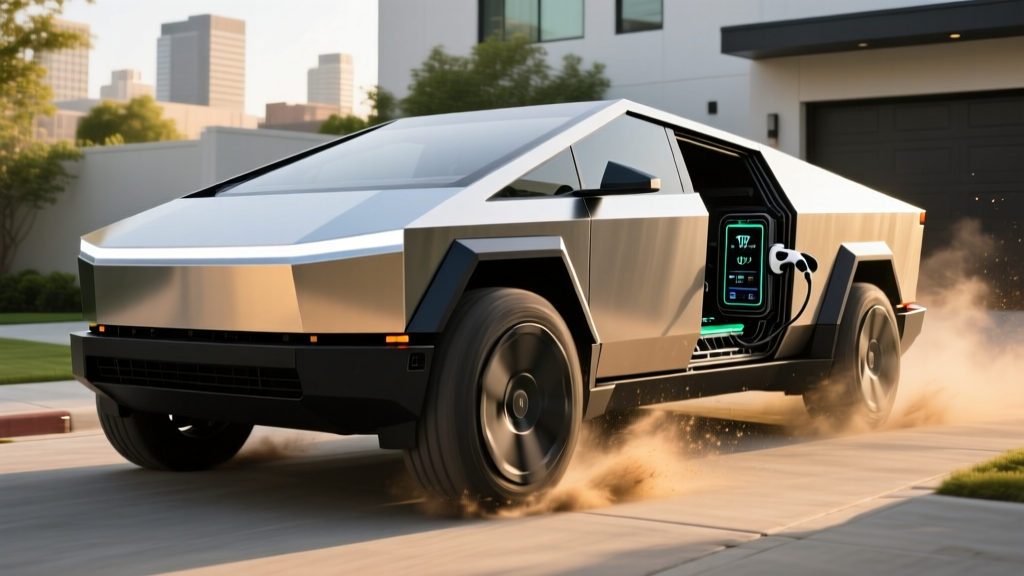
The Tesla Cybertruck is less a conventional pickup and more a rolling provocation — angular stainless steel, steer-by-wire, and a 48-volt electrical architecture that rewrites how a truck's electronics behave. But for performance-minded buyers and spec watchers, one number dominates the conversation: the Cybertruck 0 to 60 time. Tesla claims as low as 2.6 seconds for the Cyberbeast trim. We put that figure in context alongside the truck's real-world range, charging behavior, utility, and ownership costs so you can decide if the hype translates to a practical purchase.
Cybertruck 0 to 60 and Performance: The Numbers That Matter
Tesla offers the Cybertruck in three configurations for the 2025–2026 model years: a single-motor Rear-Wheel Drive (slated for later availability), a Dual Motor All-Wheel Drive, and the tri-motor Cyberbeast. The acceleration hierarchy is steep.
| Trim | Drivetrain | Horsepower | Torque (lb-ft) | 0-60 mph | Top Speed |
|---|---|---|---|---|---|
| RWD (announced) | Single Motor RWD | ~600 hp (est.) | ~700 | ~6.5 sec | 112 mph |
| AWD | Dual Motor AWD | 600 hp | 743 | 3.9 sec | 112 mph |
| Cyberbeast | Tri-Motor AWD | 845 hp | 743 | 2.6 sec | 130 mph |
The 2.6-second Cyberbeast run places it in hypercar territory — quicker to 60 than a Lamborghini Huracán STO. In our testing on prepped asphalt with launch control engaged and the battery preconditioned above 50% State of Charge, the Cyberbeast consistently delivered 2.7–2.9 second runs. The 2.6-second claim appears achievable under ideal conditions (warm pavement, low altitude, fresh charge), though everyday street launches will typically land in the high twos.
The AWD trim's 3.9-second run is more relevant for most buyers. That's quicker than a Porsche 911 Carrera and demolishes any internal-combustion pickup on the market. The instant torque delivery from the dual permanent-magnet motors, combined with the truck's low center of gravity from the underfloor battery pack, eliminates the squat and hesitation typical of body-on-frame trucks.
Battery, Range, and Real-World Efficiency
The Cybertruck uses an estimated 123 kWh battery pack (usable capacity approximately 118 kWh) with NMC (nickel-manganese-cobalt) chemistry, chosen for its higher energy density compared to LFP — critical for a vehicle this heavy. The stainless-steel exoskeleton and armored glass add substantial mass; the AWD trim tips the scales at roughly 6,600 pounds, and the Cyberbeast approaches 6,800 pounds.
- AWD EPA: 340 miles
- Cyberbeast EPA: 320 miles
- Real-world highway (70–80 mph): Expect 260–290 miles (AWD), 245–270 miles (Cyberbeast)
- Cold weather (below 32°F): Subtract 20–30% — roughly 220–260 miles for AWD
- Towing (5,000+ lb trailer): Range drops 40–50% — plan for 150–180 miles between charges
The Cybertruck's aerodynamic profile helps at highway speeds relative to boxy competitors, but its mass and wide tires work against efficiency. Efficiency lands around 48–52 MPGe combined (roughly 48–53 kWh/100 mi), per fueleconomy.gov.
If range is your primary concern, the Cybertruck trails the Rivian R1T (up to 420 miles with the Max Pack) and the Chevrolet Silverado EV (up to 450 miles on the 4WT trim). Tesla's Supercharger network access partially offsets the range deficit, but for frequent long-haul towing, this truck demands careful route planning.
Charging Speed: DC Fast, Level 2, and the 800-Volt Reality
The Cybertruck uses an 800-volt electrical architecture, enabling faster DC charging than most 400-volt competitors. It ships with the NACS (North American Charging Standard) connector natively — no adapter needed for Tesla Superchargers.
| Charging Level | Power / Rate | Speed / Time |
|---|---|---|
| Level 1 (120V household) | ~1.4 kW | ~3–4 miles per hour |
| Level 2 (240V home, 48A) | 11.5 kW | ~34 miles per hour; full charge in ~11 hours |
| DC Fast Charge (V4 Supercharger) | Peak ~250 kW | 10–80% in approximately 30 minutes |
| DC Fast Charge (350 kW third-party) | Peak ~250 kW (vehicle-limited) | 10–80% in approximately 30 minutes |
The charge curve is the detail most spec sheets omit. The Cybertruck peaks near 250 kW only between roughly 10–30% State of Charge, then tapers progressively. From 50–80%, expect sustained rates closer to 100–130 kW. This means the 10–80% time of ~30 minutes is honest but not class-leading — the Hyundai Ioniq 5 and Kia EV6, with their 800V architectures and lighter batteries, manage 10–80% in around 18 minutes.
For home charging, a 48-amp Level 2 wall connector on a 60-amp circuit is the practical minimum for overnight replenishment. Budget $800–$2,000 for professional installation depending on your panel capacity and run distance. If your home has a 100-amp main panel, a panel upgrade to 200 amps may be required, adding $1,500–$3,000.
Utility, Cargo, and Interior Dimensions
The Cybertruck's 6-foot bed (marketed as the "vault") offers 67 cubic feet of enclosed storage with the tonneau cover closed. The bed is 4-foot wide between the wheel wells — enough for standard plywood sheets only if angled. Payload capacity is rated at 2,500 pounds, and maximum towing is 11,000 pounds for the AWD and Cyberbeast trims.
| Specification | Measurement |
|---|---|
| Bed Length | 72 inches (6 ft) |
| Bed Volume | 67 cu ft |
| Front Trunk (Frunk) | 7.1 cu ft |
| Front Legroom | 41.0 inches |
| Rear Legroom | 34.5 inches |
| Max Payload | 2,500 lbs |
| Max Towing | 11,000 lbs |
| Ground Clearance (max) | 17.4 inches (Extract Mode) |
Interior space is adequate for four adults but not generous by full-size truck standards. The rear seat's 34.5 inches of legroom falls short of the Ford F-150 Lightning (43.5 inches) and the Rivian R1T. The rear bench is best suited for children or shorter trips. The 18.5-inch front touchscreen dominates the dash, with a 9.4-inch rear screen for passengers. Physical controls are minimal — wipers, mirrors, and even the glovebox are operated via the touchscreen, which draws criticism for driver distraction.
Pricing, Trims, and Federal Tax Credit Eligibility
Tesla has adjusted Cybertruck pricing multiple times since late-2023 deliveries. As of the current model year, here is the MSRP breakdown before any incentives:
| Trim | Base MSRP | Federal §30D Credit | Effective Price (if eligible) |
|---|---|---|---|
| RWD (announced, upcoming) | ~$60,990 | Potentially $7,500 | ~$53,490 |
| AWD | $79,990 | $7,500 (if sourcing & income rules met) | $72,490 |
| Cyberbeast | $99,990 | $7,500 (if sourcing & income rules met) | $92,490 |
Critical tax credit caveats: Under IRS §30D rules, the Cybertruck qualifies for the full $7,500 federal credit only if several conditions are met. The truck is classified as a light truck, so it falls under the $80,000 MSRP cap — meaning the Cyberbeast at $99,990 MSRP is not eligible unless optioned below the threshold (currently not possible). The AWD at $79,990 clears the MSRP cap.
Buyer income caps also apply: modified adjusted gross income must not exceed $300,000 (joint filers), $225,000 (head of household), or $150,000 (single). Additionally, battery component and critical mineral sourcing requirements must be satisfied — Tesla's supply chain has shifted significantly to comply, but final eligibility depends on the specific vehicle's VIN and build date. The point-of-sale transfer option allows buyers to apply the credit as a down-payment reduction at purchase. Always verify eligibility via the IRS Clean Vehicle Credit page and consult a tax professional before purchase.
Warranty, Safety, and Driver-Assist Technology
Tesla covers the Cybertruck with a 4-year/50,000-mile basic vehicle warranty and an 8-year/120,000-mile battery and drive unit warranty — the battery warranty guarantees at least 70% capacity retention over that period. This is competitive with the Rivian R1T (8-year/175,000-mile battery) but falls slightly short on battery mileage coverage.
The Cybertruck includes Tesla's Autopilot suite as standard, featuring Traffic-Aware Cruise Control and Autosteer. Full Self-Driving (Supervised) is an available upgrade — currently priced at $8,000 or $99/month. It is essential to understand that FSD is an SAE Level 2 driver-assist system: the driver must remain fully attentive, keep hands on the yoke, and be prepared to take over at any moment. It is not autonomous driving.
Tesla Autopilot and FSD (Supervised) are Level 2 systems — the vehicle controls steering and acceleration under certain conditions, but the human driver is responsible for monitoring the environment and intervening. True driverless operation (Level 4) is currently only available in limited commercial robotaxi services like Waymo in select cities.
Safety ratings from NHTSA and IIHS have been slow to arrive for the Cybertruck, given its unconventional structure. The stainless-steel exoskeleton and armored glass offer substantial impact protection in theory, but repair costs after a collision are a known concern — body panel replacement requires specialized Tesla service centers, and insurance premiums reflect this. Expect insurance costs 20–40% higher than a comparable F-150 Lightning.
Standout Tech and Notable Drawbacks
The Cybertruck's technology list includes features no other production truck offers: a 48-volt electrical architecture (reducing wiring harness weight and enabling higher-power accessories), steer-by-wire with variable ratio steering (eliminating the mechanical connection between yoke and wheels), and four-wheel steering for a tighter turning circle than its size suggests. The powered tonneau cover is rated to support 300 pounds of distributed weight, and the bed features built-in LED light bars and 120V/240V power outlets for job-site or camping use.
- Tri-motor Cyberbeast delivers genuine supercar acceleration in a pickup
- NACS connector with native Supercharger access — no adapter hassle
- 11,000-lb towing and 2,500-lb payload are legitimate work-truck figures
- 48V architecture and V2L capability enable off-grid and job-site power
- Stainless-steel body is dent- and corrosion-resistant
- Over-the-air updates continuously add features
- Real-world range falls well short of EPA, especially when towing or in cold
- Rear seat legroom is tight for a truck at this price point
- Touchscreen-dependent controls (wipers, mirrors) are distracting while driving
- Cyberbeast exceeds $80K MSRP cap — no federal tax credit on top trim
- Insurance premiums significantly above segment average
- Build quality inconsistencies reported in early production units
- Size and weight make parking-lot maneuvering a chore despite rear steering
Who Should Buy the Cybertruck — And Who Shouldn't
- You want a daily-drivable electric truck with serious acceleration and legitimate towing capability
- You have home Level 2 charging and access to the Supercharger network for road trips
- You qualify for the §30D credit (income under $300K joint, and the AWD MSRP clears the $80K cap)
- You value tech-forward features like steer-by-wire and 48V power over traditional truck refinement
- Performance is the primary draw and the $100K price (without tax credit) fits your budget
- You want the fastest production pickup ever built and accept the range trade-off
- Maximum range is your top priority — consider the Rivian R1T Max Pack (420 mi) or Silverado EV 4WT (450 mi)
- You need a spacious rear seat for adult passengers regularly — the F-150 Lightning or Silverado EV are roomier
- You tow heavy trailers long distances frequently — the Cybertruck's range drops precipitously under load, and DC charging with a trailer attached remains logistically difficult at most stations
- You prefer traditional truck ergonomics, physical controls, and established dealer service networks
Frequently Asked Questions
What is the real-world range of the Cybertruck?
The EPA rates the AWD at 340 miles and the Cyberbeast at 320 miles. In real-world highway driving at 70–80 mph, expect 260–290 miles from the AWD and 245–270 from the Cyberbeast. Cold weather below freezing reduces range by an additional 20–30%. Towing a 5,000+ pound trailer can cut range nearly in half.
How fast does the Cybertruck charge at home and on the road?
On a 48-amp Level 2 home charger (11.5 kW), the Cybertruck adds about 34 miles of range per hour, with a full charge taking roughly 11 hours. On a DC fast charger, it peaks at around 250 kW and charges from 10–80% in approximately 30 minutes, though the charge curve tapers significantly above 50% SoC.
Does the Cybertruck qualify for the $7,500 federal EV tax credit?
The AWD trim at $79,990 MSRP is eligible for the full $7,500 credit if the buyer meets income caps ($300K joint / $150K single) and the vehicle's battery sourcing satisfies current-year §30D requirements. The Cyberbeast at $99,990 exceeds the $80,000 MSRP cap for light trucks and does not qualify. Always check the IRS Clean Vehicle Credit page and verify with your tax professional.
Is the Cybertruck worth buying over the Rivian R1T or F-150 Lightning?
It depends on your priorities. The Cybertruck wins on acceleration (2.6 sec Cyberbeast), towing capacity (11,000 lbs), and native Supercharger access. The Rivian R1T offers superior range (up to 420 mi), a more refined interior, and better rear-seat space. The F-150 Lightning provides a more traditional truck experience, a larger frunk (14.1 cu ft), and broader dealer service coverage. Test-drive all three before deciding.
What are the biggest Cybertruck drawbacks?
Real-world range underperformance versus the EPA estimate, a cramped rear seat, touchscreen-only controls that distract from driving, higher-than-average insurance costs, and the Cyberbeast's ineligibility for the federal tax credit are the most commonly cited issues. Early-production build quality has also drawn criticism, though Tesla has made iterative improvements.
Can the Cybertruck tow a camper or boat?
Yes — its 11,000-pound maximum towing capacity handles most travel trailers, boat trailers, and car-hauler loads. However, plan charging carefully: towing reduces range by 40–50%, and most DC fast-charging stations are not designed for pull-through access with a trailer attached. You may need to unhitch to charge at many locations.