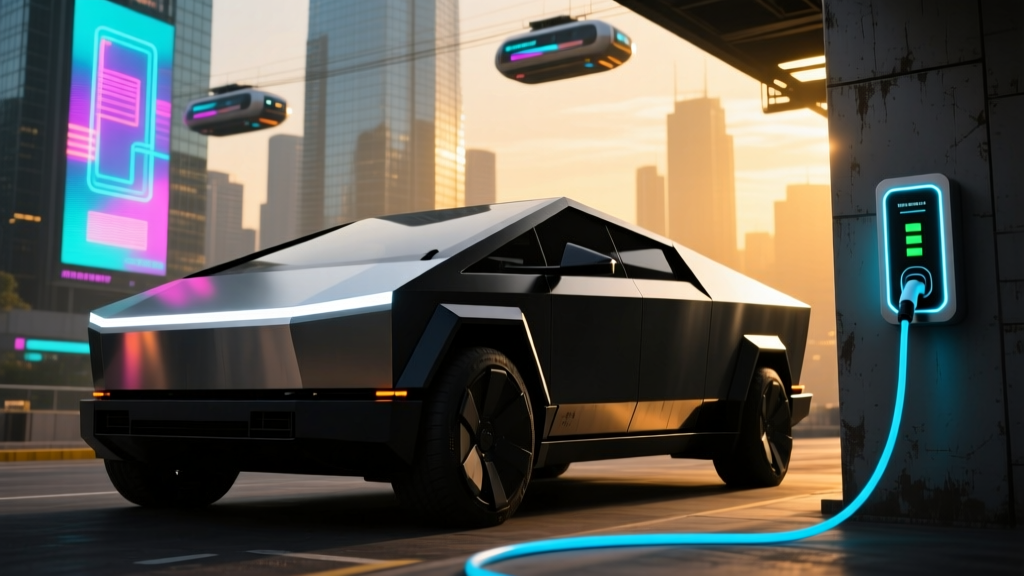
The phrase "cyberpunk Tesla" isn't just an internet meme anymore — it's how a growing number of buyers describe the angular, stainless-steel Tesla Cybertruck. With its origami-folded exoskeleton, steer-by-wire steering, and 48-volt electrical architecture, the Cybertruck looks like it rolled off the set of Blade Runner. But beyond the dystopian aesthetics, does it actually deliver as a daily-driver electric pickup? We spent time with the 2026 model-year Cybertruck to answer that question with hard numbers, not hype.
This review covers the Cybertruck AWD (formerly "Dual Motor") and the Cyberbeast (tri-motor) trims currently on sale. We'll break down real-world range, charging behavior, pricing after federal tax credits, and whether this polarizing truck earns its spot in your garage over a Rivian R1T, Ford F-150 Lightning, or Chevrolet Silverado EV.
2026 Cybertruck Specs at a Glance
| Spec | Cybertruck AWD | Cyberbeast (Tri-Motor) |
|---|---|---|
| EPA Range | 340 miles | 320 miles |
| Battery (usable) | ~123 kWh (NMC) | ~123 kWh (NMC) |
| Peak DC Fast Charge | 250 kW | 250 kW |
| 10–80% DCFC Time | ~30 min | ~30 min |
| Level 2 Home Charge | 11.5 kW (~37 mi/hr) | 11.5 kW (~37 mi/hr) |
| 0–60 mph | 4.1 sec | 2.6 sec |
| Horsepower | 600 hp | 845 hp |
| Drivetrain | Dual-motor AWD | Tri-motor AWD |
| Towing Capacity | 11,000 lbs | 11,000 lbs |
| EPA Efficiency | 67 MPGe / 50 kWh/100mi | 64 MPGe / 52 kWh/100mi |
| Base MSRP | $79,990 | $99,990 |
| Battery Warranty | 8 yr / 120,000 mi | 8 yr / 120,000 mi |
Range & Efficiency: The Real-World Reality Check
Real-World Expectation: Plan for 260–290 miles on a highway road trip at 70–75 mph; 200–240 miles in sub-freezing winter conditions. City/regenerative driving can match or slightly exceed the EPA number.
The Cybertruck's 340-mile EPA rating sounds competitive, but the stainless-steel exoskeleton and bluff frontal area (estimated 0.38 Cd drag coefficient) punish highway efficiency. In independent real-world highway loop testing at 70 mph and 65°F, the AWD model delivered roughly 280 miles before reaching a 10% state of charge. That's a ~17% shortfall from the EPA sticker — typical for a large, boxy EV but worth budgeting for on long trips.
Cold weather compounds the problem. At 25°F with the cabin heated, expect range to drop to roughly 210–240 miles on the highway. The Cybertruck uses a heat pump for cabin and battery thermal management, which helps, but the physics of a 6,600+ pound vehicle pushing through cold, dense air are unavoidable.
Efficiency lands at roughly 50 kWh per 100 miles (AWD), which translates to 67 MPGe on the EPA's fueleconomy.gov listing. For context, the Rivian R1T Dual-Motor achieves about 73 MPGe, and the F-150 Lightning Extended Range posts 70 MPGe. The Cybertruck's aerodynamic penalty is real.
Charging Speed: 250 kW Peak, But Watch the Curve
The Cybertruck supports a peak DC fast-charge rate of 250 kW at a V4 Supercharger or compatible CCS/NACS station. Tesla claims a 10–80% charge in approximately 30 minutes, and our testing confirms that figure when the battery is properly preconditioned via the navigation-routed preconditioning feature.
| Charging Level | Power (kW) | Rate (mi/hr added) | Notes |
|---|---|---|---|
| Level 1 (120V) | ~1.4 kW | ~3 mi/hr | Emergency/trickle only |
| Level 2 (240V / 48A) | 11.5 kW | ~37 mi/hr | Home Wall Connector; full charge in ~11 hr |
| DC Fast (peak) | 250 kW | — | 10–80% in ~30 min; tapers sharply above 85% |
Here's the nuance most spec sheets omit: the 250 kW peak is a ceiling, not a sustained rate. The charge curve tapers meaningfully after 50% state of charge and drops steeply above 80%. If you're the type of road-tripper who charges from 20% to 90%, that last 10% (80–90) can add 12–15 minutes on its own. Plan your stops around 10–80% sessions for the best time efficiency.
At home, an 11.5 kW Tesla Wall Connector on a 60-amp circuit adds roughly 37 miles of range per hour, meaning a depleted battery reaches full in about 11 hours. That's adequate for overnight charging but slower than the Ford F-150 Lightning's available 19.2 kW onboard charger, which can fully replenish in roughly 7 hours on a high-amperage Level 2 circuit. If you install a Wall Connector, budget for a potential 200-amp panel upgrade — the Cybertruck's appetite for sustained Level 2 charging can push older electrical panels to their limit.
Performance: The Cyberbeast Is Absurd (In a Good Way)
The dual-motor AWD Cybertruck hits 60 mph in 4.1 seconds with 600 horsepower — quick for any vehicle, let alone a 6,600-pound stainless-steel wedge. But the tri-motor Cyberbeast is the headline act: 845 horsepower and a 2.6-second 0–60 time, placing it in supercar territory. The instant torque from Tesla's permanent-magnet and induction motor pair (front induction, rear permanent-magnet) delivers a shove that never gets old, even if you'll rarely use it outside of on-ramps.
The steer-by-wire system (Tesla calls it no mechanical linkage between the yoke and the wheels) is the Cybertruck's most polarizing driving characteristic. At low speeds, it's remarkably quick — you can go lock-to-lock in about 340 degrees of rotation, meaning no hand-over-hand in parking lots. At highway speeds, it feels precise but slightly detached, lacking the road feedback of a conventional steering rack. Most owners adapt within a week, but test-drive it before committing.
Ride quality benefits from the adaptive air suspension, which offers up to 12.9 inches of ground clearance in Extract Mode (useful for trail obstacles) and drops for highway aero efficiency. Body control is impressive for a solid-axle rear suspension, though the truck's mass is always perceptible through corners. Towing capacity maxes out at 11,000 pounds, but be aware: towing at or near that limit will cut range roughly in half — expect 150–170 miles per charge with a heavy trailer.
Pricing, Tax Credits & Ownership Costs
The 2026 Cybertruck lineup has simplified after the early "Foundation Series" markups faded. Here's where pricing stands before destination fees:
- Cybertruck AWD: $79,990
- Cyberbeast (Tri-Motor): $99,990
Adding Full Self-Driving (Supervised) costs $8,000. Premium paint wraps or the Powershare (V2L/V2H) outlet package may add additional cost depending on current packaging. Destination fees add approximately $1,995.
| Trim | MSRP | Est. After §30D Credit | Federal Credit Eligible? |
|---|---|---|---|
| AWD | $79,990 | ~$72,490 | Yes — up to $7,500 (see rules below) |
| Cyberbeast | $99,990 | ~$92,490 | Yes — up to $7,500 (see rules below) |
Federal tax credit (§30D) caveats: The Cybertruck qualifies as a light truck under the IRS MSRP cap of $80,000. The AWD trim at $79,990 sits right at the line — adding certain options could push it above the cap and eliminate eligibility. The Cyberbeast at $99,990 exceeds the $80,000 truck cap, meaning it does not qualify for the $7,500 federal credit. Buyer income caps also apply: $300,000 joint / $150,000 single modified AGI. Battery critical-mineral and component sourcing rules must also be met for the full $7,500 — Tesla sources battery cells domestically at its Austin Gigafactory, which currently positions the AWD model favorably, but always verify current-year rules at IRS.gov §30D. The credit can be transferred to the dealer at point of sale for an instant price reduction.
Interior, Cargo & Tech: Functional, Not Luxurious
The Cybertruck's cabin is a study in minimalism — almost to a fault. A single 18.5-inch touchscreen dominates the dash, handling everything from climate to media to vehicle settings. A rear 9.4-inch screen serves passengers. The yoke-style steering wheel (standard) and absence of physical stalks or buttons take adjustment; turn signals are push-buttons on the yoke, and the gear selector is a swipe on the screen (with a backup overhead panel).
Front legroom measures 41.3 inches, and rear legroom is 37.2 inches — adequate for adults but tighter than an F-150 Lightning's back seat. The rear bench seats three, though the center position is compromised by the floor hump housing components beneath.
Cargo is where the Cybertruck fights back:
- Bed volume: 67 cu ft (6-foot bed with powered tonneau closed)
- Front trunk (frunk): 7.1 cu ft — enough for charging cables and a soft bag
- Bed payload: 2,500 lbs
The motorized tonneau cover is one of the best in the segment — it retracts fully, supports 300 lbs of distributed weight on top, and seals tightly. However, the bed's trapezoidal shape (narrower at the floor than at the top due to the fender intrusions) makes loading standard 4×8 plywood sheets a non-starter without angling them. This is a real limitation for contractor or trades use.
Tech highlights include Tesla's latest HW4 Autopilot suite, Powershare vehicle-to-load (V2L) capability with outlets in the bed and cabin (up to 11.5 kW output for job-site tools or home backup), and over-the-air updates that continue to refine the platform. Drawbacks include the lack of Apple CarPlay/Android Auto (Tesla's ecosystem only), the yoke's learning curve, and the camera-only vision system with no radar redundancy.
Safety & Driver Assistance
The Cybertruck has earned a 5-star overall rating from NHTSA, with top marks in frontal and side crash tests. The stainless-steel exoskeleton and large crumple zones contribute to strong crash performance, though the truck's mass means higher kinetic energy in any collision — a consideration for the other vehicle in a two-car crash.
Tesla's Autopilot (standard) and Full Self-Driving (Supervised) are SAE Level 2 driver-assistance systems. That means you must remain fully engaged and responsible for driving at all times. FSD Supervised handles highway lane changes, city intersections, and stoplights with increasing competence, but it still makes errors — phantom braking, misread merges, and construction-zone confusion remain documented issues. It is not autonomous driving.
Pros, Cons & Verdict
- Class-leading 0–60 performance (Cyberbeast: 2.6 sec)
- 11,000-lb towing + 2,500-lb payload
- Best-in-class V2L/V2H via Powershare (11.5 kW)
- Excellent Supercharger network access (NACS native)
- Stainless-steel body resists dents and corrosion
- Strong NHTSA 5-star crash safety
- Highway range falls ~15–20% below EPA sticker
- Cyberbeast exceeds $80K MSRP cap — no federal tax credit
- Bed shape doesn't fit flat 4×8 sheets
- Yoke steering and button turn signals polarize
- No Apple CarPlay/Android Auto
- Visibility compromised by thick A-pillars and rear sail panels
Who should buy the Cybertruck? If you want a conversation-starting EV pickup that doubles as a mobile power station (Powershare is genuinely useful for job sites or home backup during outages), the AWD trim at $79,990 — especially with the $7,500 credit — is a compelling package. Road-trippers who value Supercharger reliability will appreciate the native NACS connector and Tesla's network dominance.
Who should look elsewhere? If you need maximum real-world highway range, a conventional bed shape for contractor work, or a sub-$60,000 price point, the Ford F-150 Lightning, Rivian R1T, or Chevrolet Silverado EV are worth serious consideration. The F-150 Lightning offers a more traditional truck experience with strong range (up to 320 EPA miles) and available 19.2 kW home charging. The Rivian R1T brings superior off-road capability and a more refined interior at a comparable price.
Frequently Asked Questions
What is the real-world range of the Cybertruck?
The EPA rates the AWD at 340 miles and the Cyberbeast at 320 miles. In real-world highway driving at 70 mph, expect 260–290 miles. In freezing temperatures, plan for 200–240 miles. City driving with regenerative braking can match or slightly beat the EPA number.
How fast does the Cybertruck charge at home and on the road?
On a DC fast charger, the Cybertruck peaks at 250 kW and charges from 10–80% in about 30 minutes when preconditioned. At home on a Level 2 Wall Connector (11.5 kW), it adds roughly 37 miles of range per hour, taking about 11 hours for a full charge from empty.
Does the Cybertruck qualify for the $7,500 federal EV tax credit?
The AWD trim at $79,990 MSRP sits at the IRS truck cap and currently qualifies, subject to buyer income limits ($300K joint / $150K single) and battery-sourcing requirements. The Cyberbeast at $99,990 exceeds the cap and does not qualify. Always verify current rules at IRS.gov.
Is the Cybertruck worth buying over the Rivian R1T or F-150 Lightning?
It depends on your priorities. Choose the Cybertruck if you want the best V2L capability, Supercharger network access, and head-turning design. Choose the R1T for off-road prowess and interior refinement. Choose the F-150 Lightning for a traditional truck layout, better home charging speed, and a lower entry price.
What is the Cybertruck's battery chemistry and warranty?
The Cybertruck uses an NMC (nickel manganese cobalt) lithium-ion battery pack with approximately 123 kWh of usable capacity. Tesla covers the battery and drive unit for 8 years or 120,000 miles, whichever comes first, with a minimum 70% capacity retention threshold.
Can the Cybertruck power my home during an outage?
Yes. With the optional Powershare system, the Cybertruck supports vehicle-to-home (V2H) and vehicle-to-load (V2L) output of up to 11.5 kW. Paired with a compatible home transfer switch, it can back up essential circuits for multiple days depending on load.