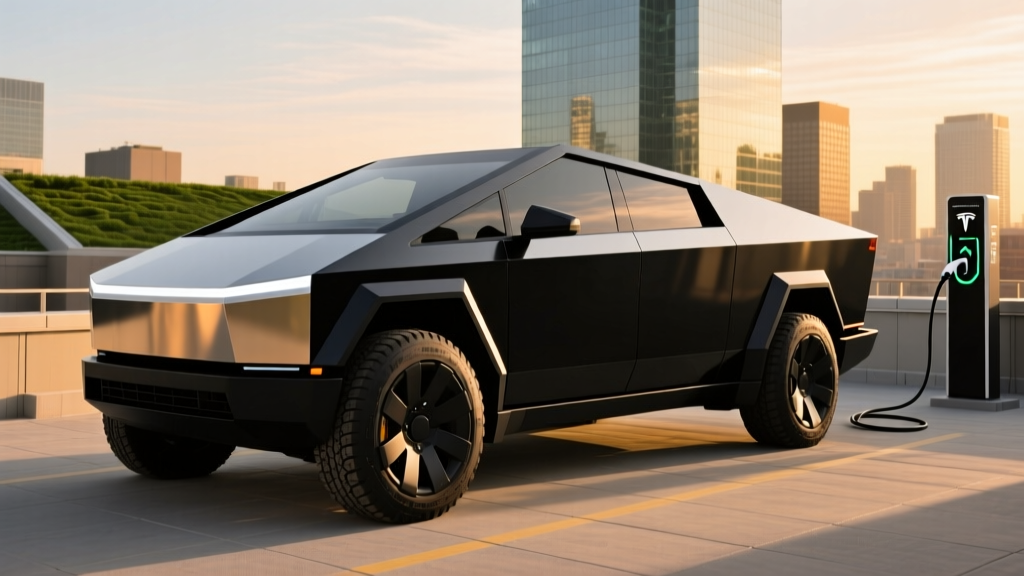
The Tesla Cybertruck Cyberbeast sits at the apex of the electric pickup segment — a tri-motor, stainless-steel brute that pairs hypercar acceleration with a pickup bed. But beneath the polarizing angular skin lies a complex machine with real-world trade-offs that spec sheets alone won't reveal. After analyzing EPA data, owner reports, and Tesla's own engineering disclosures, here's what buyers actually need to know before committing to the $99,990 Cyberbeast.
Specs at a Glance: Cyberbeast by the Numbers
| Specification | Value |
|---|---|
| EPA Range | 320 miles |
| Battery Capacity (usable) | ~123 kWh (estimated), NMC chemistry |
| Drivetrain | Tri-Motor AWD (1 front, 2 rear) |
| Horsepower | 845 hp (peak) |
| 0–60 mph | 2.6 seconds (Tesla claim, rollout subtracted) |
| Top Speed | 130 mph |
| Max DC Fast Charge | ~250 kW (V3 Supercharger compatible) |
| 10–80% DC Charge Time | ~35–40 minutes (est.) |
| Level 2 Home Charge Rate | 11.5 kW (~34 mi/hr at 48A) |
| Towing Capacity | 11,000 lbs (rated) |
| Payload Capacity | 2,500 lbs |
| Bed Length | 6 ft (72 in) |
| Cargo Volume (vault) | ~67 cu ft (bed), ~35 cu ft (frunk area under tonneau) |
| Curb Weight | ~6,840 lbs |
| Base MSRP | $99,990 (before destination) |
| Battery/Drive Unit Warranty | 8 years / 120,000 miles |
| Basic Vehicle Warranty | 4 years / 50,000 miles |
Real-World Range and Efficiency: Beyond the EPA Sticker
The EPA's 320-mile figure assumes a specific blend of city and highway driving at moderate temperatures. The Cyberbeast's efficiency rating sits at approximately 50 MPGe combined, translating to roughly 67 kWh per 100 miles — making it one of the least efficient EVs on the market by energy consumption. That's the cost of moving nearly 7,000 pounds of stainless steel and battery.
On a 75-mph highway loop in mild conditions (65–75°F), expect the Cyberbeast to deliver approximately 260–280 miles before needing a charge. Push speeds to 80+ mph or encounter headwinds on open interstates, and that figure can dip toward 240 miles. Cold weather (below 32°F) compounds the issue: battery chemistry slows, cabin heating draws significant energy (the Cybertruck uses a resistive heater supplemented by heat pump in some configurations), and range loss of 20–30% is realistic, putting winter highway range closer to 220 miles.
Towing is where the Cyberbeast's range story becomes most constrained. At its 11,000-lb maximum rated capacity, expect range to plummet to 100–140 miles depending on trailer aerodynamics and terrain. Even a 5,000-lb enclosed cargo trailer cuts range roughly in half. This isn't unique to the Cybertruck — all electric pickups face this physics problem — but it demands trip planning for anyone intending to tow beyond local distances.
Charging Speeds: DC Fast, Level 2, and the Charge Curve Reality
The Cyberbeast charges via the NACS (North American Charging Standard) connector natively — no adapter needed at Tesla Superchargers, which is a significant infrastructure advantage as of 2025. Tesla has also opened Supercharger access to non-Tesla EVs, but Tesla owners retain the most seamless plug-and-charge experience.
| Charge Level | Power / Rate | Speed (Miles Added) | Notes |
|---|---|---|---|
| Level 1 (120V household) | ~1.4 kW | ~3–4 mi/hr | Emergency/trickle only; ~80+ hrs for full charge |
| Level 2 (240V, 48A Wall Connector) | 11.5 kW | ~34 mi/hr | Full charge in ~10–11 hours; overnight ready |
| Level 2 (240V, 32A mobile connector) | 7.7 kW | ~23 mi/hr | Slower; ~16 hrs full charge |
| DC Fast (Tesla V3 Supercharger) | Up to ~250 kW peak | ~170 mi in 15 min (peak) | 10–80% in ~35–40 min; tapers above 60% |
| DC Fast (Tesla V4 Supercharger) | Up to ~350 kW (theoretical) | Faster peak, similar sustained | Limited V4 availability; CCS adapter needed for non-Tesla networks |
Charge curve reality: The Cyberbeast's large ~123 kWh battery means it can sustain relatively high charge rates longer than smaller-battery EVs, but peak 250 kW is not maintained throughout the session. Expect the charge rate to taper meaningfully above 60% state of charge, with significant slowdown above 80%. For road-trip efficiency, charging from 10–80% and driving on is faster than topping off to 100% at every stop. Preconditioning the battery (automatic when navigating to a Supercharger) is critical — arriving at a fast charger with a cold battery can cut charge speeds by 40–50%.
At home, the Tesla Wall Connector at 48 amps on a 60A circuit delivers 11.5 kW, adding roughly 34 miles of range per hour. Given the Cyberbeast's large battery, a full 0–100% Level 2 session takes approximately 10–11 hours. Most owners who plug in nightly will rarely need a full charge cycle — daily driving of 40–60 miles requires only 2–3 hours of Level 2 replenishment. Home installation of a 240V/60A circuit typically costs $800–$2,000 depending on panel proximity and local permitting, on top of the $475 Wall Connector unit.
Performance: 845 Horsepower in a Pickup
The Cyberbeast's tri-motor powertrain — one motor on the front axle and two on the rear — produces a combined 845 peak horsepower. The 0–60 mph claim of 2.6 seconds (with 1-foot rollout subtracted, as is industry convention) makes it one of the quickest production vehicles ever sold, regardless of powertrain. Independent testing by outlets like Motor Trend and Car and Driver has validated figures in the 2.6–2.7 second range on prepped surfaces.
But straight-line speed is only part of the performance story. The Cyberbeast features rear-wheel steering (up to 10 degrees), which dramatically improves low-speed maneuverability — the truck's turning circle is surprisingly tight for its 223.5-inch overall length. Adaptive air suspension provides up to 17 inches of ground clearance in Off-Road mode and can lower for highway efficiency. The steer-by-wire system eliminates the mechanical connection between the yoke (or optional round wheel) and the rack, offering variable ratio steering that requires less than a full turn lock-to-lock.
Steer-by-wire remains controversial: some drivers adapt quickly and appreciate the precision, while others report a disconnect in feel, particularly at highway speeds or during low-speed parking maneuvers. Tesla offers a round steering wheel option (no-cost) for buyers who reject the yoke, and this is strongly recommended for anyone who does regular highway driving or parking.
Pricing, Trims, and Federal Tax Credit Eligibility
The Cyberbeast is the range-topping Cybertruck trim, positioned well above the Dual Motor AWD ($79,990) and the base Rear-Wheel Drive (announced at $60,990 for 2026 delivery). Here's the current pricing landscape:
| Trim | Base MSRP | Federal Tax Credit (§30D) | Effective Price (if eligible) |
|---|---|---|---|
| Cybertruck RWD (2026) | $60,990 | Up to $7,500 (see eligibility) | ~$53,490 |
| Cybertruck Dual Motor AWD | $79,990 | Up to $7,500 (see eligibility) | ~$72,490 |
| Cybertruck Cyberbeast (Tri-Motor) | $99,990 | Up to $7,500 (see eligibility) | ~$92,490 |
Federal tax credit caveats (IRS §30D, 2025–2026 rules): The $7,500 credit is not automatic. Eligibility depends on multiple factors that buyers must verify:
- MSRP cap: Pickup trucks must have an MSRP at or below $80,000 to qualify. The Cyberbeast at $99,990 exceeds this cap and does NOT qualify for the federal §30D new vehicle credit. The Dual Motor AWD at $79,990 is at the threshold (destination charges may push it over — verify with your dealer).
- Buyer income limits: Modified adjusted gross income must not exceed $150,000 (single), $225,000 (head of household), or $300,000 (joint).
- Battery sourcing: Critical minerals and battery components must meet escalating domestic-content thresholds. Tesla's supply chain has been evolving; confirm current-year compliance on IRS.gov or via the DOE's fueleconomy.gov credit lookup tool.
- Point-of-sale transfer: Eligible buyers can transfer the credit to the dealer at purchase, reducing the purchase price directly rather than waiting for a tax refund.
Bottom line on the Cyberbeast specifically: At $99,990, the Cyberbeast is priced out of the federal new-vehicle tax credit. Buyers should check for state-level incentives (which vary by jurisdiction — consult your state's energy office or DMV) and consider whether the Dual Motor AWD trim, if it qualifies, offers a better value proposition.
Interior, Tech, and Daily Livability
The Cybertruck's interior is minimalist even by Tesla standards. A single 18.5-inch center touchscreen handles nearly all vehicle functions — climate, media, navigation, vehicle settings, and camera views. A rear 9.4-inch touchscreen serves back-seat passengers. There is no traditional instrument cluster; all driving information is displayed on the center screen, which some drivers find distracting.
Passenger space is adequate but not class-leading. Front legroom measures approximately 41.4 inches; rear legroom is around 38.3 inches — sufficient for adults on shorter trips but tighter than a Ford F-150 Lightning or Rivian R1T for extended rear-seat occupancy. The rear bench seats three, though the center position is best for children given the transmission tunnel hump and narrow shoulder room.
The 6-foot bed (marketed as "the vault") features a motorized retractable tonneau cover that can support 300 lbs of distributed weight. The bed offers 120V and 240V power outlets (up to 9.6 kW of vehicle-to-load power output), making it a functional mobile power source for job sites, tailgating, or emergency home backup. The frunk (front trunk) provides lockable storage, though it's smaller than the Lightning's massive front trunk due to the Cybertruck's more aggressive front-end design and steer-by-wire hardware packaging.
Driver assistance: The Cyberbeast ships with Tesla's Basic Autopilot (adaptive cruise control and lane-centering). Full Self-Driving (Supervised) is available as a $8,000 one-time purchase or $99/month subscription. FSD Supervised remains a SAE Level 2 system — it does not make the Cybertruck self-driving. The driver must remain attentive, keep hands on the yoke/wheel, and be prepared to take over at any moment. Tesla's camera-only vision approach (no lidar or radar) performs well in clear conditions but can struggle in heavy rain, fog, or construction zones with shifted lane markings.
Pros, Cons, and the Verdict
Pros
- Class-defining acceleration (2.6s 0–60) and 845 hp
- Native NACS connector — best-in-class Supercharger network access
- Stainless-steel exoskeleton resists dents and corrosion
- Rear-wheel steering improves low-speed maneuverability
- 9.6 kW vehicle-to-load power output from bed outlets
- Adaptive air suspension with up to 17" ground clearance
- Over-the-air updates continuously add features
Cons
- Does NOT qualify for $7,500 federal tax credit (MSRP exceeds $80K cap)
- Real-world highway range ~260–280 mi, significantly less in cold/towing
- 67 kWh/100mi efficiency is poor — high charging costs on road trips
- Steer-by-wire and yoke are polarizing; learning curve required
- Rear seat comfort and legroom trails F-150 Lightning and Rivian R1T
- Bed is only 6 feet (vs. 5.5–8 ft options on conventional trucks)
- Build quality inconsistencies reported by early owners (panel gaps, trim)
- Insurance premiums significantly above segment average
Who Should Buy the Cyberbeast?
The Cyberbeast is not a rational purchase for most truck buyers. It's a statement vehicle that excels in specific scenarios:
Best fit: Tech-forward buyers who want the fastest-accelerating pickup ever built, primarily drive in urban/suburban environments with home charging access, value the Supercharger network for road trips, and don't need maximum bed length or rear-seat comfort. It works well as a daily-driver commuter truck with weekend toy-hauling capability (motorcycles, light trailers) where the 11,000-lb tow rating is more than sufficient.
Better alternatives exist for: Buyers who need maximum range (Rivian R1T Dual-Motor Max offers ~400+ miles EPA), buyers who need a full-size rear seat for family duty (Ford F-150 Lightning is roomier), buyers who tow heavy trailers long distances (all EV pickups struggle here, but diesel remains superior), and buyers who want federal tax credit eligibility (the Cybertruck Dual Motor AWD at $79,990 may qualify, or consider the Chevrolet Silverado EV 4WT for fleet/commercial credit options).
If the Cyberbeast's combination of performance, design, and Tesla ecosystem integration resonates — and the $100K price tag (without federal credit) fits your budget — it delivers an experience no other electric pickup can match. Just go in with clear eyes about real-world range, charging costs, and the learning curve of steer-by-wire.
Frequently Asked Questions
What is the real-world range of the Tesla Cyberbeast?
The EPA rates the Cyberbeast at 320 miles. In real-world highway driving at 70–80 mph in mild temperatures, expect 260–280 miles. Cold weather (below freezing) can reduce that to 220–240 miles. Towing at max capacity drops range to roughly 100–140 miles.
How fast does the Cyberbeast charge at home and on the road?
At home on a Level 2 Tesla Wall Connector (48A/240V), the Cyberbeast charges at 11.5 kW, adding ~34 miles per hour — a full charge takes about 10–11 hours. On a Tesla V3 Supercharger, it peaks around 250 kW and charges from 10–80% in approximately 35–40 minutes, with significant tapering above 60% state of charge.
Does the Cyberbeast qualify for the federal EV tax credit?
No. Under IRS §30D rules, new pickup trucks must have an MSRP at or below $80,000 to qualify for the up-to-$7,500 federal tax credit. The Cyberbeast at $99,990 exceeds this cap. The Dual Motor AWD at $79,990 may qualify depending on destination charges and current battery-sourcing compliance. Always verify on IRS.gov before purchasing.
Is the Cyberbeast worth buying over the F-150 Lightning or Rivian R1T?
It depends on priorities. The Cyberbeast wins on acceleration (2.6s vs. ~3.8s for the Lightning, ~3.5s for the R1T) and Supercharger network access. The F-150 Lightning wins on rear-seat space, conventional truck familiarity, and tax credit eligibility (Pro/Lariat trims). The Rivian R1T wins on range (Max Pack ~400+ mi), off-road capability, and interior quality. Test-drive all three before deciding.
What's the biggest drawback of owning the Cyberbeast?
Beyond the $100K price without federal credit support, the biggest practical drawback is efficiency. At ~67 kWh/100mi, the Cyberbeast is expensive to charge on road trips (often $0.35–0.50/kWh at public DC fast chargers, meaning a 10–80% session can cost $25–40). Combined with 260-mile real-world highway range, road trips require more frequent and more expensive stops than more aerodynamic EVs. Insurance costs also run 30–50% above comparable trucks due to repair complexity and stainless-steel body panel replacement costs.
What is the Cyberbeast's battery warranty?
Tesla covers the Cyberbeast's battery and drive units for 8 years or 120,000 miles, whichever comes first, with a minimum 70% capacity retention threshold. The basic vehicle warranty is 4 years / 50,000 miles. Tesla's warranty is competitive with the segment, though some competitors (Hyundai, Kia) offer longer basic coverage.