Tesla's configurator is deceptively simple: a handful of paint colors, two wheel options, an interior choice, and a software add-on. But those few toggles swing the price of a 2026 Model Y by over $15,000 and materially alter its range, ride quality, and daily usability. If you are building a custom Model Y, every decision compounds — from the 19-inch wheels that preserve EPA range to the $8,000 Full Self-Driving (Supervised) package that remains a Level 2 driver-assist system.
This guide walks through the 2026 Model Y lineup trim by trim, option by option, with real-world range data, charging curves, and tax-credit math so you can configure confidently.
2026 Tesla Model Y Lineup: Trims, Specs & Pricing
Tesla currently offers three Model Y configurations in the US market for the 2026 model year (the refreshed "Juniper" generation introduced in early 2025). Here is the spec breakdown at a glance:
| Specification | Long Range RWD | Long Range AWD | Performance AWD |
|---|---|---|---|
| Base MSRP | $44,990 | $47,990 | $52,490 |
| EPA Range (est.) | 320 mi | 308 mi | 277 mi |
| Battery (usable) | ~75 kWh, NMC | ~75 kWh, NMC | ~75 kWh, NMC |
| Drivetrain | RWD (single motor) | Dual Motor AWD | Dual Motor AWD |
| Horsepower | ~346 hp | ~384 hp | ~456 hp |
| 0-60 mph | 5.8 sec | 4.8 sec | 3.5 sec |
| MPGe (combined) | 111 MPGe | 107 MPGe | 99 MPGe |
| Max DC Fast Charge | 250 kW | 250 kW | 250 kW |
| 10-80% DC Time | ~25 min | ~25 min | ~25 min |
| Level 2 Home Rate | 11.5 kW (~44 mi/hr) | 11.5 kW (~44 mi/hr) | 11.5 kW (~44 mi/hr) |
| Battery Warranty | 8 yr / 120,000 mi | 8 yr / 120,000 mi | 8 yr / 120,000 mi |
Source: Tesla Model Y configurator, fueleconomy.gov. Specs reflect 2026 model-year estimates; EPA certifications may vary slightly by production batch.
Real-World Range: What the EPA Sticker Doesn't Tell You
The Long Range AWD carries a 308-mile EPA estimate. In real-world mixed driving at 70°F, expect 270-290 miles. Sustained 75-80 mph highway driving drops this to 250-265 miles. In sub-freezing winter conditions (20-30°F), plan for 220-245 miles — a 20-25% reduction typical of NMC chemistry without aggressive preconditioning.
The RWD Long Range's 320-mile EPA rating is the efficiency king of the lineup. Its single-motor drivetrain eliminates front-axle drag and parasitic losses, and the lighter curb weight helps. On a 65-mph suburban commute loop, owners routinely report 300-315 actual miles. But push it to 80 mph on an interstate in January, and 260 miles is realistic.
The Performance trim's 277-mile EPA rating suffers from its 21-inch Überturbine wheels (higher rolling resistance and aero drag), stickier summer-compound tires, and more aggressive inverter tuning. If road-trip range matters, this is the wrong trim — unless you accept the 150 kW Supercharger network and plan stops accordingly.
Cold-weather mitigation: The Juniper-generation Model Y uses a heat pump (standard on all trims), which significantly reduces cabin-heating energy draw versus resistive heaters. Preconditioning the battery while plugged in — using the Tesla app's scheduled departure feature — recovers 5-10% of range that would otherwise be lost to cold-soak.
Charging Speed: DC Fast, Level 2 & the Curve Reality
All 2026 Model Y trims share the same charging hardware: a 250 kW peak DC fast-charge rate on Tesla's V3/V4 Superchargers and an 11.5 kW onboard charger for Level 2 AC.
| Charging Level | Power | Speed (approx.) | Use Case |
|---|---|---|---|
| Level 1 (120V outlet) | ~1.4 kW | ~5 mi/hr | Emergency / overnight trickle |
| Level 2 (240V, 48A) | 11.5 kW | ~44 mi/hr | Home daily charging (8-10 hr full) |
| DC Fast (V3 Supercharger) | 250 kW peak | 10-80% in ~25 min | Road trips; ~180 mi in 15 min |
The charge curve matters more than peak kW. The Model Y hits 250 kW only between roughly 10-30% state of charge. From 30-50%, it tapers to ~175 kW. From 50-80%, expect ~100-120 kW. Above 80%, charging slows dramatically to protect the NMC cells — a 80-100% top-off can add 20+ minutes. For road trips, the optimal strategy is 10-80% hops, which aligns with Tesla's navigation-based Supercharger routing.
Home charging setup: Tesla's Wall Connector ($475) delivers the full 48 amps / 11.5 kW on a NEMA 14-50 or hardwired 60A circuit. A full charge from 10% takes about 7.5 hours. Most owners charge overnight and never visit 100% except before long trips. Budget $500-$1,500 for a licensed electrician to install a 240V/60A circuit, depending on panel proximity and local permitting.
NACS advantage: The Model Y uses the North American Charging Standard (NACS) connector natively. As of 2026, Tesla's Supercharger network exceeds 30,000 stalls in North America, and competitors like Ford, GM, Rivian, and Hyundai/Kia now access it via adapter or native NACS ports. The Model Y still has the broadest, most reliable fast-charging access of any EV on the market.
Configuring Your Custom Model Y: Every Option & Its Impact
Here is where the configurator decisions get consequential. Each option affects price, range, or both:
Paint Colors
- Glacier Blue Metallic — Standard (no cost)
- Deep Blue Metallic — +$1,000
- Pearl White Multi-Coat — +$1,000
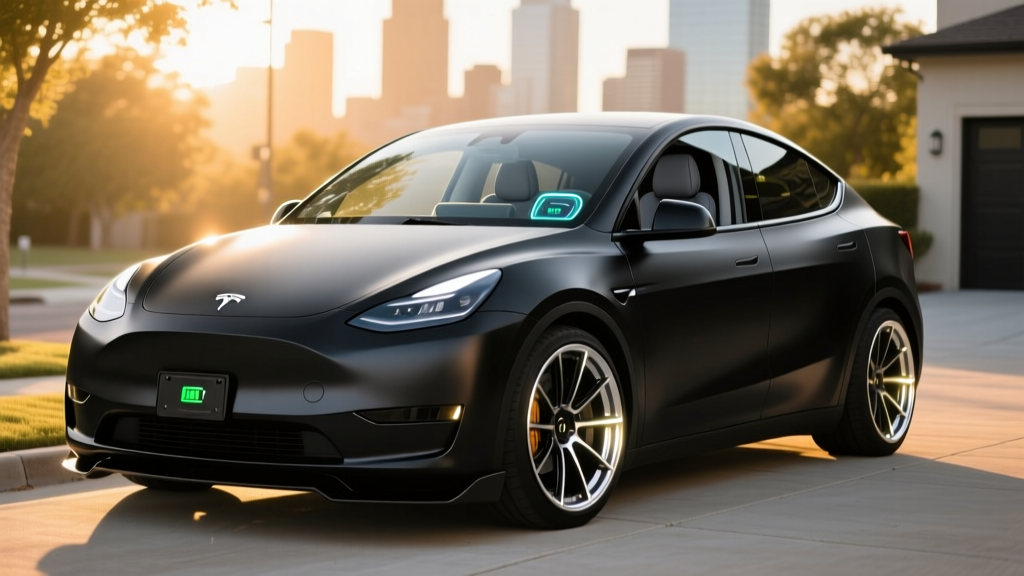
- Solid Black — +$1,500
- Quicksilver — +$2,500
- Ultra Red — +$2,500
Paint choice has zero impact on range or performance. It is purely aesthetic and resale-driven. Quicksilver and Ultra Red tend to hold value slightly better in the used market.
Wheels: The Biggest Range Decision You Will Make
- 19" Helix Wheels — Standard on Long Range (aero covers included)
- 20" Helix Wheels — +$2,000 (reduces EPA range by ~5-7%)
- 21" Überturbine Wheels — Standard on Performance (summer tires)
If range is a priority, keep the 19-inch wheels. The 20-inch upgrade costs you both $2,000 and roughly 15-20 miles of EPA range, while adding firmer ride quality and more tire-replacement expense. The 21-inch Performance wheels look aggressive but compromise winter usability — plan for a dedicated winter tire set on aftermarket 19s if you live in snow country.
Interior
- All Black — Standard
- Black & White — +$1,000
The Black & White interior uses a lighter synthetic leather that resists staining well but shows denim dye transfer on the seat bolsters over time. All Black hides wear better with kids and pets.
Seven-Seat Option (Long Range AWD only)
- Third-row seat — +$2,500
The third row is best suited for children under ~5'4". It eliminates the rear under-floor cargo area and reduces cargo volume behind the second row. For families who need occasional extra seats, it is a reasonable alternative to a minivan. For daily use with cargo needs, skip it.
Autopilot & Full Self-Driving (Supervised)
- Basic Autopilot — Standard (lane-centering, adaptive cruise)
- Full Self-Driving (Supervised) — +$8,000 one-time or $99/month subscription
Both Basic Autopilot and FSD (Supervised) are SAE Level 2 driver-assistance systems. The driver must remain fully engaged, hands on or near the wheel, eyes on the road, and ready to take over instantly. FSD adds automated lane changes, traffic-light and stop-sign recognition, and city-street navigation assistance, but it is not autonomous. Only Level 4 services like Waymo operate without a human driver.
Is FSD worth $8,000? For most buyers, the $99/month subscription is the smarter play — you can activate it for a road trip and cancel when you do not need it. The purchase price only makes sense if you drive high-mileage daily commutes in FSD-capable areas and plan to keep the vehicle 4+ years. Note that FSD does not transfer to a new Tesla unless Tesla runs a promotional transfer offer.
Tow Hitch
- Tow hitch — +$1,000 (3,500 lb rating, all trims)
Towing at or near the 3,500-pound limit will cut range roughly in half. A 1,500-pound utility trailer is more realistic and reduces range by ~30-35%.
How Much Does a Custom Model Y Actually Cost?
Let's build three representative configurations and run the tax-credit math.
| Configuration | MSRP Build | §30D Credit | Effective Price |
|---|---|---|---|
| LR RWD, Glacier Blue, 19", All Black, no FSD | $44,990 | Up to $7,500* | ~$37,490 |
| LR AWD, Pearl White, 20", B&W, 7-seat, FSD sub | $54,490 | Up to $7,500* | ~$46,990 |
| Performance, Ultra Red, 21", B&W, FSD purchase | $63,490 | Up to $7,500* | ~$55,990 |
*Federal §30D tax credit eligibility for 2026 requires:
- MSRP cap: SUVs/crossovers must be under $80,000 (all Model Y trims qualify)
- Buyer income cap: AGI ≤ $150,000 (single), $225,000 (head of household), $300,000 (married filing jointly)
- Battery sourcing: Critical minerals and battery components must meet phased-in domestic/free-trade-agreement thresholds per IRS §30D rules — Tesla's supply chain has largely met 2026 thresholds, but confirm at point of sale
- Point-of-sale transfer: You can transfer the credit to the dealer at purchase for an immediate price reduction, rather than claiming it on your tax return
The credit is non-refundable if claimed on your tax return (you need sufficient tax liability), but the point-of-sale transfer option sidesteps this limitation. Always verify eligibility with a tax professional before relying on the credit.
Interior, Cargo & Daily Livability
The Juniper-refreshed Model Y interior is materially improved over the pre-2025 version. Ambient lighting, ventilated front seats, a rear-seat touchscreen, and improved sound deadening bring it closer to luxury-compact-crossover territory.
- Cargo (behind 2nd row): 30.2 cu ft (5-seat); 26.8 cu ft (7-seat)
- Cargo (2nd row folded): 72.1 cu ft
- Frunk: 4.1 cu ft
- Rear legroom: 41.6 inches
- Front legroom: 41.8 inches
The 15.4-inch center touchscreen handles all infotainment, climate, and vehicle controls — there are no physical buttons for climate or mirrors. This minimalist approach frustrates some buyers and delights others. The rear 8-inch screen gives passengers climate and media control, which is a meaningful upgrade for families.
Notable drawbacks: The Model Y still lacks Apple CarPlay and Android Auto (Tesla's native system is capable but closed). Turn-signal stalks were removed in the refresh — signals are now on the steering wheel, which takes 2-3 weeks of muscle-memory adjustment. The panoramic glass roof has no retractable shade; in hot climates, an aftermarket sunshade ($30-50) is nearly essential.
How Does It Compare to Key Competitors?
Model Y Long Range RWD (320 mi EPA) edges out the Hyundai Ioniq 5 Long Range (303 mi) and Ford Mustang Mach-E Extended Range (312 mi). The gap narrows in real-world highway driving, where all three land in the 250-275 mile zone.
The Ioniq 5's 800V architecture peaks at ~350 kW (10-80% in ~18 min on a capable charger). The Model Y peaks at 250 kW (~25 min). On paper, Hyundai wins. In practice, Tesla's Supercharger network reliability and density offset the slower charge rate on road trips.
Tesla's software remains the most polished and responsive in the segment. Over-the-air updates are frequent and substantive. The Supercharger ecosystem, Sentry Mode, and app integration are best-in-class. But the lack of CarPlay/Android Auto is a dealbreaker for some.
At $44,990 before credits, the Long Range RWD is the price-to-range leader in the segment. The Ioniq 5 SE Standard Range starts lower (~$42,000) but with less range. The Mach-E Select starts around $43,000 with ~250 miles EPA.
Pros and Cons at a Glance
- Class-leading EPA range on LR RWD (320 mi)
- Best-in-class Supercharger network access (30,000+ stalls)
- Strong software, OTA updates, and app ecosystem
- Competitive pricing after §30D credit (~$37,500 base effective)
- Heat pump standard — strong cold-weather efficiency
- Excellent cargo versatility (72 cu ft with seats folded)
- IIHS Top Safety Pick+ and 5-star NHTSA ratings
- No Apple CarPlay / Android Auto
- Turn signals on steering wheel (learning curve)
- Glass roof lacks shade — hot in summer
- FSD ($8,000) remains Level 2, not autonomous
- Ride quality firm, especially on 20"/21" wheels
- Insurance costs above segment average
- DC fast-charge rate (250 kW) trails 800V competitors
Who Should Buy a Custom Model Y?
- You commute 30-60 miles daily and want maximum range per dollar
- You have home Level 2 charging and rarely road-trip more than 300 miles
- You do not need AWD (mild-winter or southern climates)
- You need all-wheel drive for snow or rain
- You want the 7-seat option for a growing family
- You value the 4.8-second 0-60 time for highway merging confidence
- You prioritize acceleration (3.5 sec 0-60) and sport handling
- You accept the 277-mile range trade-off and higher tire costs
- Track Days and spirited canyon driving are part of your ownership vision
- You need CarPlay/Android Auto (consider Ioniq 5, Mach-E, or EV6)
- You want the fastest possible DC charging (Ioniq 5 / EV6 at 350 kW)
- You prefer physical buttons and a traditional cockpit layout
Frequently Asked Questions
What is the real-world range of a custom Model Y?
Expect 270-290 miles in mixed driving for the Long Range AWD, 250-265 miles at sustained highway speeds, and 220-245 miles in cold weather (20-30°F). The RWD variant adds roughly 10-15 miles to each of these figures.
How fast does the Model Y charge at home and on the road?
At home on a Level 2 (240V/48A) charger, the Model Y adds about 44 miles of range per hour, fully charging overnight in 7-8 hours. On a V3 Supercharger, it peaks at 250 kW and reaches 10-80% in approximately 25 minutes.
Does the 2026 Model Y qualify for the federal EV tax credit?
All trims fall under the $80,000 SUV MSRP cap. Buyers must meet AGI limits ($150K single / $300K married filing jointly) and the vehicle must satisfy battery-sourcing requirements per IRS §30D. Tesla's current supply chain largely meets 2026 thresholds. The credit can be transferred at point of sale for an immediate price reduction.
Is the Model Y worth it versus the Ioniq 5 or Mach-E?
The Model Y wins on range, Supercharger access, software, and cargo space. The Ioniq 5 wins on DC charging speed and CarPlay support. The Mach-E offers a more traditional cockpit and competitive pricing. Test-drive all three and weight your priorities — charging ecosystem vs. charge speed vs. interface preference.
What are the biggest ownership costs beyond the purchase price?
Insurance averages $1,800-$2,400/year depending on state and driving record (above segment average due to repair costs). Home charger installation runs $500-$1,500. Electricity costs average $0.13-$0.16/kWh nationally, making a full charge roughly $10-$12 at home. Supercharging costs $0.25-$0.35/kWh depending on location and time of day.
Is Full Self-Driving worth buying?
FSD (Supervised) is a Level 2 system — not self-driving. The $99/month subscription is the lowest-risk way to try it. The $8,000 purchase only makes financial sense for high-mileage drivers who plan to keep the vehicle 4+ years and use it daily. FSD capability does not currently transfer to a new vehicle purchase.
What is the battery warranty?
Tesla covers the Model Y battery and drive unit for 8 years or 120,000 miles (whichever comes first), with a minimum 70% capacity retention threshold. Real-world degradation data from Tesla's fleet suggests most packs retain 88-92% capacity at 100,000 miles with normal charging habits (daily limit set to 80%, occasional 100% for trips).
Additional sources: NHTSA safety ratings, IIHS ratings.