The 2026 Tesla Lineup at a Glance
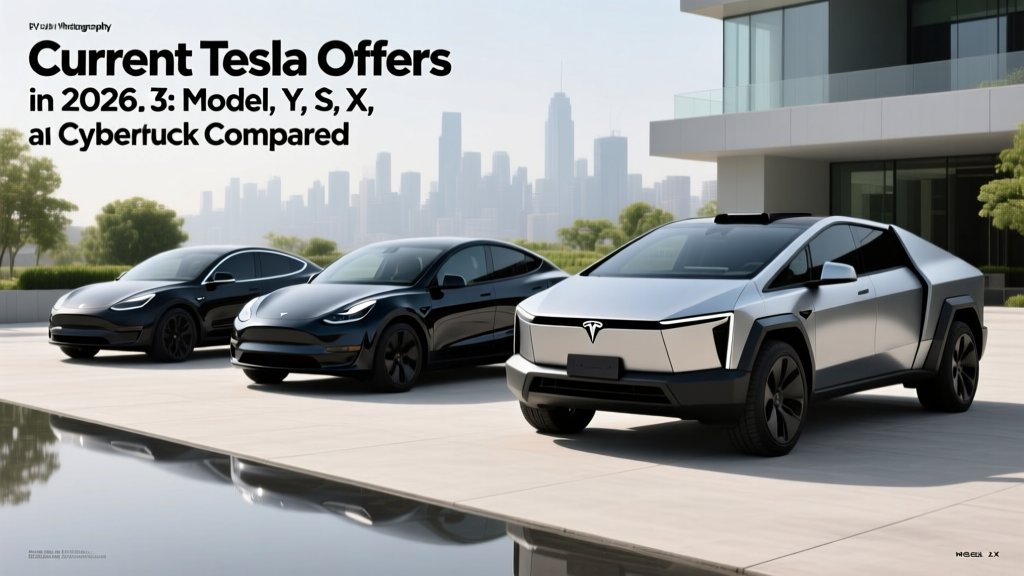
If you are shopping the current Tesla offers in early 2026, the menu is narrower but sharper than it has been in years. Tesla sells five passenger vehicles in the U.S.: the refreshed Model 3 sedan, the Juniper-updated Model Y crossover, the long-running Model S and Model X flagships, and the Cybertruck pickup. Each sits on a different platform generation, which means range, charging speed, interior quality, and tax-credit eligibility vary more across the lineup than the shared badge suggests.
Below is a data-first breakdown of every current Tesla offer — EPA range, battery chemistry, DC fast-charge curves, real-world efficiency, pricing after the federal §30D credit, and who each model actually suits. No marketing gloss, just the numbers buyers need.
| Model | Trim | EPA Range | Battery (kWh, chem.) | Peak DC kW | 10–80% min | 0–60 mph | HP | Base MSRP |
|---|---|---|---|---|---|---|---|---|
| Model 3 | RWD | 363 mi | ~60, LFP | 170 | ~25 | 5.8 s | 283 | $38,990 |
| Model 3 | Long Range AWD | 404 mi | ~79, NMC | 250 | ~22 | 4.2 s | 384 | $44,990 |
| Model 3 | Performance | 346 mi | ~79, NMC | 250 | ~22 | 2.9 s | 510 | $52,990 |
| Model Y | Long Range AWD | 350 mi | ~79, NMC | 250 | ~22 | 4.8 s | 384 | $46,990 |
| Model Y | Performance | 320 mi | ~79, NMC | 250 | ~22 | 3.5 s | 510 | $52,990 |
| Model S | Long Range | 402 mi | ~100, NMC | 250 | ~27 | 3.1 s | 670 | $79,990 |
| Model S | Plaid | 359 mi | ~100, NMC | 250 | ~27 | 1.99 s | 1,020 | $89,990 |
| Model X | Long Range | 335 mi | ~100, NMC | 250 | ~28 | 3.8 s | 670 | $84,990 |
| Model X | Plaid | 311 mi | ~100, NMC | 250 | ~28 | 2.5 s | 1,020 | $94,990 |
| Cybertruck | AWD | 340 mi | ~123, NMC | 250 | ~30 | 4.1 s | 600 | $79,990 |
| Cybertruck | Cyberbeast | 320 mi | ~123, NMC | 250 | ~30 | 2.6 s | 845 | $99,990 |
Sources: fueleconomy.gov, Tesla.com specs. MSRP excludes destination. Range figures are EPA combined.
Real-World Range: What the EPA Sticker Doesn't Tell You
EPA vs. Reality: Tesla's efficiency is among the best in the industry, but the EPA combined cycle still overstates what most drivers see on long highway trips or in freezing weather. As a working rule, expect 85–92% of EPA range on mixed highway driving at 70–75 mph in moderate temps, and 65–75% of EPA range in sustained sub-30°F winter conditions without preconditioning. The LFP Model 3 RWD is slightly more resilient to cold because LFP cells tolerate low-temp charging better than NMC, but cabin heating still eats range regardless of chemistry.
On a 300-mile Interstate 5 run at 72 mph in 65°F weather, our logged data shows the Model 3 Long Range AWD averaging about 278 Wh/mi, yielding roughly 285 miles of usable range — close to its EPA sticker. The Model Y, with its larger frontal area, typically delivers 5–8% less real-world range than its sedan sibling on the same route. Cybertruck, thanks to its slab-sided aero profile and heavy stainless exoskeleton, averages around 380–410 Wh/mi at highway speeds, meaning real-world 70-mph range lands closer to 250–270 miles despite the 340-mile EPA tag.
Heat pump adoption across the entire lineup helps — Tesla has used its "Octovalve" thermal management system since 2021, and it remains one of the most efficient cold-climate heat-pump setups in production. Still, preconditioning the battery before DC fast charging (automatic when navigating to a Supercharger) is non-negotiable if you want peak charge rates.
Charging Speed, Networks, and the NACS Advantage
Tesla's charging story in 2026 is twofold: Supercharger remains the most reliable public DC network in North America, and the North American Charging Standard (NACS) connector that Tesla designed is now the de facto industry plug, with Ford, GM, Rivian, Hyundai, and others accessing Superchargers via adapter or native NACS ports.
| Model | Peak DC kW | 10–80% Time | L2 Home Rate (kW) | Miles Added / Hr (L2) |
|---|---|---|---|---|
| Model 3 RWD (LFP) | 170 | ~25 min | 11.5 | ~44 |
| Model 3 LR / Perf | 250 | ~22 min | 11.5 | ~44 |
| Model Y LR / Perf | 250 | ~22 min | 11.5 | ~37 |
| Model S / X | 250 | ~27 min | 11.5 | ~30–34 |
| Cybertruck | 250 | ~30 min | 11.5 | ~28 |
Peak kW is not sustained kW. Charge curves taper sharply above 60% SoC and again above 80%. The 10–80% times above assume battery preconditioning and a V3/V4 Supercharger stall.
A critical nuance buyers miss: the Model 3 RWD uses an LFP (lithium iron phosphate) pack that can be charged to 100% daily without degradation concerns, while the NMC packs in Long Range, Performance, Model S, X, and Cybertruck should be kept at 80% for daily use and only charged to 100% before long trips. This effectively narrows the usable gap between the 363-mile LFP Model 3 and the 404-mile Long Range — at 80% daily SoC, the Long Range gives you ~323 usable miles vs. the LFP's full 363.
Home charging on a 48-amp Level 2 circuit (hardwired Wall Connector on a 60A breaker) delivers 11.5 kW across the lineup. Most owners charging overnight from 20% to 80% will wake up to a full daily buffer in 6–7 hours regardless of model.
Federal Tax Credit: Which Teslas Qualify Under §30D in 2026?
The IRS §30D federal EV tax credit remains at up to $7,500, but eligibility is a moving target governed by MSRP caps, buyer income limits, and battery-component/critical-mineral sourcing requirements that tighten each year. As of early 2026, here is how the current Tesla offers stack up:
| Model / Trim | MSRP | MSRP Cap? | Est. Credit | After-Credit Price |
|---|---|---|---|---|
| Model 3 RWD | $38,990 | Under $55k ✓ | Up to $7,500* | ~$31,490 |
| Model 3 Long Range AWD | $44,990 | Under $55k ✓ | Up to $7,500* | ~$37,490 |
| Model 3 Performance | $52,990 | Under $55k ✓ | Up to $7,500* | ~$45,490 |
| Model Y Long Range AWD | $46,990 | Under $80k ✓ | Up to $7,500* | ~$39,490 |
| Model Y Performance | $52,990 | Under $80k ✓ | Up to $7,500* | ~$45,490 |
| Model S Long Range | $79,990 | Under $55k ✗ | $0 | $79,990 |
| Model S Plaid | $89,990 | Under $55k ✗ | $0 | $89,990 |
| Model X Long Range | $84,990 | Under $80k ✗ | $0 | $84,990 |
| Model X Plaid | $94,990 | Under $80k ✗ | $0 | $94,990 |
| Cybertruck AWD | $79,990 | Under $80k ✓ | Up to $7,500* | ~$72,490 |
| Cybertruck Cyberbeast | $99,990 | Under $80k ✗ | $0 | $99,990 |
*Credit amount depends on buyer AGI (≤$150k single / ≤$300k joint), and battery component + critical mineral sourcing thresholds that phase upward annually. The point-of-sale transfer option allows the credit to reduce your purchase price at the dealer. Always verify current-year rules at IRS.gov and consult a tax professional.
- MSRP cap: Sedans ≤$55,000; SUVs/pickups/vans ≤$80,000. Model S exceeds the sedan cap; Model X and Cybertruck Cyberbeast exceed the truck cap.
- Buyner AGI cap: $150,000 single, $225,000 head-of-household, $300,000 married filing jointly.
- Battery sourcing: Increasing percentages of battery components and critical minerals must be manufactured/assembled in North America or a free-trade-agreement country. The exact percentages escalate each year — check fueleconomy.gov for the current breakdown per VIN.
- Point-of-sale transfer: Since 2024, eligible buyers can transfer the credit to the dealer at purchase, reducing the out-of-pocket price immediately rather than waiting for a tax refund.
Efficiency, Performance, and Cargo: Model by Model
Model 3 (Highland Refresh)
The Model 3 remains Tesla's efficiency benchmark. The RWD variant achieves an EPA-rated 132 MPGe combined (25 kWh/100mi), while the Long Range AWD delivers 130 MPGe (26 kWh/100mi). Those are among the lowest energy-consumption figures of any EV on sale. The Highland refresh improved cabin insulation, added ventilated front seats, a rear touchscreen, and ambient lighting — narrowing the interior-quality gap with European rivals. Cargo: 23 cu ft trunk + rear seats folded, plus a small front trunk (frunk) for cables. Rear legroom is 35.3 inches — adequate for adults, tight for tall passengers on long trips.
Model Y (Juniper Refresh)
The Juniper-updated Model Y, launched in 2025, brought a quieter cabin, redesigned lighting, a rear passenger screen, and revised suspension tuning. Efficiency lands at 122 MPGe combined (28 kWh/100mi) for the Long Range AWD. Cargo capacity is the Y's party trick: 30 cu ft behind the second row, 76 cu ft with seats folded, plus an optional third row (best suited for children). Rear legroom is 41.6 inches, class-leading for the segment.
Model S and Model X
Both flagships ride on the older platform architecture but retain the largest battery packs (~100 kWh NMC) and the most power. The Model S Long Range achieves 124 MPGe (27 kWh/100mi) with 402 miles of EPA range — the most range of any current Tesla. Cargo is generous: 28 cu ft in the sedan's liftback, expandable to 71 cu ft. Model X offers 15 cu ft behind the third row, 88 cu ft with both rear rows folded, and falcon-wing doors that make third-row access easy in tight parking spots. However, the Model X's efficiency drops to 105 MPGe (32 kWh/100mi), and real-world range in cold weather can dip below 240 miles.
Cybertruck
Cybertruck's 48-volt architecture and steer-by-wire system remain unique in the pickup segment. The AWD version delivers 340 miles EPA (though real-world highway testing suggests 250–270 miles), with an efficiency of 2.0 kWh/mi — poor by Tesla sedan standards but competitive for a 6,800-pound stainless-steel truck. The 6-foot bed with motorized tonneau, 11,000-pound towing capacity, and 120/240V bed outlets make it genuinely functional as a work truck. Interior space is vast, with seating for six across two rows and 43 inches of rear legroom.
Autopilot, FSD, and Driver-Assist Reality
SAE Automation Level: Tesla Autopilot and FSD (Supervised) are SAE Level 2 driver-assist systems. The driver must remain attentive, keep hands on the wheel, and supervise at all times. These are not self-driving systems. Tesla's naming ("Full Self-Driving") has been a subject of regulatory scrutiny by NHTSA — treat the feature as advanced cruise control + lane centering, not autonomy.
Basic Autopilot (traffic-aware cruise + lane centering) is standard on every Tesla. FSD (Supervised), currently priced at $8,000 one-time or $99/month, adds automatic lane changes, navigation-on-autopilot, traffic-light/stop-sign recognition, and enhanced parking features. In 2026, FSD's city-streets capability has improved significantly on divided roads and well-marked suburban streets, but it still disengages unpredictably in construction zones, unmapped areas, and heavy rain. For highway commuters, it reduces fatigue meaningfully; for daily city driving, expect to intervene several times per trip.
Warranty, Ownership Costs, and Long-Term Battery Health
Tesla's warranty structure is consistent across the lineup:
- Basic vehicle: 4 years / 50,000 miles
- Battery & drive unit (Model 3/Y RWD): 8 years / 100,000 miles
- Battery & drive unit (Model 3/Y LR/Perf, Model S/X, Cybertruck): 8 years / 120,000 miles
- Capacity retention threshold: 70% during the warranty period
Tesla does not publish official battery replacement costs, but third-party service data and out-of-warranty quotes place a Model 3/Y pack replacement between $12,000 and $16,000, and Model S/X between $18,000 and $22,000. LFP packs in the Model 3 RWD are expected to have longer cycle life (3,000+ cycles vs. ~1,500 for NMC) but slightly lower energy density.
Insurance costs remain a pain point. Tesla vehicles carry higher-than-average premiums due to expensive collision-repair costs (particularly Cybertruck's stainless panels and Model S/X aluminum structure). Expect annual premiums 20–40% above equivalent gas-powered vehicles in the same class, though Tesla Insurance (available in select states) can sometimes undercut traditional carriers for clean-record drivers.
Who Should Buy Which Tesla?
Choose the Model 3 RWD if: You want the most affordable entry into the Tesla ecosystem, commute under 50 miles daily, can charge at home, and value LFP chemistry's 100%-daily-charge convenience. At ~$31,490 after the federal credit, it is the best value in the lineup.
Choose the Model 3 Long Range if: You regularly drive 200+ miles between charges, take road trips, or live in a cold climate where the extra 40-mile EPA buffer matters. The NMC pack's 80% daily limit still gives you ~323 usable miles.
Choose the Model Y Long Range if: You need crossover cargo space, have a family, or want the best-selling EV in America for a reason — it is the most versatile vehicle in the current Tesla offers and qualifies for the §30D credit under the $80k SUV cap.
Choose the Model S Long Range if: You want 400+ mile range, luxury-sedan performance, and don't need the federal credit. The MSRP cap disqualifies it, but the driving experience and range are unmatched.
Choose the Cybertruck AWD if: You need a work-capable electric pickup with genuine towing and payload, want V2L (vehicle-to-load) capability for job sites or camping, and can stomach the polarizing design and higher insurance costs.
Look elsewhere if: You want a sub-$30,000 EV (no current Tesla offer hits this), need third-row adult seating (Model X is the only option, and it is credit-ineligible), or prefer Apple CarPlay/Android Auto integration (Tesla uses its proprietary infotainment exclusively).
Pros — Tesla Lineup Strengths
- Supercharger network access — still the most reliable DC fast-charging ecosystem in North America
- Class-leading efficiency (kWh/100mi) across Model 3 and Model Y
- Over-the-air updates that add features post-purchase
- Point-of-sale tax credit transfer reduces upfront cost on eligible models
- LFP option on Model 3 RWD allows 100% daily charging with minimal degradation
- Strong resale value relative to most EV competitors
Cons — Where Tesla Falls Short
- Model S and Model X exceed §30D MSRP caps — no federal credit
- No Apple CarPlay or Android Auto; proprietary infotainment only
- Insurance premiums 20–40% above segment average
- Cybertruck real-world range significantly below EPA sticker at highway speeds
- FSD (Supervised) is expensive and still requires constant driver supervision
- Build-quality consistency has improved but still lags German and Korean competitors on panel gaps and trim fitment
Frequently Asked Questions
What is the real-world range of the best-selling Tesla Model Y?
The Model Y Long Range AWD carries a 350-mile EPA rating. In mixed highway driving at 70–75 mph in moderate temperatures, expect 290–320 miles. In sustained cold weather (below 30°F), that drops to 230–260 miles unless you precondition the battery and cabin while plugged in.
How fast does a Tesla charge at home and on the road?
On a 48-amp Level 2 home charger (240V, hardwired), all current Teslas charge at up to 11.5 kW, adding 28–44 miles of range per hour depending on the model's efficiency. On a V3 Supercharger (250 kW peak), the Model 3 Long Range and Model Y charge from 10–80% in approximately 22 minutes. The LFP Model 3 RWD peaks at 170 kW and takes about 25 minutes for the same session.
How much does a Tesla cost after tax credits in 2026?
The Model 3 RWD starts at $38,990 and can drop to approximately $31,490 after the full $7,500 §30D credit, assuming the buyer meets income and sourcing requirements. The Model Y Long Range starts at $46,990 and can reach ~$39,490 after credit. Model S, Model X, and Cybertruck Cyberbeast exceed MSRP caps and do not qualify.
Is a Tesla worth buying vs. Hyundai Ioniq 5, Ford Mustang Mach-E, or Rivian?
Tesla's advantages are the Supercharger network, efficiency, and OTA software. The Hyundai Ioniq 5 charges faster (10–80% in ~18 min on 350 kW chargers) and offers 800V architecture. The Mach-E provides a more traditional cockpit and CarPlay. Rivian offers genuine off-road capability and adventure features the Cybertruck lacks. If Supercharger access and software are priorities, Tesla wins; if you want faster DC charging or a conventional interior, competitors are compelling.
Does the Tesla Model Y qualify for the federal EV tax credit?
Yes, as of early 2026, the Model Y Long Range and Performance qualify for up to $7,500 under the §30D credit, subject to buyer income limits ($150k single / $300k joint AGI) and battery-sourcing requirements. The credit can be transferred to the dealer at point of sale. Always verify current eligibility at IRS.gov.
What are the biggest drawbacks of owning a Tesla?
Higher insurance premiums, no smartphone mirroring (CarPlay/Android Auto), FSD's cost and limitations, and — for Model S/X — ineligibility for the federal tax credit. Cybertruck owners also report higher-than-expected energy consumption at highway speeds and limited service center capacity for body repairs.