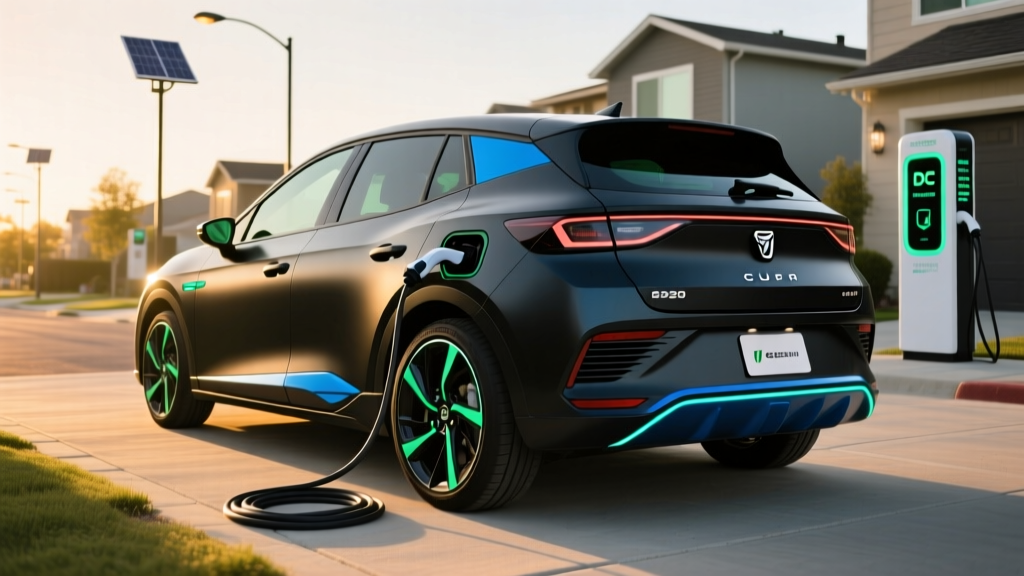
If you have been browsing European EV forums or following Volkswagen Group's sub-brand strategy, the Cupra Born electric hatchback has likely crossed your radar. Built on VW's ubiquitous MEB platform—the same architecture underpinning the Volkswagen ID.3 and ID.4—the Born trades VW's conservative styling for a sharper, more aggressive design language. But for US-based EV shoppers, the critical question is not whether the Cupra Born is a compelling hatchback in Europe. It is whether you can actually buy one, and whether the numbers justify importing or cross-shopping it against domestic alternatives.
This review breaks down the 2026 Cupra Born's battery specs, real-world range expectations, charging performance, and ownership economics—while addressing the elephant in the room: US availability.
2026 Cupra Born: At-a-Glance Specs
| Spec | Value |
|---|---|
| Battery (usable) | 77 kWh (NMC chemistry) |
| Drivetrain | Rear-wheel drive (single motor) |
| Horsepower | 240 hp (175 kW) |
| 0–60 mph | ~6.6 seconds |
| Top Speed | 99 mph (electronically limited) |
| WLTP Range | ~342 miles (550 km) |
| Estimated EPA Range | ~275–285 miles |
| Max DC Fast Charge | 185 kW |
| 10–80% DC Charge Time | ~30 minutes |
| Level 2 AC Charge Rate | 11 kW onboard charger |
| Efficiency (est.) | ~3.6–3.8 kWh/mi (~105 MPGe) |
| Cargo Volume | 13.6 cu ft (rear seats up) |
| Length / Wheelbase | 169.5 in / 108.9 in |
| Battery Warranty (EU) | 8 years / 100,000 miles (70% SoH) |
| Starting Price (EU) | ~€44,600 (~$48,500 USD) |
Real-World Range: What the WLTP Number Hides
Cupra advertises the 77 kWh Born with a WLTP range of roughly 342 miles (550 km). But US buyers should interpret that figure carefully. The EPA's testing cycle is substantially more demanding than WLTP—it features higher average speeds, more aggressive acceleration, and accounts for accessory loads like air conditioning. Based on the MEB platform's efficiency in EPA-rated vehicles like the VW ID.4, the Cupra Born would likely earn an EPA sticker in the 275–285 mile range if certified for the US market.
EPA estimate: ~275–285 miles (projected)
Highway driving (70–75 mph): Expect ~240–255 miles. The Born's upright hatchback shape creates more aerodynamic drag than a sleek sedan, and EVs lose efficiency significantly above 65 mph.
Cold weather (below 32°F): Plan for ~210–230 miles. Lacking a dedicated heat pump on all trims (standard on the VZ but optional on lower trims in some markets), resistive cabin heating can cut range by 25–35% in deep winter conditions.
Combined real-world expectation: Most owners driving a mix of city and highway will see 250–270 miles between charges in temperate weather.
The 77 kWh battery uses NMC (nickel manganese cobalt) chemistry, which offers higher energy density than LFP but is more sensitive to sustained high states of charge. For daily driving, charging to 80% preserves long-term battery health and still provides roughly 220 real-world miles—enough for all but the longest single-day drives.
Charging Speed: 185 kW DC and the MEB Curve Reality
The Cupra Born's peak DC fast-charging rate of 185 kW places it in the middle of the compact EV pack—behind the Hyundai Ioniq 5's 240 kW but ahead of older MEB vehicles capped at 135 kW. The key metric is the 10–80% charge time of approximately 30 minutes at a compatible charger.
| Level | Power | Speed | Use Case |
|---|---|---|---|
| Level 1 (120V household) | ~1.4 kW | ~4 miles/hour | Emergency top-ups only |
| Level 2 (240V home/public) | 11 kW (max) | ~32 miles/hour | Overnight home charging; full charge in ~7.5 hours |
| DC Fast Charge | Up to 185 kW peak | ~160 miles in 30 min (10–80%) | Road trips; requires preconditioning |
A few practical notes on the Born's charging behavior:
- Charge curve taper: Like all MEB vehicles, the Born sustains peak power only briefly. Expect 185 kW from roughly 10–30% SoC, then a step down to ~120 kW through 60%, and further tapering above 80%. Charging from 80–100% can add another 25–30 minutes—plan accordingly on road trips and aim to charge only to 80%.
- Preconditioning: The Born supports battery preconditioning when you set a DC fast-charger as your navigation destination. This warms the battery to optimal temperature for faster charging. Without it, cold-soaked batteries may accept only 50–80 kW initially, adding 10–15 minutes to your stop.
- Connector: European models use CCS2. If the Born were sold in the US, it would use either CCS1 or NACS (VW Group has committed to NACS adoption for future models, but the current Born still uses CCS in most markets).
For home Level 2 charging, the Born's 11 kW onboard charger is a strong point. On a 48-amp home charger (delivering ~11.5 kW), you will add roughly 32 miles of range per hour—meaning a full overnight charge easily replenishes even a depleted battery.
Performance and Driving Dynamics
The Born VZ (the performance-oriented variant with the 77 kWh pack) puts 240 hp through the rear wheels. The 0–60 mph sprint takes approximately 6.6 seconds—not sports-car territory, but quick enough for confident highway merging and passing. The standard-range 58 kWh model makes 201 hp and hits 60 mph in roughly 7.3 seconds.
Where the Born distinguishes itself from its ID.3 sibling is chassis tuning. Cupra has stiffened the suspension, sharpened the steering ratio, and added a sportier drive-mode calibration. The result is a hatchback that feels more eager in corners than most EVs in this segment. The rear-drive layout also gives it a natural balance that front-drive EV competitors cannot match.
However, the Born is not a performance EV in the Tesla Model 3 or Hyundai Ioniq 5 N sense. There is no dual-motor AWD option, no launch control, and no sub-5-second 0–60 time. It is a sporty commuter, not a track car.
Pricing, Trims, and the Tax-Credit Question
Here is where the Cupra Born becomes complicated for American buyers: it is not officially sold in the United States as of 2026. Cupra, as a brand, has not entered the US market. VW Group sells its EVs stateside under the Volkswagen and Audi badges, and the Born's platform-mate—the VW ID.4 (a crossover, not a hatchback)—serves as the closest domestic alternative.
| Trim | Battery | EU Price | Approx. USD |
|---|---|---|---|
| V2 (base) | 58 kWh | ~€38,500 | ~$41,900 |
| V3 | 77 kWh | ~€42,400 | ~$46,100 |
| VZ (e-Boost) | 77 kWh | ~€44,600 | ~$48,500 |
If VW Group decided to badge and sell the Born in the US, pricing would likely land in the $40,000–$48,000 range before incentives. But the federal §30D EV tax credit introduces variables:
- MSRP cap: Hatchbacks and sedans must be priced at or below $55,000 to qualify. The Born would likely clear this threshold.
- Income cap: Buyer AGI must not exceed $150,000 (single), $225,000 (head of household), or $300,000 (joint). Per IRS guidelines.
- Battery sourcing: Critical minerals and battery components must meet escalating domestic-content thresholds. VW Group's MEB batteries, sourced from SK On and other suppliers, have faced challenges meeting these requirements. Eligibility is not guaranteed and must be verified per VIN at the time of purchase.
- Point-of-sale transfer: Eligible buyers can apply the credit as an immediate price reduction at the dealership rather than waiting for tax filing.
Bottom line: even if the Born were available in the US, the full $7,500 credit is not automatic. Buyers should check the specific VIN on fueleconomy.gov before committing.
Interior, Cargo, and Tech
The Born's cabin follows VW Group's familiar MEB template: a 12-inch infotainment touchscreen, a compact digital instrument cluster, and a head-up display with augmented-reality navigation on higher trims. Material quality is a step above the ID.3, with more soft-touch surfaces and Cupra's signature copper-colored accent stitching.
Practical dimensions:
- Cargo (rear seats up): 13.6 cu ft — comparable to a VW Golf, adequate for weekly groceries but tight for bulky items
- Cargo (rear seats folded): ~43 cu ft — enough for a weekend trip for two with duffel bags
- Rear legroom: ~36 inches — comfortable for adults on shorter trips; tall passengers will find it snug on long drives
- Front headroom: Generous, thanks to the MEB platform's flat floor and high roofline
Notable tech features include:
- Travel Assist: VW Group's Level 2 driver-assistance combining adaptive cruise control and lane centering. This is not self-driving—the driver must keep hands on the wheel and remain attentive at all times (SAE Level 2).
- Park Assist Plus: Automated parking with memory function for repeated spaces (home garage, office lot).
- Over-the-air updates: The Born supports OTA software updates for infotainment and vehicle systems.
The biggest tech drawback? VW Group's capacitive-touch steering wheel controls and slider-based climate controls remain frustrating to use while driving. Physical buttons would be a significant improvement.
How It Compares: Cupra Born vs. the Competition
If you are considering the Born—or its closest US-available alternatives—here is how the numbers stack up against key competitors:
| Spec | Cupra Born VZ (77 kWh) | VW ID.4 Pro S (AWD) | Hyundai Ioniq 5 SEL (RWD LR) | Chevrolet Equus EV LT (FWD) |
|---|---|---|---|---|
| EPA Range | ~280 mi (est.) | 291 mi | 303 mi | 319 mi |
| Battery | 77 kWh NMC | 82 kWh NMC | 77.4 kWh NMC | 85 kWh NMC |
| DC Fast Charge Peak | 185 kW | 175 kW | 240 kW | 190 kW |
| 10–80% Time | ~30 min | ~29 min | ~18 min | ~28 min |
| 0–60 mph | 6.6 sec | 5.7 sec (AWD) | 7.2 sec | 8.0 sec |
| Base MSRP (US) | Not available | $47,290 | $47,600 | $33,600 |
The Born holds its own on paper, but the Hyundai Ioniq 5's 800V architecture gives it a decisive charging-speed advantage. The VW ID.4 offers more cargo space and AWD. And the Chevrolet Equinox EV delivers significantly more range at a lower price point.
- Sharp, aggressive styling stands out in a sea of bland EVs
- Rear-drive dynamics and sporty chassis tuning
- Competitive 185 kW DC charging for the segment
- 11 kW onboard AC charger (faster than many rivals at 7.2 kW)
- Hatchback practicality in a compact footprint
- Not available in the United States
- No AWD or dual-motor option
- Capacitive-touch controls are distracting while driving
- Cargo space trails compact crossovers significantly
- Cold-weather range loss without standard heat pump on all trims
Who Is the Cupra Born Actually For?
The Cupra Born electric hatchback is best suited for European urban commuters who want something more distinctive than a VW ID.3 but do not need crossover-level cargo space. It is a driver's EV in the hot-hatch tradition—sharp handling, quick enough for fun, practical enough for daily life.
For US buyers, the Born is unfortunately a non-starter unless you are willing to navigate grey-market importation (costly, complex, and potentially voiding any warranty). The closest domestic experience is the VW ID.4 if you want the MEB platform with more space, or the Hyundai Ioniq 5 if charging speed is your priority. If a sporty electric hatchback is what you crave, the discontinued Chevrolet Bolt EUV or a used Tesla Model 3 remain more accessible options stateside.
Frequently Asked Questions
What is the real-world range of the Cupra Born?
The 77 kWh Cupra Born carries a WLTP rating of ~342 miles, which translates to an estimated EPA range of 275–285 miles. In real-world mixed driving, expect 250–270 miles in moderate temperatures, dropping to 210–230 miles in freezing weather and 240–255 miles on sustained highway drives at 70+ mph.
How fast does the Cupra Born charge?
On a DC fast charger, the Born peaks at 185 kW and charges from 10–80% in approximately 30 minutes. At home on a Level 2 (240V) charger, the 11 kW onboard charger delivers about 32 miles of range per hour, fully replenishing the 77 kWh battery in roughly 7.5 hours.
Does the Cupra Born qualify for the US federal EV tax credit?
The Cupra Born is not sold in the US, so the §30D tax credit does not apply. If VW Group were to introduce it stateside, eligibility would depend on the MSRP cap ($55,000 for hatchbacks), buyer income limits, and battery-sourcing requirements—all of which must be verified per VIN at purchase.
Is the Cupra Born worth buying over a VW ID.4 or Hyundai Ioniq 5?
On driving dynamics and styling, the Born has an edge. But the ID.4 offers AWD, more cargo room, and US availability. The Ioniq 5 charges significantly faster (18 vs. 30 minutes, 10–80%). For US buyers, both are more practical choices until Cupra enters the American market.
What battery chemistry does the Cupra Born use?
The Born uses NMC (nickel manganese cobalt) lithium-ion cells, consistent with the MEB platform. NMC offers higher energy density than LFP but benefits from daily charging limits of 80% to maximize long-term State of Health (SoH).
What is the battery warranty?
In Europe, Cupra provides an 8-year / 100,000-mile battery warranty guaranteeing a minimum of 70% State of Health. US warranty terms would depend on how VW Group structures coverage if the Born were introduced domestically.