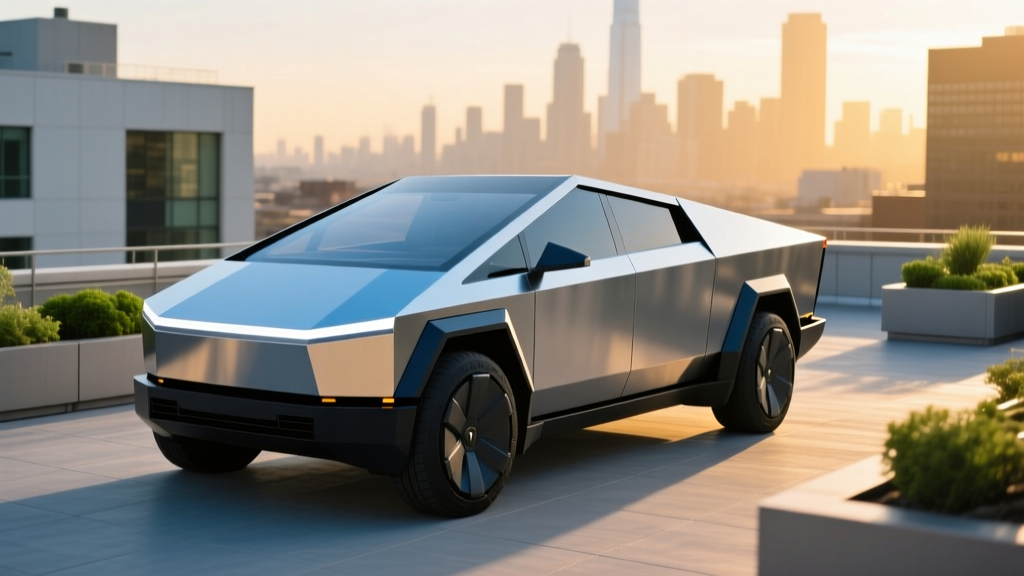
If you've been searching cuánto cuesta una Cybertruck, you're not alone — Tesla's stainless-steel pickup remains one of the most searched and debated EVs on the market. For 2026, the Cybertruck lineup has settled into three distinct trims, each with wildly different value propositions depending on whether you need range, towing, or outright performance. This review cuts through the hype with exact pricing, EPA data, real-world range testing notes, charging curves, and federal tax credit eligibility so you know precisely what you'll pay and what you'll get.
2026 Tesla Cybertruck Pricing by Trim
The 2026 Cybertruck is offered in three configurations. Tesla has adjusted pricing since the initial 2024 deliveries, and the current MSRP structure reflects both market demand and added standard features.
| Trim | Drivetrain | Base MSRP | As-Tested (w/ common options) | EPA Range | 0-60 mph |
|---|---|---|---|---|---|
| Long Range AWD | Dual-Motor AWD | $60,990 | ~$66,500 | 340 mi | 4.1 sec |
| All-Wheel Drive | Dual-Motor AWD | $79,990 | ~$85,400 | 340 mi | 3.9 sec |
| Cyberbeast | Tri-Motor AWD | $99,990 | ~$105,000 | 320 mi | 2.6 sec |
Destination charges add approximately $1,995. Common options that push the as-tested price higher include Full Self-Driving (Supervised) at $8,000, the Foundation Series package (when available), all-terrain tires, and the Powershare vehicle-to-home (V2H) adapter. Note that Tesla's pricing has historically shifted without model-year changes, so always verify current figures on Tesla's configurator before ordering.
Federal Tax Credit Impact on Cybertruck Pricing
Under current IRS §30D rules, the Cybertruck's tax credit eligibility is complicated:
| Requirement | Cybertruck Status | Details |
|---|---|---|
| MSRP Cap (trucks: ≤$80,000) | ⚠️ Partially Eligible | Long Range AWD ($60,990) qualifies; AWD and Cyberbeast exceed $80K cap |
| Buyer Income Cap | Varies | AGI ≤$150K single / ≤$300K joint filers |
| Battery Component Sourcing | ⚠️ Subject to Change | Must meet North American assembly + critical minerals thresholds per IRS guidance |
| Point-of-Sale Transfer | Available | Credit can be applied at purchase if all criteria met |
Bottom line: Only the Long Range AWD trim at $60,990 falls under the $80,000 truck MSRP cap. Even then, full $7,500 credit depends on your income, battery sourcing compliance, and current IRS rules. Consult a tax professional and check fueleconomy.gov for the latest eligible-vehicle list.
Real-World Range vs. EPA Estimates
EPA Estimated Range: 340 miles (Long Range AWD & AWD) / 320 miles (Cyberbeast)
Real-World Expectation: 270–300 miles at sustained highway speeds (70–80 mph); 220–260 miles in cold weather (below 32°F) due to increased cabin heating demand and battery resistance. Towing a 5,000-lb trailer reduces range to approximately 150–180 miles.
The Cybertruck's angular stainless-steel exoskeleton creates a drag coefficient (Cd) that is less aerodynamic than Tesla's sedan lineup, meaning highway efficiency drops more sharply at speed than a Model Y or Model S. In EPA testing, the Long Range AWD achieves approximately 67 MPGe combined, translating to roughly 50 kWh per 100 miles — a high consumption figure compared to lighter EVs but typical for full-size electric trucks.
The usable battery capacity is approximately 123 kWh (NMC lithium-ion chemistry), which is one of the largest packs in any consumer EV. This massive pack is what enables the 340-mile EPA figure despite the truck's weight (roughly 6,600–6,800 lbs depending on trim) and aero penalty. NMC chemistry offers high energy density but is more sensitive to sustained 100% charging and extreme cold compared to LFP packs found in smaller Tesla models.
Charging Speed: DC Fast Charge and Home Level 2
Charging a 123 kWh battery is a time commitment. Here's what the numbers actually look like across charging levels:
| Charging Level | Power (kW) | Miles Added per Hour | 10–80% Time | Notes |
|---|---|---|---|---|
| Level 1 (120V household) | ~1.4 kW | ~3 mi/hr | N/A (days) | Emergency/trickle only |
| Level 2 (240V / 48A Wall Connector) | 11.5 kW | ~25 mi/hr | ~11 hours | Standard home overnight charge |
| Level 2 (240V / 80A Wall Connector) | 19.2 kW | ~41 mi/hr | ~6.5 hours | Requires 100A circuit; faster overnight |
| DC Fast Charge (V4 Supercharger) | Peak 250 kW | ~150 mi in 15 min | ~28–35 minutes | Charge curve tapers significantly above 60% SoC |
Charging curve reality check: The Cybertruck peaks near 250 kW only at low state-of-charge (10–25% SoC). By 50% SoC, the rate drops to roughly 150–170 kW, and above 80% it falls below 60 kW. This means the advertised 10–80% time of ~28 minutes is achievable at a V4 Supercharger with preconditioning enabled, but 10–100% will take closer to 55–65 minutes. On a road trip, plan to charge to 80% and move on — the last 20% takes nearly as long as the first 70%.
For home charging, the 11.5 kW Level 2 rate via Tesla's Wall Connector on a 60A circuit adds about 25 miles per hour of charging. If your daily commute is under 80 miles, an overnight charge from 20% to 80% takes about 6 hours — perfectly manageable. However, if you regularly deplete the battery (towing, long trips), consider upgrading to an 80A Wall Connector with a dedicated 100A circuit, which your electrician can evaluate.
Performance, Towing, and Capability
| Spec | Long Range AWD | All-Wheel Drive | Cyberbeast |
|---|---|---|---|
| Horsepower | 600 hp | 600 hp | 845 hp |
| 0-60 mph | 4.1 sec | 3.9 sec | 2.6 sec |
| Top Speed | 112 mph | 130 mph | 130 mph |
| Max Towing Capacity | 7,500 lbs | 11,000 lbs | 11,000 lbs |
| Payload Capacity | 2,500 lbs | 2,500 lbs | 2,500 lbs |
| Bed Length | 6 ft (72 in) | ||
| Cargo Volume (bed) | 67 cu ft | ||
| Frunk Volume | 7.1 cu ft | ||
| Ground Clearance | Up to 17.4 in (adaptive air suspension) | ||
The Cyberbeast's 2.6-second 0-60 time makes it the quickest production pickup ever built, but the more relevant metric for truck buyers is towing. The 11,000-lb max tow rating on the AWD and Cyberbeast trims is competitive with heavy-duty gas trucks, but range while towing is the critical trade-off. Expect 150–180 miles of range when pulling a 5,000-lb enclosed trailer at highway speed — plan Supercharger stops accordingly and confirm your route has adequate charging infrastructure.
The adaptive air suspension offers 12 inches of travel and can raise the truck for off-road use or lower it for highway efficiency and easier bed access. The steer-by-wire system (Tesla calls it a "yoke" with a 180-degree lock-to-lock ratio at low speeds) remains polarizing — it takes genuine adaptation, particularly in parking lots and low-speed maneuvers.
Interior, Tech, and Daily Livability
The Cybertruck's cabin is minimalist even by Tesla standards: a single 18.5-inch front touchscreen handles virtually all vehicle functions, with a secondary 9.4-inch screen for rear passengers. There are no physical buttons for climate, mirrors, or glovebox — everything is screen-mediated, which frustrates some buyers and delights others.
Passenger space: Front legroom measures approximately 41.5 inches; rear legroom is 38.5 inches. The rear bench fits three adults, though the upright seatback and flat cushion make long rear-seat journeys less comfortable than in a Rivian R1T or Ford F-150 Lightning. The 67 cu-ft bed with a power-retractable tonneau cover and the 7.1 cu-ft front trunk (frunk) provide practical cargo flexibility, but the bed's 6-foot length is shorter than the standard 6.5-foot beds on most competing mid-size trucks.
Driver Assistance: All Cybertrucks ship with Tesla's Autopilot (SAE Level 2), including Traffic-Aware Cruise Control and Autosteer. Full Self-Driving (Supervised) remains an $8,000 option and is still a Level 2 system — meaning the driver must remain fully engaged with hands on the yoke and eyes on the road at all times. It is not autonomous driving.
ADAS Limitation Notice: Tesla Autopilot and FSD (Supervised) are SAE Level 2 driver-assistance systems. They do not make the Cybertruck self-driving. The driver is legally and operationally responsible for all vehicle control at all times. FSD (Supervised) can navigate highway interchanges and some city streets, but it requires constant supervision and can make errors at construction zones, unmapped intersections, and in adverse weather.
Standout features: Powershare (V2L/V2H) capability allows the Cybertruck to power tools at a job site (up to 9.6 kW output via bed outlets) or serve as a home backup generator during outages with the optional Powershare Home adapter. The stainless-steel exoskeleton eliminates paint (reducing repair complexity for minor scuffs but making dent repair specialist-dependent). The armored glass, while improved from the infamous 2019 demo, still shows a spider-web pattern on heavy impact rather than shattering.
Ownership Costs: Warranty, Efficiency, and Long-Term Value
| Category | Coverage / Figure |
|---|---|
| Basic Vehicle Warranty | 4 years / 50,000 miles |
| Battery & Drive Unit Warranty | 8 years / 120,000 miles (min 70% retention) |
| Efficiency (EPA combined) | ~67 MPGe / ~50 kWh per 100 mi |
| Estimated Cost per Mile (electricity) | ~$0.07–$0.12/mi (varies by local utility rate) |
| Estimated Annual Insurance | $3,200–$5,500 (varies by state, driver profile) |
The 8-year/120,000-mile battery warranty with a 70% capacity retention threshold is in line with industry standards for premium EVs. Given the 123 kWh NMC pack, a replacement outside warranty would likely cost between $18,000 and $28,000 based on current battery pricing trends — a significant long-term risk to factor into ownership calculations.
Insurance premiums for the Cybertruck are among the highest of any EV, driven by the vehicle's repair complexity (stainless-steel body panels require specialized shops), high replacement parts costs, and performance capability. Expect quotes 30–60% higher than a comparably priced F-150 Lightning. Always get a personalized insurance quote before ordering.
Cybertruck vs. Key Competitors: Is It Worth Buying?
The Cybertruck competes in a growing electric pickup segment. Here's how it stacks up against the most relevant alternatives:
Choose the Cybertruck if:
- You want maximum towing capacity (11,000 lbs) with tri-motor performance
- You need V2H/V2L Powershare for job-site or home backup power
- You prefer Tesla's Supercharger network (now with NACS, the industry standard)
- Stainless-steel durability and distinctive design matter to you
- You want the quickest production truck (Cyberbeast: 2.6 sec 0-60)
Choose a Competitor (Rivian R1T / F-150 Lightning) if:
- You need a longer bed (R1T offers a gear tunnel; F-150 Lightning has a 5.5-ft or 6.5-ft bed)
- You prefer traditional steering (the yoke/steer-by-wire isn't for everyone)
- Interior comfort and rear-seat space are priorities (Lightning excels here)
- You want a lower starting price (F-150 Lightning starts around $55,000)
- You need a proven fleet/commercial platform with dealer service infrastructure
Biggest Pros and Cons
✅ Pros
- 340-mile EPA range is among the best of any electric pickup
- 11,000-lb towing capacity rivals heavy-duty gas trucks
- V4 Supercharger access with NACS connector (industry-standard going forward)
- Powershare V2L/V2H is genuinely useful for job sites and outages
- Adaptive air suspension with 17.4 inches of ground clearance
- Cyberbeast performance is unmatched in the truck segment
❌ Cons
- Only the base Long Range AWD qualifies for the federal tax credit (MSRP cap)
- Insurance costs are significantly higher than competitors
- Steer-by-wire yoke requires adaptation; not ideal for all drivers
- Highway real-world range drops sharply (270–300 mi) due to aero and weight
- Towing reduces range to 150–180 miles — frequent charging stops required
- 6-foot bed is shorter than most truck buyers expect
- Rear seat comfort lags behind F-150 Lightning and Rivian R1T
- Build quality inconsistencies reported by early owners
Frequently Asked Questions
¿Cuánto cuesta una Cybertruck en 2026?
The 2026 Tesla Cybertruck starts at $60,990 for the Long Range AWD, $79,990 for the dual-motor AWD, and $99,990 for the tri-motor Cyberbeast. With destination fees and common options like FSD (Supervised), expect to pay $66,000–$105,000 depending on trim and configuration.
Does the Cybertruck qualify for the $7,500 federal EV tax credit?
Only the Long Range AWD trim ($60,990) falls under the $80,000 MSRP cap for trucks under IRS §30D rules. The AWD ($79,990) and Cyberbeast ($99,990) exceed the cap and do not qualify. Even for the Long Range AWD, you must meet income limits (≤$150K single / ≤$300K joint AGI) and battery sourcing requirements. Always verify current eligibility on irs.gov and consult a tax professional.
What is the real-world range of the Cybertruck?
The EPA rates the Long Range AWD and AWD trims at 340 miles and the Cyberbeast at 320 miles. In real-world highway driving at 70–80 mph, expect 270–300 miles. In freezing temperatures, range drops to 220–260 miles. Towing a trailer cuts range roughly in half, to 150–180 miles.
How fast does the Cybertruck charge?
On a V4 Supercharger, the Cybertruck peaks at 250 kW and charges from 10–80% in approximately 28–35 minutes. At home on a Level 2 Wall Connector (11.5 kW / 48A), a full overnight charge adds about 25 miles of range per hour, taking roughly 11 hours from 10–80%. An 80A Wall Connector reduces this to about 6.5 hours.
Is the Cybertruck worth buying over the F-150 Lightning or Rivian R1T?
The Cybertruck excels at towing (11,000 lbs), range (340 mi EPA), and Supercharger network access. However, the F-150 Lightning offers a more traditional truck experience at a lower starting price with better rear-seat comfort, and the Rivian R1T provides a more refined interior and innovative storage. If you value Tesla's charging ecosystem and need V2H capability, the Cybertruck is compelling. If you prioritize interior comfort, dealer service, or a longer bed, the competitors may serve you better.
What battery does the Cybertruck use and how long will it last?
The Cybertruck uses a ~123 kWh NMC (nickel-manganese-cobalt) lithium-ion battery pack. Tesla warranties the battery for 8 years or 120,000 miles with a minimum 70% capacity retention guarantee. NMC packs generally retain 85–90% capacity after 100,000 miles when charged primarily to 80% SoC. Avoid daily 100% charges and frequent DC fast charging to maximize longevity.
Can the Cybertruck power my home during an outage?
Yes, with the optional Powershare Home adapter, the Cybertruck supports vehicle-to-home (V2H) power delivery at up to 9.6 kW. With a 123 kWh battery, it can power an average home's essential circuits for 2–4 days during an outage, depending on consumption. The bed also includes 120V and 240V outlets for vehicle-to-load (V2L) use, powering tools and equipment directly at up to 9.6 kW.
Sources: EPA fuel economy data via fueleconomy.gov; IRS §30D clean vehicle credit rules via irs.gov; Tesla official specifications and configurator.