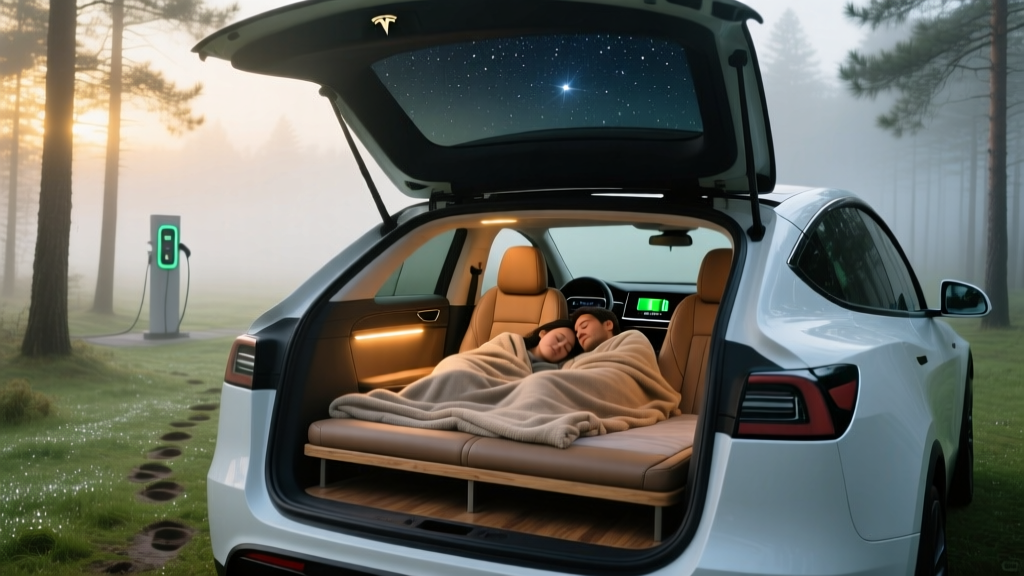
The image of a couple asleep in a Tesla has become an EV-culture staple — part road-trip romance, part practical proof that electric ownership extends beyond the daily commute. But turning a crossover SUV into a legitimate overnight shelter requires more than reclining the seats. It demands a flat cargo floor, sustained climate control that doesn't murder your battery, and enough range left in the morning to reach the next charger. The 2026 Tesla Model Y Long Range AWD remains the most popular platform for this exact use case. Here's the full ownership picture — range, charging, camp-mode energy draw, interior dimensions, and whether the numbers actually support a couple sleeping in a Tesla on a weekend trip.
2026 Tesla Model Y at a Glance: Key Specs
| Specification | 2026 Model Y Long Range AWD |
|---|---|
| EPA Range | 308 miles |
| Battery Capacity (usable) | ~78.1 kWh (NMC chemistry) |
| Drivetrain | Dual-motor AWD |
| Horsepower | 384 hp |
| 0–60 mph | 4.8 seconds |
| Max DC Fast Charge | 250 kW (peak) |
| 10–80% DC Charge Time | ~27 minutes |
| Level 2 Home Charge Rate | 11.5 kW (~44 mi/hr) |
| Efficiency | 122 MPGe combined / 28 kWh/100 mi |
| Cargo (rear seats folded) | 72.0 cu ft |
| Rear Legroom | 41.6 inches |
| Base MSRP | $48,990 |
| Federal Tax Credit (§30D) | Up to $7,500 (eligibility varies) |
| Battery Warranty | 8 years / 120,000 miles |
Real-World Range: What the EPA Sticker Doesn't Tell You
EPA Estimated Range: 308 miles
Real-World Highway (70–75 mph, mild weather): ~265–280 miles
Cold-Weather Highway (below 30°F): ~215–240 miles
City / Mixed Driving: ~290–305 miles
The EPA's 308-mile figure is achievable in stop-and-go city driving where regenerative braking recovers energy and speeds stay moderate. Highway cruising at 75 mph tells a different story — aerodynamic drag dominates, and you'll typically see 265 to 280 miles in 60–70°F conditions. Drop the thermometer below freezing, and battery internal resistance plus cabin heating can pull that down to 215–240 miles.
For the couple asleep in a Tesla scenario, the overnight climate-control draw matters just as much as driving range. Tesla's Camp Mode keeps the HVAC running at a low-power steady state. In mild conditions (50–70°F), expect roughly 1–1.5% battery drain per hour — about 8–12% over an 8-hour sleep. In colder weather with the heat pump working harder, that can climb to 15–20%. If you park with 50% state of charge, you'll wake with enough buffer to reach a Supercharger in most conditions. Park with 20% in January in Colorado, and you may wake anxious.
Charging Speed: DC Fast Charge and Home Level 2
| Charging Level | Power / Rate | Speed | Typical Use |
|---|---|---|---|
| Level 1 (120V outlet) | ~1.4 kW | ~3–5 mi/hr | Emergency / trickle |
| Level 2 (240V, 48A Wall Connector) | 11.5 kW | ~44 mi/hr | Home overnight |
| DC Fast Charge (V3 Supercharger) | Up to 250 kW peak | 10–80% in ~27 min | Road trips |
Tesla's 250 kW peak rate on V3 Superchargers is impressive on paper, but the charge curve tells the real story. The Model Y sustains roughly 200–250 kW from approximately 10% to 35% state of charge, then tapers progressively. By 60%, you're looking at ~120 kW; by 80%, roughly 60–70 kW. Charging from 80% to 100% on DC is painfully slow and unnecessary for road trips — plan your stops around 10–80% cycles.
At home, a Tesla Wall Connector on a 60-amp circuit delivers 11.5 kW, adding about 44 miles of range per hour. A full charge from 20% to 80% takes roughly 5–6 hours overnight. For couples using the Model Y as a weekend camper, this means you can leave home at 100% with minimal planning. Installation typically runs $800–$2,000 depending on panel capacity and conduit distance — factor a potential panel upgrade ($1,500–$3,000) if your home still runs on a 100-amp service.
According to fueleconomy.gov, the Model Y's efficiency of 28 kWh per 100 miles translates to roughly $0.04–$0.06 per mile on home charging (depending on your local electricity rate), compared to $0.12–$0.16 per mile for a comparable gas crossover at current fuel prices.
Interior Space: Can Two Adults Actually Sleep in It?
With the rear seats folded flat, the 2026 Model Y Long Range offers 72.0 cubic feet of cargo volume and a nearly flat load floor measuring approximately 74 inches long and 40 inches wide at the narrowest point between the wheel wells. That's enough for a full-size inflatable mattress or a purpose-built foam pad designed for EV camping.
Two average-height adults (up to about 6'1") can lie fully extended without their feet touching the tailgate. Headroom is generous thanks to the panoramic glass roof, though the sloping roofline does reduce vertical space toward the rear. Ventilation is where Tesla's Camp Mode earns its keep: the HVAC system maintains a set temperature with the cabin sealed, preventing condensation buildup that plagues tent camping and traditional car sleeping.
The glass roof is a double-edged sword. In summer, it radiates heat even with the factory tint — an aftermarket reflective shade is practically mandatory for warm-weather camping. In winter, it's an insulation weak point, and some owners add a custom-cut Reflectix panel to reduce overnight heat loss.
Pricing, Trims, and Federal Tax Credit Eligibility
| Trim | MSRP | Est. After §30D Credit | Drivetrain |
|---|---|---|---|
| Model Y Long Range AWD | $48,990 | ~$41,490 | Dual-motor AWD |
| Model Y Performance | $53,490 | ~$45,990 | Dual-motor AWD |
The $7,500 federal EV tax credit under IRS §30D is not guaranteed for every buyer. Eligibility hinges on three moving targets:
- MSRP Cap: SUVs must have a base MSRP at or below $80,000. Both Model Y trims clear this.
- Buyer Income Cap: Modified adjusted gross income must not exceed $150,000 (single), $225,000 (head of household), or $300,000 (joint filers).
- Battery Sourcing: Critical minerals and battery components must meet escalating domestic-content thresholds. Tesla's supply chain has largely adapted, but verify current-year compliance on the IRS qualified vehicles list before purchasing.
As of 2026, the credit can be transferred at the point of sale, reducing your purchase price directly rather than waiting for a tax refund. Consult a tax professional to confirm your specific eligibility — rules shift annually and depend on your filing status and the vehicle's build date.
Standout Tech and Notable Drawbacks
Tesla's 15.4-inch center touchscreen anchors an infotainment system that remains among the most responsive in the EV segment. Streaming services (Netflix, YouTube, Disney+) function while parked — a genuine advantage for couples spending evenings in the vehicle. The 17-speaker audio system delivers concert-hall quality in a quiet cabin, and the HEPA air filtration system (with Bioweapon Defense Mode) is a legitimate health feature for camping in wildfire-smoke regions or dusty environments.
On the driver-assistance front, Tesla's Autopilot and available Full Self-Driving (Supervised) remain SAE Level 2 systems. This means the driver must remain attentive and keep hands on or near the wheel at all times. Despite the "Full Self-Driving" name, this is not autonomous driving — it's an advanced lane-keeping and adaptive cruise system that requires constant supervision. Waymo and Zoox robotaxis operate at Level 4 in geofenced areas; Tesla's consumer system does not.
ADAS Limitation Notice: Tesla Autopilot and FSD (Supervised) are SAE Level 2 driver-assist systems. The driver is legally and operationally responsible for the vehicle at all times. These systems can miss stopped vehicles, struggle in construction zones, and disengage without warning. Never sleep, use a phone, or look away from the road while the system is engaged.
Drawbacks worth noting: the Model Y's ride quality is firm — you'll feel expansion joints and potholes more than in a Hyundai Ioniq 5 or Ford Mustang Mach-E. Road noise at highway speeds is noticeable, though improved over pre-2025 models. There is no Apple CarPlay or Android Auto; Tesla's native navigation is excellent but requires buy-in to their ecosystem. And while the frunk (front trunk) adds 4.1 cu ft of storage, it's not climate-controlled — don't store temperature-sensitive camping food there in summer.
Pros and Cons: The Honest Verdict
Pros
- Best-in-class Supercharger network reliability — 250 kW V3 and 350+ kW V4 stations across the US
- Camp Mode with sustained HVAC and entertainment while parked
- 72 cu ft flat-load cargo floor fits two adults on a mattress
- 122 MPGe combined efficiency keeps per-mile cost low
- OTA updates continuously add features and improve efficiency
- Heat pump standard — critical for cold-weather range preservation
Cons
- Firm ride quality and noticeable road noise on rough pavement
- No Apple CarPlay / Android Auto
- Glass roof requires aftermarket shading for summer camping
- FSD (Supervised) subscription is $99/mo and remains Level 2 only
- Rear visibility is limited — reliance on cameras for backing up
- Insurance premiums run 15–25% higher than comparable gas crossovers
Is the 2026 Model Y Worth It for Couples Who Camp?
Compared to the Hyundai Ioniq 5 (303 mi EPA, $46,650 base) and the Ford Mustang Mach-E Extended Range (320 mi EPA, $49,995 base), the Model Y holds advantages in charging infrastructure and interior cargo volume. The Ioniq 5 charges faster on paper (10–80% in ~18 minutes on a 350 kW charger) but relies on third-party networks that remain less reliable than Tesla's Supercharger ecosystem. The Mach-E offers a more traditional driving feel and standard CarPlay but trails in efficiency and cargo space.
If your primary use case involves weekend camping, road trips through remote areas, and overnight sleeping in the vehicle, the Model Y's combination of flat cargo floor, Camp Mode, and Supercharger density makes it the strongest candidate in its class. If ride comfort and traditional infotainment matter more, the Ioniq 5 or Mach-E deserve test drives.
Frequently Asked Questions
How much battery does Tesla Camp Mode use overnight?
In mild weather (50–70°F), expect 8–12% battery drain over 8 hours. In cold weather with the heat pump active, plan for 15–20%. Always park with at least 40–50% charge for overnight camping to preserve morning driving range.
Does the 2026 Model Y qualify for the $7,500 federal tax credit?
It can, but eligibility depends on your income (caps of $150K/$225K/$300K by filing status), the vehicle's MSRP (under $80K — both trims qualify), and current battery-sourcing compliance. The credit can be applied at point of sale. Verify on the IRS qualified vehicles list before purchasing.
Can a tall couple fit sleeping in a Tesla Model Y?
Adults up to about 6'1" can lie flat with the rear seats folded. The load floor measures roughly 74 inches long. Taller individuals may need to sleep at a slight diagonal or use a platform that extends over the folded-seat gap near the front seats.
How fast does the Model Y charge on a road trip?
On a V3 Supercharger (250 kW peak), the 10–80% charge takes approximately 27 minutes. Real-world stops typically last 20–30 minutes if you plan around 10–80% cycles. Charging past 80% is significantly slower and not recommended for road-trip efficiency.
Is it safe to sleep in a Tesla with the AC or heat running?
Yes. Unlike a gas car idling in a garage (carbon monoxide risk), an EV produces no exhaust. Camp Mode maintains HVAC operation safely in any ventilation condition. Just ensure the vehicle is parked in a safe, legal location and you have adequate battery charge for the next leg of your trip.
What's the warranty coverage on the Model Y battery?
Tesla covers the battery and drive unit for 8 years or 120,000 miles (whichever comes first) with a minimum 70% capacity retention threshold. If the battery degrades below 70% of original capacity within the warranty period, Tesla will repair or replace it at no cost.