Buying an electric vehicle is a long-term financial equation. You trade higher upfront costs and potentially steeper insurance premiums for drastically lower fueling expenses and reduced maintenance. But the linchpin of the entire EV ownership experience—and the primary source of those fueling savings—is the cost to charge an electric car at home.
If you rely solely on public DC fast charging, your savings evaporate. If you charge at home using off-peak utility rates, you unlock the true economic advantage of electrification. Below, we run the exact numbers for 2026: per-mile costs, five-year total ownership, federal tax credit eligibility under current IRS rules, and the depreciation realities you won't see in a manufacturer brochure.
How Much Does It Actually Cost to Charge an EV at Home?
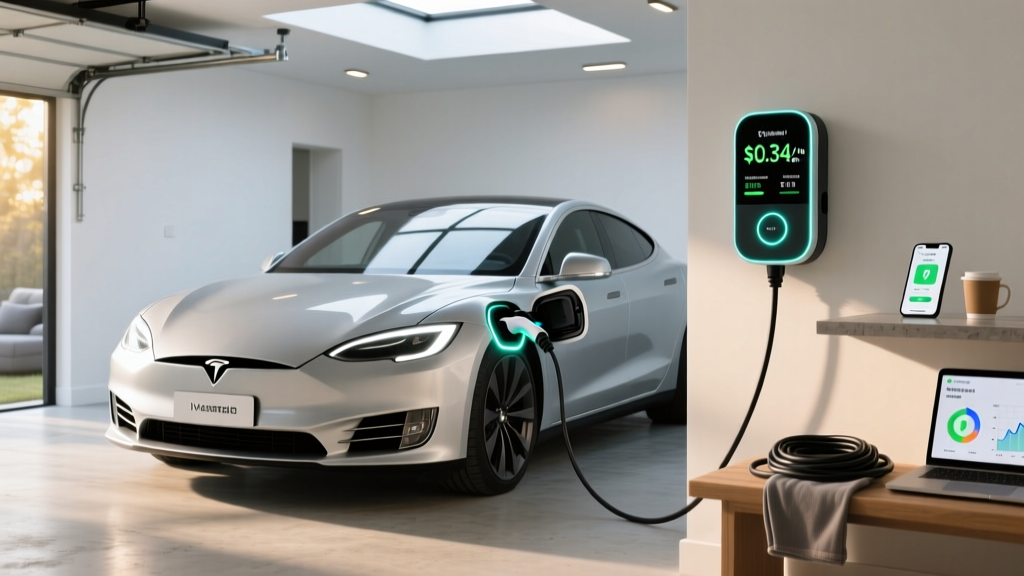
Let's establish the baseline math. The cost to charge an electric car at home depends on two variables: your vehicle's efficiency (measured in kWh per 100 miles) and your local electricity rate (measured in dollars per kWh).
According to the U.S. Energy Information Administration, the national average residential electricity rate sits around $0.17 per kWh as of early 2026, though this varies wildly—from roughly $0.11/kWh in parts of the Pacific Northwest and Louisiana to over $0.30/kWh in California and Hawaii.
Here's what home charging costs for three popular 2026 EVs at the national average rate:
| Vehicle | Efficiency (kWh/100 mi) | Cost per Mile | Cost for 300-Mile Trip | Annual Cost (12,000 mi) |
|---|---|---|---|---|
| 2026 Tesla Model Y Long Range | 26 kWh | $0.044 | $13.26 | $530 |
| 2026 Hyundai Ioniq 5 SEL | 30 kWh | $0.051 | $15.30 | $612 |
| 2026 Ford F-150 Lightning Lariat | 48 kWh | $0.082 | $24.48 | $979 |
Now compare that to a gasoline equivalent. A comparable gas-powered crossover averaging 28 MPG combined with fuel at $3.40/gallon costs $0.121 per mile—nearly three times the Tesla Model Y's home-charging cost. For the F-150 Lightning versus a gas F-150 getting 20 MPG, the gap narrows but still favors electricity: $0.082/mile electric versus $0.170/mile gas.
Pro tip: Many utilities offer time-of-use (TOU) plans with overnight rates 30-50% below the standard rate. If your utility offers $0.09/kWh between midnight and 6 AM, your Model Y annual charging cost drops to roughly $280. Always check your utility's EV-specific rate plans before assuming the standard residential rate.
Charging at Home vs. Public DC Fast Charging: The Savings Gap
Home charging is where the economics work. Public DC fast charging—while essential for road trips—destroys your cost advantage. Networks like Electrify America, EVgo, and Tesla Superchargers typically charge $0.35 to $0.55 per kWh in 2026, with some urban locations exceeding $0.60/kWh.
At $0.45/kWh on a public DC charger, that same Tesla Model Y costs $0.117 per mile—virtually identical to a gas car. This is why we consistently advise buyers: if you cannot install a Level 2 home charger, an EV's financial case weakens considerably, and a hybrid may serve you better.
Federal Tax Credit: Do You Qualify for Up to $7,500?
The federal EV tax credit under IRS §30D remains the single largest purchase incentive available, but qualifying in 2026 requires navigating a maze of requirements. The credit is not a flat $7,500 for everyone—it's a complex calculation with hard caps.
- Maximum credit: $7,500 (split into $3,750 for critical minerals + $3,750 for battery components)
- MSRP caps: Vans, SUVs, and pickups ≤ $80,000; sedans and other vehicles ≤ $55,000
- Buyer income limits (AGI): $300,000 (married filing jointly), $225,000 (head of household), $150,000 (all others)
- Battery sourcing: Critical minerals and battery components must meet escalating domestic/free-trade-partner sourcing thresholds that tighten each year through 2029
- Final assembly: Vehicle must undergo final assembly in North America
- Point-of-sale transfer: As of 2024, you can transfer the credit to the dealer at purchase, reducing your out-of-pocket cost immediately rather than waiting to claim it on your tax return
- Foreign entity of concern (FEOC): Vehicles with battery components from FEOC entities (primarily certain Chinese manufacturers) are disqualified—this restriction has expanded through 2025-2026
Which popular 2026 models qualify? As of this writing, the Tesla Model Y, Ford F-150 Lightning, and certain trims of the Chevrolet Equinox EV meet the sourcing requirements for the full or partial credit. However, battery-sourcing rules have tightened significantly, and several models that qualified in 2024 no longer qualify in 2026. Always verify current eligibility on fueleconomy.gov before purchasing—the IRS updates the qualified vehicle list periodically.
Critical caveat: The §30D credit is non-refundable. If your total federal tax liability is less than the credit amount, you cannot claim more than you owe. The point-of-sale transfer option changes this dynamic somewhat—the dealer absorbs the credit and passes it to you as a price reduction—but confirm the dealer participates in the advance payment program.
State, Local, and Utility Incentives
- Colorado: State tax credit up to $5,000 for EVs under $80,000 MSRP (stackable with federal credit)
- California: Clean Fuel Rebate of up to $1,000 through participating utilities; additional CVRP rebates for income-qualified buyers
- Massachusetts: MOR-EV rebate up to $3,500 for vehicles under $55,000
- Utility rebates: Many utilities offer $300-$1,500 rebates for Level 2 home charger purchase and installation (e.g., Con Edison, PG&E, Xcel Energy programs)
Five-Year Total Cost of Ownership: EV vs. Gas
Let's model a realistic five-year, 60,000-mile ownership scenario comparing a 2026 Tesla Model Y Long Range (AWD, ~$48,000 MSRP before incentives) against a comparably equipped 2026 Toyota RAV4 XLE AWD (~$34,000 MSRP).
| Category | Tesla Model Y LR | Toyota RAV4 XLE AWD |
|---|---|---|
| Purchase Price (MSRP) | $48,000 | $34,000 |
| Federal Tax Credit | −$7,500 | $0 |
| Effective Purchase Price | $40,500 | $34,000 |
| Fuel / Charging (60k mi) | $2,650 (home, $0.17/kWh) | $7,290 (28 MPG, $3.40/gal) |
| Maintenance (5 years) | $1,800 | $4,200 |
| Insurance (5 years) | $11,500 | $7,800 |
| Estimated Depreciation | $18,000 | $11,500 |
| 5-Year Total | $74,450 | $64,790 |
| Cost per Mile | $1.24 | $1.08 |
Assumptions: Home charging at $0.17/kWh, gas at $3.40/gal, national-average insurance premiums, depreciation based on projected 2026 resale trends. Your actual costs will vary by location, driving habits, and utility rates.
The takeaway: even with the federal tax credit, the Model Y's higher purchase price, steeper insurance, and heavier depreciation mean it does not break even with the RAV4 over five years in this scenario. However, the gap narrows dramatically with cheaper home electricity (TOU rates), state incentives, or if gas prices rise above $4.00/gallon. Over a 10-year ownership period, the EV's fuel and maintenance savings compound and can overtake the gas vehicle's advantage.
Maintenance Savings: Where EVs Genuinely Win
Maintenance is the most consistently underestimated advantage of EV ownership. Battery-electric vehicles eliminate oil changes, spark plugs, timing belts, transmission fluid, and exhaust system repairs. Regenerative braking dramatically extends brake pad life—many EV owners report original brake pads lasting 80,000-100,000+ miles.
| Service Item | EV Cost | Gas Vehicle Cost |
|---|---|---|
| Oil Changes (6-8 over 5 years) | $0 | $480–$720 |
| Brake Pads (1-2 replacements) | $0–$200 (regen extends life) | $600–$1,200 |
| Transmission Fluid / Service | $0 | $200–$400 |
| Engine Air Filter | $0 (cabin filter only) | $100–$200 |
| Tire Rotation / Replacement | $1,200–$1,800 (EVs wear tires faster due to weight/torque) | $900–$1,400 |
| Coolant / Misc. Fluids | $100–$200 | $200–$400 |
| Total Estimated | $1,500–$2,400 | $2,480–$4,320 |
The caveat: tires. EVs are heavier and deliver instant torque, which accelerates tire wear. Budget for tire replacement 10,000-15,000 miles sooner than you would on a comparable gas vehicle. Many EV owners opt for EV-specific tire compounds (like Michelin's e·Primacy or Hankook's iON) designed for lower rolling resistance and noise, though these carry a price premium.
Insurance: The Cost Most Buyers Overlook
EV insurance premiums typically run 15-30% higher than equivalent gas vehicles. The reasons are straightforward: higher repair costs after collisions (specialized high-voltage components, aluminum body panels, sensor-dense bumpers), a smaller pool of qualified body shops, and higher total-loss write-off rates when battery packs sustain damage.
For our Model Y vs. RAV4 comparison, national average annual premiums in 2026 run approximately $2,300/year for the Tesla versus $1,560/year for the Toyota—a $3,700 gap over five years. This varies enormously by driver profile, state, and insurer. Some companies (like Tesla Insurance in eligible states) offer usage-based premiums that can narrow the gap for safe drivers.
Before purchasing: Get an insurance quote for the specific EV trim you're considering. Premiums can vary by $500-$1,000/year between models with similar MSRPs, and this should factor into your purchase decision.
Depreciation and Resale Value Trends
EV depreciation has been volatile. In 2023-2024, aggressive price cuts by Tesla and a flood of off-lease EVs drove used EV values down sharply—some models lost 50-60% of their value in three years. By 2026, the market has stabilized somewhat, but EVs still generally depreciate faster than their gas counterparts.
Current 5-year depreciation projections for popular models:
- Tesla Model Y: ~38-45% (improved from 2024 lows, aided by Supercharger network access and brand recognition)
- Hyundai Ioniq 5: ~42-50%
- Ford F-150 Lightning: ~40-48%
- Toyota RAV4 (gas, for comparison): ~32-38%
The depreciation picture improves significantly if you plan to own the vehicle for 8-10 years, at which point most vehicles have plateaued in value loss. Battery longevity data from high-mileage EVs is increasingly reassuring—most modern LFP and NMC packs retain 85-90% capacity at 150,000 miles, and federal warranty requirements mandate 8 years/100,000 miles of coverage with a minimum 70% capacity retention threshold.
Home Charger Installation: The Upfront Cost You Must Budget For
To capture the home-charging savings modeled above, you'll likely need a Level 2 (240V) home charger installed. Costs vary based on your electrical panel's capacity, the distance from panel to garage, and local permit requirements.
| Component | Low Estimate | High Estimate |
|---|---|---|
| Level 2 Charger Hardware (40-48A, hardwired) | $400 | $750 |
| Electrician Labor | $500 | $2,000 |
| Permit & Inspection | $50 | $300 |
| Electrical Panel Upgrade (if needed, 200A service) | $0 | $3,500 |
| Total | $950 | $6,550 |
Most homes with modern 200A electrical panels can add a 40-48A Level 2 circuit without a panel upgrade, landing installation in the $900-$2,000 range. Older homes with 100A service may require a panel upgrade, which adds significant cost. Always get quotes from licensed electricians and check whether your utility offers a charger installation rebate—many cover $300-$1,000 of the total.
Frequently Asked Questions
How much does it really cost to own an EV over 5 years?
For a mainstream EV like the 2026 Tesla Model Y, expect a 5-year total cost of ownership around $70,000-$80,000 including purchase (after federal tax credit), home charging, insurance, maintenance, and depreciation. This is typically $5,000-$15,000 more than a comparable gas crossover, primarily due to higher purchase price, insurance premiums, and depreciation. The gap narrows with cheaper electricity rates, state incentives, higher gas prices, or longer ownership periods.
Do I qualify for the $7,500 federal EV tax credit?
Possibly. Under current IRS §30D rules, you must meet income limits ($150K single / $300K joint AGI), purchase a vehicle under the MSRP cap ($55K sedans, $80K SUVs/trucks), and the vehicle must meet battery-sourcing and North American assembly requirements. The qualifying vehicle list changes periodically as sourcing rules tighten—verify on fueleconomy.gov before buying. You can transfer the credit to the dealer at point of sale for an immediate price reduction.
How much do I save on fuel and maintenance with an EV?
At the national average electricity rate of $0.17/kWh, expect to save $4,000-$5,000 on fuel over 5 years/60,000 miles versus a 28 MPG gas vehicle at $3.40/gallon. Maintenance savings add another $1,500-$2,500 over the same period, primarily from eliminating oil changes, extending brake pad life via regenerative braking, and removing transmission and exhaust service. Total fuel + maintenance savings: roughly $5,500-$7,500 over five years.
Are EVs more expensive to insure?
Yes, typically 15-30% more than equivalent gas vehicles. Higher repair costs (specialized high-voltage components, sensor-dense body panels), a smaller qualified repair network, and higher total-loss rates when batteries are damaged all contribute. For a Model Y vs. RAV4, expect roughly $700-$900 more per year in insurance premiums. Always get a quote before purchasing—premiums vary significantly by model, insurer, and state.
How well do EVs hold their value?
EV depreciation has improved from the steep drops of 2023-2024 but still trails gas vehicles. Expect a mainstream EV to lose 38-50% of its value over five years, versus 32-38% for a comparable gas vehicle. Battery health data is increasingly positive—most modern packs retain 85-90% capacity at 150,000 miles, and the federal 8-year/100,000-mile battery warranty provides a safety net. If you plan to own the vehicle 8+ years, depreciation becomes less of a factor.
Is home charging really cheaper than gas?
At the $0.17/kWh national average, yes—dramatically. A Model Y costs roughly $0.044/mile to charge at home versus $0.121/mile for a 28 MPG gas vehicle. With time-of-use overnight rates ($0.09-$0.12/kWh), the gap widens further. However, if you rely primarily on public DC fast charging ($0.35-$0.55/kWh), your per-mile cost equals or exceeds gasoline. The economics of EV ownership depend fundamentally on reliable, affordable home charging access.