The True Cost to Charge an Electric Car: Beyond the $/kWh Sticker
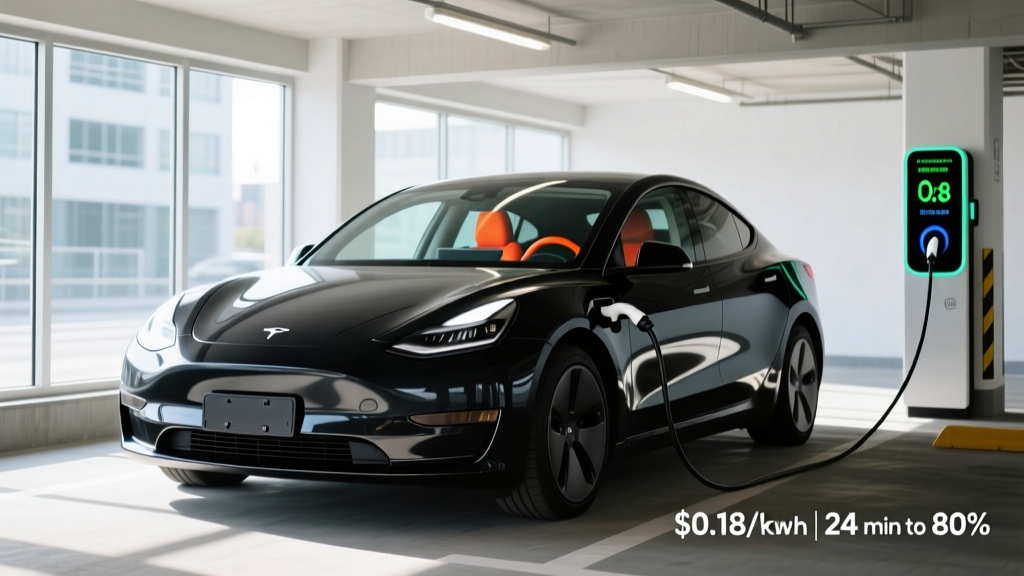
If you've searched "how much does it cost to charge an electric car" and found only vague answers, you're not alone. The real answer depends on where you charge, what you drive, and how you measure ownership. In 2026, the national average residential electricity rate hovers around $0.17 per kWh, while public DC fast charging averages $0.40–$0.55 per kWh depending on the network and time of day.
But the cost to charge an electric car is only one line item in a much larger ownership equation. This guide breaks down every cost — fuel, maintenance, insurance, depreciation, and incentives — with hard numbers, so you can decide whether an EV actually saves you money over five years.
Charging Cost Per Mile: EV vs. Gas in 2026
The single most impactful comparison for EV shoppers is cost per mile. Below, we model three realistic scenarios against a comparable gasoline vehicle averaging 28 MPG combined (similar to a 2026 Toyota RAV4 AWD).
| Scenario | Rate | Efficiency | Cost/Mile | vs. Gas |
|---|---|---|---|---|
| Home Level 2 (national avg) | $0.17/kWh | 3.5 mi/kWh | $0.049 | −59% |
| Home + Time-of-Use (off-peak) | $0.09/kWh | 3.5 mi/kWh | $0.026 | −78% |
| Public DC Fast Charging | $0.48/kWh | 3.2 mi/kWh* | $0.150 | +25% |
| Gasoline Vehicle (28 MPG) | $3.40/gal | 28 MPG | $0.121 | Baseline |
*DC fast charging efficiency is slightly lower due to charging losses (~5–8%) and higher-speed driving typical of road trips.
The takeaway is clear: home charging is where EVs win decisively. If you rely exclusively on public DC fast charging, your per-mile fuel cost can actually exceed gasoline. According to fueleconomy.gov, most current EVs achieve 100–130 MPGe combined, translating to roughly 3.0–4.0 miles per kWh.
For a driver covering 12,000 miles per year (the U.S. average per FHWA data), annual fuel costs break down as:
- Home charging (avg rate): ~$588/year
- Home charging (off-peak TOU): ~$312/year
- Public DCFC only: ~$1,800/year
- Gasoline (28 MPG): ~$1,457/year
Federal Tax Credit: Do You Qualify for Up to $7,500?
The IRS §30D Clean Vehicle Credit can reduce your effective purchase price by up to $7,500 — but eligibility in 2026 depends on a matrix of rules that trip up many buyers. Since January 2024, buyers can also transfer the credit to the dealer as a point-of-sale discount, meaning you don't need to wait until tax filing to benefit.
§30D Federal Tax Credit Eligibility Checklist (2026)
- Vehicle MSRP cap: ≤ $80,000 for SUVs, vans, and pickups; ≤ $55,000 for sedans and other body styles
- Buyer income cap (modified AGI): ≤ $300,000 joint filers / ≤ $225,000 head of household / ≤ $150,000 single filers
- Battery component sourcing: Battery components must be manufactured or assembled in North America (phase-in percentages increase annually through 2029)
- Critical minerals requirement: A percentage of critical minerals must be sourced from the U.S. or FTA partners (thresholds tighten yearly)
- Foreign entity of concern (FEOC): Vehicles with battery components or critical minerals from designated FEOCs are disqualified
- Final assembly: Vehicle must undergo final assembly in North America
- Point-of-sale transfer: Credit can be applied as an upfront dealer discount starting in 2024
- Nonrefundable: Credit cannot exceed your total federal tax liability for the year (unless transferred at point of sale)
Source: IRS.gov — Clean Vehicle Credit. Rules are subject to legislative change. Consult a tax professional for your specific situation.
The FEOC and critical-mineral sourcing rules have narrowed the list of qualifying vehicles significantly since 2023. As of early 2026, many Tesla, GM, Ford, Hyundai, and Volkswagen models qualify for at least partial credit ($3,750), while full $7,500 eligibility depends on the specific trim's battery supply chain. Always verify current eligibility on fueleconomy.gov's tax credit page before purchasing.
5-Year Total Cost of Ownership: EV vs. Gas Side by Side
To answer "how much does it really cost to own an EV over 5 years," we modeled a 2026 Tesla Model Y Long Range AWD (MSRP ~$46,630, EPA 320 mi, 75 kWh battery) against a 2026 Toyota RAV4 XLE AWD (MSRP ~$33,425, EPA 28 MPG combined). Both are popular compact crossovers driven 12,000 miles/year.
| Category | Model Y LR AWD | RAV4 XLE AWD | Difference |
|---|---|---|---|
| Purchase Price (MSRP) | $46,630 | $33,425 | +$13,205 |
| Federal Tax Credit (§30D) | −$7,500* | $0 | −$7,500 |
| Net Purchase Cost | $39,130 | $33,425 | +$5,705 |
| Fuel/Energy (5 yrs, home charging) | $2,940 | $7,286 | −$4,346 |
| Maintenance (5 yrs) | $1,500 | $3,800 | −$2,300 |
| Insurance (5 yrs) | $11,400 | $8,700 | +$2,700 |
| Depreciation (5 yrs) | $18,500 | $13,200 | +$5,300 |
| 5-Year Total Cost | $73,470 | $66,411 | +$7,059 |
*Assumes full $7,500 credit eligibility. Fuel assumes 80% home Level 2 at $0.17/kWh, 20% public DCFC at $0.48/kWh for EV; $3.40/gal for gas. Insurance and depreciation based on industry averages from Kelley Blue Book and Insurify. Actual costs vary by region, driving habits, and individual circumstances.
In this scenario, the Model Y costs roughly $7,059 more over five years — but that gap narrows significantly with off-peak electricity rates, state incentives, or higher annual mileage. A driver covering 18,000 miles/year with time-of-use rates at $0.09/kWh would see the EV break even or come out ahead.
Maintenance Savings: Where EVs Quietly Win
EVs eliminate many recurring costs that gasoline owners take for granted. The powertrain has roughly 20 moving parts compared to 200+ in an internal combustion engine. Here's what disappears from your maintenance schedule:
| Service Item | EV | Gas Vehicle | 5-Year Savings |
|---|---|---|---|
| Oil changes | None | 2×/year ($50–$80 each) | $500–$800 |
| Transmission fluid | None (single-speed) | Every 30–60k mi ($150–$300) | $150–$300 |
| Brake pads | 80–150k mi life (regen) | 30–50k mi ($200–$400/axle) | $400–$800 |
| Spark plugs | None | Every 60–100k mi ($200–$400) | $200–$400 |
| Coolant flush | Every 5+ years | Every 2–5 years ($100–$200) | $100–$200 |
| Air filter / cabin filter | Cabin only ($25–$50) | Both ($50–$100) | $125–$250 |
What EVs still need: tire rotations (EVs are heavier and have instant torque, wearing tires 10–20% faster), cabin air filter replacement, brake fluid checks, windshield washer fluid, and wiper blades. Budget roughly $300/year for EV maintenance versus $760/year for a comparable gas vehicle, based on AAA's Your Driving Costs methodology.
The regenerative braking advantage is real but often overstated. One-pedal driving and regen significantly reduce friction brake use — many EV owners report original brake pads at 80,000+ miles. However, you still need periodic brake caliper service (lubrication) to prevent seizing, especially in regions that use road salt.
Insurance Cost Reality: Why EVs Cost More to Insure
Here's the cost that EV skeptics correctly point to: insurance premiums for electric vehicles typically run 15–30% higher than equivalent gasoline vehicles. In our model, that translates to roughly $540 more per year ($2,700 over five years).
The reasons are structural, not arbitrary:
- Higher repair costs: EV battery packs are expensive to replace if damaged. Even minor collisions can trigger battery safety inspections costing $1,000–$3,000. Many insurers write off vehicles with any battery-adjacent damage.
- Specialized labor: High-voltage system repairs require certified EV technicians, who are still scarce and charge premium rates.
- Parts availability: EV-specific body panels, battery modules, and power electronics often have longer lead times than mass-produced ICE components.
- Higher vehicle values: The higher MSRP means higher comprehensive and collision payouts.
That said, insurance costs vary dramatically by insurer, driver profile, and state. Companies like Tesla Insurance (available in select states), GEICO, and Progressive have started offering more competitive EV rates as the fleet ages and repair data improves. Always get quotes from at least three insurers before purchasing — the spread can be $800+/year between the cheapest and most expensive EV policies.
Depreciation and Resale Value: The Evolving EV Market
EV depreciation has been volatile. In 2023, aggressive Tesla price cuts caused used EV values to plummet — some models lost 40–50% of value in a single year. By 2026, the market has largely stabilized, but EVs still depreciate faster than top-selling gasoline vehicles on average.
Current 5-year depreciation trends (percentage of MSRP retained):
- Tesla Model Y: ~55–60% retained (improved after 2023 price-cut shock)
- Tesla Model 3: ~50–55% retained
- Hyundai Ioniq 5: ~50–55% retained
- Ford Mustang Mach-E: ~48–53% retained
- Toyota RAV4 (gas): ~62–67% retained
- Honda CR-V (gas): ~63–68% retained
Several factors influence EV resale value going forward:
- Battery health: Buyers will increasingly demand State of Health (SoH) reports. Vehicles with >90% SoH at 5 years command a premium.
- Charging standard: NACS-equipped vehicles (now the industry standard) may hold value better than CCS-only models as the Supercharger network dominates.
- Software/feature updates: Vehicles with active OTA update histories may fare better.
- Tax credit resets: When a used EV qualifies for the separate §25E used-EV credit (up to $4,000), it supports resale demand.
State, Local, and Utility Incentives: The Variable Savings Layer
Incentive Landscape (2026)
Beyond the federal §30D credit, dozens of state and utility incentives can shift the math significantly. These vary widely by jurisdiction and change frequently, so always verify with official sources:
- California (CVRP): Up to $7,000 for income-qualified buyers (Clean Cars 4 All / CVRP programs — check energy.ca.gov for current availability)
- Colorado: Up to $5,000 state tax credit for new EVs (income-capped tiers)
- New York (Drive Clean Rebate): Up to $2,000 point-of-sale rebate
- Massachusetts (MOR-EV): Up to $3,500 for income-qualified buyers
- Utility rebates: Many utilities offer $300–$1,500 rebates for home Level 2 charger installation, plus time-of-use rate discounts (check your local utility)
- HOV lane access: Several states grant solo HOV lane access for EVs — a non-monetary perk with real time value
- Registration fee offsets: Some states charge higher EV registration fees ($100–$225/year) to replace lost gas tax revenue, partially offsetting savings
Always check your state's energy office and your utility's EV program page for current offerings. Incentive amounts and eligibility rules change frequently.
Frequently Asked Questions
How much does it really cost to own an EV over 5 years?
Based on our modeling, a mid-range EV like the Tesla Model Y costs approximately $73,000–$75,000 over five years (60,000 miles) including purchase (net of tax credit), energy, maintenance, insurance, and depreciation. A comparable gas crossover costs roughly $66,000–$68,000. The gap narrows with higher mileage, off-peak electricity rates, and state incentives — and widens if you rely on public DC fast charging. The EV breaks even for drivers covering 15,000+ miles/year with home charging access.
Do I qualify for the federal EV tax credit?
You may qualify for up to $7,500 under IRS §30D if: (1) your modified AGI is under $150K/$225K/$300K (single/HOH/joint), (2) the vehicle MSRP is under $55K (sedans) or $80K (SUVs/trucks/vans), (3) the vehicle meets battery component and critical mineral sourcing thresholds, (4) final assembly is in North America, and (5) no FEOC-sourced components are present. The qualifying vehicle list changes as supply chains shift — always check fueleconomy.gov before purchasing. Since 2024, you can transfer the credit to the dealer as a point-of-sale discount.
How much do I save on fuel and maintenance?
A typical EV driver charging primarily at home saves $800–$1,100 per year on fuel compared to a 28 MPG gas vehicle (at $3.40/gallon and $0.17/kWh). Maintenance savings average $400–$500 per year from eliminated oil changes, longer brake life, and fewer mechanical services. Combined, that's $1,200–$1,600 in annual operating savings — but these must be weighed against higher purchase price, insurance, and depreciation.
Are EVs more expensive to insure?
Yes, typically 15–30% more expensive than comparable gasoline vehicles. For a $45,000 EV, expect annual premiums of $1,800–$2,600 depending on your profile, versus $1,400–$2,000 for a $33,000 gas crossover. Higher repair costs (battery damage, specialized labor), higher vehicle values, and limited parts availability drive the premium. Shop at least three insurers — the spread between quotes can exceed $800/year.
How well do EVs hold their value?
EVs currently retain 48–60% of MSRP after five years, compared to 60–68% for top-selling gas crossovers. The gap has narrowed since the 2023 used-EV price crash but persists due to battery health uncertainty, rapid technology advancement, and aggressive new-vehicle pricing. NACS-equipped vehicles and models with strong battery warranty coverage (8 years/100,000 miles minimum) tend to hold value better. Leasing transfers depreciation risk to the lessor.
Is home charging necessary to make EV ownership affordable?
Effectively, yes. Home Level 2 charging at residential rates ($0.12–$0.22/kWh) delivers per-mile costs 50–75% below gasoline. Exclusive public DC fast charging ($0.40–$0.55/kWh) can make EVs more expensive per mile than gas. If you cannot install a home charger (apartment living, street parking), a PHEV may be a more cost-effective electrified option — or investigate whether your utility or workplace offers subsidized charging.
Methodology: Costs modeled for 12,000 miles/year over 5 years. Electricity rates from EIA state averages; gasoline from AAA national average; insurance from Insurify and NHTSA aggregate data; depreciation from Kelley Blue Book and Edmunds 2025–2026 projections. Tax credit rules per IRS §30D as of January 2026. All figures are estimates — individual results vary by location, driving patterns, and personal circumstances.