The 2026 Tesla Model Y remains the best-selling electric vehicle in the United States for good reason: strong efficiency, access to the largest fast-charging network, and a practical crossover form factor. But for shoppers running the numbers, one question dominates the purchase decision — what is the actual cost of a full charge on a Tesla Model Y, and how does that translate into monthly and annual driving expenses?
This review answers that question with hard data, then layers in the full ownership picture: EPA range, charging speeds, battery chemistry, tax-credit eligibility, and how the refreshed Model Y stacks up against the Hyundai Ioniq 5 and Ford Mustang Mach-E. All figures reflect the 2026 model year as of early 2026.
2026 Tesla Model Y at a Glance: Core Specs
| Attribute | Value |
|---|---|
| EPA Estimated Range | 320 miles |
| Battery Capacity (usable) | ~78 kWh (NMC lithium-ion) |
| Drivetrain | Dual-motor AWD |
| Horsepower | 384 hp (combined) |
| 0–60 mph | 4.8 seconds |
| Max DC Fast Charge | 250 kW (peak) |
| 10–80% DC Fast Charge | ~25 minutes |
| Level 2 Home Charge Rate | 11.5 kW / 44 mi/hr |
| Efficiency | 122 MPGe combined / 28 kWh/100 mi |
| Cargo Volume (rear seats up / folded) | 30.2 / 72.0 cu ft |
| Rear Legroom | 38.4 inches |
| Battery & Drive Unit Warranty | 8 years / 120,000 miles |
| Base MSRP (Long Range AWD) | $46,630 |
The base rear-wheel-drive Model Y (LFP battery, ~58 kWh usable, EPA 283 mi) starts at $39,990. We focus on the Long Range AWD here because it accounts for the majority of U.S. sales and is the variant most buyers cross-shop against competitors.
Real-World Range: What the EPA Sticker Doesn't Tell You
Real-World Highway (70 mph, 68°F): ~270–290 miles
Real-World Highway (30°F, cabin heat on): ~230–255 miles
City / Stop-and-Go with Regen: ~300–320 miles
Tesla's efficiency engineering is among the best in the industry, but physics still governs the outcome. At sustained highway speeds above 70 mph, aerodynamic drag pushes consumption to roughly 30–32 kWh/100 mi, cutting effective range to the 270–290 mile window. In freezing temperatures, the heat pump helps — the Model Y uses an octovalve thermal management system that scavenges waste heat from the drivetrain — but expect a 15–25% range reduction depending on trip length and cabin-heater demand.
For daily commuting under 50 miles round-trip, most owners will charge once or twice per week at home and rarely think about range. Road-trippers should plan Supercharger stops at roughly 200–220 mile intervals to keep state of charge (SoC) in the fast-charging sweet spot and avoid the steep taper above 80%.
Cost of a Full Charge on the Tesla Model Y: The Complete Breakdown
This is the core question, and the answer depends entirely on where you charge. Below we calculate the cost to replenish the Long Range AWD's ~78 kWh usable battery from near-empty to full under three common scenarios.
Scenario 1: Home Level 2 Charging (Most Common)
The U.S. Energy Information Administration reports a national average residential electricity rate of approximately $0.165 per kWh as of late 2025/early 2026. Rates vary enormously by state — California averages ~$0.28/kWh while Washington State hovers around $0.11/kWh.
| Location | Rate ($/kWh) | Cost of Full Charge | Cost per Mile (320 mi) |
|---|---|---|---|
| National Average | $0.165 | $12.87 | $0.040 |
| California (avg residential) | $0.28 | $21.84 | $0.068 |
| Washington State | $0.11 | $8.58 | $0.027 |
| Texas | $0.14 | $10.92 | $0.034 |
| Time-of-Use Off-Peak (example) | $0.09 | $7.02 | $0.022 |
At the national average, a full home charge costs roughly $12.87 — the equivalent of about 3.5 gallons of gasoline at $3.65/gal. Per mile, you're paying about 4 cents compared to roughly 12–15 cents per mile for a 28 MPG gas crossover. Over 15,000 annual miles, that's a fuel savings of approximately $1,200–$1,600 per year with home charging.
Scenario 2: Tesla Supercharger (DC Fast Charging)
Tesla Supercharger pricing varies by station, time of day, and region. Typical rates in 2026 range from $0.25 to $0.48 per kWh, with a national average around $0.35/kWh.
A full 78 kWh charge at $0.35/kWh = $27.30. However, almost no EV owner charges from 0–100% on a DC fast charger. A more realistic road-trip stop (10–80%, ~55 kWh added) costs about $19.25 and takes approximately 25 minutes. Per mile on Superchargers alone, expect to pay roughly $0.085 — still well below gasoline on a per-mile basis.
Scenario 3: Third-Party DC Fast Chargers (Electrify America, EVgo, etc.)
The 2026 Model Y comes equipped with the NACS (North American Charging Standard) connector natively. Tesla opened its Supercharger network to non-Tesla EVs, and conversely, newer Model Y vehicles can access select third-party networks via adapters or native compatibility as those networks transition to NACS. Pricing on third-party chargers typically runs $0.31–$0.55/kWh, with idle fees at some locations. Budget $25–$40 for a substantial road-trip top-up.
Annual Charging Cost Summary
| Charging Mix | Avg Cost/Mile | Annual Cost |
|---|---|---|
| 90% Home / 10% Supercharger | $0.045 | $675 |
| 50% Home / 50% Supercharger | $0.063 | $945 |
| 100% Supercharger (apartment dweller) | $0.085 | $1,275 |
| Gas equivalent (28 MPG @ $3.65/gal) | $0.130 | $1,950 |
Charging Speed Deep Dive: DC Fast, Level 2, and Level 1
| Charging Level | Power (kW) | Miles Added per Hour | Typical Use Case |
|---|---|---|---|
| Level 1 (120V household outlet) | ~1.4 kW | ~4–5 mi/hr | Emergency / overnight trickle |
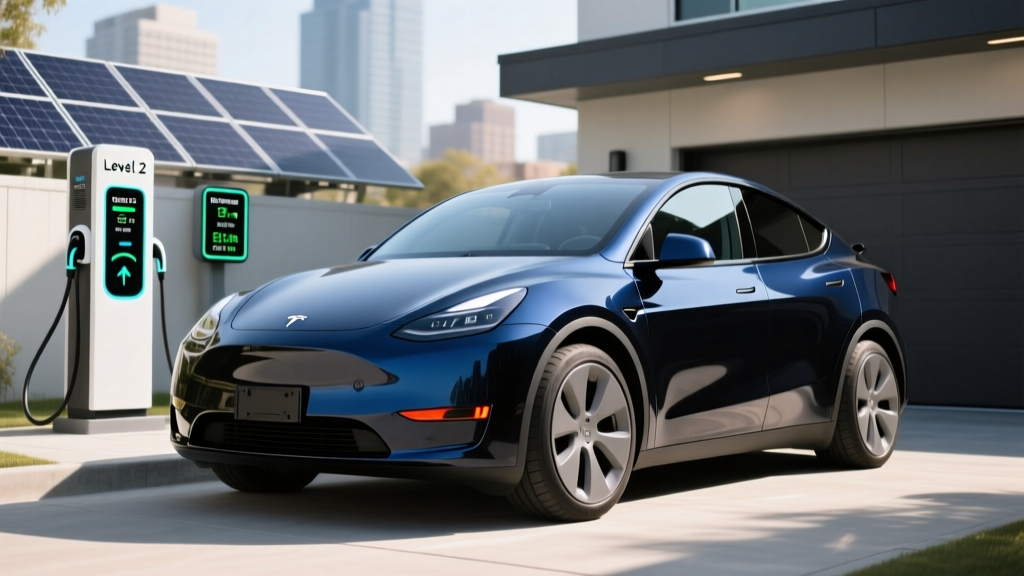
| Level 2 (240V, 48A Wall Connector) | 11.5 kW | ~44 mi/hr | Home daily charging |
| Level 2 (240V, 32A Mobile Connector) | 7.7 kW | ~30 mi/hr | Home / destination |
| DC Fast Charge (Supercharger V3/V4) | 250 kW peak | ~200 mi in 15 min | Road trips |
Understanding kW vs kWh: kW (kilowatts) measures power — how fast energy flows into the battery. kWh (kilowatt-hours) measures energy capacity — how much the battery holds. Think of kW as the width of a hose and kWh as the size of the bucket. The Model Y's 250 kW peak charge rate doesn't sustain for the entire session; the charge curve tapers significantly above 60% SoC to protect battery health. That's why the 10–80% time (~25 min) is the meaningful metric, not peak kW alone.
At home, Tesla's Wall Connector on a 60A circuit delivers 11.5 kW (48A continuous), adding roughly 44 miles of range per hour. An overnight 8-hour session replenishes about 350 miles — more than enough to refill the battery fully. Installation costs for a 240V/60A circuit typically range from $800 to $2,500 depending on panel proximity and local permitting. If your electrical panel is at capacity (common in older homes with 100A service), a panel upgrade to 200A can add $1,500–$3,500.
Performance, Efficiency, and Daily Drivability
The Long Range AWD Model Y's dual-motor setup produces 384 hp and rockets to 60 mph in 4.8 seconds — quick enough to merge confidently onto any freeway and genuinely fun in Sport mode. The single-speed reduction gear means acceleration is linear and immediate, with no shift shock.
Efficiency is where Tesla's engineering advantage shows most clearly. At 122 MPGe combined (28 kWh/100 mi), the Model Y outperforms nearly every AWD electric crossover in its class. The Hyundai Ioniq 5 AWD rates at 113 MPGe combined; the Ford Mustang Mach-E Extended Range AWD at 101 MPGe. That 10–20 MPGe gap translates directly into more miles per charge and lower per-mile charging costs.
Ride quality in the refreshed Model Y has improved over earlier Juniper-generation models, with retuned dampers and additional sound insulation. It's still firmer than a Toyota RAV4 or Honda CR-V, which some buyers appreciate for handling and others find tiring on rough pavement. The regenerative braking system offers strong one-pedal driving capability, though Tesla removed the user-adjustable regen setting — it's strong by default and non-configurable, which frustrates some new EV adopters.
Pricing, Trims, and Federal Tax Credit Eligibility
| Trim | MSRP | Est. Price After §30D Credit* |
|---|---|---|
| RWD (Standard Range, LFP) | $39,990 | Varies — see eligibility below |
| Long Range AWD | $46,630 | Varies — see eligibility below |
| Long Range AWD (7-seat) | $48,630 | Varies — see eligibility below |
| Performance AWD | $52,130 | Varies — see eligibility below |
*The federal §30D EV tax credit provides up to $7,500, but eligibility is not automatic. As of 2026, the following rules apply per IRS guidelines:
- MSRP Cap: SUVs/crossovers must have an MSRP at or below $80,000 (all Model Y trims qualify).
- Buyer Income Cap: Modified AGI must not exceed $150,000 (single), $225,000 (head of household), or $300,000 (joint).
- Battery Component Sourcing: A percentage of battery components must be manufactured or assembled in North America. This requirement tightens annually; verify current-year compliance on Tesla's website or the DOE's fueleconomy.gov credit lookup.
- Critical Minerals: A percentage of critical minerals must be sourced from the U.S. or a free-trade-agreement country. This also tightens annually.
- Point-of-Sale Transfer: Since 2024, eligible buyers can transfer the credit to the dealer at purchase, reducing the purchase price directly rather than waiting for a tax refund.
Tesla's U.S.-built battery packs and extensive North American supply chain have historically allowed the Model Y to qualify for the full or partial credit, but the specific dollar amount can shift as sourcing requirements tighten each January. Always confirm eligibility on the IRS clean vehicle credit page before purchasing, and consult a tax professional if your income is near the cap.
Interior, Cargo, Technology, and Drawbacks
The Model Y's interior follows Tesla's minimalist ethos: a single 15.4-inch center touchscreen handles virtually all vehicle functions, from climate control to mirror adjustment. There is no traditional instrument cluster — speed and navigation appear on the main screen. The refreshed model adds ventilated front seats, ambient lighting, power-folding second-row seats, and a rear-seat touchscreen for passengers.
Cargo capacity remains a strong suit: 30.2 cubic feet behind the second row and 72.0 cubic feet with seats folded. The front trunk (frunk) adds roughly 4.1 cubic feet for charging cables or a small bag. Rear legroom measures 38.4 inches — adequate for adults on longer trips, though the sloping roofline cuts into headroom for passengers over 6 feet tall.
Standout tech: Tesla's software ecosystem is best-in-class. Over-the-air updates regularly add features. The Tesla app provides remote preconditioning, charge monitoring, and location tracking. Navigation with real-time Supercharger routing and battery preconditioning is seamless — the car warms the battery as you approach a Supercharger to optimize charge speed.
Driver assistance: Basic Autopilot (Traffic-Aware Cruise Control and Autosteer) is standard and functions as an SAE Level 2 system — the driver must remain attentive with hands on the wheel at all times. Full Self-Driving (Supervised) is an $8,000 option (or $99/month subscription) that adds automated lane changes, traffic-light recognition, and city-street navigation, but it remains Level 2 and requires continuous driver supervision. It is not a self-driving system.
Pros
- Best-in-class efficiency (122 MPGe combined)
- Access to 6,000+ Tesla Superchargers across North America
- Lowest cost-per-mile charging when using home electricity
- Strong performance (4.8s 0–60) with practical cargo space
- Continuous OTA software improvements
- Excellent battery thermal management
Cons
- Firm ride quality on rough roads
- No adjustable regenerative braking setting
- All controls via touchscreen — no physical buttons for climate
- FSD (Supervised) is expensive and still requires full attention
- Rear visibility compromised by sloping roofline (no rear wiper on some builds)
- Insurance premiums run 15–30% higher than comparable gas crossovers
Model Y vs. Ioniq 5 vs. Mach-E: Is It Worth Buying?
| Spec | Tesla Model Y LR AWD | Hyundai Ioniq 5 AWD | Ford Mach-E ER AWD |
|---|---|---|---|
| EPA Range | 320 mi | 290 mi | 290 mi |
| Battery (usable) | ~78 kWh NMC | ~77.4 kWh NMC | ~88 kWh NMC |
| Efficiency | 122 MPGe | 113 MPGe | 101 MPGe |
| Max DC Charge | 250 kW | 238 kW | 150 kW |
| 10–80% DC Time | ~25 min | ~18 min (800V arch) | ~38 min |
| 0–60 mph | 4.8 sec | 5.1 sec | 5.1 sec |
| Cargo (rear up) | 30.2 cu ft | 27.2 cu ft | 29.7 cu ft |
| Base MSRP (AWD) | $46,630 | $49,650 | $48,995 |
| Cost of Full Charge (home avg) | ~$12.87 | ~$12.78 | ~$14.52 |
The Ioniq 5's 800-volt architecture gives it a faster 10–80% charge time despite slightly lower peak kW — an impressive engineering feat. But the Model Y's superior efficiency means fewer total stops on a road trip and a lower cost per mile day-to-day. The Mach-E offers a more traditional interior with physical buttons and a comfortable ride, but its slower charging and lower efficiency are tangible disadvantages for high-mileage drivers.
If Supercharger network access is your top priority, the Model Y still wins — though Tesla has opened many Supercharger stalls to NACS-equipped competitors, narrowing this gap by 2026. If you value ride comfort and a less screen-dependent interior, the Mach-E or Ioniq 5 may suit you better.
Who the 2026 Model Y Suits Best
Ideal for: Commuters with home charging access, tech-forward buyers who value software updates and app integration, families needing cargo flexibility, and road-trippers who want the most reliable DC fast-charging network in North America. The 320-mile EPA range and 25-minute fast-charge stops make 500+ mile trips practical with a single stop.
Less ideal for: Buyers who prefer physical controls and traditional instrument clusters, those without any home or workplace charging access (reliance on public charging raises per-mile costs and adds time), and drivers in regions with extremely rough roads who prioritize ride softness over handling.
Frequently Asked Questions
What is the real-world range of the 2026 Tesla Model Y?
The EPA rates the Long Range AWD at 320 miles. In real-world highway driving at 70 mph, expect 270–290 miles. In freezing weather with cabin heating, plan for 230–255 miles. City driving with regenerative braking can match or slightly exceed the EPA estimate.
How fast does the Model Y charge at home and on road trips?
At home on a 240V/48A Tesla Wall Connector, the Model Y charges at 11.5 kW, adding about 44 miles per hour — a full charge takes roughly 7–8 hours. On a Tesla Supercharger (250 kW peak), a 10–80% charge takes approximately 25 minutes. The charge curve tapers significantly above 80%, so charging to 100% on DC fast charge is not recommended and takes considerably longer.
How much does the 2026 Model Y cost after the federal tax credit?
The Long Range AWD starts at $46,630. If you qualify for the full $7,500 §30D credit (subject to income caps, MSRP limits, and battery-sourcing requirements), the effective price drops to approximately $39,130. However, credit eligibility varies by buyer and changes annually — verify on the IRS clean vehicle credit page and consult a tax professional. The credit can be transferred at point of sale to reduce your purchase price directly.
Is the Tesla Model Y worth buying vs. the Hyundai Ioniq 5 or Ford Mach-E?
The Model Y leads in efficiency (122 MPGe), range (320 mi), and Supercharger network access. The Ioniq 5 charges faster (18 min 10–80%) thanks to its 800V platform. The Mach-E offers a more conventional interior. For high-mileage drivers and road-trippers, the Model Y's efficiency advantage and charging network remain compelling. For buyers prioritizing ride comfort and physical controls, competitors are worth test-driving.
Does the 2026 Model Y qualify for the $7,500 federal EV tax credit?
It may, depending on your income, the current battery-sourcing requirements, and the specific trim. All Model Y trims fall under the $80,000 SUV MSRP cap. Buyer income must not exceed $150K (single) / $300K (joint). Battery component and critical-mineral sourcing rules tighten each year — check the IRS clean vehicle credit page and fueleconomy.gov for the latest eligibility data before purchasing.
What is the cheapest way to charge a Tesla Model Y?
Home charging on a time-of-use (TOU) electricity plan during off-peak hours is the cheapest option — as low as $7–$9 for a full charge in some utilities. Setting your Model Y to charge only during off-peak windows (typically 10 PM–6 AM) via the Tesla app or the car's scheduled charging feature maximizes savings. A full charge at home on the national average costs approximately $12.87.
How long will the Model Y battery last?
Tesla warranties the battery and drive unit for 8 years or 120,000 miles (whichever comes first), with a minimum 70% capacity retention threshold. Real-world data from Tesla's fleet suggests NMC batteries in the Long Range Model Y retain approximately 85–90% capacity after 100,000 miles with normal charging habits. Avoiding routine 100% charges and frequent DC fast charging helps maximize long-term battery health.