If you have been following the electric vehicle market, you already know BYD (Build Your Dreams) has become the world's largest producer of plug-in electric vehicles. But for US buyers, the question is less about global sales volume and more about practical ownership: what is the actual cost of BYD cars once you factor in federal incentives, charging infrastructure, and long-term battery health?
As of early 2026, BYD's footprint in the United States remains limited. The company sells commercial electric trucks and buses stateside but has not launched a full consumer passenger-vehicle lineup in the US market due to a combination of 100% tariffs on Chinese-made EVs (imposed under Section 301 trade actions) and the company's strategic focus on higher-growth markets in Southeast Asia, Latin America, and Europe. However, BYD vehicles are sold in neighboring markets like Mexico and Canada, and some US-adjacent buyers are closely tracking whether a US launch becomes viable.
This guide breaks down BYD's global pricing translated to US dollars, what you would realistically pay if these vehicles become available, how the numbers compare to US-market competitors, and whether the economics make sense under current IRS §30D tax credit rules.
BYD's Current US Market Status: What You Can Actually Buy
Let's start with a reality check. Unlike Tesla, Hyundai, or Ford, BYD does not currently sell passenger EVs through US dealerships. The brand's US operations center on commercial vehicles — electric transit buses, yard tractors, and Class 8 trucks. If you see a BYD Seal or Atto 3 on US roads, it was likely privately imported, which voids warranty coverage and may not meet NHTSA compliance standards.
That said, BYD has signaled interest in a US consumer launch, potentially through a manufacturing partnership or localized production facility to navigate tariff barriers. Until that happens, US buyers evaluating the cost of BYD cars are essentially doing forward-looking research — comparing global specs and pricing against what they can buy today from established US-market brands.
BYD Model Lineup: Global Pricing Translated for US Buyers
BYD's global passenger lineup spans affordable hatchbacks to premium SUVs. Below is a comparison of key models with pricing converted from their primary market MSRPs to USD equivalents. These figures represent base pricing before any US-specific adjustments, tariffs, or incentives.
| Model | Segment | Global Base (USD) | Battery (kWh) | WLTP Range (mi) | Chemistry |
|---|---|---|---|---|---|
| Dolphin | Subcompact hatch | ~$22,000 | 60.4 | 265 | LFP (Blade) |
| Atto 3 (Yuan Plus) | Compact SUV | ~$28,500 | 60.5 | 260 | LFP (Blade) |
| Seal | Midsize sedan | ~$36,000 | 82.5 | 355 | LFP (Blade) |
| Seal U | Midsize SUV | ~$40,000 | 87.0 | 310 | LFP (Blade) |
| Han EV | Full-size sedan | ~$45,000 | 85.4 | 325 | LFP (Blade) |
| Tang EV | 3-row SUV | ~$50,000 | 108.8 | 330 | LFP (Blade) |
Important context on range figures: BYD publishes WLTP (Worldwide Harmonized Light Vehicle Test Procedure) range numbers, which tend to run 10–15% higher than EPA estimates used in the US. A WLTP-rated 260-mile Atto 3 would likely earn an EPA estimate closer to 220–230 miles if officially rated for the US market. Always mentally discount WLTP figures when comparing against EPA-rated competitors.
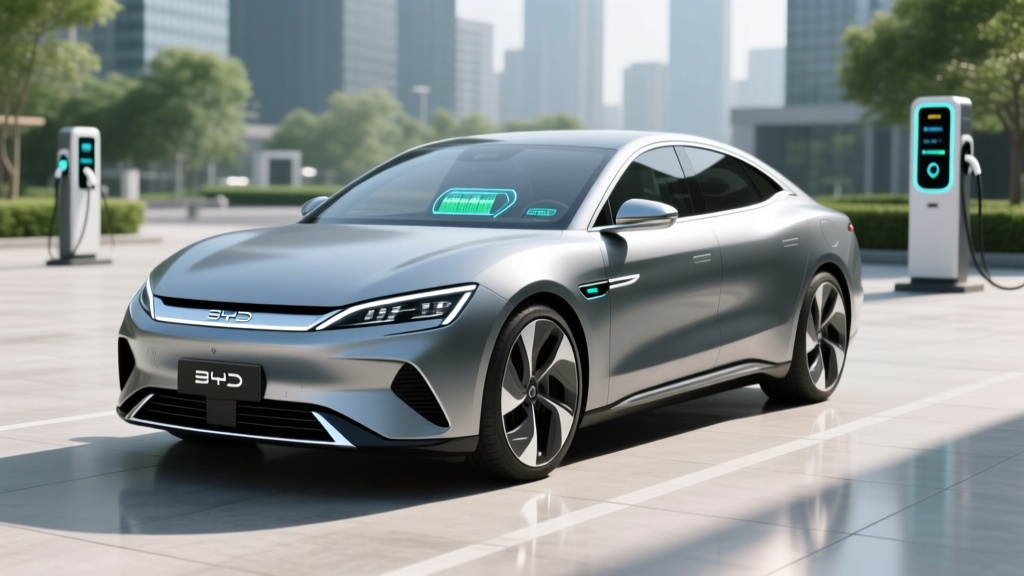
Deep Dive: BYD Seal — The Model Most Likely to Compete in the US
Of BYD's global lineup, the BYD Seal is the vehicle most frequently discussed as a potential US-market entrant. It competes directly with the Tesla Model 3 and Hyundai Ioniq 6 in the midsize electric sedan segment, and its pricing undercuts both when comparing global MSRPs.
| Battery: | 82.5 kWh usable, LFP (Blade Battery) |
| WLTP Range: | 355 miles (est. EPA ~300–310 mi) |
| Drivetrain: | RWD single-motor (Design) / AWD dual-motor (Excellence) |
| Horsepower: | 313 hp (RWD) / 530 hp (AWD) |
| 0-60 mph: | 5.9 sec (RWD) / 3.8 sec (AWD) |
| Max DC Charge Rate: | 150 kW peak |
| 10-80% DC Charge: | ~26 minutes |
| Level 2 Home Charge: | 11 kW (~35 mi/hr) |
| Cargo Volume: | 14.1 cu ft trunk (no frunk) |
| Global Base MSRP: | ~$36,000 USD equivalent |
Range and Efficiency: Real-World Expectations
WLTP sticker: 355 miles
Estimated EPA equivalent: ~300–310 miles
Real-world highway (70 mph, 75°F): ~260–280 miles
Real-world cold weather (30°F, mixed driving): ~210–240 miles
LFP chemistry holds voltage more consistently at low SoC but still suffers 15–25% range reduction in freezing temperatures. The Seal's heat pump (standard on most trims) helps mitigate cabin heating losses.
The Seal's efficiency runs approximately 28–30 kWh per 100 miles in mixed driving, which translates to roughly 112–120 MPGe — competitive with the Tesla Model 3 Long Range (132 MPGe EPA) but slightly behind the Hyundai Ioniq 6 SE Long Range (140 MPGe). The gap narrows in real-world highway driving where the Ioniq 6's lower drag coefficient (0.21 Cd vs the Seal's ~0.24 Cd) provides an aerodynamic advantage.
Charging Speed: The Seal's Notable Weakness
Here is where the cost of BYD cars starts to reveal a trade-off. The Seal's 150 kW peak DC fast-charge rate lags behind key competitors:
| Model | Peak DC kW | 10-80% Time | Mi Added in 15 min |
|---|---|---|---|
| BYD Seal | 150 kW | ~26 min | ~120 mi |
| Tesla Model 3 LR | 250 kW | ~18 min | ~175 mi |
| Hyundai Ioniq 6 LR | 240 kW | ~18 min | ~165 mi |
The 150 kW peak is a function of BYD's Blade Battery architecture, which uses LFP cells in a cell-to-body (CTB) structural pack. LFP cells inherently charge slower than NMC at high power levels due to their lower ionic conductivity at elevated C-rates. For daily Level 2 home charging, this is irrelevant — the Seal charges at 11 kW AC, adding roughly 35 miles of range per hour, which fully replenishes the 82.5 kWh pack in about 8 hours. But for road-trippers relying on DC fast charging, the 26-minute 10-80% session adds roughly 8 minutes per stop compared to a Model 3 or Ioniq 6.
Additionally, BYD uses CCS2 connectors in European markets and GB/T in China. A US-market Seal would need to adopt either the NACS (Tesla) connector or CCS1, and BYD has not confirmed which standard it would use. Given the industry's rapid migration to NACS (with Ford, GM, Rivian, and others adopting it), a US-spec BYD would likely need NACS compatibility to access the Supercharger network — currently the most reliable public charging infrastructure in the country.
The Battery Question: BYD's Blade Cell Advantage
BYD's single biggest technical differentiator is its proprietary Blade Battery — a lithium iron phosphate (LFP) cell in a long, thin form factor that passes nail-penetration tests without thermal runaway. This is not just a marketing claim; LFP chemistry is inherently more thermally stable than the nickel-manganese-cobalt (NMC) cells used in most long-range competitors.
| Factor | LFP (BYD Blade) | NMC (Typical) |
|---|---|---|
| Energy Density | Lower (~160 Wh/kg cell) | Higher (~220-260 Wh/kg cell) |
| Cycle Life | 3,000-5,000+ cycles | 1,000-2,000 cycles |
| Thermal Safety | Excellent (no thermal runaway in nail test) | Good (requires active management) |
| Cold-Weather Performance | Weaker (greater range loss below freezing) | Better (less range loss in cold) |
| SoC Recommendation | Can charge to 100% regularly | Best kept 20-80% for longevity |
| Cost per kWh | Lower (no cobalt/nickel) | Higher (commodity-sensitive) |
For ownership economics, the Blade Battery's cycle life is significant. At 3,000+ full charge cycles, a 300-mile-range BYD could theoretically travel 900,000 miles before reaching end-of-life battery degradation — far beyond any realistic vehicle lifespan. In practice, calendar aging and partial cycles mean you will likely see 85-90% capacity retention at 150,000 miles, which is excellent.
BYD typically offers an 8-year/100,000-mile battery warranty (or 8-year/125,000-mile in some markets) guaranteeing at least 70% capacity retention. This is comparable to the 8-year/100,000-mile federal minimum mandated for EVs sold in the US, though some competitors like Hyundai offer 10-year/100,000-mile coverage.
Tax Credits and Total Cost: Would a BYD Qualify?
This is where the cost of BYD cars hits a major roadblock for US buyers. Under current IRS §30D Clean Vehicle Credit rules, a new EV must meet all of the following to qualify for the full $7,500 federal tax credit:
- Final assembly in North America — BYD has no US or North American passenger-vehicle assembly plant
- MSRP caps: $55,000 for sedans; $80,000 for SUVs/pickups/vans
- Buyer income limits: AGI ≤ $150,000 (single) / $300,000 (joint)
- Battery component sourcing: Increasingly strict percentages must be manufactured/assembled in North America or FTA-partner countries
- Critical minerals: Required percentages must be sourced from the US or FTA partners — excluding "foreign entities of concern" (FEOC), which includes Chinese companies
Even if BYD launched a US-spec Seal at $36,000 MSRP, it would almost certainly fail the North American assembly requirement and the FEOC battery-sourcing rules. BYD manufactures its own batteries in China, making the critical-minerals and battery-component requirements impossible to meet under current law. The result: a BYD EV sold in the US would likely be ineligible for the $7,500 federal credit, erasing its headline price advantage against US-built competitors like the Tesla Model 3 ($38,990, credit-eligible) or the Hyundai Ioniq 6 (built in Georgia, credit-eligible).
This is the single biggest factor distorting the true cost of BYD cars for US buyers. A $36,000 Seal that cannot claim the $7,500 credit effectively costs $43,500 in after-tax-credit terms — putting it in direct competition with a Model 3 Long Range at $42,490 after credit, which offers faster charging, Supercharger access, and a proven US service network.
BYD vs US Competitors: Head-to-Head Value Comparison
To put the cost of BYD cars in perspective, here is how the Seal stacks up against its most direct US-market rivals on the metrics that matter for daily ownership:
| Spec | BYD Seal (Global) | Tesla Model 3 LR | Ioniq 6 SE LR |
|---|---|---|---|
| Base MSRP | ~$36,000* | $47,740 | $42,200 |
| After $7,500 Credit | ~$36,000 (ineligible) | $40,240 | $34,700 |
| EPA Range | ~300 mi (est.) | 363 mi | 361 mi |
| DC Fast Charge (Peak) | 150 kW | 250 kW | 240 kW |
| 10-80% Charge Time | ~26 min | ~18 min | ~18 min |
| Battery Chemistry | LFP (Blade) | NMC | NMC |
| 0-60 mph | 5.9 sec | 4.2 sec | 5.1 sec |
| US Service Network | None | Extensive | Dealer-based (broad) |
*BYD Seal pricing reflects global MSRP equivalent; no US MSRP exists as the vehicle is not sold in the United States.
The numbers tell a clear story: BYD's sticker-price advantage evaporates once you account for tax-credit ineligibility. The Ioniq 6 SE Long Range — with its EPA-rated 361 miles of range, 240 kW charging, and full $7,500 credit eligibility — lands at a lower effective price with dramatically better charging infrastructure compatibility.
Who Should Consider BYD — And Who Should Wait
The honest answer to "is a BYD worth buying?" depends entirely on your market access:
Choose a BYD (if available in your market) if:
- You live outside the US where BYD is sold directly with full warranty support
- You prioritize battery longevity and thermal safety over charging speed
- Your daily driving is under 100 miles and you charge primarily at home
- You want LFP chemistry for daily 100% charging without degradation concerns
Choose a US-market competitor instead if:
- You need federal tax credit eligibility to make the math work
- You take regular road trips and need fast DC charging + reliable public networks
- You want an established US service and parts network
- Range above 340 miles EPA is a priority (Model 3 LR and Ioniq 6 both deliver this)
For US-based buyers specifically, the practical recommendation is to monitor BYD's North American strategy but purchase from brands with current US availability. The EV market is moving fast, and waiting for a potential BYD launch means missing years of ownership savings on currently available, tax-credit-eligible vehicles.
Frequently Asked Questions
What is the real cost of BYD cars after taxes and fees?
Globally, BYD's passenger EVs range from roughly $22,000 (Dolphin) to $50,000 (Tang EV). However, in the US, these vehicles are not officially available for purchase. If imported or launched without North American assembly, they would be ineligible for the $7,500 federal tax credit, effectively increasing their cost by that amount relative to credit-eligible US competitors.
Does BYD qualify for the federal EV tax credit?
No. Under current IRS §30D rules, a vehicle must be assembled in North America and meet battery-sourcing requirements that exclude Chinese-manufactured components and critical minerals from "foreign entities of concern." BYD manufactures its vehicles and batteries in China, making credit eligibility virtually impossible under current law.
How fast do BYD cars charge at home and on the road?
At home on a Level 2 (240V) charger, the BYD Seal charges at up to 11 kW, adding approximately 35 miles of range per hour — a full charge from empty takes about 8 hours. On DC fast chargers, the Seal peaks at 150 kW, reaching 10-80% in roughly 26 minutes. This is slower than the Tesla Model 3 (250 kW, ~18 min) and Hyundai Ioniq 6 (240 kW, ~18 min).
Is BYD's Blade Battery better than competitors?
The Blade Battery's LFP chemistry offers superior cycle life (3,000-5,000+ cycles) and thermal safety compared to NMC cells. It can be charged to 100% regularly without accelerated degradation. The trade-off is lower energy density (resulting in heavier packs for the same range) and slower DC fast-charging speeds. For owners who prioritize long-term durability and home charging over road-trip charging speed, LFP is an excellent choice.
Will BYD launch passenger cars in the US?
BYD executives have expressed interest in entering the US consumer market, potentially through localized manufacturing to avoid tariffs and meet tax-credit sourcing requirements. As of 2026, no official timeline or US-spec models have been announced. The company is currently prioritizing expansion in Europe, Southeast Asia, and Latin America. Any US launch would likely require a dedicated factory or joint-venture partnership.
How does BYD range compare in real-world driving?
BYD publishes WLTP range figures, which are typically 10-15% higher than EPA estimates. The Seal's 355-mile WLTP rating would likely translate to approximately 300-310 miles EPA. In real-world highway driving at 70 mph, expect 260-280 miles. In freezing temperatures (30°F), LFP chemistry experiences greater range loss than NMC, reducing usable range to approximately 210-240 miles despite the Seal's standard heat pump.