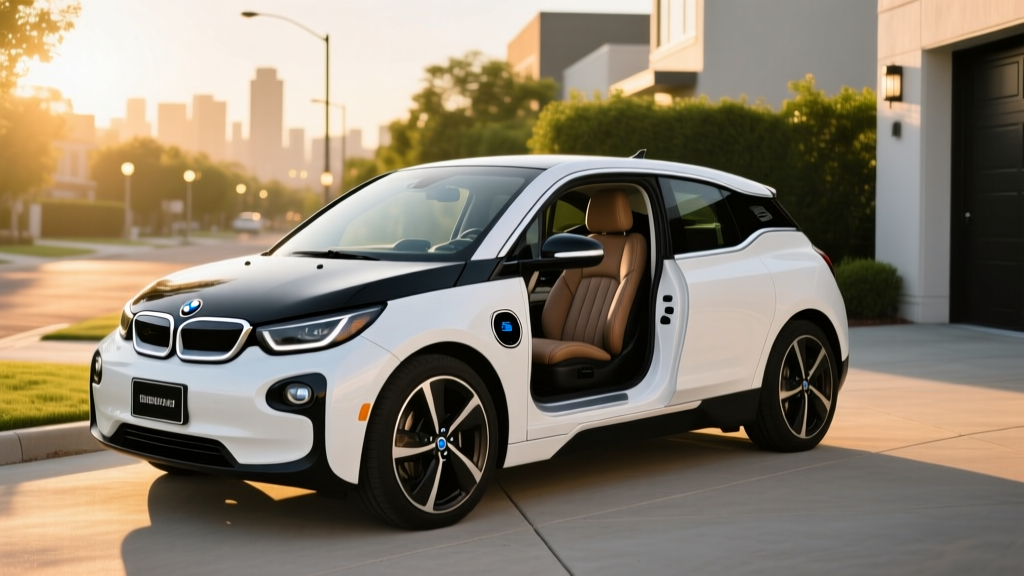
The BMW i3 remains one of the most distinctive electric vehicles ever built — a carbon-fiber city car with a futuristic interior made from recycled materials and a driving experience that still feels nimble in 2026. But with production ending in July 2022, anyone researching the cost of a BMW i3 today is navigating the used-EV market, where prices, battery health, and tax-credit eligibility work differently than with new models.
This guide breaks down what you'll actually spend to buy, charge, insure, and maintain a BMW i3 in 2026 — covering both the battery-electric (BEV) and the range-extender (REx) variants that BMW sold from 2014 through 2021 (in the U.S. market). If you're cross-shopping against a used Chevrolet Bolt, Nissan Leaf, or a new entry-level EV, the numbers below will help you decide whether the i3's quirky charm justifies its compromises.
What Does a BMW i3 Cost on the Used Market?
Because the i3 is no longer sold new, your purchase price depends entirely on model year, trim, battery size, mileage, and whether the car has the optional gasoline range extender. Here's where the market sits in early 2026 based on aggregated listing data from Autotrader, CarGurus, and Carvana:
| Model Year | Battery | Trim / Config | Typical Price Range | EPA Range (BEV) |
|---|---|---|---|---|
| 2014–2016 | 22 kWh (60 Ah) | Mega / Giga / Tera World | $9,000–$13,500 | 72–81 mi |
| 2017 | 33 kWh (94 Ah) | All trims | $12,500–$17,000 | 114 mi |
| 2018 | 33 kWh (94 Ah) | i3 / i3s | $14,000–$19,500 | 114 mi (i3) / 107 mi (i3s) |
| 2019–2021 | 42.2 kWh (120 Ah) | i3 / i3s | $18,000–$28,000 | 153 mi (i3) / 141 mi (i3s) |
The i3s variant (introduced for the 2018 model year) adds 14 horsepower, a sport suspension, wider tires, and a lower ride height — and typically commands a $2,000–$4,000 premium over a standard i3 of the same year. The REx (range extender) models, which pair the electric drivetrain with a 650cc two-cylinder BMW Motorrad gasoline engine, carry a $1,000–$2,500 premium over their pure-BEV counterparts.
Real-World Range: What the EPA Number Doesn't Tell You
EPA estimated: 153 miles (i3) / 141 miles (i3s)
Real-world highway (70 mph, mild weather): ~125–135 miles
Real-world city/mixed (moderate climate): ~140–155 miles
Cold-weather (below 32°F, heater on): ~95–115 miles
The i3 lacks a heat pump — it uses resistive cabin heating, which draws heavily from the 42.2 kWh battery in winter. Expect 25–35% range loss in sustained sub-freezing driving.
The i3's tall, narrow tires (155/70R19 on the base i3) reduce rolling resistance but also mean the car is optimized for city efficiency, not highway cruising. At 70+ mph, aerodynamic drag erodes range noticeably. For the earlier 22 kWh models, real-world range can dip to 50–60 miles in winter — making those early cars strictly fair-weather commuters unless you have reliable mid-day charging.
According to fueleconomy.gov, the 2021 BMW i3 achieves 124 MPGe combined (city 137 / highway 111), consuming roughly 27 kWh per 100 miles. The i3s drops slightly to 119 MPGe combined due to its wider tires and sport tuning.
Battery Chemistry, Capacity, and Degradation
Every BMW i3 uses NMC (nickel-manganese-cobalt) lithium-ion cells supplied by Samsung SDI. The battery packs evolved across three generations:
| Generation | Years (U.S.) | Usable Capacity | Cell Format | Noted Degradation |
|---|---|---|---|---|
| 60 Ah | 2014–2016 | 18.8 kWh | Prismatic NMC | 10–20% loss by 100k mi |
| 94 Ah | 2017–2018 | 27.2 kWh | Prismatic NMC | 8–15% loss by 80k mi |
| 120 Ah | 2019–2021 | 37.9 kWh | Prismatic NMC | 5–10% loss by 60k mi (early data) |
The i3's battery management system (BMS) is conservative — BMW built in a substantial buffer (roughly 10–15% of gross capacity is locked out) to protect long-term health. Most owners of the 120 Ah pack report State of Health (SoH) readings above 90% even at 50,000+ miles, which is encouraging for 2026 buyers.
If you're evaluating a used i3, ask the seller for a battery health report. BMW dealerships can pull a Battery Certificate showing current usable capacity. Third-party OBD2 apps like BimmerLink or Carly can also read the SoH value from the car's BMS — this is the single most important data point when buying a used i3.
Charging Speed: DC Fast, Level 2, and Level 1
Charging is where the i3 shows its age. By 2026 standards, its DC fast-charging speed is modest — but perfectly adequate for a city car that will mostly charge at home.
| Charging Level | Connector | Max Power | Speed / Time |
|---|---|---|---|
| Level 1 (120V household) | J1772 | ~1.4 kW | ~3–4 miles/hour; full charge ~28 hrs |
| Level 2 (240V home/public) | J1772 | 7.4 kW (single-phase) | ~22–25 miles/hour; 0–100% in ~5.5 hrs |
| DC Fast Charge | CCS1 (2015+ models) | 50 kW peak | 10–80% in ~38–42 min; tapers sharply above 80% |
Important CCS note: 2014 i3 models were built before the CCS standard was finalized in the U.S. and use a CHAdeMO DC fast-charge port instead. Starting with the 2015 model year, BMW switched to CCS1. If you're buying a 2014 model, verify which DC connector it has — CHAdeMO stations are increasingly rare on networks like Electrify America.
The 50 kW DC fast-charge peak is sustained only up to roughly 60% SoC, after which the charge curve tapers significantly. Plan on 10–80% taking about 40 minutes in ideal conditions (preconditioned battery, moderate ambient temperature). In cold weather without preconditioning, expect 50+ minutes.
The i3 does not support NACS (Tesla's connector) natively. You can use a CCS-to-NACS adapter at Tesla Superchargers that support non-Tesla vehicles, but confirm adapter compatibility — the i3's 50 kW peak means you won't take advantage of Supercharger speeds regardless.
Performance and Drivetrain
| Spec | i3 (120 Ah) | i3s (120 Ah) |
|---|---|---|
| Drivetrain | Rear-wheel drive (single motor) | Rear-wheel drive (single motor) |
| Horsepower | 170 hp | 184 hp |
| Torque | 184 lb-ft | 199 lb-ft |
| 0–60 mph | 6.9 seconds | 6.5 seconds |
| Top Speed | 93 mph (electronically limited) | 99 mph |
| Curb Weight | ~2,961 lbs | ~3,011 lbs |
The i3's carbon-fiber-reinforced plastic (CFRP) passenger cell keeps weight remarkably low for an EV — under 3,000 pounds for the base model. That lightness, combined with instant electric torque, makes the i3 genuinely quick off the line and exceptionally nimble in urban traffic. The 170-hp motor (or 184 in the i3s) feels more potent than the numbers suggest because there's so little mass to move.
On the highway, the i3 runs out of breath past 75 mph, and the thin tires generate noticeable road noise. This is a car engineered for urban efficiency, not interstate cruising. The turning circle of 32.3 feet is outstanding — tighter than many compact hatchbacks — making parking a non-issue.
Interior, Cargo, and Technology
The i3's interior was radical in 2014 and still looks futuristic in 2026. BMW used renewable and recycled materials throughout: eucalyptus wood dash trim, recycled PET bottle fabrics, and natural-fiber door panels. The result is an airy, minimalist cabin that feels nothing like a conventional BMW.
Practical dimensions matter for daily use:
- Cargo volume (behind rear seats): 15.1 cu ft
- Cargo volume (rear seats folded): 51.0 cu ft
- Front headroom: 40.3 inches
- Front legroom: 40.5 inches
- Rear headroom: 37.6 inches
- Rear legroom: 31.9 inches (tight for adults on longer trips)
The rear-hinged "coach doors" (suicide doors) look dramatic but require the front door to be opened first, and there's no B-pillar for structural rigidity — the CFRP cell handles that. In practice, the rear seats are best suited for children or occasional adult passengers on short trips.
On the tech front, 2019–2021 models received BMW's iDrive 6.0 system with a 10.25-inch touchscreen, Apple CarPlay (wireless), and a navigation system with an EV-specific range assistant that factors in terrain, traffic, and climate use. Earlier models run iDrive 5.0 or older with a smaller display. No i3 was ever sold with Android Auto from the factory — a notable omission for 2026 buyers.
Driver-assistance features are basic by modern standards: available Active Driving Assistant (forward collision warning, automatic emergency braking, lane departure warning) and adaptive cruise control on higher trims. There is no Level 2+ hands-free system — this is conventional SAE Level 1 assistance at best.
Federal and State Tax Credits: What Applies in 2026?
Since the BMW i3 is only available used, the new-vehicle §30D credit ($7,500) does NOT apply. Instead, buyers may qualify for the §25E Previously Owned Clean Vehicle Credit, which provides 30% of the sale price, up to a maximum of $4,000.
Requirements per IRS §25E rules:
- Sale price must be $25,000 or less
- Vehicle must be at least 2 model years old (all i3s qualify)
- Buyer income caps: $75,000 single / $112,500 head of household / $150,000 joint
- Must purchase from a licensed dealer (private-party sales excluded)
- Credit is applied at point of sale or claimed on your tax return
- Can only be claimed once per VIN (check vehicle history)
Here's what that looks like in practice for common i3 purchase scenarios:
| Scenario | Dealer Price | Max §25E Credit | Effective Cost |
|---|---|---|---|
| 2017 i3 (94 Ah), 65k miles | $15,500 | $4,000 | $11,500 |
| 2019 i3 (120 Ah), 40k miles | $22,000 | $4,000 | $18,000 |
| 2021 i3s (120 Ah), 20k miles | $26,500 | $0 (over $25k cap) | $26,500 |
| 2020 i3 REx (120 Ah), 35k miles | $24,000 | $4,000 | $20,000 |
Note that many well-equipped 2020–2021 i3s and i3s models list above $25,000, which disqualifies them from the §25E credit entirely. Negotiating the dealer price to or below $25,000 can unlock the full $4,000 credit — a significant leverage point during purchase.
Some states offer additional used-EV rebates (California's CVRP used-EV rebate, Colorado's used-EV tax credit, etc.), but these vary by jurisdiction, change frequently, and may have their own income and price caps. Check your state energy office or DMV for current programs.
Ownership Costs: Charging, Insurance, and Maintenance
Charging cost: With the national average residential electricity rate around $0.17/kWh (EIA, 2025 data), fully charging the 42.2 kWh pack costs roughly $7.17. At the i3's efficiency of 27 kWh/100 mi, that works out to about $0.046 per mile — roughly one-third the per-mile fuel cost of a comparable gas-powered BMW 2 Series.
Insurance: The i3 is moderately expensive to insure relative to its value, partly because CFRP body repairs require specialized BMW-certified shops. Expect annual premiums of $1,400–$2,200 depending on your state, driving record, and coverage level (based on average quotes from Geico, Progressive, and State Farm for a 2020 i3).
Maintenance: This is where the i3 rewards owners. There's no engine oil, no transmission fluid, no spark plugs, and no emissions system to service (on BEV models). Brake pads last well past 80,000 miles thanks to aggressive regenerative braking. BMW recommends cabin air filter replacement every ~2 years and brake fluid service every 2 years. Budget $200–$400/year for routine maintenance.
REx maintenance caveat: The range-extender models add a gasoline engine that requires oil changes, fuel filter replacement, and occasional spark plug service. If the REx engine rarely runs, BMW still recommends an annual oil change to prevent fuel system degradation from stale gasoline.
Battery warranty: BMW provided an 8-year / 100,000-mile high-voltage battery warranty guaranteeing at least 70% of original capacity. For 2014–2017 models, that 8-year window has now expired. For 2018–2021 models, the warranty is either expired or nearing expiration in 2026. A replacement i3 battery pack (if needed out of warranty) runs approximately $12,000–$16,000 including labor at a BMW dealer — a cost that can exceed the car's value on older models.
Pros and Cons
✅ Pros
- Extremely low running costs (charging + maintenance)
- Unique, premium interior with sustainable materials
- Tight turning circle and nimble city handling
- CFRP construction resists rust — no steel body panels to corrode
- Strong regenerative braking enables near one-pedal driving
- §25E credit can drop effective price below $12k on earlier models
- Excellent visibility and easy parking
❌ Cons
- Limited range — 153 mi max EPA, far less in cold or highway driving
- Slow DC fast charging (50 kW peak) by 2026 standards
- Rear coach doors are impractical in tight parking spaces
- Rear seat legroom (31.9 in) is tight for adults
- No Android Auto support from factory
- Expensive out-of-warranty battery replacement ($12k–$16k)
- Thin tires are expensive to replace and limit wet-weather grip
- No heat pump — significant winter range loss
Who Should Buy a BMW i3 in 2026?
- Commute fewer than 50 miles round-trip and can charge at home
- Want a premium, distinctive city car that's cheap to run
- Live in a mild climate (or have a garage to minimize cold-weather range loss)
- Don't regularly carry adult rear-seat passengers
- Value low maintenance and low per-mile energy costs
- Want a second car for errands and commuting, not road trips
The i3 is not the right choice if you need highway range for road trips, regularly carry four adults, live in a region with extreme winters and no garage charging, or want modern ADAS features like hands-free highway driving. In those cases, a used Chevrolet Bolt EV (238–259 mi range, more cargo space), a used Tesla Model 3 (250+ mi range, Supercharger access), or a new Hyundai Kona Electric (261 mi range, full warranty) may serve you better — though none match the i3's urban charm or material quality per dollar.
Frequently Asked Questions
What is the real-world range of a BMW i3?
For the 2019–2021 i3 with the 42.2 kWh (120 Ah) battery, expect 125–135 miles on the highway in mild weather and 140–155 miles in mixed city driving. In sustained cold below freezing, range drops to roughly 95–115 miles due to resistive cabin heating and reduced battery efficiency. The earlier 22 kWh models manage only 50–70 real-world miles depending on conditions.
How fast does the BMW i3 charge at home and on DC fast chargers?
On a Level 2 home charger (240V, 32A), the i3 charges at up to 7.4 kW, adding about 22–25 miles of range per hour — a full charge takes roughly 5.5 hours. On a DC fast charger, it peaks at 50 kW (CCS1 on 2015+ models), reaching 10–80% in approximately 38–42 minutes with a preconditioned battery. This is slow compared to modern EVs that charge at 150–350 kW.
Does the BMW i3 qualify for any federal tax credit?
The new-vehicle §30D credit does not apply since the i3 is discontinued. However, the §25E Used Clean Vehicle Credit offers 30% of the sale price up to $4,000 — provided the dealer sale price is $25,000 or less, your income falls within IRS caps ($75k single / $150k joint), and the credit hasn't already been claimed on that VIN. Always verify eligibility with a tax professional before purchase.
Is the BMW i3 expensive to maintain?
No — the BEV i3 is one of the cheapest EVs to maintain. There are no oil changes, no transmission service, and brake pads last well beyond 80,000 miles thanks to regenerative braking. Budget $200–$400 annually for cabin filters, wiper fluid, tire rotation, and brake fluid. The REx (range-extender) models add modest engine maintenance costs.
Should I buy the i3 BEV or the i3 REx (range extender)?
If your daily driving stays within the battery's range and you have reliable home charging, the pure BEV is simpler, lighter, and cheaper to maintain. The REx makes sense only if you occasionally need 200+ miles of range and don't have access to DC fast charging along your route. Note that the REx's two-cylinder engine is noisy, adds weight, and requires gasoline-engine maintenance.
How long will a BMW i3 battery last?
BMW's NMC cells in the i3 have proven durable. Owners of 120 Ah (2019–2021) models commonly report 90%+ State of Health at 50,000 miles. The battery should deliver 150,000+ miles before degradation becomes a practical concern — but if replacement is needed out of warranty, expect to pay $12,000–$16,000. Always request a Battery Certificate or OBD2 SoH reading before purchasing a used i3.