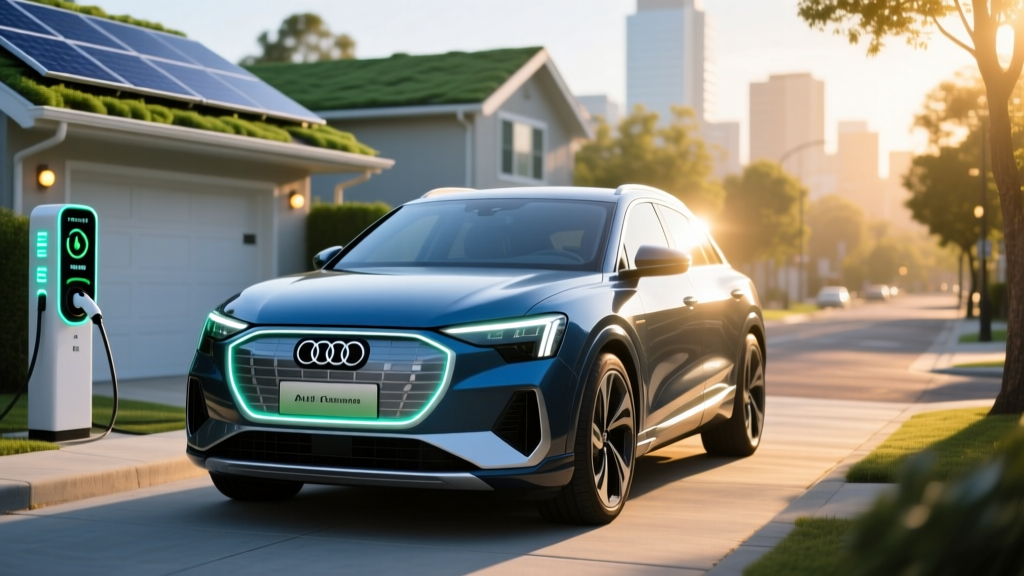
If you are researching the cost of an Audi electric car, the sticker price is only the beginning. Audi's current EV lineup — anchored by the 2026 Q4 e-tron compact SUV and the performance-focused e-tron GT — spans from the mid-$50,000s to well over $100,000. But purchase price alone doesn't tell you what you'll actually spend (or save) over five years of ownership. This guide runs the real numbers: federal tax credits, home and public charging costs, insurance premiums, maintenance savings, and the depreciation curve that has reshaped the luxury EV market.
Audi's 2026 EV Lineup: Prices and Specs at a Glance
Before calculating ownership costs, here is what Audi currently offers in the U.S. market for the 2026 model year. All figures are EPA-published or manufacturer-confirmed.
| Model | Base MSRP | Battery (usable kWh) | EPA Range | Peak DC Charge | 10–80% Time | 0–60 mph | HP |
|---|---|---|---|---|---|---|---|
| Q4 e-tron (Premium) | $51,495 | 77 kWh (NMC) | 265 mi | 175 kW | ~28 min | 7.9 sec | 201 |
| Q4 e-tron quattro | $56,495 | 77 kWh (NMC) | 242 mi | 175 kW | ~28 min | 5.8 sec | 295 |
| e-tron GT quattro | $80,195 | 85 kWh (NMC) | 270 mi | 270 kW | ~22 min | 3.9 sec | 522 |
| RS e-tron GT performance | $126,495 | 85 kWh (NMC) | 256 mi | 270 kW | ~22 min | 2.5 sec | 912 |
5-Year Total Cost of Ownership: Audi Q4 e-tron vs. Gas Rival
To make the cost of an Audi electric car concrete, we compare the most accessible model — the 2026 Q4 e-tron quattro (MSRP $56,495) — against a similarly equipped luxury gas SUV, the Audi Q5 45 TFSI quattro (MSRP ~$52,295). Both are all-wheel-drive compact luxury crossovers. We assume 15,000 miles/year, 5 years of ownership, and a home Level 2 charger for the EV.
| Cost Category | Q4 e-tron quattro (EV) | Q5 45 TFSI quattro (Gas) |
|---|---|---|
| Purchase Price (MSRP) | $56,495 | $52,295 |
| Federal Tax Credit (§30D) | −$3,750 to $7,500* | $0 |
| Effective Purchase Price | $48,995 – $52,745 | $52,295 |
| Fuel / Charging (5 yrs, 75,000 mi) | $4,125 – $6,375 | $9,375 |
| Maintenance (5 yrs) | $1,800 | $4,500 |
| Insurance (5 yrs avg.) | $12,750 | $9,500 |
| Estimated Depreciation | $22,600 (40%) | $18,300 (35%) |
| 5-Year TCO (est.) | $90,270 – $96,270 | $93,970 |
*Tax credit amount depends on battery sourcing compliance, buyer income, and point-of-sale election. See eligibility details below.
The Q4 e-tron can break even with — or beat — the gas Q5 on total cost, but only if you qualify for a substantial tax credit and charge primarily at home. Public DC fast charging at $0.40–$0.60/kWh erodes the fuel-cost advantage significantly. We detail each line item below.
Federal Tax Credit: Do You Qualify for §30D?
The IRS §30D Clean Vehicle Credit offers up to $7,500 for new EVs, but the actual amount you receive depends on a web of requirements that tightened considerably under current rules. As of 2026, the credit splits into two halves: $3,750 for meeting critical-mineral sourcing thresholds and $3,750 for battery-component manufacturing requirements. Many Audi models currently qualify for only one half ($3,750) because some battery materials are sourced from entities that don't meet the domestic or free-trade-agreement criteria.
- Income caps: Modified AGI ≤ $150,000 (single), $225,000 (head of household), $300,000 (married filing jointly)
- MSRP caps: ≤ $80,000 for SUVs/pickups/vans (Q4 e-tron qualifies); ≤ $55,000 for sedans (e-tron GT does NOT qualify)
- Battery sourcing: Critical minerals and components must meet phased-in percentage thresholds from U.S. or FTA partners — check the DOE/FuelEconomy credit tracker for current eligibility by VIN
- Point-of-sale transfer: You can elect to transfer the credit to the dealer at purchase, reducing your out-of-pocket cost immediately — but you must still meet income limits at tax-filing time or repay the credit
- No prior transfer: The vehicle's VIN must not have been used for a prior §30D credit claim
For the Q4 e-tron (classified as an SUV, under the $80,000 MSRP cap), buyers within the income limits can potentially claim $3,750 or $7,500 depending on the specific model year's battery compliance. The e-tron GT, priced well above $55,000 and classified as a sedan, does not qualify for the new-vehicle credit at all. Always verify current eligibility on fueleconomy.gov before relying on the credit in your budget.
Charging Costs: Home vs. Public, kWh Math That Matters
Understanding the cost of an Audi electric car requires separating kW (charging power, or how fast energy flows) from kWh (energy capacity, or how much the battery holds). The Q4 e-tron's 77 kWh battery holds 77 kilowatt-hours of usable energy. You pay per kWh, not per kW.
The Q4 e-tron quattro achieves approximately 87 MPGe combined, consuming roughly 39 kWh per 100 miles (source: EPA/FuelEconomy.gov). The Q5 45 TFSI gets about 25 MPG combined.
| Scenario | Cost per kWh / Gallon | Cost per Mile | Annual Cost (15,000 mi) |
|---|---|---|---|
| Home L2 charging (nat'l avg.) | $0.16/kWh | $0.062 | $930 |
| Home L2 (high-cost state, e.g., CA) | $0.28/kWh | $0.109 | $1,635 |
| Public DC fast charging | $0.45/kWh | $0.176 | $2,640 |
| Gas (Q5, 25 MPG, $3.50/gal) | $3.50/gallon | $0.140 | $2,100 |
| Gas (Q5, 25 MPG, $4.50/gal) | $4.50/gallon | $0.180 | $2,700 |
At national-average residential electricity rates, the Q4 e-tron costs roughly $0.06 per mile to fuel — less than half the gas Q5. But if you rely heavily on public DC fast chargers (Electrify America, EVgo, etc.), the EV's per-mile cost can equal or exceed gasoline. The financial case for an Audi EV hinges on reliable home charging access.
For the e-tron GT's 85 kWh battery, a full 10–100% home charge costs approximately $12.30 at $0.16/kWh or $21.25 at $0.28/kWh. Its lower efficiency (~42 kWh/100 mi) means higher per-mile costs than the Q4 e-tron across all scenarios.
Maintenance Savings: Where EVs Genuinely Cost Less
Audi EVs eliminate several recurring service items that gas-vehicle owners take for granted. Battery electric vehicles have no engine oil, no transmission fluid to flush, no spark plugs, no timing belts, and no exhaust systems. Regenerative braking dramatically reduces brake-pad wear — many EV owners report original brake pads lasting 80,000+ miles.
| Service Item | Q4 e-tron (EV) | Q5 (Gas) |
|---|---|---|
| Oil Changes | None — $0 | 7–10 changes — $700–$1,200 |
| Brake Pad Replacement | Likely none (regen) — $0 | 1–2 sets — $400–$800 |
| Transmission Fluid | None — $0 | 1 service — $200–$350 |
| Engine Air Filter | None — $0 | 2–3 replacements — $100–$200 |
| Cabin Air Filter | 2–3 replacements — $150–$250 | 2–3 replacements — $150–$250 |
| Tire Rotation / Replacement | Rotations + 1 set tires — $1,200 | Rotations + 1 set tires — $1,100 |
| Coolant / Brake Fluid | Periodic check — $100–$200 | Flushes — $200–$400 |
| Total Estimated | ~$1,800 | ~$4,500 |
The roughly $2,700 maintenance savings over five years is one of the most reliable financial advantages of EV ownership. Note that EV tires may wear slightly faster due to higher vehicle weight and instant torque — budget accordingly. Audi's EV battery warranty covers 8 years / 100,000 miles against defects and excessive capacity loss (below 70% state of health), which provides long-term peace of mind.
Insurance Costs: The Uncomfortable Reality
Insuring an Audi electric car typically costs 20–40% more than an equivalent gas model. Several factors drive this:
- Higher repair costs: EV battery packs and high-voltage components are expensive to replace after collision damage. Even minor rear-end impacts can trigger battery-safety inspections costing thousands.
- Specialized labor: Fewer body shops have high-voltage certification, limiting repair-network options and raising labor rates.
- Vehicle price: The Q4 e-tron and e-tron GT carry higher MSRPs than their gas siblings, increasing comprehensive and collision premiums.
- Claims data: Industry data from the Highway Loss Data Institute (HLDI) has consistently shown higher average claim severity for EVs.
For the Q4 e-tron quattro, expect average annual premiums of approximately $2,400–$2,700 depending on your state, driving record, and coverage levels, versus $1,800–$2,000 for the Q5. That's roughly $600–$800 more per year, or $3,000–$4,000 over five years. Always get personalized quotes from at least three insurers before purchasing — some carriers now offer EV-specific policies with battery-replacement riders that can improve value.
Depreciation and Resale Value: What Audi EVs Are Worth Later
EV depreciation has been one of the most volatile variables in ownership cost. Between 2023 and 2025, the used-EV market experienced significant price corrections driven by Tesla's aggressive new-car price cuts, expanding EV inventory, and shifting consumer sentiment. Audi EVs were not immune.
Current 5-year depreciation estimates for Audi's EV lineup:
- Q4 e-tron: ~38–45% over 5 years (slightly worse than the Q5 gas at ~32–38%)
- e-tron GT: ~45–55% over 5 years (luxury performance EVs depreciate steeply, similar to the Porsche Taycan)
Several factors influence resale: battery health documentation (buyers want verified state-of-health reports), remaining warranty coverage, and whether newer models offer substantially more range or faster charging. The Q4 e-tron's 265-mile EPA range is competitive but not class-leading — this may pressure resale values as rivals push past 300 miles.
One positive: Audi's 8-year/100,000-mile battery warranty transfers to second owners, which supports resale confidence. If you plan to keep your Audi EV for 8+ years, depreciation becomes less relevant to your personal TCO calculation.
State, Local, and Utility Incentives
- State EV rebates: Some states offer $1,000–$5,000 purchase rebates or tax credits (e.g., California, Colorado, Massachusetts, New York). Income-based tiers often apply.
- Utility charging rebates: Many electric utilities offer $250–$1,000 rebates for Level 2 home charger purchase and installation, plus off-peak charging rate discounts.
- HOV lane access: Several states grant EVs access to carpool lanes regardless of occupancy — a significant time-value benefit in congested metros.
- Reduced registration fees: A handful of states offer lower annual EV registration, though many now impose higher EV registration fees to offset lost gas-tax revenue.
Who Comes Out Ahead on the Cost of an Audi Electric Car?
- You have reliable home Level 2 charging (garage or driveway with 240V access)
- You qualify for at least $3,750 in federal tax credits (check income and battery-sourcing rules)
- Your daily commute is under 100 miles round-trip (well within the 242-mile real-world range)
- You value lower maintenance costs and want to hedge against gasoline price volatility
- You plan to keep the vehicle 5+ years, reducing depreciation impact
- You live in an apartment or lack home charging access and would rely on public DC fast charging
- Your income exceeds §30D caps, eliminating the federal credit
- You frequently drive 300+ miles in a single day in cold climates
- You prioritize lowest insurance premiums and strongest resale value
- You're considering the e-tron GT — it doesn't qualify for §30D, and insurance/depreciation are steep
The cost of an Audi electric car ultimately depends on your specific situation: your electricity rate, your tax bracket, your driving patterns, and your access to home charging. For the right buyer — one who charges at home, qualifies for incentives, and drives moderate daily distances — the Q4 e-tron can match or beat its gas counterpart on 5-year total cost while delivering a quieter, smoother, and quicker driving experience.
Frequently Asked Questions
How much does it really cost to own an Audi Q4 e-tron over 5 years?
Between approximately $90,000 and $96,000 in total cost of ownership over five years (including purchase, charging, insurance, maintenance, and depreciation), depending on your tax credit eligibility and electricity rates. This is roughly comparable to — or slightly better than — the gas Q5 at ~$94,000, provided you charge primarily at home and qualify for federal incentives.
Does the Audi e-tron GT qualify for the federal tax credit?
No. The e-tron GT's MSRP exceeds the $55,000 sedan cap under IRS §30D rules, and it is classified as a sedan rather than an SUV. Only the Q4 e-tron (under the $80,000 SUV cap) is potentially eligible, and even then the actual credit amount ($3,750 or $7,500) depends on battery-sourcing compliance and your income level.
How much do I save on fuel by driving an Audi EV?
At national average electricity rates ($0.16/kWh) and gasoline prices ($3.50/gallon), the Q4 e-tron saves roughly $1,000–$1,200 per year versus the gas Q5. Over five years, that's $5,000–$6,000 in fuel savings. However, if you rely on public DC fast charging at $0.45/kWh, savings shrink to near zero or become negative.
Are Audi electric cars more expensive to insure?
Yes. Expect to pay approximately 20–40% more for insurance on a Q4 e-tron versus a Q5, translating to roughly $600–$800 additional per year. Higher repair costs, specialized labor requirements, and the vehicle's MSRP all contribute. Shop quotes from multiple insurers — some offer EV-specific policies.
How well do Audi EVs hold their value?
The Q4 e-tron is estimated to depreciate roughly 38–45% over five years, slightly worse than the gas Q5 at 32–38%. The e-tron GT depreciates more steeply at 45–55%. Battery health documentation, remaining warranty, and competitive range all influence resale. Keeping the vehicle beyond 5 years reduces depreciation's impact on your personal TCO.
What about the Audi Q8 e-tron?
Audi discontinued the Q8 e-tron (formerly just "e-tron") in the U.S. market after the 2024 model year due to slow sales. If you find one as a used or certified pre-owned vehicle, it may qualify for the used EV tax credit (§25E, up to $4,000) if it meets price, income, and prior-ownership requirements. Check the IRS used-EV credit page for details.