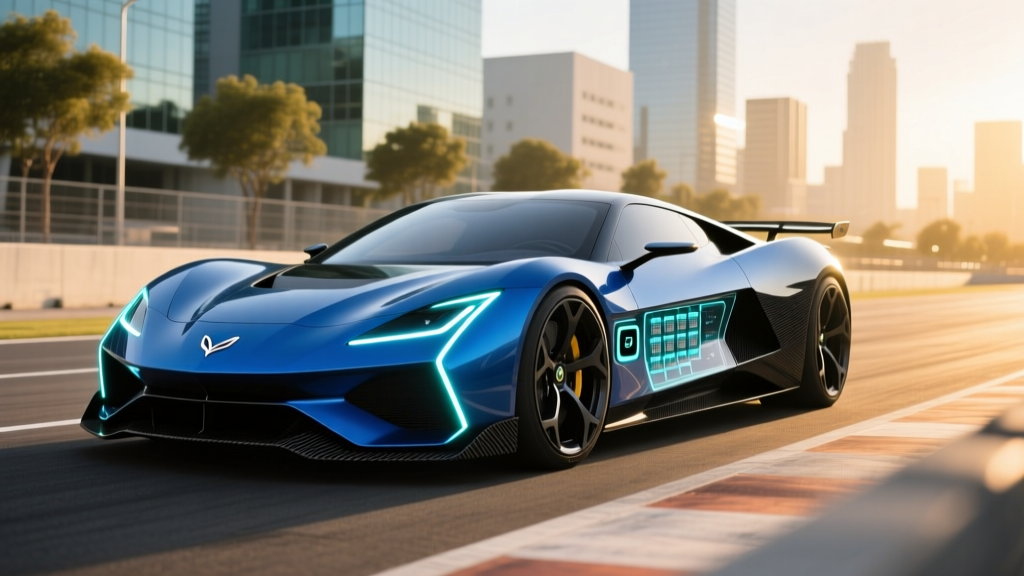
If you're searching for a production-ready electric Corvette you can buy today, the honest answer is that one does not yet exist. Chevrolet has not announced a battery-electric Corvette for sale as of early 2026. What does exist are Corvette electric hypercar concepts and design studies — most notably the internal GM concepts and renderings that have circulated since 2022, alongside the E-Ray hybrid (a gasoline V8 paired with an electric front axle). If you want electrified Corvette performance now, the 2025–2026 Corvette E-Ray is the closest production option, starting around $106,000 with 655 combined horsepower and a mild electric assist. A fully electric Corvette, if it arrives, will likely target the 2028+ timeframe based on GM's Ultium platform trajectory and statements from Corvette chief engineer Tadge Juechter.
What Are the Corvette Electric Hypercar Concepts?
The term "Corvette electric hypercar concepts" generally refers to a cluster of design exercises and speculative studies rather than a single revealed vehicle. The most prominent include:
- GM internal design studies (2022–2024): General Motors has confirmed internally exploring an electric Corvette, leveraging the Ultium battery platform. These were not publicly unveiled as formal concept cars at auto shows but were referenced in executive interviews and patent filings.
- Third-party renderings and speculative designs: Automotive designers and publications have produced numerous "electric Corvette" renderings, often imagining a low-slung, quad-motor layout with 1,000+ horsepower. None of these are official GM products.
- Chevrolet Corvette E-Ray (production, not a concept): The E-Ray, introduced for the 2024 model year and continuing into 2026, is a hybrid — not a full EV. It pairs the 6.2L LT2 V8 (495 hp) with a front-axle electric motor (160 hp) for 655 combined hp and standard all-wheel drive. It cannot drive on electric power alone for meaningful distances; the small ~1.9 kWh battery provides torque fill and AWD traction, not standalone EV range.
GM CEO Mary Barra has stated that the Corvette brand will eventually go electric, but no timeline has been committed. The current mid-engine C8 architecture was engineered primarily around internal combustion, making a full EV conversion of the existing platform unlikely. A future electric Corvette would almost certainly ride on a dedicated EV platform.
Estimated Specs: If an Electric Corvette Arrives
While no official specs exist, we can make informed projections based on GM's Ultium platform capabilities (as seen in the GMC Hummer EV, Cadillac Lyriq, and Chevrolet Silverado EV) and the competitive landscape of electric hypercars and supercars:
| Specification | Electric Corvette (Projected/Speculative) | 2026 Corvette E-Ray (Confirmed) |
|---|---|---|
| Powertrain | Dual- or tri-motor AWD (Ultium-based) | 6.2L V8 + front electric motor (AWD) |
| Combined Horsepower | 800–1,100 hp (est.) | 655 hp |
| 0–60 mph | ~2.0–2.5 seconds (est.) | 2.5 seconds (manufacturer) |
| Battery Capacity | 85–120 kWh usable (est.) | ~1.9 kWh (hybrid assist only) |
| Battery Chemistry | NMC (Ultium pouch cells) | N/A (lithium-ion hybrid pack) |
| EPA Range | 250–350 miles (est., if optimized for range) | Not rated for EV-only; ~450 mi total gas range |
| DC Fast Charge (peak) | 200–350 kW (est., 800V architecture possible) | No DC charging (hybrid, no plug) |
| 10–80% Charge Time | ~18–25 minutes (est.) | N/A — self-charging hybrid |
| Estimated Base MSRP | $120,000–$200,000+ (if produced) | $106,595 (1LZ coupe, 2025 MSRP) |
| Federal §30D Tax Credit | Likely ineligible (MSRP cap for sedates is $55K; performance vehicles face sourcing hurdles) | Not eligible (hybrid, not a PHEV with ≥4 mi EV range) |
Key takeaway on range: A performance-oriented electric Corvette would likely prioritize power delivery and handling over maximum range. Expect an EPA rating in the 250–350 mile band, with real-world highway driving yielding roughly 200–280 miles — especially at sustained high speeds where aerodynamic drag and energy consumption spike. Cold-weather testing on similar Ultium vehicles shows a 15–30% range reduction in freezing temperatures.
How Does an Electric Corvette Compare to Gas and Existing EV Rivals?
The competitive set for a potential electric Corvette spans both traditional supercars and emerging electric performance cars. Here's how the landscape looks in 2026:
| Vehicle | Powertrain | Horsepower | 0–60 mph | EPA Range / Fuel Economy | Base MSRP |
|---|---|---|---|---|---|
| Electric Corvette (projected) | BEV (AWD) | 800–1,100 hp | ~2.0–2.5s | ~250–350 mi | $120K–$200K+ |
| 2026 Corvette Z06 | 5.5L flat-plane V8 (RWD) | 670 hp | 2.6s | 15/27 mpg (EPA) | $115,895 |
| 2026 Corvette E-Ray | V8 hybrid (AWD) | 655 hp | 2.5s | 19/25 mpg (EPA est.) | $106,595 |
| Tesla Model S Plaid | Tri-motor BEV (AWD) | 1,020 hp | 1.99s | 396 mi | $89,990 |
| Lucid Air Sapphire | Tri-motor BEV (AWD) | 1,234 hp | 1.89s | 427 mi | $249,000 |
| Porsche Taycan Turbo GT | Dual-motor BEV (AWD) | 1,019 hp (Launch Control) | 2.1s | 269 mi | $230,000 |
| Rimac Nevera | Quad-motor BEV (AWD) | 1,914 hp | 1.85s | ~340 mi (WLTP) | $2,200,000 |
The data reveals a tension: EVs like the Model S Plaid and Lucid Air Sapphire already deliver hypercar-level acceleration at a fraction of the projected electric Corvette cost. However, neither offers the Corvette's mid-engine proportions, lightweight sports-car dynamics, or brand heritage. A future electric Corvette would need to differentiate on handling, weight distribution, and driving engagement — not just straight-line speed, which EVs have commoditized.
Real Ownership Costs: What Would an Electric Corvette Actually Cost to Run?
Let's model a realistic 5-year ownership scenario for a hypothetical electric Corvette priced at $150,000, compared to the current Z06 and E-Ray. These projections use fueleconomy.gov data for gas vehicles and average U.S. electricity rates.
| Cost Category | Electric Corvette ($150K est.) | Corvette Z06 ($115,895) | Corvette E-Ray ($106,595) |
|---|---|---|---|
| Purchase Price | $150,000 | $115,895 | $106,595 |
| Federal Tax Credit (§30D) | $0 (likely MSRP/income ineligible) | $0 | $0 |
| Energy/Fuel (60K mi) | ~$4,500 (30 kWh/100mi × $0.15/kWh avg) | ~$14,400 (18 mpg avg × $3.60/gal) | ~$12,000 (22 mpg avg × $3.60/gal) |
| Maintenance (5 yr) | ~$2,500 (tires, cabin filter, fluid top-offs) | ~$6,000 (oil, brakes, belts, tires) | ~$5,500 (similar to Z06, less brake wear from regen) |
| Insurance (5 yr avg) | ~$22,000 ($4,400/yr — high-value EV) | ~$16,000 ($3,200/yr) | ~$15,000 ($3,000/yr) |
| Estimated Depreciation (5 yr) | ~$67,500 (45% — EV depreciation risk) | ~$40,500 (35% — strong Corvette resale) | ~$37,300 (35%) |
| Total 5-Year Cost | ~$246,500 | ~$192,795 | ~$176,395 |
Energy savings are real but don't offset the premium. An electric Corvette would save roughly $8,000–$10,000 in fuel over 5 years compared to the Z06. However, higher insurance premiums (EVs typically cost 15–25% more to insure due to battery replacement risk and specialized repair requirements) and steeper projected depreciation erase those gains. Corvette gas models hold value exceptionally well — a dynamic that an unproven electric variant would need years to establish.
Charging Reality: What Owners Would Actually Face
If GM builds an electric Corvette on an 800V-capable Ultium derivative, charging would likely mirror the Silverado EV or a future performance platform:
| Charging Level | Power (kW) | Miles Added Per Hour | Typical Use Case |
|---|---|---|---|
| Level 1 (120V household) | ~1.4 kW | ~3–4 mi/hr | Emergency/trickle only |
| Level 2 (240V home, 48A) | ~11.5 kW | ~30–35 mi/hr | Overnight home charging (~8–10 hr for full) |
| DC Fast Charge (peak) | ~250–350 kW | ~600–900 mi/hr (at peak) | Road trips; 10–80% in ~18–25 min |
Home charging is essential for a performance EV. Public DC fast charging works for road trips, but daily use demands a Level 2 home charger. Installation costs for a 240V/48A circuit typically run $800–$2,500 depending on panel capacity and distance from the electrical panel. Homes with older 100-amp panels may need a $2,000–$4,000 panel upgrade to support simultaneous EV charging and household loads.
Charging curve reality: Peak DC charge rates (e.g., 350 kW) are only sustained at low state-of-charge (SoC), typically between 10–40%. Above 80% SoC, charge speed tapers dramatically to protect the battery. A "10–80% in 18 minutes" claim does not mean a full 0–100% charge takes 25 minutes — the final 20% can take an additional 20–30 minutes.
Common Misconceptions About an Electric Corvette
| Myth | Fact |
|---|---|
| "You can buy an electric Corvette right now." | No production BEV Corvette exists. The E-Ray is a hybrid — it has no plug and no meaningful EV-only range. It cannot charge from a wall outlet. |
| "An electric Corvette would qualify for the $7,500 federal tax credit." | Almost certainly not. The IRS §30D credit caps MSRP at $80,000 for SUVs/pickups/vans and $55,000 for other vehicles. A $120K+ electric Corvette would exceed both caps. Additionally, buyer income limits ($150K single / $300K joint) and battery-sourcing requirements further restrict eligibility. See IRS §30D guidelines. |
| "Electric hypercars can't match gas supercars on a track." | EVs dominate in instant torque and acceleration. The Rimac Nevera holds multiple production-car speed records. However, sustained track use exposes thermal management limits — battery and motor heat can trigger power derating after multiple hot laps, something the mid-engine Z06 handles with mature cooling systems. |
| "EV batteries won't last in a performance car." | Modern NMC and LFP batteries are engineered for 200,000+ miles with <10% degradation under normal use. GM's Ultium battery warranty covers 8 years/100,000 miles against falling below 60% capacity. Performance driving accelerates degradation slightly due to heat, but not catastrophically. |
| "A plug-in hybrid Corvette is the same as an electric Corvette." | The E-Ray is a mild hybrid (no plug, tiny battery). A true PHEV Corvette would need at least 20–40 miles of EV-only range and a charge port. Neither exists as of 2026. |
Decision Framework: What Should You Do Right Now?
If you want electrified Corvette performance today: Buy the 2025–2026 Corvette E-Ray. It delivers 655 hp, AWD, 2.5-second 0–60, and the sound and soul of a V8. It does not plug in and offers no EV-only driving, but it is the most electrified Corvette you can purchase.
If you want maximum straight-line EV performance now: The Tesla Model S Plaid ($89,990, 1,020 hp, 1.99s 0–60, 396 mi range) or Lucid Air Sapphire ($249,000, 1,234 hp, 427 mi range) deliver hypercar acceleration today. Neither is a sports car in the Corvette tradition, but the numbers are undeniable.
If you want to wait for an electric Corvette: Understand that no official announcement, timeline, or pricing exists. GM has signaled eventual electrification of the Corvette brand, but 2028–2030 is the earliest realistic window for a production model. Monitor GM's investor presentations and Corvette-specific media for formal reveals.
If track driving is your priority: The gas C8 Z06 remains the benchmark for sustained high-performance driving. Its 670 hp flat-plane-crank V8, mature thermal management, and proven cooling systems make it more reliable for repeated hot laps than any current EV, which may derate under sustained high-load conditions.
Frequently Asked Questions
Has Chevrolet officially announced an all-electric Corvette?
No. As of early 2026, Chevrolet has not announced a production all-electric Corvette. GM executives have stated the brand will eventually electrify, but no model name, platform, timeline, or pricing has been confirmed. Any specs discussed in media are speculative projections based on the Ultium platform.
Is the Corvette E-Ray a plug-in hybrid?
No. The Corvette E-Ray is a conventional hybrid (HEV-style with AWD assist), not a plug-in hybrid (PHEV). It has no charge port, no EV-only driving mode, and its ~1.9 kWh battery recharges solely through regenerative braking and the V8 engine. It cannot qualify for the federal EV tax credit.
Would an electric Corvette be eligible for the federal EV tax credit?
Almost certainly not. Under current IRS §30D rules, the credit caps vehicle MSRP at $55,000 for non-SUV/pickup/van body styles. A performance electric Corvette priced above $100,000 would be ineligible regardless of battery sourcing or buyer income. Tax rules are subject to legislative change — consult a tax professional for current-year eligibility.
What is the fastest electric car available in 2026?
The Lucid Air Sapphire (1.89s 0–60) and Tesla Model S Plaid (1.99s 0–60) are the quickest production sedans. Among true hypercars, the Rimac Nevera (1.85s 0–60, 1,914 hp) holds the crown, though at $2.2 million it occupies a different market entirely. None of these are sports cars in the Corvette mold — they are luxury performance sedans or hypercars.
How does EV maintenance compare to a gas Corvette?
EVs eliminate oil changes, spark plugs, timing belts, and exhaust-system maintenance. However, tire wear increases due to instant torque and heavier vehicle weight (EVs typically consume tires 20–30% faster). Brake wear decreases significantly thanks to regenerative braking. Overall, EV maintenance costs run roughly 40–60% lower than equivalent gas performance cars over 5 years, according to DOE data.