Is Corn a Renewable Resource for Transportation?
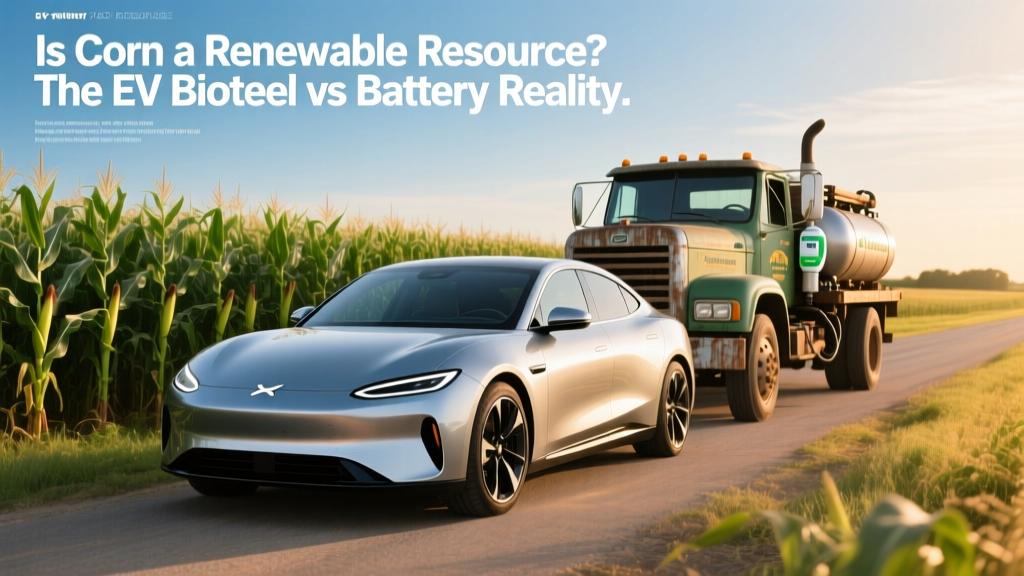
The question "is corn a renewable resource" comes up constantly in energy debates — especially as drivers weigh ethanol-blended gasoline against fully electric vehicles. Corn is technically renewable: you can plant it, harvest it, ferment it into ethanol, and repeat the cycle annually. But renewability alone doesn't answer the real question for car buyers in 2026: which path — corn ethanol or battery electric — delivers more usable energy per acre, lower cost per mile, and fewer lifecycle emissions?
As an EV analyst who has owned multiple electric vehicles and tracked energy economics for years, I'll break down the hard numbers. The answer involves physics, agriculture, and the brutal math of energy conversion — and it has major implications for whether your next car should plug in or fill up with E85.
The Energy Conversion Problem: Corn to Wheels
Corn ethanol follows a long, lossy energy chain. You start with sunlight hitting a cornfield. Photosynthesis converts roughly 1-2% of solar energy into plant biomass. The corn is harvested, transported, milled, fermented, distilled, and blended into gasoline (typically E10 at 10% ethanol, or E85 at up to 85% ethanol for flex-fuel vehicles).
By the time ethanol reaches your fuel tank, the well-to-wheel efficiency is estimated at roughly 20-25% of the original solar energy input, according to lifecycle analyses from Argonne National Laboratory's GREET model. A flex-fuel vehicle running E85 typically achieves around 105 MPGe combined — far below the 120-140 MPGe of modern EVs.
Compare this to the electric pathway: solar panels convert 20-22% of sunlight into electricity. That electricity flows through the grid (with ~5-8% transmission loss) into an EV battery (90-95% charge efficiency) and then to an electric motor (90-95% efficient). The total well-to-wheel efficiency for a solar-charged EV lands around 15-18% of original solar input — similar in raw percentage but with a critical advantage: solar panels don't compete with food crops, and the electricity can come from wind, hydro, or nuclear as well.
EV Efficiency in 2026: The Numbers That Matter
Let's ground this in a concrete vehicle comparison. We'll use the 2026 Tesla Model Y Long Range AWD as our EV benchmark — one of the best-selling electric vehicles in America — against a typical E85-capable flex-fuel SUV.
| Spec | Value |
|---|---|
| EPA Range | 320 miles |
| Battery Capacity | 78.1 kWh usable (NMC chemistry) |
| Efficiency | 122 MPGe combined / 28 kWh/100mi |
| Max DC Fast Charge | 250 kW (peak) |
| 10-80% DC Charge Time | ~24 minutes |
| Level 2 Home Charge | 11.5 kW (~44 mi/hr) |
| 0-60 mph | 4.8 seconds |
| Horsepower | 384 hp (dual motor AWD) |
| Cargo Volume | 76.2 cu ft (rear seats folded) + 4.1 cu ft frunk |
| Rear Legroom | 41.6 inches |
| Base MSRP | $44,990 |
| Battery Warranty | 8 years / 120,000 miles (min 70% retention) |
Cost Per Mile: Ethanol vs Electricity
This is where the "is corn a renewable resource" question becomes a wallet question. Let's compare the cost to drive 100 miles in each scenario:
| Fuel Type | Efficiency | Price | Cost/100 mi |
|---|---|---|---|
| E85 Flex-Fuel SUV | ~16 mpg (E85) | $2.85/gal | $17.81 |
| Regular Gasoline (E10) | ~24 mpg | $3.40/gal | $14.17 |
| EV (home L2, $0.14/kWh) | 28 kWh/100mi | $0.14/kWh | $3.92 |
| EV (DC fast charge, $0.38/kWh) | 28 kWh/100mi | $0.38/kWh | $10.64 |
Even at public DC fast-charging rates, the EV costs less per mile than E85 ethanol. At home charging rates, the EV is roughly 4-5x cheaper per mile than a corn-ethanol flex-fuel vehicle. Over 15,000 annual miles, that's a savings of $1,500-$2,100 per year on fuel alone.
Land Use and the True Renewability Question
Here's where the data gets uncomfortable for corn ethanol. According to USDA data, roughly 90 million acres of U.S. farmland grow corn, with about 40% of that crop going to ethanol production. That's approximately 36 million acres — an area larger than Iowa — dedicated to fueling vehicles through fermentation.
The energy yield per acre tells the story:
- Corn ethanol: ~1,000-1,200 gallons/acre, yielding roughly 15,000-18,000 miles of driving per acre (in a 25 mpg flex-fuel vehicle on E85)
- Solar panels + EV: An acre of modern solar panels (~400 W panels, ~20% efficiency) generates roughly 800,000-1,000,000 kWh/year, enough to drive an efficient EV approximately 2.8-3.6 million miles per acre annually
That's not a typo. Solar-to-EV produces roughly 150-200x more vehicle miles per acre than corn-to-ethanol. Even accounting for solar panel manufacturing emissions and battery mining, the land-use argument overwhelmingly favors electrification.
Federal Tax Credits and EV Purchase Economics
One factor that corn ethanol doesn't offer buyers: federal purchase incentives. Under IRS §30D rules for 2026, the Tesla Model Y may qualify for up to $7,500 in federal tax credits — but eligibility depends on several requirements:
- Vehicle MSRP must not exceed $55,000 (SUVs/vans/pickups) or $25,000 (sedans)
- Buyer modified AGI must be under $150,000 (single) or $300,000 (joint)
- Battery components must meet escalating domestic-content requirements
- Critical minerals must be sourced from the U.S. or FTA-trade partners
- Credit can be transferred to the dealer as a point-of-sale discount
- Final vehicle assembly must occur in North America
Eligibility changes as sourcing rules tighten annually. Consult a tax professional and verify current rules at irs.gov before purchasing.
| Trim | MSRP | Est. After $7,500 Credit |
|---|---|---|
| Long Range AWD | $44,990 | $37,490 |
| Performance AWD | $48,990 | $41,490 |
Charging Speed: What You Actually Need to Know
Charging speed is the top concern for EV shoppers coming from gasoline or ethanol. The Model Y Long Range supports up to 250 kW peak DC fast charging on Tesla Superchargers or compatible NACS stations. However, peak rate isn't sustained — the charge curve tapers significantly above 80% State of Charge (SoC) to protect the NMC battery chemistry.
| Level | Power (kW) | Miles Added Per Hour | Use Case |
|---|---|---|---|
| Level 1 (120V outlet) | 1.4 kW | ~5 mi/hr | Emergency/trickle |
| Level 2 (240V, 48A) | 11.5 kW | ~44 mi/hr | Home overnight |
| DC Fast (Supercharger) | 250 kW peak | ~162 mi in 15 min | Road trips |
For daily driving, Level 2 home charging is all most owners need. A full overnight charge from 20% to 100% takes about 7 hours at 11.5 kW — you wake up with a full "tank" every morning, something no ethanol vehicle can offer.
One critical note on preconditioning: the Model Y automatically warms its battery when you navigate to a Supercharger. This is essential in cold weather — without preconditioning, DC fast charging speeds can drop by 40-60% because cold lithium-ion cells accept charge much more slowly.
Standout Tech and Notable Drawbacks
Pros
- Class-leading efficiency at 122 MPGe combined
- Access to Tesla Supercharger network (17,000+ stalls in U.S.)
- Over-the-air updates continuously add features
- 76.2 cu ft cargo space rivals midsize gas SUVs
- Instant torque: 0-60 in 4.8s with no transmission lag
- Heat pump standard for efficient cold-weather cabin heating
- Low center of gravity from floor-mounted battery pack
Cons
- No Apple CarPlay or Android Auto — Tesla-only infotainment
- Rear visibility limited by sloping roofline
- Insurance premiums 15-25% higher than comparable gas SUVs
- Touchscreen-only controls for mirrors, glovebox, and wipers
- NMC battery degrades faster if routinely charged to 100%
- Panel gap and paint quality inconsistencies persist
- Autopilot is Level 2 driver-assist, NOT self-driving
Who Should Buy an EV (and Who Shouldn't)
The corn-vs-battery question ultimately resolves into a use-case decision:
Choose an EV like the Model Y if:
- You have access to home Level 2 charging (garage or driveway with 240V)
- Your daily commute is under 200 miles round-trip
- You want the lowest cost per mile and can charge at home
- You value instant acceleration, quiet operation, and low maintenance
- You're willing to plan 20-25 minute DC fast-charge stops on road trips
Stick with liquid fuel (including ethanol blends) if:
- You live in an apartment with zero charging access and no workplace chargers
- You regularly tow heavy loads over 300+ miles (towing cuts EV range 30-50%)
- You operate in extreme cold (-20°F or below) with no garage
- You need 5-minute refueling for commercial/fleet duty cycles
The Bottom Line: Renewability Is Necessary but Not Sufficient
So, is corn a renewable resource? Yes — technically. You can grow it every year, indefinitely, as long as topsoil and water hold out. But renewability is only one dimension of sustainable transportation. When you measure energy efficiency, land use, cost per mile, and tailpipe emissions, battery electric vehicles powered by an increasingly clean grid outperform corn ethanol on nearly every metric that matters to a car buyer in 2026.
The ethanol pathway converts sunlight to corn to liquid fuel to motion with roughly 80% total energy loss. The EV pathway converts sunlight (or wind, or hydro) to electricity to battery to motion with roughly 75-85% total energy loss — but with far more vehicle miles per acre and zero tailpipe emissions. As the U.S. grid continues decarbonizing, that gap only widens.
For car buyers, the answer is practical: if you can charge at home, an EV like the Model Y delivers more miles per dollar, per acre, and per kilowatt-hour than any corn-derived fuel. The renewability debate is settled — batteries win on the math.
Frequently Asked Questions
Is corn ethanol truly carbon-neutral?
No. While the corn plant absorbs CO₂ during growth, the full lifecycle — fertilizer production, farming equipment, fermentation, distillation, and transportation — generates significant emissions. EPA lifecycle analyses estimate corn ethanol reduces greenhouse gas emissions by roughly 20-40% compared to conventional gasoline, but it is far from carbon-neutral. EVs charged on the average U.S. grid produce fewer lifecycle emissions than E85 vehicles.
How does the Model Y's real-world range compare to its EPA rating?
The EPA rates it at 320 miles. Expect 270-290 miles on the highway at 70-75 mph, and 230-260 miles in sub-freezing temperatures. City driving with regenerative braking can stretch past 330 miles. These numbers assume the battery is at 100% SoC — Tesla recommends daily charging to 80% for NMC battery longevity, which gives roughly 256 usable EPA miles for daily use.
Does the 2026 Tesla Model Y qualify for the $7,500 federal tax credit?
It may, depending on your income, the vehicle's battery sourcing compliance, and current IRS rules. The MSRP is under the $55,000 SUV cap, and assembly occurs in the U.S. However, critical-mineral and battery-component sourcing requirements tighten each year under §30D. Check the fueleconomy.gov tax credit tracker and consult a tax professional before relying on the credit.
Can I use E85 ethanol in any car?
No. Only vehicles designated as "flex-fuel" by the manufacturer can safely burn E85 (up to 85% ethanol). Using E85 in a non-flex-fuel vehicle can damage fuel lines, injectors, and engine seals. Check your owner's manual or look for a yellow gas cap labeled "E85."
What happens to EV batteries at end of life?
Modern EV batteries like the Model Y's NMC pack are designed to last 15-20 years before reaching 70% capacity. At end of life, over 90% of battery materials (lithium, nickel, cobalt, manganese) can be recovered through hydrometallurgical recycling — far more sustainable than the continuous extraction and fermentation cycle of corn ethanol.