The Corn Question: Renewable Fuel or Agricultural Loophole?
Every time fuel prices spike or EV charging infrastructure makes headlines, the same counter-argument surfaces: "Why go electric when corn ethanol is a renewable fuel?" It's a fair question for anyone weighing their next vehicle purchase, especially when flex-fuel vehicles (FFVs) and E85 pumps still dot the Midwest landscape. But answering it requires looking past the "renewable" label and examining the actual energy math, land-use costs, and tailpipe-to-grid emissions data.
This isn't a conventional EV review — it's a powertrain-decision framework. If you're shopping for a new vehicle in 2026 and trying to decide between a corn-ethanol-capable flex-fuel vehicle, a hybrid running on E15, or a full battery-electric vehicle, the numbers below should clarify which path actually delivers on the "renewable" promise.
The short answer: corn is technically a renewable crop, but corn ethanol as a transportation fuel is among the least efficient ways to convert sunlight into vehicle miles. Let's break down why, with hard data.
Corn Ethanol by the Numbers: Energy Return and Land Use
Corn ethanol has been blended into U.S. gasoline since the Renewable Fuel Standard (RFS) was established in 2005 and expanded in 2007. Today, nearly all U.S. gasoline contains at least 10% ethanol (E10), and flex-fuel vehicles can run on up to E85 (85% ethanol). But the energy economics are sobering.
| Metric | Value | Source |
|---|---|---|
| Energy Return on Investment (EROI) | ~1.3:1 to 1.8:1 | USDA / Argonne National Lab |
| Acres of U.S. corn dedicated to ethanol | ~40% of total corn crop (~37 million acres) | USDA ERS |
| Energy density of E85 vs gasoline | ~27% lower (83,000 vs 114,000 BTU/gal) | AFDC |
| Well-to-wheel CO₂ (E10 vs pure gasoline) | ~2-5% reduction (disputed) | EPA / Congressional Budget Office |
| Water consumption per gallon of ethanol | ~2.8 gallons (irrigation + processing) | USDA |
| Fertilizer-related N₂O emissions | Significant; N₂O is 265× more potent than CO₂ | EPA GHG Inventory |
The EROI figure is the critical one. For every unit of fossil-fuel energy invested in growing, harvesting, fermenting, and distilling corn ethanol, you get back roughly 1.3 to 1.8 units of fuel energy. That's a marginal net gain — and it only looks "renewable" if you ignore the diesel tractors, natural-gas-fired distillation, and synthetic nitrogen fertilizer (produced from natural gas via the Haber-Bosch process) that make the system work.
EV Efficiency vs. Corn Ethanol: The Sunlight-to-Miles Comparison
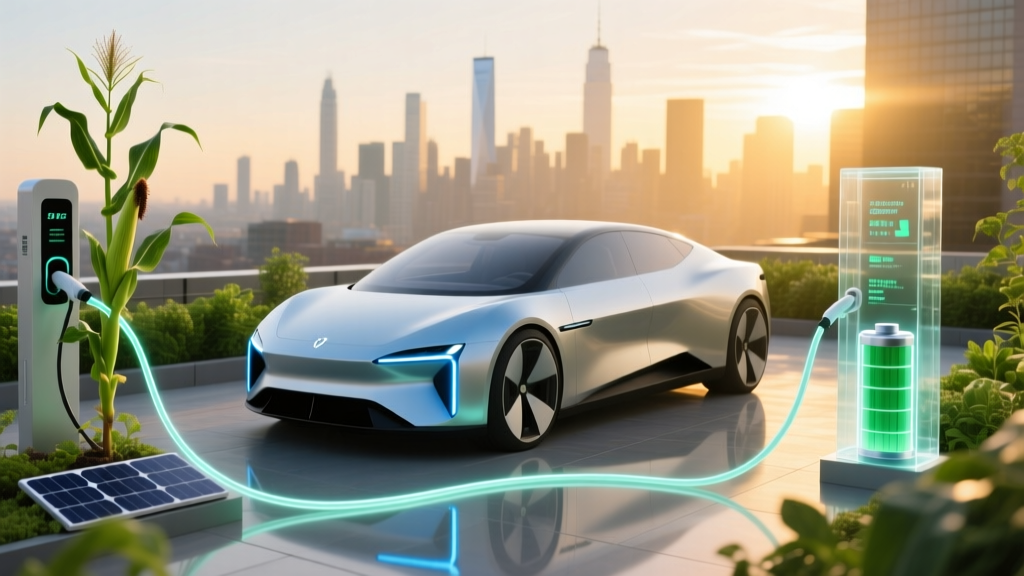
The strongest argument against corn ethanol as a transportation strategy isn't that corn isn't renewable — it's that the conversion pathway from sunlight to vehicle motion is dramatically less efficient than solar-to-battery-to-electric-motor.
Corn Ethanol Path: Sunlight → Photosynthesis (~1% efficiency) → Corn harvest → Fermentation & distillation (~60% process efficiency) → E85 tank → ICE engine (~25-30% thermal efficiency) = ~0.15-0.2% overall sunlight-to-motion efficiency
EV Path: Sunlight → Solar panel (~20-22% efficiency) → Grid/battery (~90% charge/discharge) → Electric motor (~90% efficiency) = ~16-18% overall sunlight-to-motion efficiency
Result: An EV powered by solar is roughly 80-100× more efficient at converting sunlight into miles driven than a flex-fuel vehicle running on corn ethanol.
This is physics, not politics. Photosynthesis is fundamentally a low-efficiency process, and every additional conversion step (fermentation, distillation, transportation, internal combustion) compounds the losses. Electric motors, by contrast, convert over 90% of electrical energy into motion.
What This Means for Your Vehicle Purchase in 2026
If you're cross-shopping a flex-fuel vehicle against an EV or PHEV, here's the decision landscape as of 2026:
| Factor | Flex-Fuel (E85) | Battery EV | Plug-in Hybrid |
|---|---|---|---|
| Fuel cost per mile (national avg) | $0.14-$0.18 (E85) | $0.04-$0.06 (home charging) | $0.05 electric / $0.12 gas |
| E85 station availability | ~4,300 stations (mostly Midwest) | N/A | N/A |
| Federal tax credit (§30D) | $0 — not eligible | Up to $7,500 (subject to rules) | Up to $7,500 (subject to rules) |
| Tailpipe CO₂ (per mile) | ~350-400g (E85) | 0g (tailpipe) | 0g electric / ~350g gas |
| Maintenance cost (annual) | Higher (ICE complexity) | Lower (fewer moving parts) | Moderate (dual systems) |
| Range flexibility | 300-400+ mi (gas/E85) | 250-400 mi EPA (varies) | 30-50 mi electric + 300+ mi gas |
Flex-fuel vehicles receive no federal EV tax credit under IRS §30D. They also suffer from E85's lower energy density — you'll see 20-30% fewer miles per gallon compared to pure gasoline, which often cancels out the per-gallon price discount at the pump.
The Real-World EV Alternative: A 2026 Benchmark
To put the efficiency argument in concrete terms, consider a mainstream 2026 EV like the Hyundai Ioniq 6 (a representative mid-size electric sedan). Its specs illustrate why electrification outpaces biofuel on nearly every ownership metric:
| Spec | Value |
|---|---|
| EPA Range | 361 miles |
| Battery | 77.4 kWh (NMC lithium-ion) |
| Efficiency | 140 MPGe / 24 kWh/100mi |
| Max DC Fast Charge | 240 kW (10-80% in ~18 min) |
| Level 2 Home Charge | 10.9 kW (~44 mi/hr) |
| 0-60 mph | 5.1 seconds (RWD) |
| Horsepower | 225 hp |
| Base MSRP | ~$42,715 |
| Federal Tax Credit | Up to $7,500 (eligibility varies) |
| Battery Warranty | 10 years / 100,000 miles |
At $0.13/kWh (national residential average), fully charging the Ioniq 6's 77.4 kWh battery costs about $10.06 — delivering 361 miles of range. That's $0.028 per mile. An E85 flex-fuel sedan getting 22 mpg on E85 at $2.80/gallon costs $0.127 per mile — over 4× more per mile driven. Source: fueleconomy.gov.
Is Corn Ethanol Truly Renewable? The Nuanced Answer
Corn itself regrows every season — that's technically renewable. But calling corn ethanol a "renewable fuel" in the same category as wind, solar, or battery-electric transport requires several generous assumptions:
- Land-use change: Converting grasslands or forests to corn production releases stored carbon, potentially negating ethanol's lifecycle benefit for decades. A 2022 study in PNAS found that the RFS-driven expansion of corn cultivation increased net GHG emissions when indirect land-use change was included.
- Fossil-fuel inputs: Synthetic nitrogen fertilizer is produced from natural gas. Farm equipment runs on diesel. Distillation requires heat, typically from natural gas or coal. These inputs make ethanol a fossil-fuel derivative with a biological feedstock, not a truly renewable energy source.
- Food-vs-fuel tension: Diverting ~40% of the U.S. corn crop to fuel production affects food prices, livestock feed costs, and global grain markets. The Congressional Budget Office has flagged this trade-off repeatedly.
- Water intensity: Corn ethanol requires roughly 2.8 gallons of water per gallon of fuel produced — a significant burden in drought-prone regions like the Ogallala Aquifer zone.
- Soil degradation: Continuous corn monoculture (driven by ethanol demand) accelerates topsoil erosion and nutrient runoff, contributing to the Gulf of Mexico dead zone.
Cellulosic ethanol (from switchgrass, agricultural waste, or wood chips) has a stronger sustainability case — but as of 2026, it remains a niche product with minimal commercial scale. The "renewable" fuel in your E85 pump is overwhelmingly corn-derived.
Charging Infrastructure vs. E85 Availability
One argument for flex-fuel vehicles is fueling convenience — you can fill up in 5 minutes at any gas station. But the E85-specific infrastructure is far thinner than most buyers realize:
| Metric | E85 Stations | Public EV Chargers |
|---|---|---|
| Total U.S. locations | ~4,300 | ~75,000+ |
| States with 100+ stations | 8 (MN, IL, IA, IN, OH, WI, MI, SD) | 40+ |
| Home fueling capability | None (residential E85 tanks not practical) | Level 1 (120V) or Level 2 (240V) |
| Avg. fueling/charging time | ~5 minutes | 18-35 min (DC fast) / 6-10 hrs (Level 2 home) |
| Price variability | High (E85 often scarce outside Midwest) | Moderate (home rate locked; public varies) |
For EV owners with home Level 2 charging, the "fueling" experience is waking up to a full battery every morning — no station visits required for daily driving. E85 owners without a nearby flex-fuel pump are effectively driving gasoline cars with a sticker badge.
Federal Tax Credits: EVs Win, Biofuels Don't Qualify
Under IRS §30D, new clean vehicle credits apply exclusively to battery-electric, plug-in hybrid, and fuel-cell vehicles. Flex-fuel vehicles running on corn ethanol are not eligible for any federal purchase incentive.
- Vehicle must be a BEV, PHEV, or FCV (not flex-fuel/ethanol-only)
- MSRP cap: $80,000 (SUVs/pickups/vans) or $55,000 (sedans)
- Buyer income cap: $300K (joint), $225K (head of household), $150K (single)
- Battery components must meet escalating U.S./FTA-country sourcing requirements
- Critical minerals must meet separate sourcing thresholds (increasing annually)
- Credit can be transferred to dealer at point of sale for an immediate price reduction
- Always verify current eligibility on fueleconomy.gov and consult a tax professional
This means a $42,000 EV that qualifies for the full $7,500 credit effectively costs $34,500 — a price point that no new flex-fuel vehicle with comparable features and interior space can match, especially once you factor in the higher per-mile fuel cost of E85.
Pros and Cons: Corn Ethanol vs. Going Electric
Corn Ethanol (Flex-Fuel) Pros
- Uses existing gas-station infrastructure
- 5-minute fill-up, no charging wait
- Supports U.S. agricultural economy
- No range anxiety in rural areas
- Works in extreme cold without efficiency loss
Corn Ethanol (Flex-Fuel) Cons
- Low EROI (~1.3-1.8:1) — barely net-positive energy
- 27% lower energy density than gasoline
- No federal purchase incentive
- Higher cost per mile than home-charged EV
- E85 stations rare outside 8 Midwest states
- Significant land, water, and fertilizer inputs
- ICE maintenance costs (oil, filters, transmission)
Battery EV Pros
- ~80-100× more efficient sunlight-to-miles pathway
- $0.03-0.06/mile fuel cost (home charging)
- Up to $7,500 federal tax credit
- Minimal maintenance (no oil, filters, exhaust)
- Home charging = full "tank" every morning
- Zero tailpipe emissions
- Instant torque, quiet operation
Battery EV Cons
- Higher upfront purchase price (before credits)
- Charging takes 18-35 min on road trips (DC fast)
- Cold weather reduces range 15-30%
- Home charger installation may require panel upgrade ($500-$2,000+)
- Public charging reliability still inconsistent in some regions
- Battery replacement cost out of warranty ($8,000-$20,000)
The Verdict: Renewable in Name, Not in Practice
Is corn renewable? The crop itself, yes — you can plant it again next spring. But corn ethanol as a transportation fuel is a fossil-fuel-intensive industrial process wearing a green label. With an energy return barely above break-even, massive land and water requirements, and no pathway to the efficiency gains that battery-electric systems deliver, it functions more as an agricultural subsidy program than a genuine clean-energy strategy.
For 2026 vehicle buyers, the practical takeaway is clear: if your goal is reducing per-mile cost, lowering emissions, and minimizing fossil-fuel dependence, a battery-electric vehicle (or a PHEV if you lack home charging) outperforms a flex-fuel vehicle on every measurable metric. The $7,500 tax credit, $0.03/mile home-charging cost, and 140+ MPGe efficiency of mainstream EVs make the math decisive — even before factoring in the environmental cost of converting prairie to cornfield.
Corn belongs in the silo, not the fuel tank. The renewable energy future runs on electrons, not ethanol.
Frequently Asked Questions
Is corn ethanol better for the environment than gasoline?
Marginally, at best. When you account for the full lifecycle — fertilizer production, farm equipment diesel, distillation energy, and indirect land-use change — corn ethanol's greenhouse gas reduction compared to pure gasoline is estimated at just 2-20% by most peer-reviewed studies. Some analyses, including a 2022 PNAS study, found that RFS-driven corn expansion may have increased net emissions. By contrast, an EV charged on the current U.S. grid (which is ~40% renewable nationally) produces 50-70% fewer lifecycle emissions than a gasoline car — and that figure improves every year as the grid gets cleaner.
Can I use E85 in any car?
No. Only vehicles specifically designated as Flex-Fuel Vehicles (FFVs) can safely run on E85. These have fuel-system components resistant to ethanol's corrosive properties and engine-control software calibrated for high-ethanol blends. Using E85 in a non-FFV can damage fuel lines, injectors, and seals. Check your owner's manual or look for a yellow fuel cap labeled "E85."
Why does the government still subsidize corn ethanol?
The Renewable Fuel Standard (RFS) mandates blending biofuels into the transportation fuel supply. While the original intent was energy independence and emissions reduction, the program has become deeply intertwined with agricultural economics and congressional representation from corn-belt states. The RFS creates a guaranteed market for corn, supporting farm incomes even as the environmental case for corn ethanol has weakened.
What about cellulosic ethanol — is that more sustainable?
Cellulosic ethanol, made from non-food biomass like switchgrass, wood chips, or agricultural residues, has a significantly better energy and emissions profile than corn ethanol. However, commercial-scale production has repeatedly fallen short of projections. As of 2026, cellulosic ethanol remains a small fraction of total U.S. biofuel output. It's a more promising pathway but not a current alternative at scale.
Should I buy a flex-fuel vehicle or an EV in 2026?
If you have access to home charging (a garage or driveway with a 240V outlet), an EV is the stronger financial and environmental choice. The combination of the §30D tax credit (up to $7,500), dramatically lower per-mile fuel costs, and reduced maintenance makes the total cost of ownership favorable for most drivers within 3-5 years. If you live in an apartment without charging access and drive primarily in the Midwest where E85 is readily available, a flex-fuel vehicle offers a marginal emissions benefit over pure gasoline — but a PHEV is still a better bridge option.