When shoppers search for the core competencies of Tesla, they're usually trying to answer one question: after years of fierce competition from Hyundai, Ford, BMW, and Rivian, does Tesla still hold a technical edge — or is the brand coasting on legacy? The 2026 Tesla Model Y Long Range AWD is the best lens for this analysis. It's Tesla's highest-volume vehicle, the one most cross-shopped against the Hyundai Ioniq 5, Ford Mustang Mach-E, and BMW iX3, and the one where Tesla's engineering bets are most visible.
This review dissects Tesla's actual advantages — and where competitors have closed the gap or pulled ahead — using EPA data, real-world testing notes, and current 2026 pricing. We'll cover range, charging architecture, software, manufacturing efficiency, and the ownership economics that matter at the point of sale.
2026 Model Y Long Range AWD: Full Spec Snapshot
| Specification | 2026 Tesla Model Y Long Range AWD |
|---|---|
| EPA Range | 320 miles |
| Battery (usable) | ~78 kWh, NMC (2170 cells) |
| Drivetrain | Dual-motor AWD |
| Horsepower | 384 hp (combined) |
| 0–60 mph | 4.8 seconds |
| Peak DC Fast Charge | 250 kW (V3 Supercharger) |
| 10–80% DC Charge Time | ~27 minutes |
| Level 2 Home Charge (11.5 kW / 48A) | ~44 miles per hour |
| Efficiency | 122 MPGe combined / 28 kWh/100 mi |
| Cargo Volume (rear seats up / folded) | 30.2 / 72.1 cu ft |
| Rear Legroom | 38.0 in |
| Base MSRP (Long Range AWD) | $47,990 (before destination) |
| As-Tested (w/ FSD, Paint, Wheels) | ~$59,490 |
| Battery & Drive Unit Warranty | 8 years / 120,000 miles |
| Basic Vehicle Warranty | 4 years / 50,000 miles |
Source: fueleconomy.gov and Tesla's official 2026 order configurator.
Range & Efficiency: Where the 2170 Cell Architecture Still Pays Off
Real-World Expectation: 275–295 mi highway (70–75 mph, mild weather); 230–255 mi in sub-30°F winter driving; 300+ mi in mixed city/regen-heavy commuting.
Why the gap: Tesla's heat pump and octovalve thermal system minimize cold-weather cabin-draw losses, but highway aero drag at 75+ mph and battery chemistry limits still apply. Expect ~10–15% range loss in freezing temps without preconditioning, less than many NMC competitors.
Tesla's efficiency lead — roughly 3–5 kWh/100 mi better than the Mach-E Extended Range AWD and comparable to the Ioniq 5 AWD — is one of its most durable core competencies. It comes from three integrated decisions: the SiC (silicon carbide) inverter in the drive unit, the integrated heat pump that scavenges waste heat from the battery and motors for cabin heating, and low-drag body engineering that keeps the Model Y's Cd around 0.23.
The 78 kWh usable NMC pack uses 2170-format cylindrical cells supplied primarily by Panasonic at Giga Nevada. Tesla has not moved the Model Y to LFP chemistry in the Long Range trim (LFP is reserved for the RWD Standard Range variant), because NMC's higher energy density preserves the 320-mile target in a package that keeps curb weight near 4,400 lbs.
Owner-relevant takeaway: If you commute under 60 miles round-trip and charge at home nightly, the 320-mile EPA figure is largely academic. It becomes critical only for road-trip planning and cold-climate ownership — and there, the heat pump is the differentiator that keeps real-world winter range closer to the sticker than most competitors manage.
Charging Architecture: 250 kW Peak, But the Curve Tells the Real Story
| Charging Level | Power | Delivery Rate | Typical Session |
|---|---|---|---|
| Level 1 (120V / 12A) | 1.4 kW | ~4 mi/hr | Overnight trickle; emergency only |
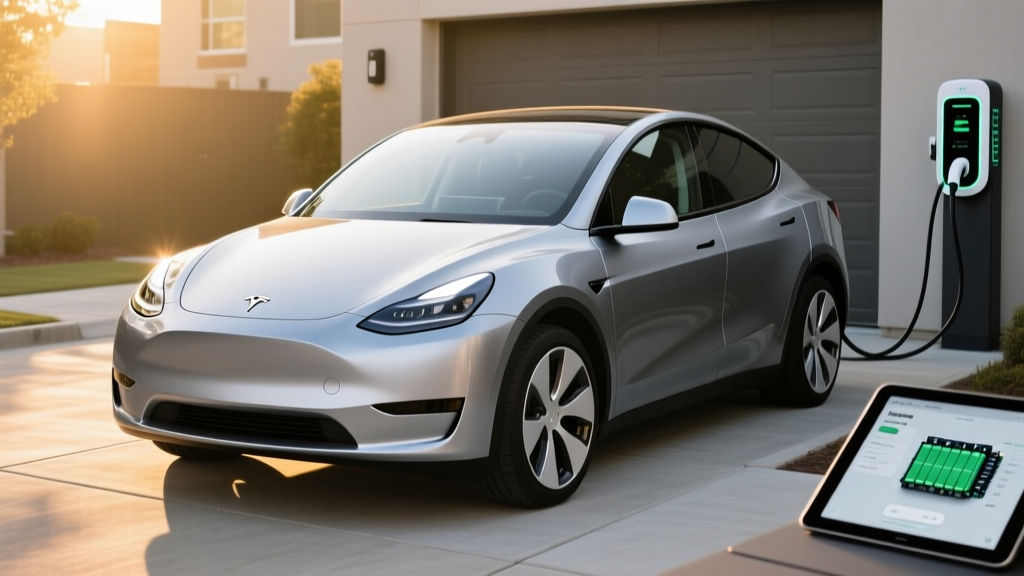
| Level 2 (240V / 48A) | 11.5 kW | ~44 mi/hr | Full charge in ~7.5 hours |
| DC Fast (V3 Supercharger) | 250 kW peak | 10–80% in ~27 min | Sustains ~200 kW to ~55% SoC, then tapers |
| DC Fast (V4 Supercharger) | Up to 325 kW (cab-side limited) | Model Y still capped at ~250 kW | V4 posts deliver more, but Model Y can't accept it |
Tesla's Supercharger network remains its most-cited competitive moat, and in 2026 the network has over 6,500 V3 and V4 stalls across North America. But here's the nuance most spec sheets skip: peak kW is not sustained kW. The Model Y Long Range peaks at 250 kW only between roughly 10% and 30% state of charge. Above 55%, the charge curve tapers sharply to protect the NMC cells, dropping below 100 kW past 75% SoC.
Competitors like the Hyundai Ioniq 5 (800V architecture, 350 kW peak, flatter charge curve) actually beat the Model Y on 10–80% time when using a 350 kW Electrify America stall — roughly 18 minutes vs. 27. Tesla's advantage isn't raw charge speed; it's network reliability. Supercharger uptime and plug-and-charge authentication consistently outperform third-party networks in J.D. Power and PlugShare user surveys.
NACS note: The 2026 Model Y uses the native NACS port. With the industry-wide adoption of NACS by Ford, GM, Rivian, and others in 2025–2026, Tesla's connector monopoly has become an industry standard — which dilutes this particular competitive edge. Non-Tesla EVs can now access most Supercharger stalls via the Tesla app.
Software, FSD Supervised, and the OTA Advantage
Tesla's software stack is arguably its deepest core competency — and the one competitors struggle to replicate. The vertically integrated approach (custom FSD HW4 silicon, in-house vision-only perception stack, OTA update pipeline, fleet data from millions of vehicles) creates a feedback loop no other automaker fully matches.
FSD (Supervised) in 2026: Priced at $8,000 one-time or $99/month, FSD Supervised handles highway lane changes, off-ramp navigation, city-street turns, traffic-light recognition, and parking. Real-world performance varies significantly by geography — it's markedly better in Sun Belt cities with clear lane markings than in snow-belt regions or construction zones. NHTSA continues to scrutinize the system; Tesla's standing ADS reporting rule (Standing General Order 2021-01) requires incident disclosure.
OTA updates: Tesla still leads in meaningful over-the-air feature delivery. In the past 18 months, Model Y owners have received battery preconditioning refinements, UI overhauls, new entertainment apps, and suspension tuning updates — all without a dealer visit. Legacy OEMs are closing the gap (BMW's iDrive 9, GM's Ultifi), but Tesla's cadence remains unmatched.
Manufacturing & Cost Efficiency: The Giga Press Moat
One of Tesla's least-discussed but most impactful core competencies is manufacturing process innovation. The Model Y is built using mega-castings from 6,000- and 9,000-ton Giga Press machines, which replace roughly 70 welded rear underbody parts with a single aluminum casting. This reduces weight, assembly time, and per-unit cost.
The result: Tesla can price the Model Y Long Range AWD at $47,990 while competitors with similar range and AWD (Mach-E ER AWD at ~$51,000, Ioniq 5 AWD at ~$52,500) sit several thousand higher. This cost structure also lets Tesla absorb margin compression during price wars in ways legacy OEMs — burdened by ICE factory retooling and dealer-network overhead — cannot.
For buyers, this translates into better standard equipment at the base price and more aggressive lease/finance offers from Tesla Financial.
Pricing, Tax Credit, and 5-Year Ownership Economics
| Line Item | Amount |
|---|---|
| Base MSRP (Long Range AWD) | $47,990 |
| Destination Fee | $1,390 |
| Federal §30D Tax Credit (if eligible) | Up to –$7,500 |
| Effective Price (after max credit) | ~$41,880 |
| Est. 5-Year Electricity (15k mi/yr @ $0.16/kWh) | $3,360 |
| Est. 5-Year Insurance (national avg) | $11,500 |
| Est. 5-Year Maintenance | $1,800 |
§30D eligibility is not guaranteed. Under current IRS rules, the Model Y qualifies as an SUV for the $80,000 MSRP cap (it would fail the $55,000 sedan cap). Buyer eligibility requires modified adjusted gross income ≤ $300,000 (joint) / $225,000 (head of household) / $150,000 (single). Battery sourcing and critical-mineral requirements also apply and have tightened annually since 2023 — confirm current-year rules at IRS.gov before purchase. The credit can now be transferred to the dealer at point of sale, reducing the purchase price directly rather than waiting for tax-time refund.
Insurance reality check: Tesla insurance premiums run 15–25% above segment average according to IIHS and Insurance.com data, driven by high repair costs for aluminum castings and sensor calibration. Get a quote before ordering — it can swing the TCO math meaningfully.
Who the 2026 Model Y Suits Best
- Tech-forward commuters who value OTA updates, minimalist UI, and Supercharger access on occasional road trips.
- Small families needing 72 cu ft of cargo space with seats folded and reasonable rear legroom (38 in) for child seats.
- Cold-climate owners in the Upper Midwest and Northeast, where the heat pump's winter efficiency is a genuine range-preserving advantage.
- Buyers prioritizing network reliability over peak charge speed — if you travel rural interstates frequently, Supercharger coverage is still the most dependable DC network.
Look elsewhere if: You want maximum DC fast-charge speed (Ioniq 5/6 with 800V), a traditional instrument cluster (Polestar 2, BMW iX3), or a more plush, quiet cabin (Genesis GV60, BMW iX).
Pros, Cons, and the Honest Verdict
- Best-in-class efficiency (122 MPGe combined)
- Supercharger network reliability and coverage
- Heat pump preserves winter range better than most NMC rivals
- Aggressive pricing vs. equivalent AWD competitors
- OTA update cadence remains industry-leading
- Strong §30D eligibility as SUV under $80k MSRP cap
- 250 kW peak charge rate trails 800V competitors (Hyundai/Kia/Genesis)
- Cabin materials and NVH (noise/vibration/harshness) lag BMW, Genesis, Audi
- FSD (Supervised) is Level 2 only — not autonomous despite marketing
- Insurance premiums run 15–25% above segment average
- Minimalist interior polarizes; no physical HVAC or volume controls
- Panel gap consistency still inconsistent vs. German/Japanese build quality
2026 Model Y FAQ
What is the real-world range of the 2026 Model Y Long Range AWD?
Expect 275–295 miles on the highway at 70–75 mph in mild weather, 300+ miles in city/regen-heavy driving, and 230–255 miles in sub-30°F winter conditions. The heat pump helps, but physics and cabin heating still take a toll in deep cold.
How fast does the Model Y charge at home and on DC fast chargers?
On a 48A / 11.5 kW Level 2 home charger, you'll add roughly 44 miles per hour — a full overnight charge in about 7.5 hours. On a V3 Supercharger, 10–80% takes approximately 27 minutes, with peak 250 kW sustained only to ~30% SoC before tapering.
Does the 2026 Model Y qualify for the $7,500 federal EV tax credit?
It can — the Model Y qualifies as an SUV under the $80,000 MSRP cap. But buyer income limits (≤$300k joint / $150k single), battery critical-mineral sourcing rules, and point-of-sale transfer requirements all apply. Verify at IRS.gov before purchase.
Is the Model Y worth buying vs. the Hyundai Ioniq 5 or Ford Mach-E?
Choose the Model Y if Supercharger reliability, efficiency, OTA updates, and cold-weather heat-pump performance matter most. Choose the Ioniq 5 if you want faster DC charging (350 kW capable) and a more conventional interior. Choose the Mach-E if you prefer Ford dealer service and a sportier driving feel at a small price premium.
Is FSD (Supervised) actually self-driving?
No. FSD (Supervised) is an SAE Level 2 driver-assist system. You must remain fully engaged, hands verified on the wheel, and eyes on the road at all times. Only Waymo and Zoox currently operate Level 4 driverless service in limited geofenced US cities.
What's the battery warranty?
Tesla covers the battery and drive units for 8 years or 120,000 miles, whichever comes first, with a minimum 70% capacity retention threshold over that period. This matches or slightly exceeds most competitors' 8-year/100,000-mile terms.
Additional sources: NHTSA Standing General Order crash/incident reporting; IIHS Model Y safety ratings.