Verdict: Is the 2026 Cybertruck Still the Coolest Truck on the Road?
Two years after deliveries began, the Tesla Cybertruck remains the most polarizing and talked-about electric vehicle in production. Whether you love the stainless-steel exoskeleton or find it impractical, there's no denying its cultural impact. But beyond the angular aesthetics and viral drag races, the 2026 Cybertruck is a serious full-size pickup with real towing capability, class-leading tech, and a charging network advantage that no competitor can match.
This review digs past the hype. We break down the real-world range you can expect (spoiler: it's below the EPA sticker on highway runs), the actual DC fast-charging curve at Superchargers, the current federal tax credit situation under IRS §30D rules, and whether the Cybertruck's ownership proposition holds up against the Ford F-150 Lightning and Rivian R1T in 2026.
2026 Cybertruck Trim Lineup and Pricing
Tesla simplified the Cybertruck lineup for 2026 after retiring the limited Foundation Series. Here's what's available now, with pricing before any incentives:
| Trim | Drivetrain | 0-60 mph | MSRP | Est. After §30D Credit |
|---|---|---|---|---|
| Long Range AWD | Dual-Motor AWD | 4.1 sec | $79,990 | $72,490* |
| Cyberbeast | Tri-Motor AWD | 2.6 sec | $99,990 | $92,490* |
*Tax credit estimates assume buyer meets all IRS §30D requirements. See the tax credit section below for eligibility details. The single-motor RWD variant, originally announced at ~$60,000, remains unreleased as of early 2026.
Federal Tax Credit Eligibility (§30D)
- Maximum credit: $7,500 ($3,750 for critical minerals + $3,750 for battery components)
- MSRP cap: Trucks must be under $80,000 — only the Long Range AWD qualifies
- Income caps: $150K single / $225K head of household / $300K joint (MAGI)
- Battery sourcing: Must meet critical-mineral and battery-component requirements per IRS guidelines
- Point-of-sale transfer: Eligible buyers can apply the credit at purchase, reducing the out-of-pocket cost immediately
The Cyberbeast at $99,990 exceeds the $80,000 truck MSRP cap, making it ineligible for the federal credit. Consult a tax professional to confirm your personal eligibility — rules are subject to change.
Range and Efficiency: EPA Sticker vs. Real World
| Spec | Long Range AWD | Cyberbeast |
|---|---|---|
| EPA Range | 340 miles | 320 miles |
| Battery (usable) | ~123 kWh (NMC) | ~123 kWh (NMC) |
| Efficiency (MPGe) | 67 MPGe combined | 62 MPGe combined |
| Energy consumption | 50 kWh/100 mi | 54 kWh/100 mi |
Real-World Range Reality Check
EPA estimate: 340 miles (Long Range AWD)
Expect in practice:
- City/mixed driving at moderate temps: ~300–320 miles
- Sustained 75 mph highway: ~250–270 miles (aerodynamic drag is brutal on a 6,800-lb stainless wedge)
- Cold weather (below 32°F): ~220–250 miles (LFP packs suffer more, but even this NMC pack loses 20–30% in deep cold)
- Towing a 5,000-lb trailer: ~150–170 miles
The Cybertruck's angular shape and massive frontal area hurt highway efficiency. On a 300-mile road trip at 75 mph with a headwind, plan for a mid-route charge stop.
According to fueleconomy.gov, the Long Range AWD achieves 67 MPGe combined, which is respectable for a truck this size but trails the more aerodynamic Rivian R1T (dual-motor) at ~73 MPGe. Efficiency matters when you're paying per kWh on the road — at $0.35/kWh on public DC chargers, the Cybertruck costs roughly $0.175/mile to fuel, versus about $0.12/mile for a more efficient EV sedan.
Charging Speed: Supercharger Advantage and Home Setup
| Charging Level | Power | Speed / Time | Notes |
|---|---|---|---|
| Level 1 (120V) | ~1.4 kW | ~3 miles/hour | Emergency only; ~110 hours for full charge |
| Level 2 (240V, 48A) | 11.5 kW | ~23 miles/hour | Full charge in ~11 hours; recommended home setup |
| DC Fast (peak) | 250 kW | 10–80% in ~30 min | Peak rate only; tapers significantly above 60% SoC |
| DC Fast (V4 Supercharger) | Up to 350 kW* | 10–80% in ~25 min* | *Cybertruck currently capped at ~250 kW intake |
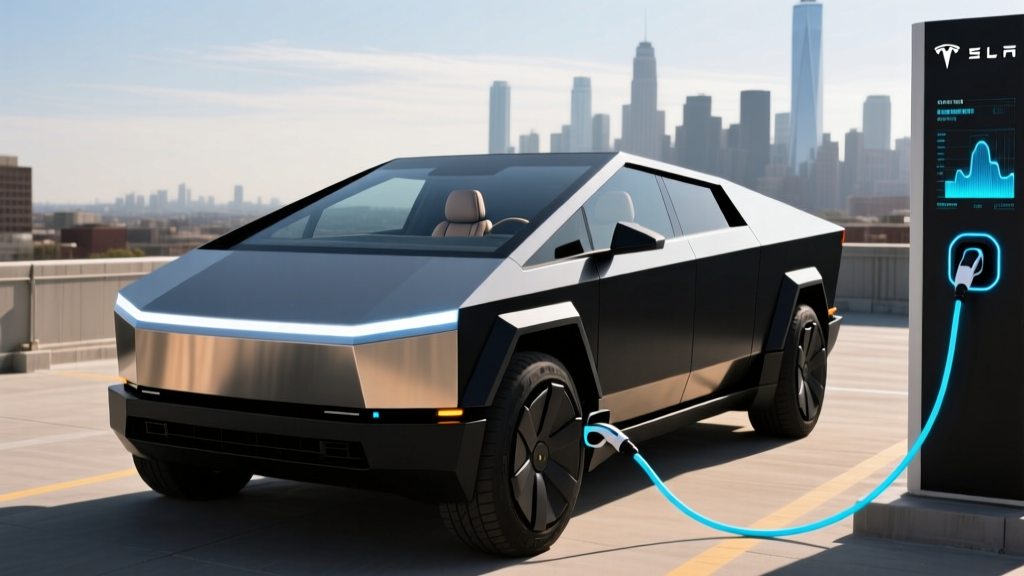
The Cybertruck uses the NACS (North American Charging Standard) connector natively — no adapter needed at any of Tesla's 6,000+ North American Superchargers. This is a significant real-world advantage: Tesla's network consistently leads in uptime and reliability compared to third-party CCS networks.
Charging curve reality: The Cybertruck's ~123 kWh NMC pack can accept up to 250 kW at low state of charge, but like all large lithium-ion packs, the charge rate tapers as the battery fills. Expect roughly:
- 10–40% SoC: Sustained ~230–250 kW (the fastest portion)
- 40–60% SoC: ~180–200 kW
- 60–80% SoC: ~100–130 kW (significant taper)
- Above 80%: Drops below 50 kW — never fast-charge past 80% on a road trip unless necessary
For home charging, a 48-amp Level 2 wall connector on a 60-amp circuit adds about 23 miles per hour of charging. Most owners who drive 40–60 miles daily will replenish their commute in 2–3 hours overnight. Budget $800–$1,500 for a professional Level 2 installation (equipment + electrician + permit), or $2,000–$4,000+ if your panel needs upgrading to 200A service.
Performance and Capability
The Cybertruck is quick in a way that defies its 6,800-pound curb weight. The tri-motor Cyberbeast hits 0-60 mph in 2.6 seconds — supercar territory from a pickup truck. Even the dual-motor Long Range manages 4.1 seconds, which outpaces most sport sedans.
| Capability | Long Range AWD | Cyberbeast |
|---|---|---|
| Horsepower | 600 hp | 845 hp |
| Torque | ~740 lb-ft | ~1,030 lb-ft |
| Towing capacity | 11,000 lbs | 11,000 lbs |
| Payload | 2,500 lbs | 2,500 lbs |
| Bed length | 6 ft (72 in) | 6 ft (72 in) |
| Cargo volume (bed) | ~67 cu ft | ~67 cu ft |
| Frunk | ~7 cu ft (lockable) | ~7 cu ft (lockable) |
| Ground clearance | Up to 17.4 in (adaptive air suspension) | Up to 17.4 in |
| Approach/departure angle | 35°/30° | 35°/30° |
The adaptive air suspension offers 12 inches of travel, raising the truck from a highway-friendly ride height to serious off-road clearance. The 48-volt electrical architecture (a first for a production vehicle at this scale) enables steer-by-wire and rear-wheel steering, giving the 20-foot-long truck a surprisingly tight turning circle of ~37 feet.
Towing reality: The 11,000-lb rating is competitive with the F-150 Lightning (10,000 lbs max) and exceeds the Rivian R1T (11,000 lbs with Max Tow). But towing any heavy trailer will cut your range roughly in half. Plan accordingly.
Interior, Tech, and Daily Livability
The Cybertruck's interior is minimalist even by Tesla standards. A single 18.5-inch touchscreen handles infotainment, climate, and vehicle controls. There are no physical buttons, no instrument cluster, and no traditional gauge readouts. Rear passengers get a 9.4-inch screen for climate and media control.
Dimensions and Space
- Front legroom: 41.3 inches
- Rear legroom: 38.2 inches (tight for a full-size truck — the F-150 Lightning offers ~43 inches rear)
- Seating: 5 passengers (bench front seat with fold-down center armrest)
- Cargo behind rear seats: Limited; no traditional under-seat storage
Standout Tech
- Steer-by-wire: No mechanical connection between the yoke and wheels; variable ratio means less hand movement at low speeds
- Rear-wheel steering: Up to 10° for tighter turns and better high-speed stability
- Stainless-steel exoskeleton: Ultra-hard 30X cold-rolled steel eliminates paint (no paint chips, but fingerprint magnet)
- Armor glass: Laminated glass designed to resist impacts (though early-production units had fitment issues)
- Bioweapon Defense Mode: HEPA filtration system for cabin air
- Powershare: Up to 11.5 kW of onboard power (120V and 240V outlets in bed and cabin) — enough to run power tools or back up essential home circuits
Driver Assistance
Tesla's Autopilot comes standard with adaptive cruise control and lane centering. Full Self-Driving (Supervised) is available as a $8,000 add-on or $99/month subscription.
Both Autopilot and FSD (Supervised) are SAE Level 2 driver-assistance systems. The driver must remain fully attentive, keep hands on the yoke, and be prepared to take over at any moment. Tesla's "Supervised" branding is accurate — this is not autonomous driving. Only Level 4 services like Waymo operate without a human driver in geofenced areas.
Notable Drawbacks
- Rear visibility is poor; the sloping bed cover and thick C-pillars create massive blind spots (mitigated somewhat by camera feeds)
- The yoke steering is polarizing; some drivers find it impractical for three-point turns and parking maneuvers
- No Apple CarPlay or Android Auto — Tesla's ecosystem is closed
- Panel gaps and build quality have improved since 2024 launch but still draw scrutiny vs. legacy automakers
- The motorized tonneau cover, while slick, can be slow to open and has had reliability complaints
Warranty and Long-Term Ownership
| Coverage | Term |
|---|---|
| Limited vehicle warranty | 4 years / 50,000 miles |
| Battery & drive unit | 8 years / 120,000 miles (minimum 70% retention) |
| Roadside assistance | 4 years / 50,000 miles |
The 8-year/120,000-mile battery warranty with a 70% capacity retention threshold is competitive. Tesla's NMC chemistry in the Cybertruck has shown moderate degradation patterns based on fleet data — expect roughly 8–12% capacity loss over the first 100,000 miles under normal use. Avoid frequent DC fast-charging above 90% SoC and regular deep discharges to 0% to maximize longevity.
Insurance costs are a real consideration. The Cybertruck's repair complexity (stainless-steel body panels, steer-by-wire, armor glass) pushes premiums higher than comparable trucks. Expect $2,500–$4,000/year depending on your profile, location, and coverage. Get quotes before purchasing.
Cybertruck vs. the Competition
| Attribute | Cybertruck LR AWD | F-150 Lightning Lariat | Rivian R1T Dual-Motor |
|---|---|---|---|
| Starting MSRP | $79,990 | ~$62,990 | ~$75,900 |
| EPA Range | 340 mi | 320 mi (Extended) | 352 mi (Max Pack) |
| 0-60 mph | 4.1 sec | ~4.0 sec | ~4.5 sec |
| Towing | 11,000 lbs | 10,000 lbs | 11,000 lbs |
| Bed length | 6 ft | 5.5 ft | 4.5 ft (standard) |
| Charging network | NACS / Supercharger | NACS (2025+) / Supercharger | NACS adapter / Supercharger |
| Rear legroom | 38.2 in | ~43 in | ~37 in |
Pros
- Native NACS + Supercharger access — best charging network
- Class-leading performance (Cyberbeast: 2.6s 0-60)
- Unique design with stainless-steel durability (no paint to chip)
- 11.5 kW Powershare for job-site or emergency backup power
- Steer-by-wire + rear steering = surprisingly agile
- Over-the-air updates continuously add features
Cons
- Highway range drops sharply (~250 mi at 75 mph)
- Rear seat is cramped for a full-size truck
- High insurance and repair costs
- Yoke steering not for everyone
- Cyberbeast ineligible for §30D tax credit ($80K cap)
- Build quality still catching up to legacy OEMs
Who Should Buy the Cybertruck?
Choose the Cybertruck if:
- You value Supercharger network reliability and want native NACS without adapters
- You need onboard power (Powershare) for tools, camping, or emergency backup
- Performance is a priority — the Cyberbeast is the fastest production truck ever made
- You want a conversation-starting design and don't mind attention
- Your daily commute is under 100 miles round-trip (home charging covers you)
Look elsewhere if:
- You regularly carry rear-seat adults (F-150 Lightning is far roomier)
- You need 350+ miles of real-world highway range without stopping
- You want a traditional truck experience with physical controls and CarPlay
- Budget is a primary concern — the F-150 Lightning XLT starts ~$17K lower
Frequently Asked Questions
What is the real-world range of the 2026 Cybertruck?
The EPA rates the Long Range AWD at 340 miles, but expect 250–270 miles on sustained highway driving at 75 mph, and 220–250 miles in freezing temperatures. City and moderate-speed driving can approach 300–320 miles. Towing cuts range to roughly 150–170 miles.
How fast does the Cybertruck charge at home and on the road?
At home on a 48-amp Level 2 charger, the Cybertruck adds about 23 miles of range per hour (11.5 kW), fully charging in ~11 hours. On DC fast chargers, it peaks at 250 kW and charges from 10–80% in roughly 30 minutes, though the rate tapers significantly above 60% SoC.
How much does the Cybertruck cost after federal tax credits?
The Long Range AWD starts at $79,990 and may qualify for up to $7,500 under IRS §30D, bringing the effective price to ~$72,490 — if you meet income caps ($300K joint / $150K single), and the vehicle meets battery-sourcing requirements. The $99,990 Cyberbeast exceeds the $80,000 truck MSRP cap and does not qualify. Always verify current rules at irs.gov.
Is the Cybertruck worth buying over the F-150 Lightning or Rivian R1T?
It depends on priorities. The Cybertruck wins on performance, Supercharger convenience, and onboard power capability. The F-150 Lightning wins on rear-seat comfort, lower starting price, and traditional truck usability. The Rivian R1T wins on build quality, off-road sophistication, and adventure-oriented design. Test-drive all three before deciding.
Does the Cybertruck qualify for the federal EV tax credit?
Only the Long Range AWD at $79,990 qualifies under the §30D MSRP cap for trucks ($80,000). Eligibility also depends on your modified adjusted gross income, the vehicle's battery critical-mineral sourcing, and whether the credit is still available (program rules evolve). The point-of-sale transfer option lets eligible buyers apply the credit at purchase rather than waiting for tax filing.
What battery chemistry does the Cybertruck use?
The Cybertruck uses NMC (nickel manganese cobalt) lithium-ion cells in a ~123 kWh usable pack. NMC offers higher energy density than LFP, which is critical for a heavy truck needing 300+ miles of range. Tesla's structural battery pack integrates the cells into the vehicle chassis for rigidity.
How reliable is the Cybertruck?
As a low-volume, first-generation product with novel technology (steer-by-wire, 48V architecture, stainless body), the Cybertruck has had more early-owner complaints than established models. Issues reported include tonneau cover malfunctions, trim rattles, and software glitches. Tesla has addressed many via OTA updates and service campaigns, but long-term reliability data is still limited. Per NHTSA, check for open recalls and service bulletins before purchasing.