Converting to an EV Car: The Short Answer
Converting to an EV car means replacing a gas-powered vehicle with a battery-electric vehicle (BEV) — or in some cases, physically converting a classic car to electric powertrain. For the vast majority of buyers, buying a new or used BEV is the practical path. Expect to spend $30,000–$55,000 on a mainstream EV with 250–340 miles of EPA range, charge mostly at home on a Level 2 (240V) setup costing $800–$2,200 installed, and save roughly $800–$1,500 per year on fuel and maintenance versus a comparable gas car. The federal §30D tax credit can reduce the purchase price by up to $7,500 if you, the vehicle, and the battery sourcing all qualify. However, real-world range drops 15–30% in cold climates and at sustained highway speeds, and apartment dwellers without home charging access face a significantly harder ownership experience.
What Does Converting to an EV Car Actually Involve?
The phrase "converting to EV car" covers two very different things. The first — and what 99% of buyers mean — is switching your daily driver from a gas vehicle to a battery-electric vehicle. This involves choosing an EV, arranging home or workplace charging, learning public charging networks, and adjusting how you think about refueling.
The second meaning is a physical EV conversion of an existing gas car — pulling the internal combustion engine, fuel tank, and exhaust, then installing an electric motor, controller, and battery pack. This is a niche hobbyist pursuit costing $15,000–$40,000+ in parts and labor, typically performed on classic cars (old VW Beetles, Porsche 914s, Ford Rangers). Companies like EV West and Electric GT offer conversion kits, but the result rarely matches a modern production EV in range, safety, or reliability. Unless you're restoring a vintage vehicle and want electric drivetrain, buying a production BEV is the far more practical route.
This guide focuses on the ownership transition: what changes, what it costs, and how to decide if you're ready.
EV vs Gas vs Hybrid: The Numbers Side by Side
Before converting to an EV, understand how it stacks up against what you're driving now. Here's a data-driven comparison using current mainstream models:
| Metric | 2026 Tesla Model Y RWD (BEV) | 2026 Toyota RAV4 LE (Gas) | 2026 Toyota RAV4 Prime (PHEV) |
|---|---|---|---|
| Base MSRP | $44,990 | $30,425 | $43,690 |
| Federal Tax Credit (§30D) | Up to $7,500* | $0 | Up to $7,500* |
| EPA Range / MPG | 320 mi (BEV) | 30 MPG combined | 42 mi electric + 38 MPG gas |
| Energy/Fuel Cost (5 yr / 75k mi) | ~$3,200 (electricity) | ~$9,400 (gasoline at $3.50/gal) | ~$5,100 (mixed) |
| Maintenance (5 yr) | ~$1,800 | ~$3,600 | ~$3,200 |
| Estimated 5-Yr Total Cost of Ownership** | ~$42,500 | ~$43,400 | ~$44,500 |
* §30D credit eligibility depends on buyer income, MSRP caps, battery critical-mineral sourcing, and point-of-sale transfer. See IRS.gov §30D for current rules.
** Total cost includes purchase price (minus credit), fuel/energy, maintenance, and average insurance over 5 years at 15,000 mi/yr. Excludes depreciation variance. Source: fueleconomy.gov and manufacturer MSRP data.
The takeaway: a BEV like the Model Y can achieve cost parity with a gas RAV4 within 5 years when the federal credit applies and you charge at home. Without the credit or with exclusively public DC fast charging, the math shifts back toward gas or hybrid.
Real Costs of Converting to an EV Car
Beyond the sticker price, converting to EV ownership involves several cost categories gas-car drivers don't think about. Here's a realistic breakdown:
| Category | Cost Range | Notes |
|---|---|---|
| Home Level 2 Charger (Equipment) | $350–$700 | 32A–48A hardwired or NEMA 14-50 plug-in units (e.g., ChargePoint Home Flex, Emporia Level 2) |
| Electrical Installation | $500–$1,500 | Varies by panel capacity, run distance, and permit requirements. A 200A panel usually suffices; older 100A panels may need a $1,500–$3,000 upgrade. |
| Electricity Cost (Annual, 15k mi) | $450–$900 | At $0.12–$0.25/kWh and 3–4 mi/kWh efficiency. Varies heavily by state utility rates. |
| Insurance (Annual) | $1,800–$2,800 | EVs typically cost 15–25% more to insure than gas equivalents due to higher repair costs and battery replacement risk. |
| Tires (Replacement Interval) | $800–$1,400 / set | EVs wear tires 20–30% faster due to instant torque and heavier curb weight. Budget for 30,000–40,000 mi replacement cycles. |
| Public DC Fast Charging | $0.30–$0.60/kWh | Only relevant if you road-trip frequently or lack home charging. At $0.48/kWh, fueling an EV on the road costs roughly the same per mile as gas. |
The Home Charging Advantage
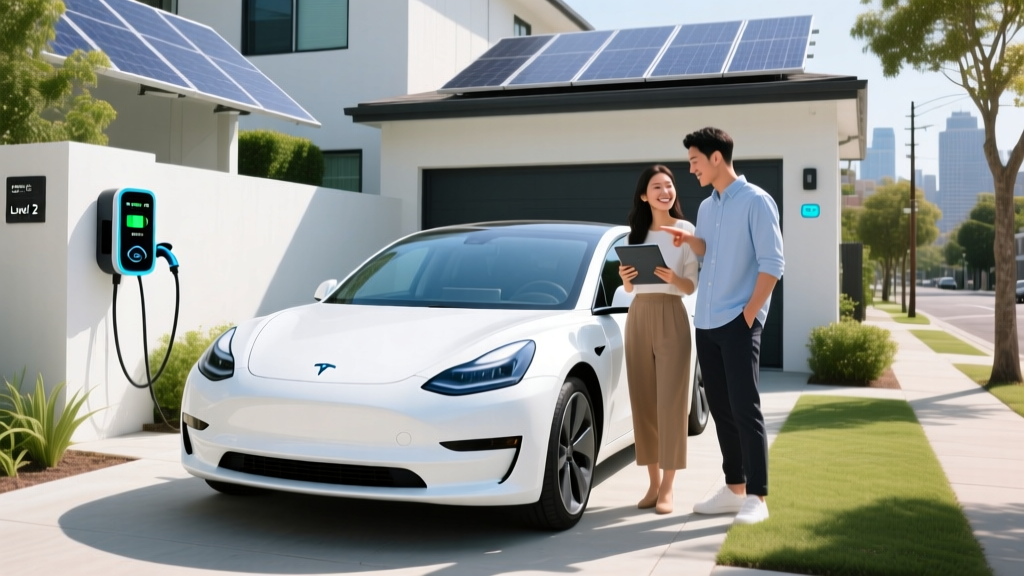
Over 80% of EV charging happens at home. If you have a garage or driveway with access to a 240V outlet (NEMA 14-50) or can have one installed, you'll wake up to a full "tank" every morning — roughly 200–300 miles of range depending on your vehicle. A Level 2 home charger delivers 7.2–11.5 kW, adding 25–44 miles of range per hour of charging. An overnight 8-hour session fully replenishes even the largest consumer EV batteries.
If you live in an apartment, rely on street parking, or your building lacks EV infrastructure, your experience will be significantly harder. Public Level 2 chargers (at grocery stores, workplaces, or parking garages) are slower and less reliable than home charging, and DC fast charging exclusively will accelerate battery degradation and cost nearly as much as gasoline per mile.
Real-World Range vs EPA Stickers: What You'll Actually Get
Every EV sold in the US carries an EPA-estimated range. This number is useful for comparison but optimistic for many real-world scenarios. Here's what to expect when converting to an EV car:
Range Reality Check
EPA Sticker: 320 miles (2026 Tesla Model Y Long Range)
Real-World Highway (70 mph, 75°F): ~260–280 miles
Real-World Cold Weather (30°F, highway): ~210–240 miles
Real-World City/Mixed (moderate climate): ~290–315 miles
Why the gap? EPA testing includes low-speed urban cycles and assumes moderate temperatures. Sustained highway driving at 70+ mph increases aerodynamic drag (which scales with the square of velocity), and cold weather increases battery internal resistance while also requiring cabin heating. EVs with heat pumps (standard on Hyundai Ioniq 5, Tesla Model Y, and others) recover some cold-weather efficiency versus resistive heaters, but 15–30% range loss below freezing is physics, not a defect.
DC Fast Charging: The Curve Matters More Than Peak kW
Automakers advertise peak DC fast-charge rates — "250 kW!" — but that number only applies at low state-of-charge (SoC) and optimal battery temperature. The charge curve tapers significantly above 80% SoC to protect the battery. Here's a realistic example:
- Peak rate: 250 kW (at 10–30% SoC)
- Sustained average (10–80%): ~160–180 kW
- 10–80% charge time: ~18–22 minutes on a 350 kW-capable charger
- 80–100%: An additional 20–30 minutes (tapers to under 40 kW)
Practical road-trip strategy: charge from 10% to 80%, then drive on. Never wait for 100% on a road trip unless you're parking overnight.
Common Misconceptions About Converting to EV
| Myth | Fact |
|---|---|
| "EV batteries need replacing every 5 years and cost $20,000." | Modern NMC and LFP batteries are warrantied for 8 years / 100,000 miles at 70%+ capacity retention. Real-world degradation data shows most packs retain 85–92% capacity after 100,000 miles. Full replacement is rare and typically $8,000–$16,000 if needed out of warranty. |
| "The power grid can't handle millions of EVs." | Most EVs charge overnight during off-peak hours when grid demand is low. A 2025 Lawrence Berkeley National Lab study found that even with 30% EV adoption, managed overnight charging requires minimal grid upgrades. The real challenge is local distribution transformers in dense neighborhoods — not generation capacity. |
| "EVs are worse for the environment because of battery mining." | Even on the dirtiest US grids (coal-heavy regions), an EV's lifetime emissions are lower than a comparable gas car within 1–2 years of driving according to the Union of Concerned Scientists. On cleaner grids (California, Pacific Northwest), the breakeven is under 1 year. Battery recycling infrastructure is scaling rapidly. |
| "I'll be stranded with no charging stations." | The US now has over 70,000 public charging ports, with Tesla Supercharger access opening to NACS-equipped vehicles from Ford, GM, Rivian, and others. The real issue isn't total count — it's rural coverage gaps and broken chargers on non-Tesla networks. Plan road trips with apps like A Better Routeplanner. |
| "I can't take road trips in an EV." | A 300-mile EPA range EV with DC fast charging adds ~200 miles in a 20-minute stop. A 600-mile road trip requires 2 charging stops and adds roughly 40–50 minutes total vs a gas car. For drivers who road-trip more than 6 times a year, a PHEV may be a better fit. |
Do You Qualify for the Federal EV Tax Credit?
The §30D Clean Vehicle Credit can reduce your effective purchase price by up to $7,500, but eligibility is a three-part test that trips up many buyers. As of 2026, the rules include:
- Income caps: Modified AGI must not exceed $150,000 (single), $225,000 (head of household), or $300,000 (joint filers).
- MSRP caps: Vans, SUVs, and trucks must have an MSRP ≤ $80,000; sedans and other vehicles ≤ $55,000.
- Battery sourcing: A percentage of critical minerals and battery components must be sourced from the US or free-trade-agreement countries. This requirement tightens annually, and some previously qualifying models may lose eligibility.
- Point-of-sale transfer: You can transfer the credit to the dealer at purchase, reducing your out-of-pocket cost immediately — rather than waiting to claim it on your tax return.
- Used EV credit: A separate credit of up to $4,000 (or 30% of sale price, whichever is lower) applies to used EVs under $25,000, with lower income caps.
Always verify current eligibility on the IRS Clean Vehicle Credits page and consult a tax professional. Rules change annually, and manufacturer eligibility lists shift as battery sourcing evolves.
Decision Framework: Is Converting to an EV Car Right for You?
Choose a BEV (Full Electric) If:
- You have home charging access (garage, driveway, or building with EV infrastructure)
- Your daily commute is under 100 miles round-trip
- You road-trip fewer than 5–6 times per year (or are willing to plan charging stops)
- You live in a moderate or warm climate (or accept 20%+ range loss in winter)
- You want the lowest operating cost and simplest maintenance schedule
- You qualify for the §30D credit or your state offers additional EV incentives
Choose a PHEV (Plug-In Hybrid) If:
- You can't reliably charge at home but want some electric driving
- You frequently drive 300+ miles in a day or road-trip often
- You live in an extreme cold climate where BEV range loss is a dealbreaker
- You want electric commuting (25–45 mi range) with gas-engine backup for longer trips
- You're not ready to fully commit to charging infrastructure planning
Stick With a Gas or HEV (Standard Hybrid) If:
- You have no home or workplace charging and your area has sparse public infrastructure
- Your budget is strictly under $28,000 and you don't qualify for used-EV credits
- You tow heavy loads regularly (EV towing range drops 40–50%)
- You drive 400+ miles daily for work and can't accommodate charging downtime
First-Time EV Buyer Checklist: 8 Things to Do Before You Buy
- Audit your charging access. Can you install a 240V outlet? Does your electrical panel have 40–50A of spare capacity? Get a quote from a licensed electrician before choosing a car.
- Calculate your real daily mileage. Most Americans drive 30–40 miles per day. A 250-mile EPA range EV covers this easily — you don't necessarily need the longest-range (and most expensive) trim.
- Check your state and utility incentives. Beyond the federal §30D credit, many states and utility companies offer rebates for EV purchases and home charger installation. These vary by jurisdiction — check your local utility website.
- Test-drive for regen braking feel. One-pedal driving (where lifting the throttle slows the car via regenerative braking) takes 1–2 weeks of adjustment. Some EVs let you customize regen strength; others don't.
- Verify insurance costs before buying. Get quotes for the specific EV trim you're considering. Insurance premiums vary wildly by model — a Tesla Model Y may cost 20% more to insure than a Hyundai Ioniq 5 in the same zip code.
- Research the charging networks near you. Download the PlugShare or ChargePoint app and look at what's within 10 miles of your home, workplace, and common routes. Note reliability scores, not just charger count.
- Understand the warranty. Federal law mandates a minimum 8-year / 100,000-mile battery and powertrain warranty for EVs. Some manufacturers (Hyundai, Kia) offer 10-year / 100,000-mile coverage. Confirm what capacity retention threshold triggers a warranty replacement (typically 70%).
- Plan for tire costs. Budget for EV-specific tires (often $200–$350 per tire) and expect to replace them every 30,000–40,000 miles due to the vehicle's weight and instant torque delivery.
Frequently Asked Questions
How much does it cost to install a home EV charger?
A Level 2 home charger installation typically costs $800–$2,200 total (equipment + electrician + permit) if your electrical panel has sufficient capacity. The charger unit itself runs $350–$700 for quality 32A–48A units. If your home has an older 100A panel that needs upgrading to 200A, add $1,500–$3,000. Always hire a licensed electrician and pull a permit — unpermitted electrical work can void home insurance.
How long do EV batteries actually last?
Data from fleets and long-term owners shows most modern NMC and LFP battery packs retain 85–92% of original capacity after 100,000 miles. LFP (lithium iron phosphate) chemistry, used in base-model Tesla Model 3/Y and some Ford models, shows even slower degradation and can tolerate regular 100% charging. Battery replacement before 150,000 miles is uncommon. The federal warranty minimum is 8 years / 100,000 miles at 70% capacity retention.
Is converting a gas car to electric worth it?
For a classic or specialty car, an EV conversion can cost $15,000–$40,000 and yield 80–150 miles of range. It's a passion project, not a cost-saving measure. For a daily driver, buying a production EV is dramatically more practical — you get modern safety features, warranty coverage, DC fast charging, and EPA-certified range. A physical conversion only makes sense for a vehicle with sentimental or collector value.
What happens if I run out of charge on the road?
Running an EV to 0% is rare with modern route-planning apps (A Better Routeplanner, built-in navigation) that account for elevation, temperature, and charger availability. If it happens, you'll need a flatbed tow to the nearest charger — EVs should never be flat-towed or towed with drive wheels on the ground, as this can damage the motor. Most EV roadside assistance programs cover this.
Do EVs save money in the long run?
Yes, if you charge at home. At $0.15/kWh and 3.5 mi/kWh efficiency, electricity costs about $0.043 per mile. A gas car at 28 MPG and $3.50/gallon costs $0.125 per mile. Over 15,000 annual miles, that's a $1,230/year fuel savings. Add reduced maintenance (no oil changes, fewer brake replacements due to regen braking, no transmission fluid) and the total annual savings reach $1,500–$1,800. The breakeven versus a gas car's lower purchase price typically occurs at 4–6 years, faster with the §30D credit.
Can I charge an EV with a regular 120V outlet?
Yes — this is called Level 1 charging and delivers roughly 1.2–1.4 kW, adding about 3–5 miles of range per hour. For a driver covering 30 miles per day, overnight Level 1 charging (10–12 hours) can be sufficient. However, for vehicles with larger batteries or drivers covering more distance, Level 1 is impractically slow and Level 2 (240V) installation is strongly recommended.