If you've ever looked at a classic car or a beloved daily driver and wondered about converting a car to electric, the short answer is: it's possible, but rarely cost-effective for daily transportation. A professional EV conversion typically costs between $15,000 and $40,000+ on top of the donor vehicle, yields 80–200 miles of range depending on battery size, and requires custom engineering. For most buyers, purchasing a new or used production EV delivers better range, warranty coverage, safety, and tax-credit eligibility for a comparable or lower total investment.
Quick Verdict: Should You Convert?
Converting a car to electric makes sense if: you're preserving a classic or sentimental vehicle, need a unique project car, or want a specific vintage platform with zero emissions. It does not make sense if: you're trying to save money on daily transportation — a new Chevy Equinox EV starts around $33,600 (before potential tax credits) and offers 315+ miles of EPA range with a full factory warranty.
What an EV Conversion Actually Involves
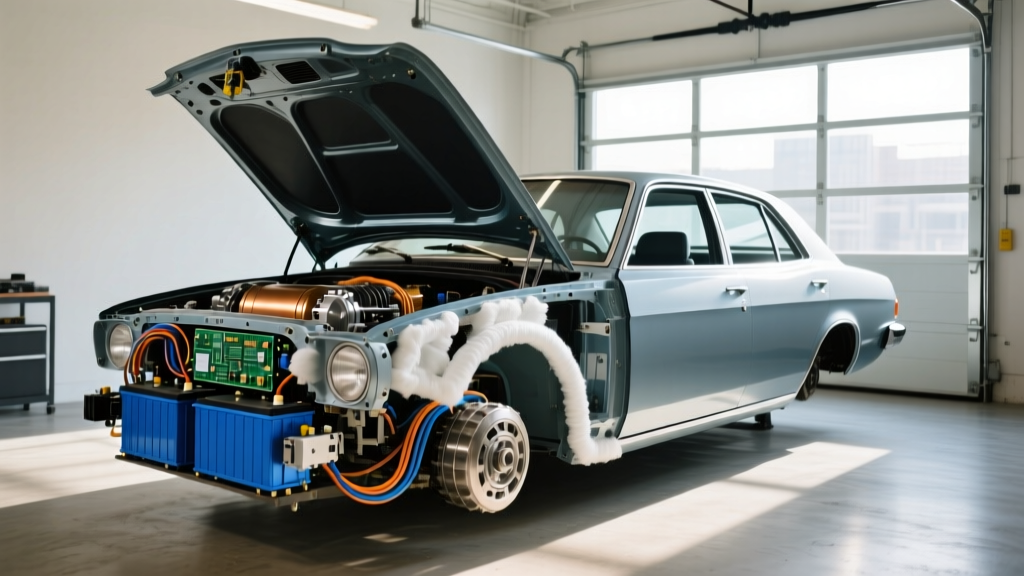
An electric vehicle conversion replaces the internal combustion engine, fuel system, exhaust, and often the transmission with an electric motor, motor controller, high-voltage battery pack, and charging system. The 12V electrical system is typically retained for lights, infotainment, and accessories, though it now draws from a DC-DC converter linked to the main traction battery.
The major subsystems in a typical conversion include:
- Electric motor: Usually an AC induction or permanent magnet motor, ranging from 50 kW to 200+ kW depending on performance goals
- Motor controller (inverter): Manages power delivery from battery to motor — sized to match the motor's peak current draw
- Battery pack: Lithium-ion modules (often salvaged from production EVs like the Nissan Leaf or Tesla Model S) or new LFP cells, typically 20–60 kWh for a conversion
- Battery management system (BMS): Monitors cell voltage, temperature, and state of charge — critical for safety and longevity
- Onboard charger: Handles Level 1 and Level 2 AC charging, typically 3.3 kW to 7.2 kW in conversions
- Thermal management: Basic conversions may lack active cooling; higher-end builds include liquid cooling for the battery and motor
- Instrumentation: Custom or adapted gauges for state of charge, power draw, and battery temperature
Companies like EV West, Zero EV, and Stealth EV offer turnkey kits and components, while full-service conversion shops handle complete builds. The complexity varies enormously: a lightweight VW Beetle conversion with a 20 kWh pack is fundamentally simpler than converting a 5,000-lb SUV that demands a larger battery and more powerful motor to maintain acceptable performance.
EV Conversion Cost Breakdown: The Real Numbers
This is where most conversion dreams meet reality. Here's what the components and labor actually cost in 2026:
| Component | Budget Build | Mid-Range Build | High-End Build |
|---|---|---|---|
| Electric motor + controller | $2,000–$4,000 | $5,000–$8,000 | $10,000–$18,000 |
| Battery pack (20–60 kWh) | $3,000–$6,000 | $7,000–$12,000 | $12,000–$20,000 |
| BMS + wiring + safety | $1,000–$2,000 | $2,000–$4,000 | $3,000–$6,000 |
| Charger + DC-DC converter | $800–$1,500 | $1,500–$3,000 | $2,500–$5,000 |
| Fabrication + labor | $3,000–$5,000 (DIY) | $8,000–$15,000 | $15,000–$30,000+ |
| Instrumentation + misc. | $500–$1,000 | $1,500–$3,000 | $2,000–$5,000 |
| Total conversion cost | $10,000–$18,000 | $25,000–$45,000 | $45,000–$85,000+ |
These figures exclude the donor vehicle itself. If you're converting a $5,000 classic Porsche 914, the total investment might be $35,000–$50,000. If you're starting with a $2,000 Honda Civic, you're still looking at $12,000–$20,000 total for a basic build — and that's before considering what happens if a custom component fails out of warranty.
Range, Charging, and Performance: What to Expect
The biggest limitation of most conversions is range. Space constraints in a vehicle not designed for a battery pack typically limit you to 20–40 kWh of usable battery capacity, compared to the 60–100+ kWh in modern production EVs.
Real-World Conversion Range Expectations
Battery size: Most conversions use 20–40 kWh packs
Efficiency: Converted vehicles are typically less efficient than purpose-built EVs due to weight distribution compromises and older aerodynamics — expect 3.5–5.0 miles/kWh
Realistic range: 70–200 miles depending on pack size, driving style, and climate
Cold-weather loss: 20–35% range reduction in freezing temps, with no heat pump in most conversions
Charging is another compromise. Most conversions support Level 1 (120V, ~1.4 kW) and Level 2 (240V, 3.3–7.2 kW) AC charging through an onboard charger. DC fast charging is rare in conversions due to the complexity of integrating CCS or NACS communication protocols with a custom BMS — meaning a full charge typically takes 4–10 hours at home, and road-trip charging at DC fast stations is usually not an option.
Performance can actually be a bright spot. Electric motors deliver instant torque, so even a modest 100 kW motor can make a lightweight classic car feel genuinely quick. However, weight distribution often suffers — batteries are heavy and may not fit in the ideal location, potentially affecting handling compared to the original vehicle.
Conversion vs. Buying a Production EV: The Head-to-Head
Here's how a typical mid-range conversion stacks up against buying a new production EV in 2026:
| Factor | EV Conversion (Mid-Range) | New Production EV (e.g., Chevy Equinox EV, Tesla Model 3) |
|---|---|---|
| Total cost | $27,000–$50,000+ | $33,600–$44,000 MSRP |
| EPA-rated range | Not EPA-rated; est. 80–150 mi | 315–363 mi (EPA certified) |
| DC fast charging | Rarely available | 150–250 kW; 10-80% in 18–25 min |
| Battery warranty | None (component warranties only) | 8 years/100,000 mi (federal mandate) |
| Safety ratings | Not crash-tested post-conversion | NHTSA/IIHS rated; modern ADAS |
| Federal tax credit (§30D) | Not eligible | Up to $7,500 if eligible (see IRS §30D rules) |
| Insurance | Specialty/collector policies; limited options | Standard EV policies widely available |
| Resale market | Niche; depends on build quality and vehicle | Establishused EV market with depreciation data |
The production EV wins on nearly every practical metric. It offers certified range, fast charging, crash-test ratings, a battery warranty backed by a manufacturer, and potential eligibility for the federal §30D tax credit (up to $7,500, subject to MSRP caps, buyer income limits, and battery-sourcing requirements — always verify current rules at irs.gov). A conversion is a passion project, not an efficiency play.
Legal, Registration, and Insurance Considerations
Converting a car to electric doesn't end when the wrenches stop turning. You'll need to navigate your state's DMV requirements for modified vehicles. Most states require a special inspection to verify the conversion is safe and properly documented. Some states issue a new title notation reflecting the electric powertrain; others require a bonded title or specialty registration.
Insurance is a significant hurdle. Mainstream insurers often won't cover a converted vehicle under a standard auto policy. You'll likely need a specialty or collector-car insurer, and premiums may be higher given the custom nature of the build and limited actuarial data on conversion safety. Hagerty and similar specialty insurers are common choices, but coverage terms vary widely.
If you plan to drive the converted vehicle daily, check whether your state allows converted vehicles to qualify for HOV lane access or other EV perks — in most jurisdictions, these incentives are reserved for factory-built EVs and PHEVs.
When Converting Makes Sense (And When It Doesn't)
Decision Framework: Should You Convert?
Choose an EV conversion if:
- You own a classic or collector car you want to preserve and drive regularly without fossil fuels
- The vehicle has sentimental value that no production EV can replace
- You have a specific project-car vision (e.g., an electric vintage Land Rover or air-cooled Porsche)
- You have the budget for a $25,000–$60,000+ project on top of the donor car
- You accept limited range, no DC fast charging, and no factory warranty
Buy a production EV instead if:
- You need reliable daily transportation with 250+ miles of range
- You want DC fast charging for road trips (10-80% in under 25 minutes)
- You want a battery warranty (8 years/100,000 miles is standard)
- You want to qualify for the §30D federal tax credit or state EV incentives
- You want NHTSA crash-test ratings and modern driver-assistance features
- Your total budget is under $35,000 and you need a practical vehicle
Common EV Conversion Myths vs. Facts
| Myth | Fact |
|---|---|
| "Converting is cheaper than buying an EV" | A quality conversion costs $25,000–$50,000+ and yields less range than a $33,000 Chevy Equinox EV with 315 EPA miles |
| "I'll get 300 miles of range" | Space and weight limits restrict most conversions to 20–40 kWh packs, yielding 80–150 real-world miles |
| "I can fast-charge on road trips" | DC fast charging integration is extremely rare in conversions due to BMS communication complexity; most are AC-only |
| "Any mechanic can fix it" | Converted EVs require specialized high-voltage knowledge; most independent shops won't service custom conversions |
| "It'll qualify for EV tax credits" | The federal §30D credit applies only to new qualifying production vehicles from OEMs — conversions are not eligible |
| "Conversions are zero-maintenance" | While there's no oil change, custom components (controllers, BMS, chargers) can fail and are not covered by a single warranty |
Alternatives to Converting: Get Electric Without the Wrench
If the goal is electric driving without a massive project, consider these alternatives:
- Buy a new affordable EV: The 2026 Chevy Equinox EV ($33,600), Hyundai Kona Electric ($32,975), and Nissan Leaf ($28,140) all offer strong range and full warranties
- Buy a used EV: The federal used-EV credit (up to $4,000 under §25E) makes pre-owned EVs like the Chevy Bolt EUV or Tesla Model 3 even more accessible — check IRS used-EV credit rules
- Consider a PHEV: If you can't commit to full electric, a plug-in hybrid like the Toyota RAV4 Prime (42 miles electric-only, 38 mpg combined) offers gas-free commuting with a gas backup
- Lease an EV: Lease deals on EVs often include the tax credit as a capitalized-cost reduction, lowering monthly payments significantly
Frequently Asked Questions
How much does it cost to convert a gas car to electric?
A basic DIY conversion costs $10,000–$18,000 in parts, while a professional mid-range build runs $25,000–$45,000. High-end conversions with large battery packs and performance motors can exceed $80,000. These costs are in addition to the donor vehicle purchase price.
How far can a converted electric car drive on a charge?
Most conversions achieve 80–150 miles of real-world range, depending on battery pack size (typically 20–40 kWh), vehicle weight, and driving conditions. This is significantly less than most 2026 production EVs, which offer 250–400+ EPA-rated miles.
Can I fast-charge a converted EV?
DC fast charging is rarely feasible in a conversion. Integrating CCS or NACS communication protocols with a custom battery management system is technically complex and expensive. Most conversions are limited to Level 2 AC charging (3.3–7.2 kW), requiring 4–10 hours for a full charge.
Is converting a car to electric legal?
Yes, but you must comply with your state's DMV requirements for modified vehicles, which typically include a special inspection and title update. Insurance requires a specialty policy, and converted vehicles generally do not qualify for federal or state EV tax incentives.
Does an EV conversion qualify for the federal tax credit?
No. The §30D federal clean vehicle credit applies only to new qualifying vehicles manufactured by qualified OEMs. Conversions performed by individuals or aftermarket shops are not eligible. See the IRS §30D page for current eligibility rules.
Is it cheaper to convert a car or buy a new EV?
For daily transportation, buying a new or used production EV is almost always more cost-effective. A $33,600 Chevy Equinox EV offers 315 EPA miles of range, DC fast charging, an 8-year battery warranty, and potential tax-credit eligibility — for less than the cost of most professional conversions.