The Convertible Tesla Roadster in 2026: Still the Most Anticipated EV on Earth
More than eight years after Elon Musk pulled the tarp off the second-generation Tesla Roadster in November 2017, the halo sports car remains in "coming soon" status. As of early 2026, Tesla has not begun deliveries, and the official Roadster page still lists the vehicle as a reservation-based future product rather than a configurable, purchasable model. That hasn't stopped enthusiasts, investors, and would-be buyers from searching obsessively for hard specs on the convertible Tesla Roadster.
This profile compiles every confirmed and estimated specification Tesla has published, cross-references them against what we know about Tesla's current battery and powertrain architecture, and applies real-world ownership context — including range expectations, charging reality, and the thorny question of federal tax-credit eligibility for a $200,000+ electric sports car.
Full Spec Sheet: Convertible Tesla Roadster (Announced)
| Specification | Tesla-Published / Estimated |
|---|---|
| EPA Range (Target) | 620 miles (est.) |
| Battery Capacity | 200 kWh (usable, est.) |
| Battery Chemistry | NMC (nickel manganese cobalt) — high energy density required for 620-mi target |
| Drivetrain | Tri-motor AWD (1 front, 2 rear) |
| Horsepower | ~1,000+ hp (wheel torque: 10,000 Nm claimed) |
| 0–60 mph | 1.9 seconds (standard); sub-1.0s with SpaceX package (claimed) |
| Top Speed | 250+ mph |
| Quarter Mile | 8.8 seconds (claimed) |
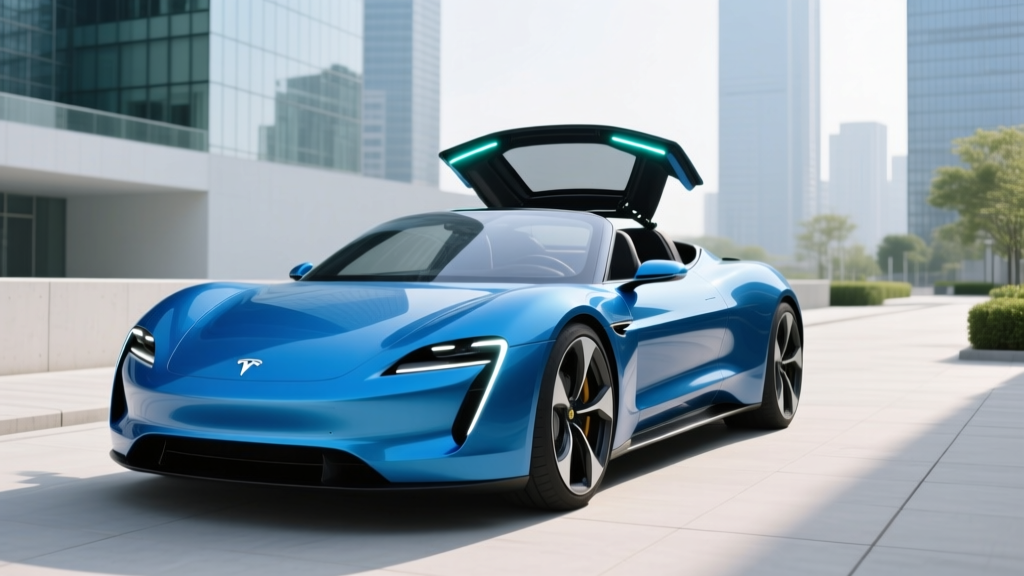
| Body Style | 2+2 convertible (removable glass roof stored in trunk) |
| Seating | 4 (2 front + 2 rear, rear seats very limited legroom) |
| Cargo Volume | ~5–7 cu ft (estimated, roof panel stowage reduces space) |
| Base MSRP | $200,000 (est.); Founders Series $250,000 |
| Reservation Deposit | $50,000 (fully refundable historically) |
| Battery Warranty | Expected 8 yr / 150,000 mi (based on Tesla Model S precedent) |
| Federal Tax Credit (§30D) | Not eligible — exceeds MSRP cap |
Range Reality: What 620 Miles Actually Means on the Road
Tesla's stated target of 620 miles of range would make the Roadster the longest-range production EV ever built, dwarfing the Lucid Air Grand Touring's EPA-rated 516 miles. Achieving that figure requires a 200 kWh battery pack — roughly double the capacity of a Model S Long Range — packed into a low-slung sports car chassis.
But as with every EV, the EPA sticker is a starting point, not a guarantee. Here's what real-world driving will likely look like:
• EPA Target: 620 miles
• Mixed driving (city/highway 50/50): ~520–560 miles
• Sustained 75+ mph highway: ~440–490 miles (aerodynamic drag dominates at speed)
• Cold weather (below 32°F): ~380–440 miles (NMC chemistry loses 20–30% in deep cold without preconditioning)
• Track use / aggressive driving: 200–300 miles (high discharge rates consume energy rapidly)
The 200 kWh pack will almost certainly use NMC (nickel manganese cobalt) chemistry rather than LFP (lithium iron phosphate). LFP offers excellent cycle life and thermal stability but lower energy density — making it impractical for a 620-mile target in a sports car footprint. Expect Tesla to use its latest 4680-format NMC cells, potentially with a dry-electrode manufacturing process for improved energy density.
For context, a 200 kWh battery at an efficiency of 3.0 miles/kWh (optimistic for a performance AWD vehicle) yields 600 miles. Tesla's 620-mile claim implies an efficiency target of roughly 3.1 mi/kWh, or about 32 kWh/100 miles — a figure that would be impressive given the tri-motor AWD powertrain and wide performance tires.
Charging Speed: Peak kW, 10–80% Time, and Home Charging
A 200 kWh battery changes the charging equation entirely. Even Tesla's V4 Superchargers, which deliver up to 350 kW at the stall, will need significant time to refill a pack this large.
| Charging Method | Power / Rate | Estimated Time (10–80%) | Miles Added per Hour |
|---|---|---|---|
| Tesla V4 Supercharger (DC fast) | Peak ~350 kW (est.) | ~35–45 minutes | ~550–650 mi/hr at peak |
| Third-party DC fast (CCS w/ adapter) | Up to 350 kW (stall-dependent) | ~40–50 minutes | Varies by network |
| Home Level 2 (Tesla Wall Connector, 48A) | 11.5 kW | ~14–16 hours (full charge) | ~34 mi/hr |
| Home Level 2 (80A circuit, if supported) | 19.2 kW | ~8–9 hours (full charge) | ~57 mi/hr |
| Level 1 (120V standard outlet) | 1.4 kW | ~140+ hours (full) | ~4 mi/hr |
Several critical nuances for prospective Roadster owners:
- Charge curve taper: Like all lithium-ion packs, the Roadster's 200 kWh battery will accept peak charge rates only at low states of charge (roughly 10–40%). Above 80% SoC, charging slows dramatically to protect cell longevity. A "10–80% in 35 minutes" claim doesn't mean a 10–100% session takes much less than 55–65 minutes.
- Home charging is overnight territory: Even with a 48-amp Level 2 Tesla Wall Connector on a 60-amp circuit, fully replenishing a depleted 200 kWh pack takes roughly 14 hours. Most owners will plug in nightly and rarely deplete fully — but a 20–80% daily window still requires 5–6 hours at 11.5 kW.
- Panel upgrade likely required: An 80-amp home charging circuit (for 19.2 kW Level 2) requires a 100-amp dedicated breaker and likely a 200-amp or larger main service panel. Budget $1,500–$4,000 for professional installation by a licensed electrician, potentially more if a panel upgrade is needed.
- Preconditioning matters: Tesla's navigation-routed battery preconditioning warms the pack before arriving at a Supercharger, enabling faster peak charge rates. Always navigate to your charging stop for optimal speed.
Performance: Tri-Motor AWD and the Sub-2-Second 0–60 Claim
The Roadster's headline number — a 1.9-second 0–60 mph time — would make it the quickest production car ever sold. For reference, the current Tesla Model S Plaid achieves 1.99 seconds with its tri-motor setup and ~1,020 horsepower. The Roadster, with a lighter sports car chassis (est. 4,400–4,700 lbs despite the massive battery) and potentially updated motors, aims to beat that figure.
The more controversial claim is the optional "SpaceX package," which Tesla has said will include cold-gas thrusters mounted around the vehicle to achieve a sub-1.0-second 0–60 time. This package has not been demonstrated publicly and its street-legal status remains uncertain under NHTSA regulations.
What we can expect with confidence from the tri-motor AWD drivetrain:
- Torque vectoring: Independent rear motors enable precise torque distribution to each rear wheel, improving corner exit grip and stability.
- Regen braking: Aggressive regenerative deceleration enables one-pedal driving in most scenarios, though a roadster-class car will still rely heavily on its mechanical brakes at track speeds.
- Thermal management: Sustaining 1,000+ hp outputs requires sophisticated cooling. Expect Tesla's latest heat-pump-based thermal architecture, similar to the Model S Plaid's track-mode cooling loops.
Pricing, Tax Credits, and Total Cost of Ownership
The convertible Tesla Roadster is positioned as a halo product, not a volume seller. Pricing has shifted significantly since the original 2017 announcement.
| Trim / Configuration | Est. MSRP | §30D Federal Credit | Effective Price |
|---|---|---|---|
| Roadster (Base) | $200,000 | $0 (exceeds MSRP cap) | $200,000 |
| Roadster Founders Series | $250,000 | $0 (exceeds MSRP cap) | $250,000 |
Under current IRS §30D rules, the federal EV tax credit caps eligible vehicles at an MSRP of $55,000 for sedans and $80,000 for SUVs, trucks, and vans. The Roadster — at $200,000+ — far exceeds any of these thresholds. Buyers will not qualify for the up-to-$7,500 federal credit, regardless of income or battery sourcing.
Additional ownership cost considerations:
- Insurance: Expect annual premiums of $5,000–$9,000+ for a $200,000 electric sports car with 1,000+ hp. Tesla's own insurance product may offer competitive rates based on real-time driving data.
- Electricity cost: At $0.15/kWh (national average for home charging), a full 200 kWh charge costs approximately $30. At 3 mi/kWh, that's roughly $0.05/mile — dramatically cheaper than premium gasoline in a comparable sports car.
- Maintenance: No oil changes, minimal brake wear (thanks to regen), but tire replacement on wide performance rubber will run $2,000–$4,000 per set.
- Depreciation: Tesla halo vehicles have unpredictable depreciation curves. The original 2008 Roadster has become a collector item; the Gen 2 may follow a similar path given limited production.
Interior, Tech, and Daily Usability
The Roadster is a 2+2 convertible, meaning two full-size front seats and two rear seats best suited for children or cargo overflow. Tesla has shown renders of a minimalist interior anchored by a large central touchscreen (likely 17-inch, similar to the refreshed Model S/X) and a yoke-style steering wheel.
Key tech features (expected):
- Tesla's latest infotainment OS with gaming-capable hardware (AMD Ryzen-based)
- Autopilot standard; Full Self-Driving (Supervised) available as an option — note this remains an SAE Level 2 driver-assistance system requiring active driver supervision at all times
- Glass roof panel that removes and stores in the trunk (Tesla's "Infinity Roof" concept)
- Over-the-air software updates for continuous feature additions
- Sentry Mode, Dashcam, and Tesla's full camera-based vision suite
Practical limitations:
- Cargo space will be severely limited — expect 5–7 cubic feet at best, further reduced when the roof panel is stowed
- Rear seats are cosmetic for adults; legroom will likely fall below 28 inches
- Ground clearance on a low-slung sports car will challenge steep driveways and speed bumps
- No towing capacity — this is a pure performance vehicle
Pros, Cons, and Key Competitors
- 620-mile target range — longest of any announced production EV
- 1.9-second 0–60 mph (if validated) — quickest production car ever
- Tri-motor AWD with advanced torque vectoring
- Removable glass roof for open-air driving
- Tesla Supercharger network access (17,000+ stalls in North America)
- OTA updates and Tesla's software ecosystem
- Not yet in production — delivery timeline remains uncertain after years of delays
- $200,000+ price with zero federal tax credit eligibility
- 200 kWh battery means very long home charging times (14+ hours full charge)
- 2+2 seating with minimal cargo and rear-seat space
- Insurance costs will be extreme for a 1,000+ hp vehicle
- Specs are preliminary — final EPA numbers may differ at launch
Key competitors to cross-shop:
- Lucid Air Sapphire: $249,000, 1,234 hp, 0–60 in 1.89s, 427-mi EPA range. Currently available and proven.
- Rimac Nevera: $2.2M, 1,914 hp, 0–60 in 1.85s, 340-mi WLTP range. Hypercar-tier, extremely limited production.
- Porsche Taycan Turbo GT: ~$230,000, 1,092 hp, 0–60 in 2.1s, 269-mi EPA range. Proven handling and build quality.
- Lotus Evija: ~$2.3M, 1,972 hp, limited production. Track-focused hypercar.
Frequently Asked Questions
Can I buy the convertible Tesla Roadster right now?
No. As of 2026, the Tesla Roadster remains an announced product. Tesla accepts reservations (historically a $50,000 deposit), but production and deliveries have not begun. Tesla has repeatedly delayed the timeline — originally targeting 2020, then 2022, then 2025. A firm production date has not been confirmed.
What is the real-world range of the Tesla Roadster?
Tesla targets 620 miles (EPA est.), but real-world mixed driving will likely yield 520–560 miles. Sustained highway speeds above 75 mph could reduce range to 440–490 miles, and cold-weather driving in sub-freezing temperatures may drop range to 380–440 miles. These are estimates based on the announced 200 kWh battery and expected NMC chemistry; final EPA certification will provide verified numbers.
How fast does the Roadster charge at home and on the road?
On a Tesla V4 Supercharger (up to 350 kW), expect a 10–80% session in roughly 35–45 minutes. At home on a 48-amp Level 2 Tesla Wall Connector (11.5 kW), a full charge takes approximately 14–16 hours. An 80-amp Level 2 circuit (19.2 kW) cuts that to roughly 8–9 hours but requires significant electrical infrastructure.
Does the Tesla Roadster qualify for the $7,500 federal EV tax credit?
No. Under current IRS §30D rules, the federal tax credit applies only to vehicles with an MSRP at or below $55,000 (sedans) or $80,000 (SUVs/trucks/vans). The Roadster's estimated $200,000+ MSRP disqualifies it entirely, regardless of buyer income or battery component sourcing.
Is the Tesla Roadster worth waiting for vs. buying a Lucid Air Sapphire or Porsche Taycan Turbo GT?
If you need a vehicle today, the Lucid Air Sapphire delivers comparable performance (1,234 hp, sub-2-second 0–60) with proven reliability and 427 miles of EPA-verified range — and it's available now. The Porsche Taycan Turbo GT offers world-class handling dynamics that Tesla hasn't historically matched. The Roadster's advantage, if it ships as promised, is the combination of 620-mile range and open-top driving that neither competitor offers. But years of delays make the wait a genuine risk.
What battery chemistry will the Roadster use?
The Roadster is expected to use NMC (nickel manganese cobalt) chemistry in Tesla's 4680 cell format. NMC provides the high energy density needed for a 620-mile range target in a sports car chassis. LFP (lithium iron phosphate), used in Tesla's Standard Range vehicles, is too heavy and energy-dense-limited for this application. NMC cells typically degrade 10–15% over 150,000–200,000 miles under normal use.
Will the SpaceX thruster package be street-legal?
Tesla has claimed an optional "SpaceX package" with cold-gas thrusters for sub-1-second acceleration. NHTSA has not publicly commented on the street legality of such a system, and its inclusion in a production road car is unprecedented. Until Tesla demonstrates a road-legal prototype, treat this claim as aspirational.