The Short Answer on Converting a VW Bug to Electric
Converting a classic VW Beetle to electric power in 2026 typically costs $15,000 to $35,000 on top of the donor car's price, yields 60 to 120 miles of real-world range depending on battery size, and takes 3 to 12 months for a DIY build. The result is a zero-tailpipe-emission classic with instant torque and minimal maintenance — but it will not match a modern production EV on range, fast-charging speed, safety, or eligibility for the federal §30D tax credit. If your goal is a weekend cruiser with 80 miles of range and a unique garage piece, a conversion makes sense. If you need a daily commuter with DC fast charging and 250+ miles of range, a used production EV delivers more capability for similar money.
What an Electric VW Bug Conversion Actually Involves
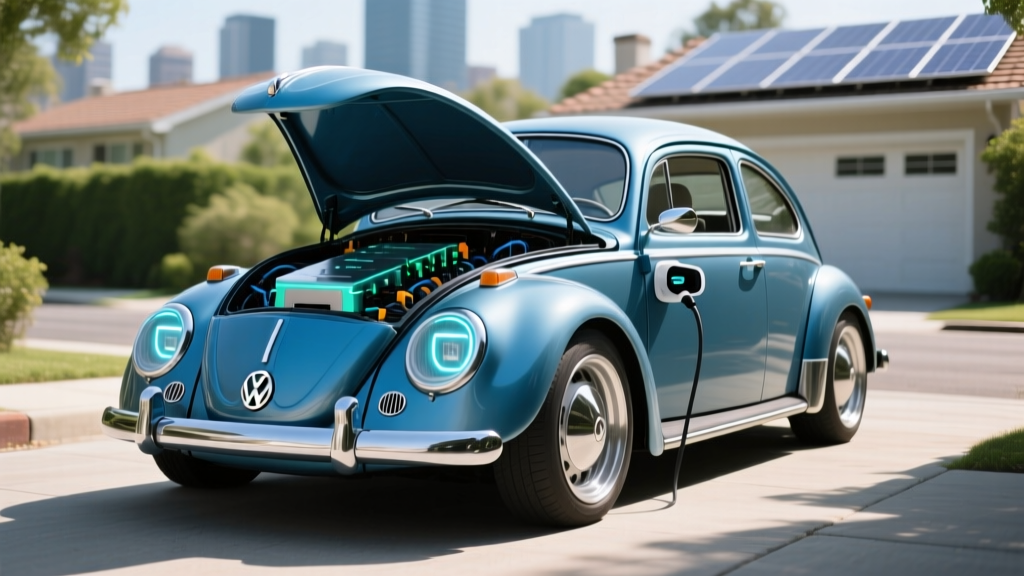
A conversion replaces the Beetle's air-cooled flat-four engine, fuel tank, and exhaust with an electric motor, motor controller, battery pack, and onboard charger. The original transmission is often retained (locked in second or third gear for single-speed simplicity), though some builders use a direct-drive setup with a reduction gear.
The most common donor vehicles are the 1966–1979 VW Beetle (Type 1), prized for their light weight (roughly 1,850–2,000 lbs curb), simple mechanicals, and large aftermarket community. Kits from companies like EV West, Electric Classic Cars, and Zeus Motors have made the process more accessible, though "accessible" is relative — this is still a multi-month fabrication and wiring project for most builders.
Core Components You'll Source
- Electric motor: Typically a NetGain Hyper9 or Warp-series DC motor, or a repurposed Tesla drive unit for higher-performance builds. Output ranges from 50 kW (67 hp) to 150+ kW (200+ hp).
- Motor controller: Matches the motor — an MC-600 or similar for DC setups; integrated inverter for Tesla-sourced drives.
- Battery pack: The single largest cost. Builders use either new LFP (lithium iron phosphate) modules or salvaged NMC (nickel manganese cobalt) packs from wrecked Teslas, Nissan Leafs, or Chevy Bolts. Usable capacity typically lands between 20 kWh and 40 kWh due to the Beetle's limited space and weight tolerance.
- Onboard charger: Usually 3.3 kW to 7.2 kW (Level 2 AC). DC fast charging is rare in conversions due to cost and packaging constraints.
- BMS (Battery Management System): Essential for safe operation — monitors cell voltage, temperature, and balancing.
- DC-DC converter: Steps down high-voltage pack to 12V for lights, wipers, and accessories.
2026 Conversion Cost Breakdown: Parts, Labor, and Hidden Expenses
Here's what a realistic budget looks like for a competent DIY conversion using new or quality salvaged components in 2026. Professional shop conversions start around $40,000 and can exceed $75,000 for a show-quality build.
| Component | Budget Build | Mid-Range Build | High-Performance Build |
|---|---|---|---|
| Donor VW Beetle (running) | $4,000–$7,000 | $7,000–$12,000 | $12,000–$18,000 |
| Electric motor + controller | $2,500–$4,000 | $4,000–$7,000 | $7,000–$12,000 |
| Battery pack (20–40 kWh usable) | $4,000–$7,000 | $7,000–$12,000 | $12,000–$18,000 |
| BMS + DC-DC converter | $800–$1,500 | $1,500–$2,500 | $2,500–$4,000 |
| Onboard charger (3.3–7.2 kW) | $600–$1,200 | $1,200–$2,000 | $2,000–$3,500 |
| Wiring, adapters, fabrication | $1,500–$3,000 | $3,000–$5,000 | $5,000–$8,000 |
| Instruments, throttle, safety cutoffs | $500–$1,000 | $1,000–$2,000 | $2,000–$3,500 |
| Registration, inspection, insurance | $500–$1,000 | $1,000–$2,000 | $2,000–$3,500 |
| Total Estimated Cost | $14,400–$24,700 | $25,700–$44,500 | $44,500–$70,500 |
Hidden costs first-timers miss: Upgrading the 6V-to-12V electrical system (pre-1967 Beetles), reinforcing suspension for battery weight (add 300–600 lbs depending on pack size), brake upgrades (the stock drums struggle with the added weight and instant torque), and heater replacement (no waste heat from an ICE means you need an electric cabin heater or heat pump — a 2–3 kW PTC heater is typical but draws from your pack).
Range, Charging, and Performance: What the Numbers Actually Look Like
A converted Beetle's efficiency depends heavily on weight, tire choice, and aerodynamics. The Beetle's drag coefficient (~0.48 Cd) is poor by modern standards, and added battery weight increases rolling resistance. Expect 250–350 Wh/mile in real-world driving — far thirstier than a 2026 Hyundai Ioniq 6 (~240 Wh/mile EPA).
Real-World Range Expectations
| Battery Size (Usable) | Efficiency | Estimated Range (70°F, City/Mixed) | Estimated Range (30°F or 75 mph Highway) |
|---|---|---|---|
| 20 kWh | 300 Wh/mi | ~65 miles | ~45 miles |
| 30 kWh | 320 Wh/mi | ~94 miles | ~65 miles |
| 40 kWh | 340 Wh/mi | ~118 miles | ~80 miles |
Cold weather can reduce range by 25–40% due to battery internal resistance and cabin heating draw. Most conversions lack active thermal management (liquid heating/cooling), so LFP cells in particular lose significant capacity below freezing.
Charging Speeds
Most conversions are limited to Level 2 AC charging:
- Level 1 (120V, 1.4 kW): Adds roughly 4–5 miles of range per hour. A full charge of a 30 kWh pack takes ~21 hours.
- Level 2 (240V, 7.2 kW): Adds roughly 20–25 miles per hour. A full charge of a 30 kWh pack takes ~4–5 hours. This is the practical daily charging method.
- DC Fast Charging: Rarely included in conversions. Adding a CCS or NACS DC inlet with a compatible charge controller adds $3,000–$6,000 and requires significant packaging space and high-voltage safety engineering. Most builders skip it.
Performance
A typical mid-range conversion with a NetGain Hyper9 motor (roughly 85 kW / 114 hp peak) and a 30 kWh pack delivers a 0–60 mph time of 8–12 seconds — comparable to or slightly quicker than the stock 40–60 hp flat-four. High-performance builds using a Tesla small drive unit (up to 200 kW / 268 hp) can hit 0–60 in under 6 seconds, but this demands upgraded brakes, suspension, and driveline components. The stock VW swing-axle rear suspension (pre-1969) is not engineered for this kind of torque.
EV Conversion vs. Buying a Production EV: The Honest Comparison
This is the decision most prospective converters wrestle with. Here's how a mid-range Bug conversion stacks up against a 2026 production EV at a similar total investment:
| Attribute | VW Bug EV Conversion (Mid-Range) | 2026 Chevy Equinox EV LT (~$33K) | Used Tesla Model 3 (~$25–30K) |
|---|---|---|---|
| Total Cost | $25,700–$44,500 | ~$33,000 (before credit) | $25,000–$30,000 |
| EPA / Real Range | No EPA rating; ~94 mi real | EPA 319 mi; ~270 mi real hwy | EPA 272–341 mi; ~230–290 mi real |
| Battery Capacity | ~30 kWh usable (NMC or LFP) | 85 kWh usable (NMC) | 60–82 kWh (NMC/LFP) |
| DC Fast Charge | Typically none | 150 kW peak; 10–80% in ~30 min | 170–250 kW; 10–80% in ~18–25 min |
| Level 2 Charge Time | ~4–5 hrs (7.2 kW) | ~9.5 hrs (11.5 kW) | ~6–8 hrs (11.5 kW) |
| Federal Tax Credit (§30D) | Not eligible | Up to $7,500 (if eligible) | Up to $4,000 used-EV credit |
| Safety (Airbags, ABS, Crumple Zones) | None (original 1960s–70s structure) | Full suite; IIHS Top Safety Pick | 5-star NHTSA; Autopilot standard |
| Warranty | None (self-built) | 3 yr/36K mi basic; 8 yr/100K mi battery | Remaining factory or aftermarket |
| Maintenance (Annual Est.) | $200–$500 (minimal) | $300–$600 | $400–$800 |
| Unique Factor | Extremely high — one-of-a-kind | Low — common commuter | Low — ubiquitous |
The tradeoff is stark: The conversion gives you a unique, emotionally rewarding classic with minimal running costs but sacrifices range, charging speed, safety, warranty, and tax-credit eligibility. A production EV is the rational daily-driver choice; a conversion is a passion project that happens to be electric.
Real-World Ownership: What First-Time Converters Need to Know
Home Charging Access Is Non-Negotiable
Without DC fast charging, you are entirely dependent on AC charging. A dedicated 240V/40A circuit (Level 2, ~9.6 kW) in your garage is effectively required. Installation by a licensed electrician runs $800–$2,500 depending on panel capacity and run length. If your home panel is maxed out at 100A, a panel upgrade to 200A adds $1,500–$3,500. Public Level 2 chargers (via networks like ChargePoint or EVgo) can supplement, but at 20–25 miles of range per hour of charging, they're impractical for anything beyond topping off.
Insurance and Registration
Registering a converted vehicle varies significantly by state. Some states (California, Oregon, Washington) have clear processes for registering a converted EV, often requiring a brake-and-light inspection and a VIN verification. Others make it more difficult. Specialty insurers like Hagerty and Grundy offer agreed-value classic car policies that can cover EV conversions, but expect premiums of $600–$1,500/year depending on agreed value and usage restrictions (many classic policies cap annual mileage at 3,000–5,000 miles).
No Federal Tax Credit
The IRS §30D Clean Vehicle Credit applies only to new and qualified used EVs purchased from a dealer, with specific battery-sourcing, MSRP, and buyer-income requirements. A DIY conversion of a classic car does not qualify for any federal EV tax credit. Some states and local air-quality districts offer rebates for EV conversions (California's CC4A program, for example, has occasionally included conversion incentives), but these are limited and change frequently. Check your state's energy office for current programs.
Resale Reality
A well-executed conversion by a known builder (e.g., Zelectric, Electric Classic Cars) can command a premium in the collector market — $40,000 to $80,000+ for a documented, sorted build. However, a DIY conversion with unknown components and no documentation typically depreciates. Expect to recover 40–60% of your conversion investment at resale unless the build quality and documentation are exceptional.
Common Misconceptions About EV Conversions
| Myth | Fact |
|---|---|
| "It'll save me money vs. buying a new EV." | At $25K–$45K all-in, a conversion costs as much as or more than a new Chevy Equinox EV or used Tesla Model 3 — with less range, no fast charging, no warranty, and no tax credit. |
| "I can just drop in Tesla batteries and get 200+ miles." | The Beetle's weight tolerance and physical space limit you to roughly 20–40 kWh of usable battery. Even at the high end, expect ~118 miles max in ideal conditions — half that in cold or at highway speeds. |
| "It's a weekend project with a kit." | Even with a pre-packaged kit, expect 200–500 hours of labor spanning 3–12 months. Fabrication, wiring, BMS programming, and safety-system integration are not trivial. |
| "It'll be street-legal everywhere." | Registration processes vary widely by state. Some states require special inspections, updated lighting, or even refuse to re-title a converted vehicle as an EV. Research your state's DMV process before starting. |
| "No maintenance means no ongoing costs." | While there's no oil, spark plugs, or exhaust to maintain, you still need brake service, suspension bushings, tire replacement, 12V battery replacement, and periodic BMS/battery health checks. Budget $200–$500/year. |
Decision Framework: Should You Convert or Buy?
Choose a VW Bug EV Conversion If:
- You want a unique, emotionally rewarding classic car that's daily-drivable for short commutes (under 50 miles round-trip).
- You have garage space, a 240V outlet (or willingness to install one), and 200+ hours of patience for a build project.
- You value the building process as much as the end result — fabrication, wiring, and problem-solving appeal to you.
- You accept that this will not be your only vehicle for road trips or long commutes.
- You have a realistic budget of $25,000–$45,000 (all-in) and understand resale may not recover your full investment.
Choose a Production EV If:
- You need a reliable daily driver with 250+ miles of range and DC fast charging for road trips.
- You want a warranty, modern safety features (airbags, ABS, automatic emergency braking), and insurance simplicity.
- You want to take advantage of the §30D federal tax credit (up to $7,500 for new, up to $4,000 for used qualifying EVs) to reduce effective cost.
- Your total budget is under $35,000 and you need maximum capability per dollar.
- You don't have the time, tools, or workspace for a multi-month build project.
Frequently Asked Questions
How long does a VW Bug EV conversion take?
A DIY conversion typically takes 3 to 12 months, depending on your skill level, available time, and whether you use a pre-configured kit or source individual components. Professional shop conversions usually take 2 to 6 months once the build starts, but wait lists at reputable shops can add 6–18 months.
Can I use a Tesla motor and battery in a VW Beetle conversion?
Yes, but with significant caveats. Tesla small drive units (from Model 3/Y) are popular for high-performance conversions and can produce 200+ kW, but they require a compatible inverter controller (aftermarket solutions exist from companies like EV West and Damien Maguire's open-source projects). Tesla battery modules are heavier and physically larger than ideal for a Beetle — packaging 40+ kWh is challenging. Salvaged Tesla packs also come with unknown degradation history.
Is LFP or NMC battery chemistry better for a conversion?
For a VW Beetle conversion, LFP (lithium iron phosphate) is generally the safer choice: it's more thermally stable (lower fire risk in a car with no engineered crash structure), tolerates 100% state-of-charge storage better, and has longer cycle life (3,000–5,000 cycles vs. 1,000–2,000 for NMC). The tradeoff is lower energy density — LFP cells are heavier and bulkier per kWh, which matters in a weight-sensitive Beetle. NMC offers more range in the same space but requires more careful thermal management and should not be regularly charged to 100%.
What's the cost per mile to drive a converted Beetle vs. the original gas engine?
A stock 1970 Beetle got roughly 25 MPG combined. At $3.50/gallon, that's $0.14 per mile in fuel. A conversion averaging 300 Wh/mile charged at the US residential average of ~$0.17/kWh costs roughly $0.05 per mile in electricity — about one-third the fuel cost. At 5,000 miles/year, that's a savings of roughly $450/year in energy costs. The conversion won't pay for itself through fuel savings alone; the value proposition is the driving experience and ownership satisfaction.
Do I need to upgrade the Beetle's brakes and suspension for an EV conversion?
Almost certainly, yes. A battery pack adds 300–600 lbs depending on capacity, and electric motors deliver instant torque that the original drum brakes and soft suspension weren't designed for. Most experienced builders upgrade to front disc brakes (a common swap from a later-model VW or Porsche 914), add stiffer torsion bars or coilover suspension, and install a brake booster (the stock vacuum booster relied on engine manifold vacuum, which no longer exists). Budget $1,500–$3,500 for brake and suspension upgrades.
Can I still get the car smogged and registered after conversion?
EV conversions are exempt from emissions testing (there are no emissions to test), but the registration process varies. Some states will re-title the vehicle as an electric car with a simple inspection; others require a specially assigned VIN or a "specially constructed vehicle" (SPCNS) process. Before purchasing a donor car, contact your local DMV to understand the exact requirements in your state. The NHTSA does not regulate individual conversions, but your state may reference federal safety standards for lighting and glazing.